Review of Ghosts of Hanley House

GhostsOfHanleyHouse2

The last review I wrote was for Let’s Scare Jessica to Death, a low budget film from 1971.  In that review I explain to readers about a certain kind of fear. It’s a fear that  has the potential of grabbing viewers at the very beginning of the film. It is a fear that the movie will be stink-a-roo.  It smacks viewers with its mediocrity and lays out a path of uncertainty. Will the path lead to something worthy of 89 minutes of time?  Or will this movie be a waste of time?  I then argue that viewers should march on ahead and ignore any initial signs of mediocrity. For there will be a pay off.  Granted, I never promise the readers a 5 star masterpiece, but I do argue that the film is delightfully scary and, in the end, well made. In short, I argue that viewers should overcome any stereotypes they may have concerning low-budget  films. I beg readers to give it a chance.

Today, I present another low-budget film from a similar time period. As with Let’s Scare Jessica to Death, the film may not seem appetizing in the beginning. Within the first several minutes, viewers will be confronted with poor lighting, wooden acting, and a seemingly endless barrage of credits that are normally reserved for the end of the film. Once again, viewers face the question, “Shall I proceed further into this film?”  “Shall I be patient and see if Ghosts of Hanley House   has anything decent to offer?” Well, let me answer these questions.

TURN BACK!! DO NOT PROCEED INTO THE HAUNTED HOUSE! DEATH WILL FIND YOU! YOU WILL BE BORED TO DEATH!

Seriously, if this were a film student’s final project, it might be worthy of a C. But I don’t think this a student film. I do believe it was presented to a paying audience. Oh boy! There are jump cuts. There are breaches in continuity. The lighting is poor, the exposures suck. There are all kinds of film school no-nos.

It’s a simple story. A group of people spend the night in a house to see if it is haunted. It is. There had been murders on the premise some time ago. That’s about all there is to know. Well, alright, there are a few somewhat interesting scenes pertaining to the haunting. The household awakens in the middle of the night to the sound of galloping horses, that’s cool. A chandelier swings on its chain, that’s pretty neat. Clocks spin backwards, and that’s, uh, neato.  There are a couple of other scenes of that are “groovy spooky.” But it’s a waste of time sitting though this flick and waiting for the every once in a while “boo.”

There is much information available about this film. I found it on archive.com, the same place I found Let’s Scare Jessica to Death.  Wikipedia and imdb. have very little information about this film.  I did some research on Louise Sherrill, the writer and director of this film. It turns out that this is the only film she has directed. She is credited with only two more movies on imdb – as an actress. I was hoping to find something interesting about the history of this film; some unintentional milestone, some kind of hidden trivia treasure. Maybe it was indeed a school project. What if it an unknown John Carpenter worked the lighting, or a then amateur Wes Craven worked the sound.  But no, nothing like that. Perhaps this was filmed at a famous house, maybe the house where a real murder took place. Ah but that doesn’t seem likely.  I guess there is nothing about this film that is destined for greatness. Therefore I will end this review,  honoring the time-tested expression “the less said the better.” It is obscure for a reason. So let it be obscure. With that I write no more!

Review of Let’s Scare Jessica to Death

Let's_Scare_Jessica_to_Death-1971-MSS-054


How does one watch John Hancock’s 1971 thriller Let’s Scare Jessica to Death? Let me detail the way!

Step 1) Go to Google and type into the Search Engine box “Let’s Scare Jessica to Death” and then hit Enter

Step 2) At the top of the next screen, click “videos” in the menu just below the search box

Step 3) Out of the 128,000 or so results that appear, find the option that comes from archive.org and click it.

Step 4) Now go back and put a line through steps 1 – 3 because you can skip those steps and go directly to archive.org and search for the title on the site ( Hey, I had to go through Steps 1-3 the first time, so you should too!)

Step 5) Click the movie’s “start” arrow, watch, and let the fears begin!

In step 5, I write of “fears.”  What fears are these? I will tell you! I am referring to paralyzing trepidation that will overtake your body when you realize that you are about to endure 89 minutes of a low-budget film from the early 1970s.  I point to those moments of bitter agony when you are first exposed to the actors’ awkward performances; moments that occur early on in the film, causing you to wonder “will this be worth it?” “Shall I abandon the ship now before I get in too deep?”  Beware of the the forced frivolity that occurs when the four main characters sit down to dinner – laughter that is supposed to be natural and lighthearted will become forced and mechanical, like the maddening giggles of an eerie doll.  By this time, your fears may be great, for you have been down this road several times before, trying to give an old, low-budget film a chance, being ever so noble, gambling a large chunk of your evening, only to endure much pain as the movie fails to improve.  Folks, I have good news for you. Let’s Scare Jessica to Death does get better.  The overall style and genuinely creepy scenes make-up for those common imperfections that are often found in low budget films.

Let’s Scare Jessica to Death is one of those creepy films that has haunted me since my childhood. It refused to stay buried, and so I saw it again in my twenties. Now, in 2018, at the ripe young age of forty-six, it was time for me to face it again. (I write of a similar experience in my review entitled Memories That Would Not Fade on Account of the House That Would Not Die)

I had forgotten most of the plot; I only knew that it had something to do with a young lady that was recently released from a mental institution (hint: her name is Jessica) and a haunted house that was waiting to welcome her back to reality. Actually I wasn’t even sure if it was a haunted house. I had remembered her being “with friends” in some kind of scary environment by a lake. Were these friends trying to scare her to death, take advantage of her fragile emotional state for some kind of ill-gotten gain?  That would have explained the title, for sure. Anyway, I wasn’t sure. Oh but I had to be sure.  If this is indeed a haunted house film, then I needed to know those details so that I could do my duty and write up a review for this blog.   And that is what happened.  In the end I say that this film qualifies as a haunted house film.  And I am glad I watched it again.  This third time I enjoyed it, despite certain shortcomings. Hopefully I will remember the details of the story for a long time to come. I can understand why I didn’t remember the details from my first viewing experience. After all I was about, I don’t know, eleven years old?  But why couldn’t I remember any specifics the second time around? Maybe I was stoned. I don’t know.

The story as to do with madness, a country house, the undead, and hippies. Jessica has been released from the asylum in the care of her husband Duncan. They are to begin a new life in the country. Along with a hippie friend named  Woody, they move to a farm house, where they will work the land. The old men in the nearby town are creepy. (No they are  not creepy BECAUSE they are old men, I’m not ageist, they are just creepy in general).  The house they have purchased has a history. Owned by the Bishop family in the 1800s, young Abigail Bishop  drowned in the nearby lake shortly before her wedding day. Her body was never found!  At the farm house, there happens to be an old silver framed picture of the Bishop family; mother, father and daughter (Abigail). Portraits of people long since dead always have something to tell in haunted house movies!  And you know what else the farm house has? A hippie girl named Emily. She has been squatting there.  Duncan and Jessica invite her to stay, so now we have two couples and a total of four main characters. Meanwhile Jessica is hearing voices. She is seeing doors and rocking chairs move on their own accord. Is her madness returning or is this house really haunted?

The finer points of the plot surprised me upon this third viewing. First of all, I was wrong about Jessica living with “friends” after her release. Well yes, there is friend Hippie Woody and newfound friend Hippie Emily, but I hadn’t realized she was with a husband until the third viewing. Secondly, I was off base when I had assumed that the plot revolved around people close to Jessica trying to “scare her to death”. I won’t rule that out for you, my lovely potential viewers of this film, but there is more involved than that (if that is an issue at all).  How could I have forgotten that film involves the “undead”; also known as vampires! In fact, on Wikipedia, this film is compared to Joseph Sheridan Le Fanu’s  1871 vampire novel Carmilla (I wrote about that novel at HorrorNovelReviews.com ) I see faint similarities but nothing more.

Throughout my synopsis, I often refer to the term “Hippie.” But it’s not just me, Wikipedia also uses the term to describe some of the film’s characters. Certainly this term dates the movie. You know what else dates this film? The background music. For me it is a good thing. There is the gentle music from an acoustic guitar mixed in with the sounds of nature. There is a piano to accompany the flowing waters. The film does have its moments of symphonic scares, but it’s nature’s noise and the simple sounds of the guitar and piano that stand out and do their job well at complementing this simple movie. For some, this guitar and piano might scream “Hippie Music!!”, but not me. It is simply appropriately atmospheric.

Over the years, the film has achieved cult status. Its mixed reviews are a testament to both its low-budget style (with amateur acting at times) and simple yet effective use of a creepy atmosphere in its storytelling. One can find the filming location in Old Saybrook, Connecticut.  There they can see the creepy cemetery, the stores on main street (where the creepy old men gathered) and the scary, gothic style farm house.   See for yourself!


Hmmm, what else can I say about this film? I know!  The hippie girl Emily, she is played by Mariclare Costello  who was once married to the late Allan Arbus. Arbus, of course, of course, played Psychiatrist Dr. Sidney Freedman on the TV show MASH.   1200

His famous line is “Ladies and Gentleman, take my advice. Pull Down you pants and slide on the ice.”  But to me, Mariclare Costello stands out on account of her resemblance to Jim Morrison’s girlfriend Pamela Courson. See the similarities yourself:

                               Oh come on, they look a little alike, don’t they?  Well I think so, at least a little bit. And give this movie a try. I’m not saying that it’s a cinematic masterpiece, but it is likeable. You should like it to. At least a little bit.

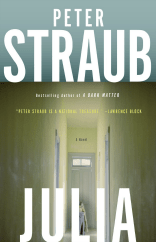
A Review of Julia – by Peter Straub

“Julia Dream. Dreamboat Queen. Queen of all my dreams.” – Pink Floyd


I love “Julia Dream”, a song by Pink Floyd. I don’t, however, love Julia , a novel by Peter Straub. I mean – I like the novel. A little. Somewhat like. I guess.   Okay, okay – I’ll stop dripping out these qualifying phrases and get to the heart of the matter.

Here’s the synopsis – A woman (Julia) fleeing a troubled past finds herself living in a haunted house. She struggles to make sense of her new surroundings. Who is that young mysterious blonde girl that she keeps encountering in the nearby neighborhood? And why does Julia sometimes hear the sounds of someone rummaging around her house while she sleeps at night.

As per the synopsis on Amazon:

Julia’s first purchase upon leaving her husband is a large, old-fashioned house in Kensington, where she plans to live by herself well away from her soon-to-be ex and the home where their young daughter died.

Does the mysterious girl have something to do with her daughter’s death? Is Julia being haunted by ghosts?

Many of the haunted house novels and movies that I have absorbed follow a formula similar to this. Authors Darcy Coates and Blair Shaw, for instance, have published several stories about women who suddenly find themselves living alone in a haunted house. Often they are burdened with the baggage of tragedies past, and this only makes their haunting encounters all the more unbearable. Or maybe, these encounters are one and the same with what has haunted them in the past; maybe these are old phantoms disguised as something new. Jeffery Konvitz abides by this formula in his novel The Sentinel The story within the film Sensoria follows this pattern as well.  Yet Julia, published in 1975, predates all of these. Is it then a first of its kind? Probably not.  Shirley Jackson’s 1959 novel The Haunting of Hill House has a somewhat similar synopsis. The protagonist is not alone in the haunted house, but she does arrive with plenty of emotional baggage, so much so that she becomes an unreliable narrator.  Her sense of reality is in question, and therefore so are her perceptions. This is the same situation readers face with confronting Straub’s central protagonist. Are Julia’s experiences real or are they hallucinations; byproducts of her troubled mind? Thus, the influences of Shirley Jackson are easily recognizable.


I have no objection to an adherence of a formula, so long as it’s not a strict adherence. Julia_PeterStraub_156There needs to be ingredients of originality in the brew somewhere. Julia is not without originality. My criticism with the story has to do with its telling. At times, the events of the tale are ambiguous and vague. I found myself confused; is this event that Straub is describing real, or is it a dream. Or, is it just a section that’s poetically licensed to do whatever the hell it wants to do? I know what you’re thinking  “Well this kind of writing is to be expected in a mysterious novel that features an unreliable narrator.” To a degree I agree (hey that rhymed!). But as my great grandmother would say, “enough is enough of anything.”  When a situation is written so vaguely that comprehension is lost and the flow of the story suffers, then Houston, we have a problem.  Sometimes I wasn’t sure as to which character was  thinking/dreaming up a specific surreal situation.

It is well known that the supernatural is a staple of Peter Straub’s works. He is considered one of the masters of his genre and I in no way wish to challenge this mastery. However I learned from Wikipedia  that Julia is Peter Straub’s third novel, but it’s also his first attempt  at writing about ghosts and the supernatural. Bryant Burnette who writes for the blog Truth Inside the Lie has read Straub’s first two novels, and wasn’t all that impressed with them. He saw a marked improvement in Julia, at least in terms of character development. At the same time, he too finds his vagueness daunting.  He says:

.. failing that understanding, our lack of understanding is a part of the narrative.  Straub isn’t 100% successful at this 100% of the time — he occasionally falls back on the old trope of having a character be vague when it makes much more sense for them to be explicit — but he gets it right way more than he gets it wrong.

I would say he gets a right more than half the time.

 Having not read his first two novels, I can only compare Julia with the one other novel of Straub’s that I have read. A fitting comparison it is, because they are similar in certain ways. But the later novel, Novel # 5, (reminds me of this song, replace “novel” with “mambo”) is superior. I am referring to Ghost Story.

Both Julia and Ghost Story convey the idea of a vengeful, female spirit. Julia is a relatively short novel whereas Ghost Story is a gigantic, ambitious work. To me, Julia is the “practice novel;” an exercise Straub must perform while on the way toward the masterpiece that is Ghost Story. Straub learns from his early works. The fruits of his creative and mechanical maturity bear out symbolically, from the ghost of a young girl (in Julia) to the ghost of a fully grown woman (In Ghost Story). This time, Straub’s vagueness add to the overall eeriness of the story.

I am no expert of the works of Peter Straub. He is a favorite of many, including Stephen King. In both of the works that I have read I see talent. But Ghost Story is where his talent is fully realized.  In Julia, this talent – it’s there, but  it is still struggling to come to fruition. Therefore, alas, I can only give it a half-hearted recommendation.  But at least I put my whole heart into explaining why I  “sort of liked” and did not “love” this book, as I promised I would do way back at the end of the first paragraph. Remember? But of course you do! You rock, but not was well as Pink Floyd.


Twenty-One Books I Read in 2017

bookcase

Another year is coming to an end. I asked myself, “What should be the subject of the last post of 2017?” Should I list the pros and cons of this year’s life events? Nah! Well, I should write some kind of anecdotal article about all those precious feeeeeeelings that stirred in my soul this year, shouldn’t I? Nah to that as well!  Hmmm. This was tough. How about an article about the books that I have read in 2017?  Sure, why not! But here are some reasons “why:”

  1.  It can serve as a nice literary recap.
  2. Also, I  can finally add another item to my blog category –Loving Those Lists; haven’t posted in the grouping lately.
  3. Besides, it will be fun.
  4. To top if off, I will get to be as cool as Author Alistair Cross; who listed the books he read on his FB page. (Two books that he co-authored are on my list)

I took an inventory and counted twenty-one books. I use the term “books” liberally as this list includes novellas and short story collections. At one point, I lump together three short stories as “one book,” although the total world could on these three probably doesn’t equate to a full length novel. In one book of stories, I had read about half of them, but what the heck, I list it as a finished reading because I’m just that kind of guy. Sue me!

Okay, ready? You are? Well good! Cause here we go, in order of sequence.
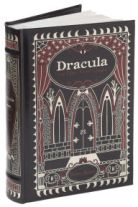
draculabandn21) Dracula by Bram Stoker

 I began Dracula in 2016 but I read most of it in 2017.  I loved the first two thirds of the book. This is where the suspense, description and actions is; the stuff of the story. The last third was a little “Blah”, filled with accounts of breakfasts and tedious dialogue. But the beginning makes up for the weaker end! I really loved the description of Dracula’s Castle, so much so that I wrote the article Dracula’s Castle 


ravencrest2) The Ghosts of Ravencrest by Tamara Thorne and Alistair Cross

 A modern book influenced by Gothic lore. It is filled with ghosts, witches, creatures, and good ol’ fashion S&M. Review is here  
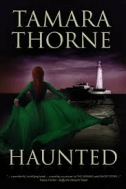


Haunted23) Haunted by Tamara Thorne

Best selling author David Masters moves into a haunted California home by the ocean. The house is part of an odd seaside community that is a mixture of cantankerous yokels and new age flakes. Interesting read, review is here 


castleofotranto4) The Castle of Otranto – Horace Walpole

 This is where Gothic Literature begins. A kingdom, a castle. Princes and Princesses. Betrayal and murder. Ghosts. It was written in 1764. A tedious read, but an iconic book. Review is here 
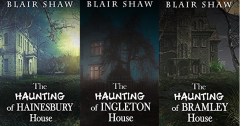
 

BlairShawBooks5) The Haunting of Hainesbury House, Ingleton House, Bramley House – Blair Shaw

 These are actually three “sold separately” novellas. Or are they novelettes? Anyway, the formula for the three is the same – a single woman (recently widowed, divorced, etc.) begins a new life in a new house , which obviously ends up being haunted. Simple but enjoyable reads.  Here is the review.


LeFanuBook6) Best Ghost Stories – Joseph Le Fanu

When it comes to ghost stories, he is the master! I didn’t read all the stories in the this book but I read the following: Squire Toby’s Will, Schalken the Painter, Madam Crowl’s Ghost, Carmilla, Ghost Stories of the Tiled House and The Authentic Narrative of the Haunted House

I wrote a review of Carmilla, a story of a female vampire that predates Stoker’s Dracula, here at HorrorNovelReviews.com

And I wrote a an article about three of his haunted house stories here  
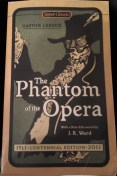
 

PhantomOfTheOperaBook7) The Phantom of the Opera – Gaston Leroux

Fantastic book, read most of it while in Paris, the city where this macabre tale takes place. Wrote an article about it here at HorrorNovelReviews.com


HeadfulOfGhosts8) A Head Full of Ghosts – Paul G. Tremblay

 Suspenseful tale of a possessed teenage girl. Or, is she? No matter, reality TV will exploit her. Interesting read.  I didn’t write a review


Seasons - Something Wicked9) Something Wicked Comes this Way – Ray Bradbury

 A carnival comes to town – to steal the life force of customers. This horror tale confronts the issue of the passing of time and the longing for youth. I write about the book here: 
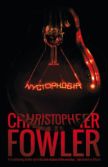
 

 NYCTOPHOBIA Udder Cover10) Nyctophobia – Christopher Fowler

 Interesting story of a haunted house on the sunny cliffs of Spain. Unexpected ending. Review is here  


Seasons - Dandelion Wine11) Dandelion Wine – Ray Bradbury

 Reading Something Wicked Comes this Way left me desiring more from Bradbury. It is a summer kind of book and it was a nice summer read.  Nostalgia at its best. Of course I find a way to relate it to horror here 


Seasons - Summer of 4212) Summer of 42 – Herman Raucher

 Still in the mood of summer stories about youth, I went for this book and I loved it. A young boy falls for an older woman in this heartwarming yet sad tale. See this article as I compare themes of Summer of 42 with a later Raucher work.
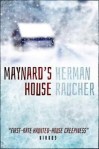
 

MH213) Maynard’s House – Herman Raucher

 And…this is the later work.  From sandy beaches and beach houses to snowy terrains and haunted cabins.  A Vietnam veteran stuggles with PTSD in cabin isolated from civilization. Who are those strange visitors that come to him?  Read about here and here.
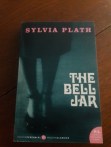
 

SylivaPlath14) The Bell Jar – Sylvia Plath

Sometime this summer, I had a dream that I was taking a course and this was required reading. I decided to read it, just in case I ever have the same dream and find myself at the end of the course. It’s about a young woman’s struggle with identity and madness.
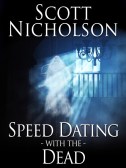
 

 SpeedDatingDead15) Speed Dating with the Dead – Scott Nicholson

Not literally! No one dates Jim Morrison, or Sylvia Plath, or Abe Lincoln. It’s about a paranormal convention at a hotel. Demons show up and the conventioneers just can’t seem to handle them. Read a review here
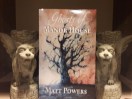
 

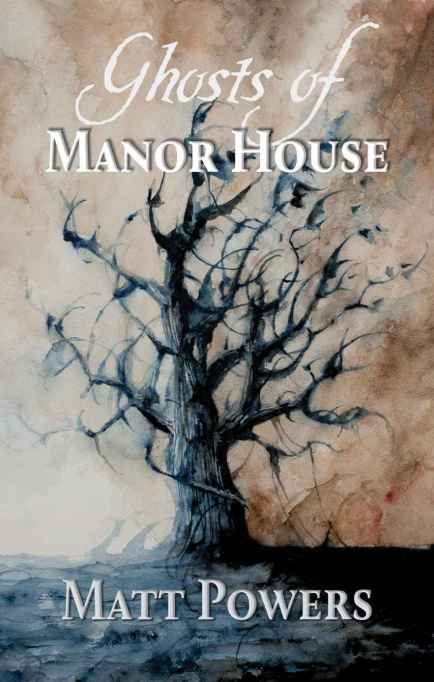
GhostsManor216) The Ghosts of Manor House – Matt Powers

 Shorter than a novel, longer than a novella, I helped Author Matt Powers promote his intriguing story about a house that is indeed alive. Read about it here  

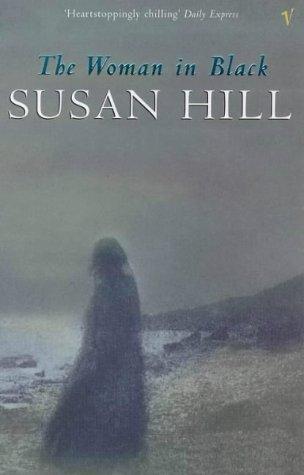
The-Woman-In-Black17) The Woman in Black – Susan Hill

 This novella is a modern classic. Modern Gothic at is best. A young lawyer must search for legal papers in the house of his former client, now deceased. It’s a house in the countryside, surrounded my marshes, overcome by fog and other wraith-like things.

Here is a review  

WitchesRavencrest18) The Witches of Ravencrest – Tamara Thorne and Alistair Cross

 Sequel to The Ghosts of Ravencrest. First we learn of the ghosts. Then we learn more about the witches that conjure and communicate with these spirits. Read my review here 


sentinel-book19) The Sentinel – Jeffery Konvitz

 I saw the film starring the late, great Burgess Meredith. Finally in 2017 I read Konvitz’s iconic novel about an apartment complex with a strange blind priest that “stares” out the window of his unit. Strange things are afoot in this building.  Tenant Allison Parker can attest to that!  Review is forthcoming.
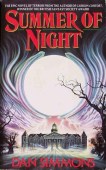
 

summer of night - dan simmons - uk pbk20) Summer of Night – Dan Simmons

I should have read this in the summer. It too would have fulfilled last summer’s yearning for tales of young boys in their summer months. It’s a long read but well worth it. Several boys in the summer of 1960 encounters very ghoulish things in their own home town of Elm Haven. Review is forthcoming.
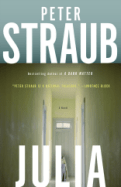
 

Julia_PeterStraub_15621)  Julia – Peter Straub

 I still have one or two more chapters to go. I probably won’t finish this until 2018, but the bulk of the book I read in 2017 so I am allowed to put it on this list (Yes I am!) From the author of Ghost Story comes another tale of specters and haunted houses.  A review is forthcoming.


Special Feature Updated with – A short Christmas Ghost story – written by me! Read for free!

The special feature of this blog is updated.  Come read “Spirits in the Night, Exchanging ‘Chances.” I wrote his last year. But if you haven’t yet read it,  you can read it this year! See, I don’t discriminate that way!

Here’s the link Spirits in the Night, Exchanging Chances


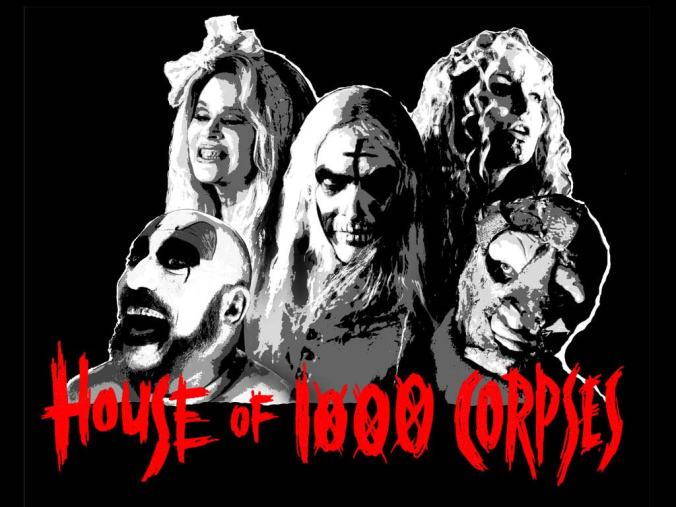
House of 1000 Corpses (Because it has the word “house” in the title!)

Yes I am doing it.

(Doing what?)

 I am lumping Rob Zombie’s film House of 1000 Corpses in with a collection of films that includes The Haunting, The Shining, The Legend of Hell House. 

(Why are you doing that?)

See, because, Zombie’s film has the word “House” in it.

(But Zombie’s film isn’t a haunted house movie, and the rest that you mention are haunted house movies. Using your logic, you might as well include House of Cards with the disgraced Kevin Spacey,  or Animal House with John Belushi popping like a zit. Furthermore why not review the genre of House music. Look, here’s a House jam for ya! How about Full House with those bratty twins?)

House-of-1000-Corpses

Okay, perhaps this situation calls for a more detailed explanation. Back in May, I reviewed the 1974 film The House of Seven Corpses. This film more closely resembles a haunted house film than Zombie’s film. It has some of the atmospheric trappings, including a long staircase, high ceilings, and a grave or two out in the back.  Still, I guess I kind of artificially widened the parameters of the haunted house film genre so that I could review Hof7Corpses.  Overall, I didn’t like the film very much. I found it dull and pointless.  Throughout the review, I compare it to House of 1000 Corpses, making parallels where perhaps there were none. Was Zombie trying to “remake” the 1970s film and do it better by adding 993 corpses to the equation?  I humorously and erroneously made that conclusion. Truth be told, I can’t find any references that links the two films.  But I’m not looking that hard because I just can’t take this subject that seriously. However I was right about one thing. I had written that , even though Zombie’s film has a mere 19% approval rating on rottentomatoes.com , I would like it better than The House of Seven Corpses.

I wrote:

..soon I will watch Zombie’s film and then decide with finality if one thousand corpses are better than seven

Well I recently tested this hypothesis. And I was correct. One thousand corpses are better than seven. There is the finality. Reading between the lines, it seems that I was promising a review. So…here it is!  THIS is why I am reviewing House of 1000 Corpses.

House of 1000 Corpses is more of a gore/slasher movie than a haunted house film. It is resembles The Texas Chainsaw Massacre and has little in common with films such as The Amityville Horror or The Shining. Therefore I’m not going to spend a lot of time and effort on this review.  The synopsis will be brief as hell = a car full of youngsters breaks down near the house of a psychotic family. Youngsters meet family and the stuff of horror-gore breaks out on the screen.

This film is widely panned. I’m not going to go against the grain and declare my love for it. But I will say, House of 1000 Corpses is an entertaining movie at the very least.  Rob Zombie is the Quentin Tarantino or Oliver Stone of horror.  He seems to have applied a “no-rules style” of filmmaking to  the film.  It mashes together all kinds of styles; black and white footage with color, video with film, crazy shots and sequences – all this he mixes into an insane brew that smells of..genius?  If “genius” is too strong, than substitute it with “fun.” Zombie has “fun” with the tools and tricks of cinema; he gathers themes and styles from a toy box of tropes and splashes them with bloody gore. Many critics don’t appreciate all this gore. Too much controversy with all the horror-erotic scenes as well.  It goes over the top into the unforgivable, and still it marches on. In a weird way, this constant pushing of the medium somehow justifies the style in the end.  My opinion, of course.  No it’s not a great movie. Perhaps it’s not even “good.”  But it’s an amusing spectacle, certainly preferable to the boring The House of Seven Corpses.

And that’s all I’ll say about that!

Special Feature Updated – Christmas Ghosts and Haunted Houses

Hello Ghosts!

I am rerunning an article I wrote last year. It’s about the tradition of telling ghost stories at Christmas.  Since holiday season is upon us, I decided to make the article the Special Feature.  I cleaned it up a bit, corrected a few typos.

Here is a link!  But don’t forget, it’s also available on The Home Page underneath the Special Feature menu.


Review of The Ghost and Mr. Chicken

The poor, terrified little girl. She had been through so much already. After ninety minutes of ruthless horror, she should have been cuddled and eased into warmth and security. Instead, she found herself alone in a room inside a house that was not her own. That is when she saw it – a brutal reminder of her terrifying experience.  She screamed. She cried. All that blood!

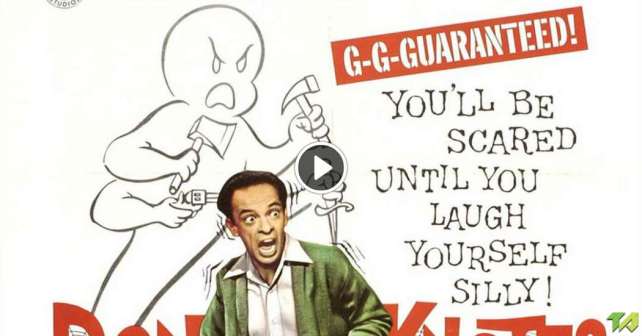
But it wasn’t really blood. It was the markings of a red crayon pressed upon several of the keys on a toy organ. My older cousin Susie, then at the age of five, had stumbled upon this organ in the upstairs bedroom of my parents house. She was staying there for the night and my two older sisters had arranged for her to find this sight. They had done their best to mimic that scary, self-playing organ that was featured in the movie they had taken their little cousin to see earlier in the evening.  This ninety minute movie was brought to them by the letter “G”. “G” for Gore? Gruesome? Ghastly? None of that.  “G” is the rating as in “General” audiences. It shares the same rating as films such as Bambi and Chitty Chitty Bang Bang.  So as it turned out, my cousin was all freaked out over some scenes from a silly comedy movie starring none other than Don Knotts, the comedian known mostly for his role as Barney Fife on The Andy Griffith Show.  The movie was The Ghost and Mr. Chicken. All this happened before I was born. I guess people were more innocent in ‘them there olden days’ of 1966.

GhostAndMrChicken

Years after the fact, my family would rehash the details that led up to “Little Susie’s scare.” My uncle laughed out loud when remembering how “the world’s least scary movie” had frightened his daughter. I was a young’un when I first heard these comedic tales of “Little Susie’s Scare.” But I didn’t see The Ghost and Mr. Chicken until I was an adult. I first saw it a couple of years ago when it aired on Svengoolie , a television program that features a hilarious horror host (That’s Svengoolie!) that presents viewers with a weekly movie. Then I watched it again on Svengoolie the following year. Finally I saw it for a third time a month ago (Guess what show?) After the third time, I finally made it a point to write up this review. After all, this is a haunted house movie.

Here is a Svengoolie Song parody of the movie:


Since I sat though this movie three times, one would assume that I liked this movie.  Well, let me explain – I tune into Svengoolie regularly, often watching repeat movies, even ones I don’t like as much. And sometimes, since I tune in for the laughs and antics of the host , I don’t always pay attention to the key  plot details of a movie. Sometimes I pick up on the story on the second viewing, or even a third.  Now, do I like The Ghost and Mr. Chicken? Sure, I mean, what’s not to like? Perhaps its Don Knotts. Yes, the man has his critics. I will get into this criticism in a moment. But first, let me go over the general storyline.

The main character of the Ghost and Mr. Chicken is the gullible and awkward Luther Heggs.  To this I say, “Atta’ boy Luther!” This is a reoccurring joke that happens whenever Luther is in a crowd. Someone shouts this greeting to him. And guess who plays Luther? If you said “Don Knotts, the you’d be correct! Luther is a typesetter for the local newspaper, but he aspires to be more.  Suddenly he receives an offer that could be his big break into investigative journalism. He must spend the night in the town’s haunted house, The Simmons mansion, and then write up a report about any strange goings ons that he might encounter. A very frightened Luther accepts the job and he is frightened out of his wits.  Inside this cobwebbed house, he finds knives puncturing bleeding portraits. He stumbles upon secret passageways. Finally, he discovers an organ with bloody fingerprints on its keys. It plays all by itself! Oh my!

Luther’s first-hand account of his stay at the haunted house is printed in the paper. The out-of-town estate owner sues poor Luther for libel. How dare that buffoon defame his mansion with tales of ghosts! Will poor Luther be able to get the court to believe his story? Will the haunting reoccur before the eyes of court appointed witnesses?

As previously mentioned, Don Knotts is primarily known for playing Barney Fife , Sheriff Andy Taylor’s inept deputy and sidekick. So how does Knotts do in the leading role? Some will say “not so well”. They might say that he became a caricature of his own self; that his budging eyes became bulgier, his signature look of surprise becomes what might resemble a man having a seizure. They could say he overacts; gives a “slapstick on steroids” kind of performance. With all of this I would agree.  However, this does not ruin the film for me. See, I feel right at home with the post Andy Griffith Don Knotts. I was not introduced to him as the tamer Barney Fife but as the goofy bank robber that slid up a wall in the movie The Apple Dumpling Gang.  Then I  would go on to seem as the flamboyant Mr. Furley on television show Three’s Company. All this before I ever saw a single episode of Andy Griffith. To me, Don Knotts was always a living cartoon character. His physical features were naturally comedic and his acting style was always exaggerated .

The Ghost and Mr. Chicken has the humor of simpler times. It’s a dated movie and many might think that it fails the test of time. For whatever time period it makes the grade, I do enjoy watching it. It is directed by Alan Rafkin, a man known primarily for directing television comedies. He directed four episodes of Mary Tyler Moore, twenty-three episodes of The Bob Newhart Show, seventeen episodes of Sanford and Son, twenty two episodes of Laverne and Shirley and a whopping one hundred and twenty-three episodes of One Day at a Time.  And there  is much more where all that came from! Check out his resume.

I say give The Ghost and Mr. Chicken a try. Who knows, maybe it will make you cry and scream like a little girl Susie! (Hey it could still happen? Okay..fine! That will never ever happen again)


The Woman in Black – Modern Gothic at its Best!

My claim to expertise has been compromised!   

(Readers be like:  ShockEmojiShockEmoji2ShockEmojiShockEmoji2)

How dare I claim to be an expert on haunted house literature when I have only just recently read The Woman in Black by Susan Hill!  I am sooo late to the game – very late! I apologize for my tardiness.

(Readers be like:  MadEmojiUseMadEmojiUse2MadEmojiUseMadEmojiUse2 )

This is a major faux pas, since what we have here is a modern “classic”, in every sense of the word.   The Woman in Black is a novella of high quality. It serves as the definitive model for the various adaptions that premiered across various mediums including two films (Made for British TV movie of 1989  and Made for the Big Screen in 2012) and one TheWomanInBlackplay (In London 1987 ). It relays a standard and reminds us of the “shoulds” of a ghost story; it should be descriptive, mysterious, suspenseful, and of course scary.  In addition – Susan writes with a nineteenth century style, giving the story a welcoming Gothic flavor . All of this is a testament to its greatness; a greatness that I should not have ignored for so long.

The story is simple. Who needs a lot of complexity when “simple” gets the job done, right? Anyway, retired lawyer Arthur Kipps refuses to join with his wife and stepchildren in the frivolity of telling ghost stories, for he takes the matter seriously. His real experience with ghosts rivals all of their silly yarns. His true tale is disturbing and deadly; his family wouldn’t understand.

As a young London lawyer, Arthur is sent to the remote coastal village of Crythin Gifford to attend to the affairs of the late Mrs. Alice Drablow. He must attend her funeral and then retrieve all of the significant legal documents that are scattered about at her former place of residence – Eel Marsh House (gotta love that name!) At her funeral, he sees a mysterious, sickly woman dressed in black. When Arthur mentions her to another funeral attendee, the other freaks out and won’t admit to seeing her. Likewise, no one in the village wants to discuss the late Mrs. Drablow. They want nothing to do with her house, which exists a few miles outside the village. It is surrounded my marshes. It is impossible to get there at high tide. Arthur heeds not the warnings of the people, for he has a job to do. He stays all alone at Eel Marsh House. In the end he will experience something so horrific that he will not be able to share the story with his stepchildren many years later.

As I read this novella and prepared for this review, I could not help but notice parallels between several aspects of this story and certain themes that I have written about here at this blog. First, it pays homage to the “Christmas Ghost Story”, a topic I have written about extensively (For starters, there’s this:  Christmas Ghosts and Haunted Houses ). The ghost story sessions mentioned at the beginning of this novella occur on Christmas Eve. One of Arthur’s stepchildren correctly points out that such a pastime is part of the English Christmas tradition; at least it was in the days of yore. I am reminded a bit about the Christmas haunted house story by the name of Smee. (See  Review of Smee – A Christmas Ghost Story by A.M. Burrage. To date, this post receives the most traffic). Like Arthur Kipps, the narrator of the ghost story in Smee is reluctant to take part in certain holiday festivities on account of a past terrifying experience. In Smee, the activity that frightens him is a hide-and-seek type game. In The Woman in Black, it is the telling of the ghost story that is unsettling. In both cases, readers learn of the backstory that causes these protagonists to fret on Christmas Eve. In both scenarios, its is this backstory that will turn into the main story.

TheWomanInBlack2Second, the haunted house of this novella is surrounded by terrain that is descriptively creepy. Ghostly grounds are a nice compliment to the haunted house that stands on its domain. I wrote about this here: Ghostly Grounds: Explorations Outside of the Haunted Houses of Film and Literature. While eerie events take place inside the house (inside the locked nursery!), most of the terror takes place outside the walls of Eel Marsh House. There is a nearby cemetery where Arthur once again sees the woman in black. Even more creepier are the marshes. Only by a Causeway can a traveler make safe passage to the house. However, the frequent sea frets often obscure the safe passages. It is here out on these foggy marshes that Arthur hears what I deem to be the most terrifying element of the story. In a good ghost story, things that are not seen are more frightening then then the stuff spoiled by sight. Had I read The Woman in Black before writing the “Ghostly Grounds…” article, I certainly would have made reference to Susan Hill’s story.
Finally, Susan Hill strives for the style of the traditional English ghost story. In my opinion she succeeds at this feat. I have written about the traditional English ghost story, in articles such as J.S. LeFanu and Haunted Houses and Everything I Know About Haunted Houses I Learned from British Literature . First of all, though published in 1983, the book is written in the Gothic style that permeates these ghostly tales of yore. For instance, The Woman in Black is told in the first person and is a story within a story, which was a common plot device back then. The sentences are long and they often give way to passive voice. Susan Hill will write “my spirits rose” instead of “I began to feel better” or “you look unwell” instead of “you look sick.” Furthermore, the story is saturated with descriptions, often about the sky, the grounds and the weather.

What does this style do for the story? A lot! In establishes tone and wraps readers in a certain kind of chilling mood; a mood that modern ghost stories just aren’t able to invoke. And yet, with all its mimicry of the old style, there is something “modern” hidden within that I cannot explain. Somehow this work stands apart from Hill’s literary predecessors. Perhaps it’s the absence of archaic terminology that I often stumble upon when reading the ghosts stories of yesteryears. Maybe she benefits by learning from the old stories in a way that the authors of the traditional stories could not since they were but fledglings of their time. I’m just guessing here. But this “something” that I’m so desperately trying to convey testifies to the overall mystery that surrounds this novel. Heck, even the time period of the story is somewhat enigmatic. Like most gothic tales, this is a period piece. But Hill never explicitly states the year. Cars appear in the book, but so do traps and horses. A man on the train “takes out his watch”, he doesn’t look at his wrist. Telephones are mentioned, but so is the telegraph. Often communication is left to old fashion letters and telegrams.

I have heard good things about the 2012 film version of the book starring Daniel Radcliffe – Good ol’ Harry Potter! I am looking forward to seeing and reviewing that film. But the book is a tough act to follow, so we’ll just have to see. But I’m optimistic.  I’m sure I will enjoy it, but probably not as much as the novella.


Halloween Is Over (Or is it???)

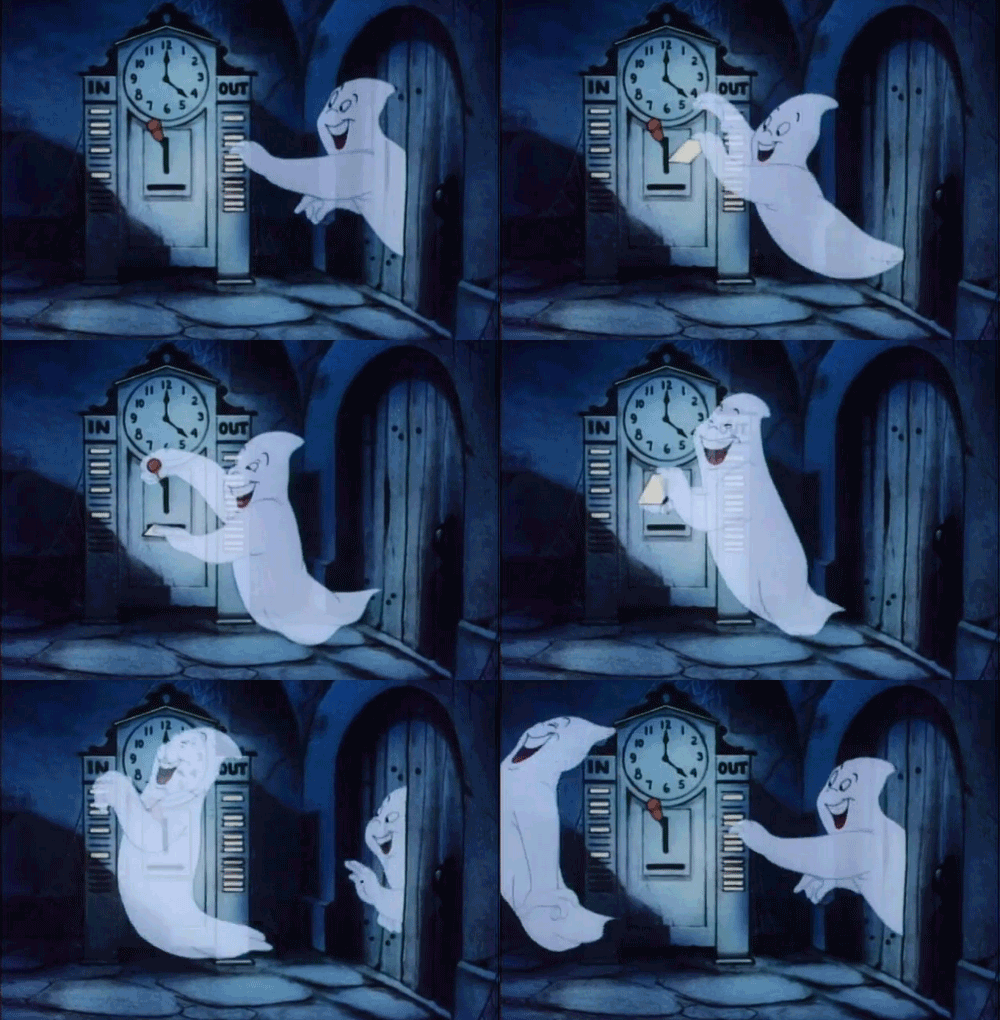
All Hallow’s Eve has passed. All of the free roaming spirits have returned to their graves. Or have they?

GhostGif

They might have “clocked out” for the season, but a bunch of them are still haunting this blog! PLEASE, help me get rid of them!

This is a Ghost Hunt Contest! Find Ghosts – win a book!!


Help me find these ghosts. In turn, I will reward you with points. When all is said and done, the person with the most points will win an autographed copy of Matt Power’s book, “Ghosts of Manor House”

Some ghosts are worth more points than others. The chart below shows the point value for each ghost:

Some ghosts are worth more points than others. The chart below shows the point value for each ghost:

Red Ghost: 1 point

redghost3

         RED GHOST FOUND!

Yellow ghost: 5 pointsyellowghost2

Blue Ghost: 10 points

blueghost2

Green ghost: 25 points

greenghost2

Orange ghost: 50 pointsoramgeghost3

Purple Ghost: 75 points

purpleghost2

White ghost: 100 points

whiteghost2


Find one, find two, or find them all! Once you find a ghost, post the identity (color) and location of the ghost in the comment section below and then I shall remove the ghost from the blog and distribute to you the earned points. For instance, you might say in the comment: “In the Cat and the Canary article, inside the paragraph that begins ‘the movie is a remake of the 1927 film’, I found a blue ghost.

Or you can email me the identity and location at dwcheely@yahoo.com

The person with the most points wins a free autographed copied of Matt’s book – Ghosts of Manor House


ManorHouse