Review of The House on the Moor

The House on the Moor CoverThere’s an accepted adage that one should ‘never judge a book by its cover.’ Sorry Mr. Adage, but that is exactly what I am going to do. Not only am I going to judge the cover, but I an going to evaluate the paper, fonts, and even the box it came in.  I am going to offer my opinion on the illustrations as well. And my opinion is this = Saul Goodman. (it’s all good, man!)  Oh and the story is all right as well.

Why all this mumbo-jumbo about the physical book? Well see, I stumbled onto Author William Meikle’s thread on Goodreads.com.  He posted a link to Dark Renaissance Press –the publisher for his book – The House on the Moor.   Unfortunately,  the Dark Renaissance website is down at the time of this post.  But Meikle describes exactly why I was attracted to his book in his blog.  I’ll leave it to the author to tell you about it:

The Deluxe Hardcover Edition is bound in smooth black leather, and the front cover stamped with a haunted house in red foil, further enhanced with solid black headbands and a red book ribbon. The book will be protected by a black slipcase and deluxe hardcover edition will be signed by the author and the artist.

The Signed and Numbered Hardcover Edition is bound with the printed front cover art. It is furthered enhanced with black headbands, and a black book ribbon. The signed and numbered hardcover edition is signed by the author.

From – https://williammeikleblog.wordpress.com/2015/11/19/the-house-on-the-moor-signed-hardcovers-in-stock/


Now how could a lover of haunted house literature such as myself not be interested in something like this! Then, after seeing the illustrations of the talented M. Wayne Miller , I was sold. See some of Mr. Miller’s work below:

In the age of digital downloads, I am impressed that authors such as Miekle take the time and effort to publish a well designed, hardcover book. Not that there is anything wrong with ebooks – I read the all the time! I publish them myself!  But the pleasure of holding a book, flipping through the paper pages and then storing it on a cherry wood shelf cannot be replaced. The House on the Moor is joy to multiple senses.  I have already expressed how attractive the book looks.  But there is more. The cover is feels smoothly sensual when an open hand glides across its surface. And it seems to have that new car smell! Ah but it is a book – so the olfactory pleasure is, perhaps, more intellectual?

As for the other senses, I wouldn’t know how it sounds; this is not an audio book. I have made no attempt to eat it so I wouldn’t know how it tastes. But what about that other sense, the one called “imagination” which yields the power to bring all the senses together inside the brain?  The plot certainly stimulates the imagination.  It is a simple yet engaging story, filled with mood-setting charm.  John and Carole visit a mysterious old man named Blacklaw in his house on the moor.  John’s grandfather Hugh was a dear friend of Blacklaw’s in the olden days. In their prime, both men, bold and dashing, were celebrated for their feats and adventures, until one final act of daring caused Hugh’s demise. This act occurred in the cellar of the house on the moor. John is ready to hear the tale. Cautiously, over the course of several sittings, Blacklaw tells the tale as his energy is slowly drained.  It is a story of the occult and magical spells.  It is a story that explains the haunting that is occurring inside the house during present time Now readers, cue in the imagination – this power that brings together all the senses inside the brain.  I could almost taste the Scotch that guests and hosts of the house drink during the tellings. I The House on the Moor Spine 2could almost feel the warmth from the fireplace and nearly hear it crackling.  Could my mind hear the eerie chanting rituals that arise from the cellar? I think so. Could it see all the way up to the top of the library tower, where hidden in the shadows of the rafters was some kind of phantom? I believe so.

This is a book to cherish, to read by the fireplace in your favorite sitting chair with a sifter of brandy at your side. When not in use it belongs on the bookshelf in its protective black case, with a spine of shiny-red etching that spells to each and every onlooker: The House on the Moor.

Architecture, Design, and Furnishings of a Haunted House

haunted house color


A well-described setting is essential to a good haunted house novel. Readers need to be able to “see” the house with their minds’ eye. Therefore, authors often take special care when describing the architectural layout. This same care is applied to describing the inside of the house. From marble statues and ornate wall décor to  winding corridors or spiral staircases, it is the author’s job to convey these visuals in such a way that encourages readers to temporarily forsake their off-page surroundings and take in the haunting environment that that exists within the pages.

In order for this vicarious relocation to be accomplished, writers and readers need to be familiar with certain terms that are related to architecture and interior design. I have come across many of these terms in both in my reading and writing. When reading, I may have come upon a word that described, say, a part of the roof, but I was at a loss to understand the description since I was unfamiliar with the term. Likewise; when writing, I found myself searching in vain for the right set of phrases to describe an architectural component, only to discover that there was a single word that could define the whole shebang.

This piece will examine the physical components of the houses within this genre. I will provide pictures along with definitions and examples ripped  from the pages of classic and indie novels. Definitions are provided courtesy of Merriam-Webster.com. Hopefully this will be helpful to readers and writers of this genre.


Eaves

EAVES

Definition: the lower border of a roof that overhangs the wall.

“Shaking off from my spirit what must have been a dream, I scanned more narrowly the real aspect of the building. Its principal feature seemed to be that of an excessive antiquity. The discoloration of ages had been great. Minute fungi overspread the whole exterior, hanging in a fine tangled web-work from the eaves. Yet all this was apart from any extraordinary dilapidation.”  The Fall of the House of Usher by Edgar Allan Poe.


CANDELABRUM  Candelabrum

Definition: an object with several branches for holding candles or lights.

“Now in no one of the seven apartments was there any lamp or candelabrum, amid the profusion of golden ornaments that lay scattered to and fro or depended from the roof. There was no light of any kind emanating from lamp or candle within the suite of chambers.” – The Red Masque of Death by Edgar Allan Poe.


PinaclePINNACLE

Definition:  an upright architectural member generally ending in a small spire and used especially in Gothic construction to give weight especially to a buttress.

“Little curved towers and pinnacles, with outlines suggestive of leaping flames, predominate; while the body of the building is in the form of a circle.” – House on the Borderland by William Hope Hodgeson.


GABLE

Definition: a section of a building’s outside wall that is shaped like a triangle and that is  Gableformed by two sections of the roof sloping down.

“It faced south, with one gable end buried to the lower windows in the eastward rising hill, and the other exposed to the foundations toward the street. Its construction, over a century and a half ago, had followed the grading and straightening of the road.” – The Shunned House by H.P. Lovecraft.


                                                                                              Hearth

HEARTH                                                                    

Definition: a brick, stone, or concrete area in front of a fireplace

“The fire he had left to die was roaring to life again, the blaze filling the entire hearth. He could feel its searing heat.” – The Amityville Horror by Jay Anson.


VERANDA                                                                                                                                                Veranda

Definition:   a usually roofed open gallery or portico attached to the exterior of a building

“…she put her feet down firmly and went up to the veranda and the door. Hill House came around her in a rush; she was enshadowed, and the sound of her feet on the wood of the veranda was an outrage in the utter silence.” The Haunting of Hill House by Shirley Jackson


MantelMANTEL

Definition: 1 a :  a beam, stone, or arch serving as a lintel to support the masonry above a fireplace. b :  the finish around a fireplace 2) A Shelf above the fireplace.

“..from the exquisite symmetry of the marble mantles to the filigree of the wrought iron handrails, only the best had been good enough for the man or woman who’d owned this place.” Coldheart Canyon: A Hollywood Ghost Story by Clive Barker


FLUE                                                                                                                                                 

chimney-flues

Definition: a channel in a chimney for conveying flame and smoke to the outer air

“They searched for him in the attic room and cubby hole and press, and even up the chimney flue and everywheres I guess, but all they ever found of him was his pants and round-abouts. And the goblins will get you if you don’t watch out.” The Little Orphan Annie by James Witcomb Riley


manaclesMANACLES

Definition: either one of a set of two metal rings designed to lock around a person’s wrists or ankles.

“The room was empty and quiet. Manacles and chains hung from the walls.” The House on the Moor by William Meikle


RAFTERS                                                                                                                                  

rafters

Definition: any of the parallel beams that support a roof

“He looked up, but all he could see were dark shadows high in the rafters.” – The House on the Moor by William Meikle


balustradeBALUSTRADE

Definition: a kind of low wall that is placed at the sides of staircases, bridges, etc., and that is made of a row of short posts topped by a long rail.

“They reached the second floor and, turning to the right, started along the balcony corridor. On their right, the heavy balustrade continued. To their left, set periodically along the paneled wall, were bedroom doors.” Hell House by Richard Matheson


TAPESTRIES                                                                                          black tapestry

Definition: heavy cloth that has designs or pictures woven into it and that is used for wall hangings, curtains, etc.

“The seventh apartment was closely shrouded in black velvet tapestries that hung all over the ceiling and down the walls, falling in heavy folds upon a carpet of the same material and hue.” – The Red Masque of Death by Edgar Allan Poe

Review of The Haunting of Blackwood House

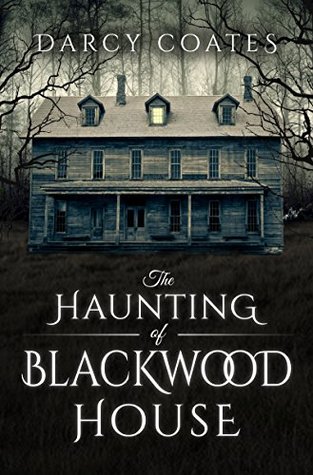
Haunting of Blackwood HouseThe Haunting of Blackwood House  is the second book of Darcy Coates that I have read and reviewed. It certainly won’t be the last. I admire her talent as a storyteller. I learned of her talents by exploring her novella The Haunting of Gillespie House. It treated me to a good old-fashioned haunting, so it was only natural that I would want to visit another of her haunted abodes. So The Blackwood House was next. This house accommodated me as well, nestling me with ghostly delights and treats of terror as I snuggled in my bed, reading only by the light of my e-reader. Thank you Darcy for taking in a late night lodger and leaving the lights off for me so that your ghosts may shine!

I foresee myself as becoming not merely a fan of her books, but a friend of her work as well. As any good friend should do, I accept the good along with the mediocre. So far I see no bad. Here is what’s good about The Haunting of Blackwood House: the haunting of Blackwood House. No, the preceding sentence is not an exercise in redundancy. What I am saying is that the haunted house itself is what makes this book. It has a rich back-story – build on grounds known to be a hotbed for supernatural energy, founded by a mysterious spiritualist many decades ago, to later be inhabited by an axe-wielding serial killer that turns victims into ghosts. The house changes ownership over the years and for each set of inhabitants, there is danger. It just so happens that the families that live in the house just can’t keep from killing each other.

Mara is the house’s latest resident. She lives there alone, but her boyfriend Neil keeps her company. Sometimes he sleeps over, but often Mara spends the night in Blackwood House alone. It is when she is by herself that the house tends to show off its ghostliness. Footsteps are heard in the attic. Voices of crying children are heard from the fireplace. There are the ghostly images of a hanging man in the foyer; of a deceased woman rocking an infant in the rocking chairs. There are some eerie moments here folks, and I love them all.

So, what is mediocre about this book? Answer – the characters. Mara was raised in a family of spiritualists. She has “the gift” but throughout the story, she is in denial of it to the point where she abhors all things religious and supernatural (later it will be revealed that her “gift” tends to feed the haunting). Her animosity can get under the skin of the reader when she constantly tries to rationalize away the ghostly phenomena. Mara is somewhat of an enigma. She is high maintenance yet independent minded. Her boyfriend Neil suffers on account of this, never knowing whether to step in to offer her assistance of back off in fear of cramping her style. In short, she is annoying and he is a doormat, and these two don’t break out of these molds too often. Their love story is a side story, that doesn’t really branch off or melt into the larger story of the haunted house. Therefore, it’s a bit distracting. Mind you, these aren’t “bad” characters; they are believable (as with Mara’s case, all of us are haunted by contradictions of character), they just lack that special something that absorbs readers into their essences.

It can be summed up as follows: Mara’s psychic abilities strengthen the haunting power of The Blackwood House. In turn, The Blackwood House, with its mysteries, history, and spooky spectacles, makes for a strong piece of haunted house fiction. The brawn of the book is enough to carry its weaker elements – the characters – to the home stretch. For at times, they are baggage for the larger story. But when the baggage becomes burdensome, have no fear, for soon the focus will return to the strengths of the story – and the reader will once again feel hauntingly at home.

Review of Coldheart Canyon – A Hollywood Ghost Story

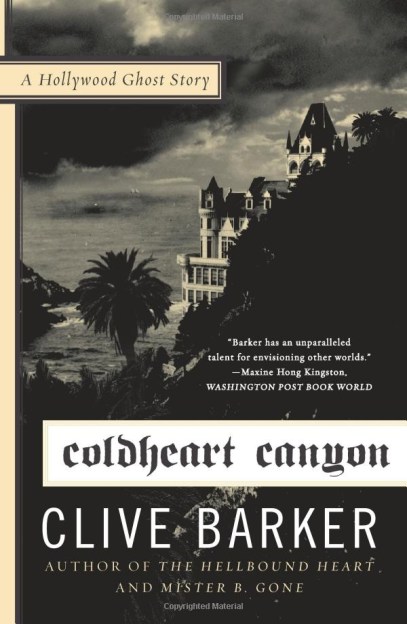
ColdheartCanyonFame! Fortune! Power! Pleasure! – these things are the gods of this world, so sayeth a religion teacher I knew many moons ago. These are the lower-case gods; false gods, gods that are appetizing to the flesh but poisonous to the soul. I’ll add a few more – Beauty! Youth!  In sum, these gods represent an overwhelming lust for “the good life.”

 Many religions have a geographical center. There is Israel, Mecca, Babylon, and The Vatican. Where might the practitioners of “the good life” congregate?  Which city values youth and beauty? Where do these youthful and beautiful creatures go to seek out fame, fortune, power and pleasure?  The answer – Hollywood! Become a movie star! Be the face that everyone in world loves! Earn your millions. Party on down! Work the scene for a while and become a producer. Make and break careers!  Oh what fun!

There is a microcosm of such vanity and decadence in Hollywood’s own backyard. It’s called Coldheart Canyon. Over the years, the biggest names in the film business gathered in a hideaway house in the heart of this canyon. While concealed from the spotlight of the motion picture’s capital, they kept its values alive with decadent parties, mass intoxication, and bizarre orgies. This was true in life…and in death. Magic within the house helped some to achieve eternal youth. For others, it provided a desire for pleasure eternal; for fame that never ceases. Even after death, the spirits of celebrities return to this canyon to dwell in its foliage, hoping against hope that they should be permitted inside the house once again and “relive” the glory. These spirits – they materialize in solid form! Remember – I said that the gods of fame, fortune, power and pleasures appeal to fleshy beings – beings that still want to feel the erotic pleasures that only their sexual organs can muster. Out in the canyon these “spirits” wait and yearn. While passing the years, they mate with the creatures of the canyon; coyotes, birds, rodents, anything that moves and breathes.  The offspring of such couplings are quite an abomination; their body parts are half human and half animal.  All this on account of that room inside the house; a room with walls of supernatural tiles that pull its occupants into a magical forest where time stands still, where the strange and erotic come to life, where youth and beauty can be restored. Alas, the house and room are guarded by Katya Lupi, the owner and mistress of the house. Once a beauty from the silent era of film, she lives on in pristine form in the year 2001.  She is the queen of this kingdom and she deprives her former peers of the silver screen of this restorative power.  For she is cold. She is heartless. Hence the term Coldheart Canyon.

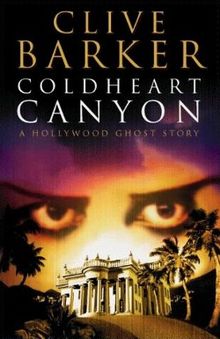
If you haven’t already guessed, I have been describing the meat and guts of Clive Barker’s novel – Coldheart Canyon – A Hollywood Ghost Story.  So please don’t go looking for Coldheart Canyon, you will not find it. It exists only in the imagination of Barker. But he ColdheartCanyon2has generously shared the contents of his mind with us so that we may also get a glimpse of this macabre world. Now there are some (and you may be one of them) that do not want any part of Clive Barker’s imagination. This is understandable, for there are sensitive folks out there. Barker graphically describes the human anatomy and the situations that arise when one piece of anatomy meets another. He also describes the anatomy of things that are not human. For instance, there is this goat boy (who happens to be the son of Satan) that is quite often visibly aroused. I’ll leave it at that.

One of the most common complaints in the one-star reviews (but there are plenty more 5 star ratings) is that this book is nothing more than a glorification of porn. Folks, it is a lot more than that. Yes it’s explicit at times. But to condemn this piece solely on account of its X-rated themes is to miss out on its profound exploration of human nature. From the no-holds-barred examination of Hollywood culture to the rich descriptions of the characters, Coldheart Canyon – A Hollywood Ghost Story is certainly a unique and compelling piece of work.

I must admit – I did not always feel this way. I first read this book shortly after it hit the bookstores. Initially I was not overly impressed. At the time I purchased this novel, I was in the mood to read a kind of ghost story like the ones I had grown up with and was anxious to vicariously explore a haunted house in the tradition of Amityville..  I did not find the kind of familiar tale I sought out.  In the beginning and with interest, I followed the plight of the main character Todd Picket- a movie star that was just beginning to show signs of aging. When his face-lift operation went wrong, he was forced to hide from the public eye in an isolated house in a canyon until he recovered. I was anxious to read about the ghostly footsteps he might hear, or the trespassing of specters across his halls, or the moans and groans of midnight ghosts. Instead I got a tale that was part fantasy, part macabre, part erotic. I was disappointed and I’m not sure I even finished the book.

Ironically, I came to like The Coldheart Canyon – A Hollywood Ghost Story after I became dedicated to haunted house lore. This second time around, I accepted the tale for what it was and not for what I had once demanded it to be. It is not your average haunted house tale. Most of the ghostly activity takes place in canyon outside of the premises. The fantasy and adventure occurs within one room of the house. Although this is not my favorite haunted house novel, it certainly belongs within the genre. Some of it I found a little hokey.  Nevertheless, it’s entertaining and intriguing. The story is unique; it’s not enslaved to formula – it is not a follower. But does it lead? I don’t know about that. Some would say it does. For me, it just “is.” As such it just persists, like many of its ghosts that are damned to its canyon.  Try the book. You might like it.

Review of Haunted-3D


I’m going to take a little break from the American and English traditions of haunted house fiction. For now it’s “Goodbye Hollywood and Hello Bollywood!”  But let me be frank. I’m not very familiar with Bollywood films. Just to prove my ignorance, I’m not even sure if Haunted – 3D by Vikram Bhatt is a “Bollywood” film. I had once assumed all Hindi Language films from India were part of the Bollywood scene, but this is not so. According to wikipedia, Bollywood is one of many film production companies in India. Bollywood or no Bollywood, Haunted – 3D is part of a genre known as the Indian ghost movie.

Popular not only in India, Indian ghost movies are well liked in the Middle East, Africa and Southeast Asia. How about the U.S?  Well, wikipedia doesn’t list the United States as being a treasure trove for such films. I’m only going by what the friendly folks of this online encyclopedia say.  If true, maybe all that will change once my fellow Americans discover this article.  Millions of Americans will see this blog post and decide “Hey! Maybe I should give these films a chance!”  Ha! I can only wish for that many page hits. I found this film on youtube. I’m guessing that if there were to be a place on the Internet capable of making Indian ghost stories available to Americans, it would be youtube.com

A common theme in Indian ghost stories is that of a modern person who unwittingly encounters ghostly happenings that link to events that have happened a long time ago. Such is the case in Haunted -3D.  A young man named Rehan is asked by his realtor father Hindi haunted-3d4to investigate a house that is on the market. Little does Rehan know that the house is haunted. But he soon finds out soon enough. As he settles in to stay and sleep at this house, he witnesses many things. Doors are slamming, books are falling off the shelf, a piano begins to play on its own accord, and ghostly handprints appear on the windows. Then there is the crying and screaming that occurs in the middle of the night. This is what disturbs Rehan the most. Disturbs and…intrigues him. For it is a female voice that cries out in the dark of night. He makes it his job to de-haunt the house.  In doing so, he will travel back to the past to make things right. He will help the beautiful Meera deal with the tragic events that took place in her life and in her time – seventy-five years in the past.

When I think of Indian films, I think of music. I think of dancing. Singing and dancing is what I would always see when I would flip through the TV channels on a Saturday afternoon and stop on a Hindi language program. Should it then be surprising to encounter singing and dancing in a horror movie?  There is plenty of music in Haunted-3D. These are love songs – pop songs.  There is one dancing scene as well but it is done in humor.  See, this film is as much of a love story as it is a ghost story.  This fusion is not uncommon in Indian ghost stories. In fact, romance is at the heart of the gothic tradition, especially the stories written in the 18th century.

Haunted-3D is many things at once. It’s a love story that’s both sat and uplifting. It’s funny and quirky. Some scenes are action packed. Some scenes are brutal to watch. Other scenes are downright campy. It has ghosts, evil spirits and time travel.  I am still trying to figure out if this mish-mash of styles worked for me or not. At times I felt as if I was receiving a well-rounded education in the genre arts. Other times, I felt as if I was watching a film with an identity crisis; a film that was trying to be too many things. I HindiTonguecannot say which scene or set of scenes made me feel one way or another. This ambivalence seems only to exist as a whole and cannot be broken down to the sum of the film’s parts. Despite this ambivalence, I did enjoy the film. It is worth watching but at the same time it is a little long at two hours and twenty minutes. Since I saw this film on the computer screen, I did see it in 3D. There were parts of the film that were crying out for 3D glasses. Alas, I had none.  The dialogue is spoken in Hindi, but there are English subtitles. However, the characters speak in English from time to time.

I’d like to close this review on a good note. The special effects in this film are awesome. They’re done with style; they didn’t over do it.  Ghosts materialize; evil spirits possess the body – kudos to these creepy scenes.  The best is when an evil spirit chases a couple through a forest. The spirit runs in midair! It’s as if there was an invisible platform far above the couple’s heads.  This did not look cheesy.  Instead, the chase appears so damn real!  Bizarre I’ll grant you, but nevertheless – real.


Review of The Shining (Novel, Movie, Mini-series)

The time “to shine” has arrived! I’ve been promising this review for quite a while now. Finally it has come. …Heeeeeeeeeeeere’s Johnny!


** Warning: there are spoilers lurking about! They are hiding everywhere. You may encounter a seemingly innocent sentence and then suddenly, out of nowhere – BOO! One will grab you. You have been warned. **
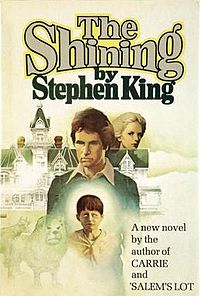
 

ShiningnovelThe Book

Let me begin was a story refresher. The Shining is about a five year old boy named Danny Torrance that has special powers which the book calls “The Shining”. He has precognition and extra sensory perception to name a few. His father, Jack Torrance, is an unemployed writer. Formerly a school teacher, he lost his teaching when he pummeled one of his students for taking a knife to his car tires. Jack has anger issues. He is an alcoholic as well. After a heavy night of drinking, he witnesses Danny making a mess out of his papers on his desk. He breaks his arm when pulling him away from the desk. Many of Jack’s issues stem from the abuse he had suffered from his father. Nevertheless, his wife Wendy stays by his side, on the condition that gives up the booze and cleans up his act. Jack complies. Not only does he give up drinking, but he lands himself a job as a caretaker for the swanky yet empty Overlook Hotel for the winter when the Hotel shuts down.. It is up high in the Colorado Mountains. He and his family move in. Soon they will be snowbound. The Overlook Hotel is haunted. It too shines, just like Danny. Jack and Danny will unintentionally awaken the Hotel’s ghosts. Danny does so on account of his ability to shine and Jack on account of his unstable personality; ghosts just love to munch down on disturbed psyches.

In the “spirit” of the book (and the film) (and the television mini-series), I think it’s time to call forth some ghosts as well. These will be the ghosts of reviews past.

Several months ago, I wrote about house divided, brother against sister, and family tensions with the end result being the physical destruction of their house. This occurs in The Fall of The House of Usher.   A few weeks later, I presented a house that preys on the psychic abilities of a fragile young woman. You can learn more about this story by visiting Hill House at The Haunting of Hill House/The Haunting: Book Vs. Movie. Months later I introduced a family that rented a big old house for the summer. The wife/mother fell in love with it, so much so that longed to be a part of it. And the house was more than willing to possess her! This is what happens in Burnt Offerings. Then, only about a week or two ago, I informed you of a certain masquerade party. But this party was not all fun and games, was it? In fact it was quite deadly. You can revisit The Masque of Red Death anytime you wish.

Now, how was that trip down the haunting memory lane? It is a nice collection of “ghosts” if I do say so myself. But why resuscitate them at this time? Just for the hell of it? No. I called upon them for a reason. And the reason is: all of these stories influenced Stephen King when it came to writing The Shining.  From Wikipedia:

The Shining was also heavily influenced by Shirley Jackson‘s The Haunting of Hill House,[15]Edgar Allan Poe‘s The Masque of the Red Death and The Fall of the House of Usher,[13] and Robert Marasco‘s Burnt Offerings.[10] The story has been often compared to Guy de Maupassant‘s story “The Inn”.[16]

(I have not yet read “The Inn” Maybe it’s time to do so.)

I do believe the descriptions as I have written them point to the themes that King borrowed. Just like with The Fall of the House of Usher, The Shining is an account of a dysfunctional family that resides in a building that meets its destruction at the story’s end. As with The Haunting of Hill House, The Overlook Hotel feeds off of the psychic abilities of one of its inhabitants. In the first story, Hill House claims a vulnerable young woman named Elenaor Vance. Not only does the story hint that the house comes into power on account of her special abilities, but the house takes advantage of her emotional instability as well. In The Shining, the Overlook Hotel uses five-year-old Danny Torrance as a battery; siphoning power from his psychic nature in order to bring on a haunting. However, the unstable one of the family is his father, Jack Torrance. As an alcoholic with anger issues, the Hotel takes advantage of his personal demons as it slowly possesses him. Jack ends up being a willing servant of the Hotel; a Hotel that conjures up alcohol, gets him drunk and pressures him to kill his family – all under the guise of caring for The Hotel. Likewise with The_Shining_by_Stephen_King_Covermother in Burnt Offerings that looks after the house obsessively; a mother who gives in to the possessive demands of the house. Finally, the ghosts of The Overlook reenact a hedonistic masquerade party that took place on the property decades beforehand. At midnight on the night of their ghostly appearance, tragedy will be waiting in the same way that Death ready to pounce in The Masque of Red Death.
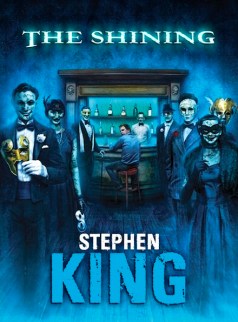
Yes, Stephen King borrowed from many sources. But this is not a criticism. The final product which he assembled from the various themes was indeed a masterpiece. He is like a chef that uses only the finest ingredients to concoct his stew. One does not bitch that the chef stole from the line cooks that prepped the meat, potatoes and carrots. Rather, one enjoys all the makings of this tasty treat.

I must confess. I like The Shining more than the books that influenced it. But don’t get me wrong – I love all of the preceding works. It’s just that King’s work has that extra “shine” that lures me to his story over the others. It might be the depth of the characters. Maybe it’s because all the story elements fall perfectly into place. Perhaps it’s the trip itself; the scenic drive across the story arc that makes for the best reading experience. Or maybe I just happen to have a special gene that predisposes my taste buds for the flavor of “The King!” I don’t know.

In addition to the aforementioned haunted house literature, there were other factors that influenced King’s “shining” ideas. Real life experience was one such factor. The story goes that King and his family were staying at mountain top hotel. They were the only guests! The hotel was going to shut down for the winter the very next day. It was an empty, spooky experience to be the only occupants in such a grand sized place. At night, he was plagued with nightmares. He dreamed of the corridor’s firehouse. It turned into a snake and chased his three year old son. Drawing on this experience, King began to formulate the ideas that would eventually become The Shining.

Located in Estes Park, Colorado, the name of the Hotel that inspired King’s story is named The Stanley Hotel attracts visitors to this day. Writing workshops are held there annually. (See also my blog post about Scott Nicholson’s Creative Spirit. It is a horror story about a artistic retreat and I refer to The Stanly Hotel. Supposedly, the Hotel has a haunted history in real life. They sponsor ghost tours. However, I cannot find any stories of such hauntings that take place before The Shining was published. Are these tours merely publicity stunts? I wouldn’t know.
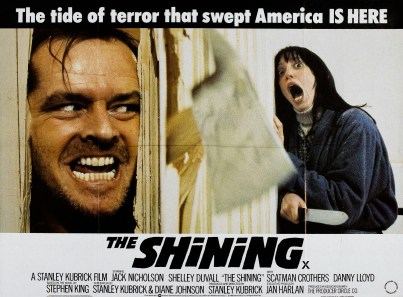


The_Shining-movie_poster-03The Movie

Now, what about the movie starring Jack Nicholson and Shelley Duvall? Stephen King is not a fan. Not one bit. In a 2014 interview with Rolling Stone magazine, he complains that the portrayal of Wendy Torrance (played by Shelley Duvall) was nothing short than an exercise in misogyny.

“Wendy Torrance is just presented as this sort of screaming dishrag”

On Jack Torrance (played by Nicholson), he notes that the character was sort of crazy from the onset, contrary to the Jack Torrance of the book.

“In the book, there’s an actual arc where you see this guy, Jack Torrance, trying to be good, and little by little he moves over to this place where he’s crazy. And as far as I was concerned, when I saw the movie, Jack was crazy from the first scene.”

To these ends I agree. Shelley Duvall is annoying in her fragility. Jack Nicholson does seem crazy from the very beginning. One of the first scenes shows Jack interviewing for the position of the Hotel caretaker. During the interview, he smiles and laughs in a way that only Jack Nicholson can. It’s what he does. He’s creepy no matter what. To quote Mad Magazine, “Jack Nicholson doesn’t mean to make horror films. His romantic comedies just turn out that way.” Nevertheless, if I were the Interviewer (Mr. Ullman), I would steer clear of this man.

In general, Stephen King finds fault with the overall lack of character development. Salon.com mentions a quote he gave to BBC.

“We’re looking at the people, but they’re like ants on an anthill, aren’t they doing interesting things, these little insects”

I too have the same impression. But I must say, this “ants on an anthill” perspective is both the weakness as well as the strength of the film. Yes you read that right. Let me explain. What viewers lose in terms of character development they gain in atmosphere.   The film has fostered an air of detachment. Quite often, viewers are far away from the happenings, only to slowly zoom in with the camera as it creeps upon scene after scene.   This helps to create a larger-than-life environment; The Overlook Hotel is so much larger than life that it includes death in its equation as well. The brilliance of Stanley Kubrick is evident in the jagged angles of his aerial shots of the mountain road that lead to the hotel. From a corridor on the other side of the room, we see the characters walk the length of a corridor further away in the eye the camera; another trick of atmospheric cinematography to create a feeling that is the opposite of intimacy. It is one of remoteness; of being led into a situation that is beyond anyone’s control. One of the film’s famous scenes is of little Danny Torrance riding his big wheel through the lounges and down the corridors. When he rides across the tile floor, the rumbling of his plastic tires is heard echoing against the corners of these chambers, wherever they might be. Every now and then he rides across carpeting. The noise stops – for a few seconds. These are somewhat unsettling seconds, for we know the echoing rumbling will return. And it does. The vastness of the Hotel is juxtaposed with one if the “ants” that resides on its premises – one if its little toys on wheels.

Let me be clear, the book is definitely better than the film. If I was Stephen King and some filmmaker changed key parts to my story, or flattened out my characters, I might be upset at the final result as well. But since this is not my book, I can enjoy Kurbick’s vision of King’s novel, and enjoy it I do. Of course I’m not alone. It seems to make every top ten list of haunted house films (For example, Time and MovieWeb).Kubrick does not fully explore the depth of the characters. It is obvious that his favorite character is the Overlook Hotel itself. But he certainly raises the hotel to frightening heights.


Book Vs. The Movie

Here is a list of some of the differences between the film and the book.

Jack Torrance

  •  Book – A writer and school teach who struggles with alcoholism and anger issues. His shamed history includes beating up a student, breaking his son’s arm and almost getting into a deadly car accident with his friend at the wheel. Takes job at the overlook to build up his resume and write a play. His character constantly struggles to curb his anger and do the right thing.
  •  Film – Jack’s history is downplayed. He seems quite unbalanced from the very beginning


Tony

  • Book – Little Danny’s imaginary friend. Tony is the one who “reveals things” to the boy, i.e. the past, the future, the thoughts of his parents. Turns out that Tony is a product of the boy’s deepest caverns of the subconscious
  •  Film – Mostly the same, except toward the end, Tony seems to take possession of Danny. This doesn’t happen in the book.


Mr. Ullman

  • Book – The manager of the Overlook. He can’t stand Jack Torrance. He does not want him as the caretaker but his hands are tied. The board of directors (one of which is Jack’s friend) has guaranteed Jack the job. He treats Jack condescendingly. Later in the story, Jack unearths scandal on the hotel. As revenge, Jack phones Ullman and threatens to write a book on all the wrong doings that have occurred at the Overlook.
  •  Film – The manager takes a liking to Jack from the very start. Even with his rather unsettling posture in the interview. Go figure!


The History of The Overlook Hotel

  •  Book – There is a lot of history presented in the book. A former caretaker named Grady killed his family then himself. In room 217 (237 in the film), an older woman kills herself. Going back further in years, a mob execution takes place in the presidential suite. The hotel had changed hands often, operating as dummy corporations under the helm of the shady Horace M Derwent. He held a masquerade back in 1945 to celebrate a grand reopening of the hotel. Later in the story, the masquerade returns to life, with every occupant that has died on the premises over the years. The book goes on to describe the party as  “a long and nightmarish masquerade party went on here and had gone on for years”  and “The parties that were all one went on and on, populated by generations of guests”
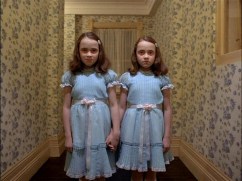
  •  Film – Very little history. The Grady tragedy is mentioned. Also, the film has it that the Hotel was build over an Indian burial ground. This is not so in the book. Here’s something to note: the two twin daughters of Mr. Grady, their ghosts appear to Danny, inviting him to play in with them forever and ever. This doesn’t occur in the book.


The Boiler

  •  Book – One of Jack’s duties as the caretaker is to depressurize the boiler in the basement. “It creeps” is what the caretaker of the regular season tells Jack. This boiler is what ends up being Jack’s, and the Hotel’s undoing. The Overlooks blows up with Jack inside. His family escapes safely.
  •  Film – This plot is left out of the film. Jack meets his demise freezing to death in a ShiningMovieFrozenJackmaze of hedges. Too bad this was left out; it was also symbolic of Jack’s sanity.

Dick Halloran

  •  Book – Cook at the Hotel, meets with family before all employees vacate the premises for the winter. Shares the gift of “The Shining” with Danny. Tells Danny to call him telepathically if anything goes awry during their stay. In the end, Danny calls him and Dick comes and rescues them
  •  Film – Much the same. More description of his character in the book. However, in the film, he dies. Jack axes him to death. Halloran is played by Scatman Crothers  This is the second time Jack Nicholson bests poor Crothers. In One Flew Over the Cuckoo’s Nest, Nicholson gets him fired as the night watchman at the insane asylum. But I guess that’s better then dying.

Hedges

  • Book – The hedges are cut so that they resemble animals; horses, tigers, lions. They come to life at various points. A lion ends up chasing Halloran’s snow mobile.
  •  Film – Instead of hedge animals, there is a maze of hedges. Jack chases Danny in there. Danny finds his way out ant escapes but Jack doesn’t.


Also of note, Jack does not write “All work and no play make Jack a dull boy” over and over again obsessively in the book, nor does he say “Heeeere’s Johnny!” He does not chase his family with an axe. Rather, he uses a mallet. And those creepy twins – the little girl ghosts – they are not in the book.
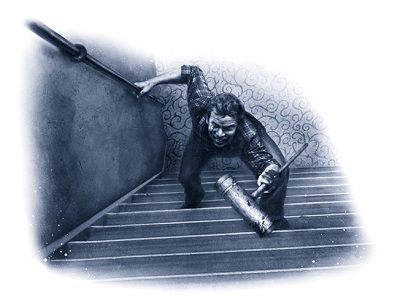
ShiningMovieTwins             The_Shining_by_Stephen_King_Jack_Coming_up_the_Stairs


The Television Mini-series.


ShiningTV2I knew a guy, big Marvel comics fan, and whenever you asked him about a recent marvel superhero movie, he would say something to the tune of “I liked it! It stuck to the original story of the comics” or “I didn’t like it, it strayed from the original story”. To him, the quality of a film adapted from previous material seems to be solely based upon how well it regurgitates the plot of its predecessor. How well a story re-translates itself from book to film doesn’t seem to be an important factor in his analysis. I mean, if a film based on a book totally sucks, but it sticks to the original story, then by his standards the film isn’t allowed to suck.

Let’s apply his standards to The Shining movie and to The Shining television mini-series.The movie sucked because it strayed heavily from the original plot and the mini-series was fucking awesome because it, for the most part, told the story as per the book. Okay, let us be done with this application, shall we? Because it is this application that sucks. It is this guy’s standards that blows chunks.

The movie strays heavily from the original plot. It is not as good the book but it is still a good film. The television mini-series, on the other hand, closely resembles the book. Does this make it good? No, but it is not terrible either. Well not all of it is terrible.


Here’s what is terrible – the acting. It was typical made-for-TV acting. The man and woman who play Jack and Wendy Torrance seem better suited for a shampoo commercial. The boy that plays Danny has too many lines. He talks way too much and actually makes me cry out for little Jake Lloyd from Star Wars The Phantom Menace.

Elliot Gould plays Ullman and he does so robotically. Seriously, listen to him when he speaks – he sounds like a low-toned Speak n Spell.

Nevertheless, the series has its enjoyable moments. It is scary and it does give viewers more background information than the film.   But I still prefer the film. In fact, sometimes ShiningTVthe series tries to imitate the film. When Jack smashes his way into the bathroom, in the book he says nothing. In the film he says “Heeeeeere’s Johnny!” Which will the series choose to emulate, the book, which it had been kept true to all along, or the movie? For some reason, it chose the movie, but instead of the calling out to The Tonight Show host of the 60’s and 70s, Jack says “booo!” followed by “here come’s papa bear!” Corny! The series should have had him remain silent.

************************************

The Shining, as a whole, is a magnificent piece of work. Beginning with King to be retold by Kubrick, it is a story that invokes one of my favorites haunted house themes – a house that is an entity in and of itself – a house that is more than the sum of its ghosts. I love the Shining and may it shine on forever and ever and ever and ever and ever and ever and…..


Review of The Haunting of Gillespie House

Haunting of Gillespie HouseThere are occasions when a novel helplessly succumbs to the tropes of its stated genre. Page after page is littered with overused themes.  They reach out from these pages and smack the reader across the face.   “Look at me! Look at me!” they shout from in between the lines, “Look at me and let me lock you inside every literary device that I the author I can conjure up from the catalog!”  Conversely the opposite is also true.  Like a summer wind that blows across an ocean beach, the familiar and expected can be refreshing.  If a story is imaginative and well written, then the proverbial themes within will wrap the reader in nestling comfort as s/he settles on in to the story.  Such is the case with Darcy Coates’s The Haunting of Gillespie House


This beautifully written piece features a large house in the countryside. Protagonist Elle agrees to stay and watch over this house while the elderly owners (Mr. and Mrs. Gillespie) go away on a trip. The house is shrouded with mystery and intrigue.  There are locked rooms with hints of activity occurring behind the doors. Peculiar scratching-noises are heard within various walls.  The third floor contains rooms with beautiful antique furniture strangely hidden away. Certain revelations lead to the conclusion that there is a secret passage somewhere in the house. But where is it?

The grounds surrounding the house have their share of intrigue as well. There is a hidden cemetery with gravestones of Gillespie family members dating back to the 1800s. All of them have the same year of death inscribed into the stone, which alludes to the fact that some kind of horrible tragedy was responsible for these deaths.  Fast forwarding to current times, Elle discovers that deadly misfortune has also plagued the surviving members of the Gillespie clan – poor Mr. And Mrs. Gillespie have recently suffered through a sad set of circumstances.

As I made my way through this creepy and enjoyable journey that is the book, I was reminded of the thrills I experience when I play graphic adventure video games. These games are usually non-linear and there are plenty of puzzles to be solved along the way. (See MystShivers, and Amnesia: The Dark Descent . The last two are Haunted House themed games.)

For those not into gaming, I hope that I have not cheapened The Haunting of Gillespie House by making this comparison. But for me, the association is appropriate because both platforms inspire suspense as I travel though the various mediums anxiously wondering, “what is behind door # 6?”

The Haunting of Gillespie House – the tone is inviting, the descriptions are colorful, and the writing is superb.  Do I have any complaints?  Minor ones, mostly concerning the length of the story.  This is a long novella.  I wanted more – I wanted a novel.  The ending is somewhat abrupt.  I felt there were seeds to more story planted here and there. With just a little more nurturing they could have developed into something great.  However, it turns out that The Haunting of Gillespie House had already outgrown its original intent. Darcy Coates states in her after word that this tale was supposed to be a short story.  It ended up being much too long to fit within the boundaries of the short story format as unintended themes manifested and grew. This happens quite often when writing a story.  So she had to let the story grow into its preferred outcome. I think there could have been more, but who am I?

As a bonus, Coates includes a short story entitled The Crawlspace for readers that purchase her ebook. This story is what was left behind when The Haunting of Gillespie House grew to big for its bridges. When I say, “left behind”, I do not mean to imply that this story is a collection of discarded material. Rather, it is the youngling that The Haunting of Gillespie House was destined to spawn from. Keep in mind though, that it is a different story altogether.   It’s a good story too.

Overall, I highly recommend this book. This well-written piece is a page-turner.  While The Haunting of Gillespie House does put readers in a somewhat uncomfortable state of wanting more, it also leaves behind a desire to explore more works from Darcy Coates.


What’s new – 2/2/2016

NewsHello ghosts! Yes that’s you – the readers of my haunted house pieces. That’s how I refer to the people of my haunted house Facebook page so I might as well extend the same courtesy to the readers of my blog.  I thought it might be nice to post a news piece every once in a while with updates on who’s haunting what house, which ghosts are floating around these days – things like that. In other words, it will be a piece on what’s coming around the bend in my world of haunted houses within film and literature.

That said, let’s get to it!

****************************************************

First of all, I have written a haunted house book that will soon be available for purchase. It’s called The House Sitter. Here’s a picture of the cover:

HouseSitter
It’s a story about Brad Johnson, a writer who is tortured with a dark and demented mind. He envisions things that threaten his sanity. In order to dispel these visions, he haunts “things”. He writes horror stories centered on household objects. Although the terrible visions are then expunged from his mind, they end up clinging to the targeted objects and haunting them for real.

Brad Johnson agrees to house sit for a friend. While under his care, the house becomes haunted.

The story will be told from three different perspectives. First there’s the third person narrative which moves the overall action of the story. Second, there are the journals Brad keeps. There are written in the first person.Third, there are the stories that Brad writes. One is about a boy who falls down his grandparents’ laundry chute, only to discover a maze filled with monsters and demons. The second concerns a disturbed young man that rents an attic bedroom. He invites a woman to his room, only to murder her. He locks the body out on the balcony. But his date is not content with being dead. Her animated corpse tries to break in and return to the attic. Finally, there is a wicked old man with a house full of mysterious antiques. One such item is a music box that summons ghosts.

These perspectives often intertwine. What happens in the narrative effects what Brad write’s about in his journal. The sentiments expressed in his journal find their way into his stories. What happens in the stories can, from time to time, spill over into the objective reality of the third person narrative.

This book should be available in the next couple of weeks. I am currently giving updates on its status at my Facebook author page:

*****************************************************

Still with me, ghosts? How’s it ‘Shining’? That cheesy pun is my way of calling attention to a project I am currently working on. I will be reviewing Stephen King’s groundbreaking novel The Shining along with Stanley Kubrick’s film version of the same story. The television mini-series will be included in the review as well. I have read Stephen King’s TheShiningnovel a couple of years ago but I am skimming through it once again. I own the Kubrick film and have seen it several times. But hey, what’s one more viewing? Once more in preparation for this review!   So far I have watched 2/3 of the series. I will certainly finish it up and get to work writing! The piece will include quotes from Stephen King and other interesting tidbits that are directly or indirectly related to the story.


****************************************************

I am currently reading two haunted house novels: Clive Barker’s Coldheart Canyon and Darcy Coates’s The Haunting of Gillespie House. I am really enjoying both books. Expect reviews in the near future!

****************************************************

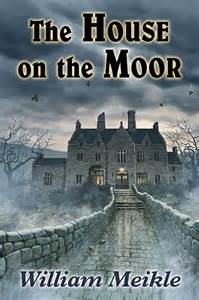
Soon it will be my birthday! It’s about a month away. I am going to ask my loving wife to buy a special present – a leather bound illustrated haunted house novella by William Meikle – The House on the Moor


Check it out here!

http://darkrenaissance.com/product/the-house-on-the-moor

HouseOnTheMoor

****************************************************

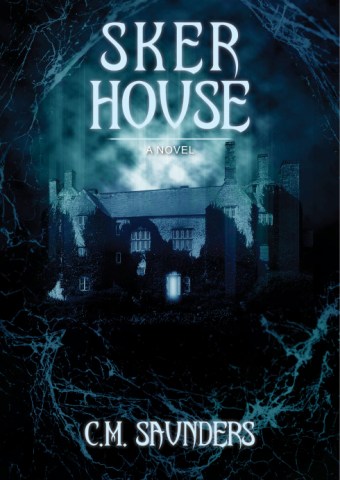
Another author has joined my Facebook page. Welcome C.M Saunders! He has an impressive library of books for sale. His next book, due out March 1st, is a haunted house novel. Yay for that! It’s called Sker House and you can check it out here:

https://cmsaunders.wordpress.com/

SkerHouse


And here again is a link to my Facebook page:

https://www.facebook.com/HauntedHousesMoviesAndBooks

****************************************************

Hope the year so far has been treating everyone well! Bye for now!


~ Daniel W Cheely


Review of The Sentinel

TheSentinelCaradineWatchingOn previous occasions I have reviewed Haunted House stories where the house serves as a portal to some other dimension. First on my list are some of the houses in H.P. Lovecraft’s stories. These include The Strange High House in the Mist, – a tale of house that sits on a mountain top with a door that opens into The Heavens for any celestial deity who happens to be in the neighborhood, and Dreams in the Witch House – an account of a house possessed with “unearthly geometry” that allows a brilliant mathematician to visit dark worlds.  The second “house as a portal story” that I reviewed is House on the Borderland by William Hope Hodgson. The protagonist of his stories lives in a house that transports him across space and time.

Now I have a third one for ya! The story comes from a book by Jerry Konvitz, published in 1974. I have not read it. Instead I saw the corresponding film in which Konvitz wrote the screenplay. Both the book and film are called The Sentinel (not to be confused with the political thrill which came out in 2007). Let’s examine the film’s title as it relates to the theme I was discussing in the first paragraph.

A sentinel is a guard. As mentioned, the film fits into the theme of houses that serve as portals to other dimensions. One might then conclude that perhaps the “sentinel” of this movie guards this mystic door. If this “one” does in fact arrive at this conclusion, than this “one” would be correct. Question: What kind of portal does this sentinel guard? Answer: The doorway of Hell! It is a door to hell and, more apropos to the film, from Hell.   See, not too many people here on earth are knocking each other over to go through the door. But, I bet there are plenty of beings that just can’t stand the heat down there and want out. Hence, a sentinel is needed to keep these hellish folks at bay. And where might this doorway be? In an apartment complex in New York City! I mean, where else could such a portal be located? So understand – any crime, debauchery and ill-will that arises in this city ( I think there just might be some of this is good ol’ NY city) just might be due to the sentinel being asleep on the job! I’m just kidding! Any kind of nasty shenanigans that happen on the streets of New York is not on account of the things that slip through this door. These things are confined to the apartment complex and its many units.

Along comes unsuspecting Alison Parker. She is a fashion model with a troubled past. She had been placed under psychiatric care for suicide attempts. Determined to make it on her own, she refuses her live-in boyfriend’s marriage proposals. She moves out of his place and into an apartment complex where the rent is startling cheap. See what I did there with the word “startling”? I was giving you a hint as to what kind of apartment complex this is. Maybe it’s the one I was referring to earlier; the one that has a doorway to hell? Ya think? Well you “think” correctly!

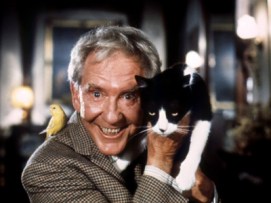
Right off the bat, Alison is freaked out by the blind priest that does nothing but stare out a window from a top floor unit. What’s the deal with that guy? Miss Logan, the real-estate agent, tells her that he is harmless. But she does not divulge any other information about him. Maybe Alison’s new neighbors know something about him? She asks Charles Chazen, an older gray haired guy that walks around with a parakeet on his shoulders. He says to forget about that priest. He’s just a strange but harmless guy. Speaking of strange, Mr. TheSentinelPartyChazen is little bit offbeat himself. The two “lesbian sisters” that live below Alison are not exactly normal either. Nor is the gathering that is being held for all the tenants. Mr. Chazen leads Alison to one of the apartments where – surprise, surprise! A party is going on. The lesbian lovers (sisters) are there, as well as several other tenants. There is dancing and music, all in honor of the birthday celebrant – Charles Chazen’s cat!
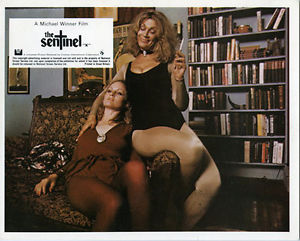
After a while, Alison is disturbed by all these neighbors. Their parties that take place in the apartment above her are too loud. Her bedroom chandelier is always shaking at three in the morning. She complains to Miss Logan about this, only to have her tell her that she has no neighbors. Father Halliran (the blind priest) is the only other tenant in the complex. So who were all those people at the party? Who is Charles Chazen? Where did those sister lovers come from? Are they all byproducts of her disturbed mind? Nah, they are just people who died and went to hell. Didn’t Miss Logan tell her about that doorway to the underworld? No, I guess she didn’t. Maybe she herself doesn’t know about that feature of the property, but I doubt it. She does, however, take the time to show Alison all the units where she claimed there were people living and partying. Inside all that existed was was cob-webbed emptiness; dusty rooms with paint peeling off the ceiling – rooms void of furniture.

I remember seeing some of this movie on TV when I was a wee young lad. Of course, all the R-rated stuff was removed. But it fascinated me until I was sent to bed long before the movie was over. Finally, thirty-five years later, I got to see the ending. It’s a very good ending, by the way. But how about the rest of the film? Did I like it? Mostly. Sort of, you know. A little bit.

There are several things that are great about this movie and several things that are not so great. As a matter of fact, the “not so great” stuff is downright sucky! But let’s begin with what makes this film great, and that is – the supporting cast. What a great supporting cast it is!

Ava Gardner  plays Miss Logan. While this character is not a scene grabber, Gardner’s subtlety makes a believable character out of this real-estate lady. John Carradine has never looked creepier playing the blind priest with white, pupil-deprived eyes. And then TheSentinalLadieswe have Burgess Meredith who who with charm and grace gives a stunning performance as the eccentric and festive neighbor Charles Chazen. Then there’s Sylvia Miles. She may not be as well known but she shines and the eccentric lesbian neighbor Gerde who partners with Jennifer, the mute exhibitionist who masturbates in front of Alison. Jennifer is played by Beverly D’Angelo who might be best knows as “Ellen Griswold” in the National Lampoon’s Vacation movies. Eli Wallach is good as the cynical detective.

There are also now-famous actors that have brief roles, including Christopher Walken, Tom Berringer, Jeff Goldblum. Supposedly Richard Dreyfus has a walk on role but I totally missed him.

It’s a thrill watching this ensemble. The cast that portrays those wacky neighbors shine in scenes where they are altogether, like the birthday party. What is not a thrill is watching the two main characters. Ho Hum!

Christina Raines plays Alison Parker. Her acting is bland. Even worse is Christopher Sarandon who plays Michael Lerman, Alison’s lawyer boyfriend. He’s stiffer than a board!

Unfortunately, this former husband of Susan Sarandon has a lot of screen time. Too much! Large chunks of the movie revolve around him as he confers with police and priests. See, he is using his skills as a lawyer to research the haunted apartment complex and discover more about the strange blind priest. Oh God, I wish he didn’t! I found myself shouting at the TV, “Just stay out of it Mr. Mustachio Douchebag! (he dons a cheesy mustache. I don’t know if he has “that other thing”) I want to see more of the neighbors and the haunted complex and less of you and your research!”

TheSentinel

Finally, at the film’s end, the neighbors make a screen welcoming return. They bring with them several deformed people. Hell is emptying! And there’s the blind priest – The Sentinel! A terrific scene this is!

By the way, I am recommending this film despite the snore-fest that is Raines and Sarandon. The supporting cast makes the film, as does the atmosphere within the apartments. It’s a decent idea too, a hell portal inside a New York apartment building.

In the land of the novels, there is a sequel book (The Guardian) and another on its way.

But there is only one movie. Maybe I’ll read the novels. They are probably much better TheSentinelMerediththan the film. But I say – give this movie a chance. If nothing else, get a hold of the DVD and watch only the scenes with Burgess Meredith. I love that man!
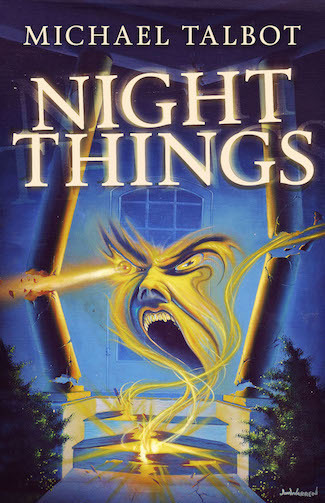
 

A Review of Night Things

nightthingsWhat a noble effort! A publishing company dedicated to reviving rare and out of print books. I am referring to Valancourt Books. Some of their specialties include gothic and horror literature. Take these two genres, get them drunk and throw them in a room together. What will spring off from this mating? Haunted House novels! There are plenty of such novels available for purchase at their website. The subjects of some of my previous reviews are books re-released by Valancourt Books. They include Burnt Offerings by Robert Marasco and The Elementals by Michael McDowell. Of course I read an original copy of The Elementals and the publisher listed was Avon Books:  A Division of The Hearst Corporation,  but still, it is available today at Valancourt Books.

I loved both Burnt Offerings and The Elementals. I’m sorry to say that I can’t share this love for the novel that is up for review in this blog entry, another title rereleased by Valancourt Books. I’m loving me some Valancourt Books, but I’m not feeling it for Night Things by Michael Talbot, originally released in 1985.

To be fair I liked the first half of the book. It’s the second half that ruins it for me. I felt as if one writer began the story then threw down the pen and went off to go sailing. Then it seemed a second wannabe writer was snooping around the first writer’s study and came across the half-completed manuscript and then decided to finish it. This seems so at least from the perspective of the plot. The writing style is consistent.

Night Things has a promising beginning. It includes a backstory of a woman shrouded in mystery, who, as a young girl, has been plagued with haunting visions. As an adult, she had fortified herself in a custom designed house. Its interior is like that of a labyrinth with connecting rooms and long corridors, all built utilizing uncanny geometry. Some reviewers have compared this house to the houses of The Haunting of Hill House and House of Leaves.  But I cannot indulge in this comparison since Night Things is inferior to both of these novels.

Many years later, a newly formed family of three is set to stay in the house for the summer. Relationships are strained. Lauren’s new husband Stephen does not take to ten-year-old son (approx. age) Garret, nor he to him, and this tension sets forth some interesting character dynamics. Late in the night a ghostly phantom begins to visit Garret in his bedroom. Shit is getting good! All the ingredients for a good haunted house novel are in place.

But then…

Stephen takes a long absence from the story and this absence creates a conspicuous void in the pre-established story. Myth and spiritualism and “the explanations of it all” are awkwardly dumped into the story by passerby characters. The “Night Things” lose their mystery. One such “thing” has the hackneyed title of “The Master”. He leads around pathetic man in the likes of Dracula’s Renfield or Frankenstein’s Ygor.   The Epilogue doesn’t seem to fit with the ending developments.

I wish I could have enjoyed this book more, not only for the sake of Valancourt Books but for the author as well. Michael Talbot died of Leukemia in 1992 at the young age of 38. NightThingsTalbotHow sad. It should be noted that his accomplishments in writing come not from his fiction pieces such as Night Things, but from his works of non-fiction. He was a writer in the fields of science and new age. He wrote several pieces for Omni  and Village Voice.  Perhaps his most noteworthy work is The Holographic Universe, which is free online:


https://archive.org/stream/HolographicModelOfTheUniverse/holouni#page/n3/mode/2up

Here’s an excerpt:

“. . . there is evidence to suggest that our world and everything in it. . . are also only ghostly images, projections from a level of reality so beyond our own it is literally beyond both space and time”


In Olav Hammer’s “Claiming Knowledge: Strategies of Epistemology of From Theosophy to the New Age,” Hammer states that Talbot postulates that “Consciousness affects material reality.”

I have read similar theories. Whereas I do not subscribe wholeheartedly to these theories, I find them fascinating. Perhaps I will explore Talbot’s work in these matters and leave his fiction behind. Night Things notwithstanding, it seems that Talbot was an interesting and highly intelligent person.