Review of The House By the Cemetery

housecemetaryItalian Horror. How I want to get to know thee!  I have heard some great things about you. You have style, so I’m told.

To be honest,  we have gotten together a couple of times.  Our first date was Suspiria by Dario Argento. Aside from a few minor issues, I thought it was a good film. And I witnessed that “style” that I was told to look for. All in all, it was a good first date.  Our second meeting was Demons by Lamberto Bava but produced by Argento. This date wasn’t as good. Yeah the style was there, but there was a lot missing.

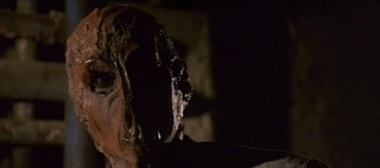
Let’s talk about our most recent date; The House by the Cemetery by Lucia Fulci.  It went horribly, didn’t it?  And I so wanted for us to have a good date.  It didn’t have to be a great date, just good.  But it wasn’t.

I really did want this to like this film. I was hopeful for about 10 minutes.  But on the eleventh minute – down, down down goes the film.

Here’s a quick summation of the plot. Dr. Normal Boyle moves his family into a house in New England. There he will continue the research of his colleague who had committed suicide.  Turns out, this colleague was researching a notorious killer referred to as Dr. Freudstein.  And yes, Dr. Freudstein will do some killing in this film. Meanwhile, the ghost of a little girl appears to little Bobby, Boyle’s son, warning him to stay away from this house.

So what’s wrong with the film?   These things.

  • The language dubbing is terrible. I would rather there have been English subtitles while the characters spoke Italian.  The voices sound canned and unnatural
  • While this house is by a cemetery, the cemetery has very little to do with the plot.
  • The character actors – the characters they play come off as a bit strange.  The thing is, I never knew if they were supposed to be weird in order to arouse suspicion of if they just ended up being odd due to bad acting/overacting. The latter turns out to be the case.
  • There are more plot holes in this film than there are pot holes on Chicago streets.
  • There are all kinds of hints at secrets to come. But these secrets don’t materialize. Maybe the writer, Elisa Briganti, http://www.imdb.com/name/nm0108978/?ref_=tt_ov_wr just forgot that she put these “hints” in there!
  • Poor story continiuity in terms of the most elemental aspects of realism.   The boy is trapped in the basement with the killer, door is locked. He screams, cries, and the killer almost gets him. The next scene he is in his bed upstairs, slightly sad, a little scared. Just a bad day. Meanwhile the killer remains in the basement.
  • This is a terrible incoherent film through and through.


There is a lot of gore in this film. This neither thrills me nor upsets me. It is just there. house-by-the-cemetery-2

Is there anything good about this film? Sure!  The atmospherics are damn good!  The house looks scary on the inside and out.  Establishing shots of the house are excellent. In fact, there is a lot of decent camera work and photography direction. There is a scene of a little girl looking out the house window. The camera zooms and we the viewers realize that we are looking at a painting of the house. They pull off these effects very well.

In sum – good filming in and otherwise bad film. But guess what? I’m still going to court Italian Horror. Maybe I’ll stick with Dario Argento for now. Sadly, I don’t think he has made any haunted house movies (but I could be wrong).  But I’ll just appreciate him for the general thrills and scares.


Review of Ju-On: The Curse 2

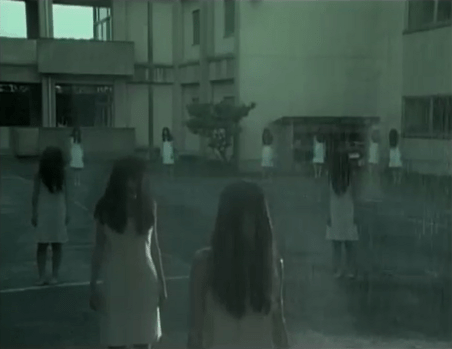
ju-onthecurse22What should I say about Ju-On: The Curse 2?  Let’s see…what did I write about Ju-On: The Curse, the first film of the series? Let me go back in the archives and read.  Hmm.  Uh huh.  Yup. Okay. I’ll just do a Copy and Paste, place that review here and then I’ll be done!  Good day folks!

On second thought, I won’t do that. But the two films are similar is so many ways that they are almost identical. As reviews on Rotten Tomatoes point out, the first thirty minutes of the film replays the final scenes of the first film.  When I started the film, I found myself wondering, “Did I put on the wrong movie?”  “Am I once again watching the first film?”  Both movies are divided into several parts, or “vignettes.” Since the stories of the first film do not flow in sequential order, I couldn’t remember which scenes began or ended the film. This is partially why I thought I was at the beginning of the first film, when in fact I was at the ending of the first film, when in actual fact I was at the beginning of the second film. Oh the confusion!  But at least the stories in the second film are shown in chronological order, unlike the first film. At least I think they are.

Both films feature the “Ju-On”, or “The Curse-Grudge”;  a transmissible phenomenon involving murderous spirits that strike from beyond the grave. The Saeki house once again serves as the catalyst of this curse. It has a violent past, and the spirits of murdered victims wreak havoc on the living; especially those who enter the premises. Even if they survive, they are cursed. When leaving the Saeki house, the curse follows them and the vengeful spirits can then murder them in their own homes.  Then their homes are haunted and the curse can spread to the occupants of their home.

The creepy spirit of Kayako Saeki is back; along with her little creepy boy Toshio, who likes to open his mouth and release a wicked sounding cat’s mewl.  Both films are 70 minutes long, and both were made for Japanese television.  Perhaps, in this second installment, Kayako is a little bit creepier? Maybe?  Her ghostly body certainly contorts in ways that it hadn’t in the first film. And now she has the power to duplicate herself!  When all those ghostly hands (all belonging to her) attack those windows – yikes-a-roni!

I can’t decide which film I prefer. But remember, for me, these films are simply prerequisites for the film that I really wish to review: Ju-On – The Grudge, the first feature film in the Ju-On series. But of course you already know this, since you’ve memorized all that I have said in my review of the first film. I have already seen it and I do like it better than its predecessors. But I needed to see these in order that I present a well-researched review of Ju-On – The Grudge. And I will…soon.  Until then, enjoy the “Ju-On Curse” films.  They’re not bad. They’re okay.


Review of Smee (A Christmas Ghost Story By A.M. Burrage)

smeeGoosebumps! (Uh…what?)  You heard me. Goosebumps!  (I don’t get it). These little shits crawled all over my skin as I read this delightful tale. And when I listened to an audio arrangement of the story, with creepy sound effects and all, these bumps honked like a mudda’ goose!

The story I am referring to is “Smee” by A.M Burrage, which was originally published as part of a collection in the book Someone in the Room, 1931.

(To  read it online. Check out  http://www.scaryforkids.com/smee/ )

(To listen to the story, check out this narration from David Lewis Richardson

https://www.youtube.com/watch?v=muJyiMMAfTk )

(Was it really so scary that if caused goosebumps?) Well, it was scary. Scarier than some, less scary than others. (Was it, I don’t know, touching?) Well, people touched a ghost now and then, it that’s what you mean. (What I mean is, “What’s with the goosebumps?!”).  The overall concept of this story gave them to me!  Twelve friends playing a hide-and-seek type game inside a huge, dark house, and then suddenly – there is this mysterious thirteenth player that hides with them!  This description alone should be enough to tickle a whole assortment of inner senses.  But then there’s more.  To complete the story is to witness multiple rounds of this game; numerous chilling adventures to court your most precious fancies.

The story takes place on Christmas Eve.  It is a story within a story.  Tony Jackson is forced to explain to his friends why he wishes not to partake in their post-dinner, hide-and-seek game. To explain his hesitancy, he relays a story of a Christmas Eve past, where, after dining, he and eleven friends play a game called “Smee!,” which is similar to hide-and-seek.  The name is based on the phonetic similarities to the phrase “It’s me!” One person per game bares the title “Smee.” No one knows the identity of “Smee” except for the one that chooses the card that assigns that person the title.   “Smee” then hides and the others seek. When a seeker encounters another player, s/he calls out “Smee?” If the other player replies with “Smee!”, the seeker moves on.  When the real “Smee” is found, s/he is silent when asked about his/her identity. The finder then joins Smee in hiding and waits. Soon, all the players except for one will be hiding with Smee.  The last player to find “Smee” (and the rest of the party) is the loser.

Poor Jackson had a frightening experience playing that game on that particular Christmas Eve.  It just so happened that a ghost had joined in the game!

At the beginning of every game, the one who is “Smee” leaves the group to hide. Now, wouldn’t the players see the one who leaves? If they were not witnesses to “Smee’s” departure, wouldn’t they still be able to deduce the identity of the absent player by process of elimination? In order for this game to work, the house had to be pretty damn dark so that no one can see each other!  And so it is in this tale. Also, the house has to be big. Once again, the house in the story meets the requirements.  There are many hiding places in the numerous rooms and corridors. The host warns that, due to certain constructional patterns, some of the areas in the house can lead to danger if one is not careful, especially when roaming around in the dark. Now, isn’t this just the perfect setting and situation to add such haunting delights?

Let me refer back to the article I wrote several days ago, Christmas Ghosts and Haunted Houses. In the article, while borrowing from other sources, I describe the setting of a Christmas Haunted House.  I rephrase a section of Keith Lee Moris’s article:

 “Winter’s ability to capture our imagination is at its strongest precisely when we are the farthest slightly removed from its more harmful elements.”

Then I go on to say (in my words):

Let’s say, perhaps, that our frolicking friends are feeling “warmly vulnerable” during a ghost story session at a Christmas Eve gathering. Let’s remove the last visages of safety and allow winter’s symbolic doom to come inside. It’s warm. Festive. Have a drink. Merry Christmas! Fires. Games. Ghost stories. And then – real ghosts haunt the house. Frightful! This is what I would call A Christmas Haunted House.

In other words, A Christmas ghost story with a haunted house usually begins in a warm house where a festive party is taking place. This party distracts the characters from the darkest elements of winter – in the beginning. But as the story unfolds, the harshness of the season creeps inside (symbolically), often in the form of a ghost.

Stories of ghosts invading Christmas celebrations are perhaps reflective of our ancient ancestors’ struggle against the forces of nature at winter solstice.

In my article, I argue:

 During the festive solstice celebrations, the lingering darkness and the bitter cold continued exert their powers.  These forces surrounded their fragile, festival fires, where the celebrants sought warmth and light.

Soon the fires would be extinguished. But the darkness and the cold temperatures would remain. 

“Smee” certainly deals with the “dangers of darkness” theme.  Here we have a group of  smee-coverfriends celebrating Christmas – a holiday known for its colorful lights. They have already dined and are feeling quite cheerful. They then test their fragile bubble of festivity by eliminating the light. They find themselves in darkness, which is always present underneath the light. And with the darkness comes frightening entities.

There is very little mention of the weather in this story.  We truly don’t know if “the weather outside is frightful.”   However, during the game, one of the players mentions that she would rather play a quiet game beside the fire where it is warm. So to a small extent, cold temperatures contribute to the overall sense of gloom.

“Smee” offers the ultimate Christmas haunted house. It is dutifully dark and sprawling with passages. Complying with the archetypal Christmas ghost story irony, the frightful exploration of the house is all part of a jovial, holiday game.  “Oh what they find is frightful, but the story is so delightful.”  Yes it is! Turn on your Christmas/holiday lights, shut off all other lighting and listen to this story.  It will be fun!

Review of A Strange Christmas Game

strangechristmasgame2

Folks, we have approached a milestone.   This will be the first piece of ghostly literature for which I have listened to a narrator speak the story to me.  I followed along with the text on a website as an audio file played on.  The story is “A Strange Christmas Game” by J.H. Riddell, (a.k.a. Charlotte Riddell) 1863. You too can read and/or listen to this story.  Just click on the link below and listen and listen as famed author and storyteller Michael Whitehouse narrates the story narrates the story.

http://www.vaultofghastlytales.com/2015/12/a-strange-christmas-games-by-j-h-riddell.html

I found several versions of the telling on the internet, each varying in wording. I wasn’t sure which was the best, most true to the original source, etc. But in the end I paid it no mind and just settled on a version that is hosted by www.vaultofghastlytales.com

Followers of my blog, surely by now you have read my recent article Christmas Ghosts and Haunted Houses? Here is in excerpt from that article:

“Let’s say, perhaps, that our frolicking friends are feeling “warmly vulnerable” during a ghost story session at a Christmas Eve gathering. Let’s remove the last visages of safety and allow winter’s symbolic doom to come inside. It’s warm. Festive. Have a drink. Merry Christmas! Fires. Games. Ghost stories. And then – real ghosts haunt the house. Frightful! This is what I would call A Christmas Haunted House.

People of days past used to tell ghosts during the cold winter. Winter was perceived as dark, dreary and scary. At Christmas Eve gatherings, celebrants would eat, drink and be merry. They would play games. And… they would tell ghost stories. Ghost stories are fun when one is beside a warm fire and in the accompaniment of family and friends; feeling all warm and cozy, while the threat of winter rages outside their windows.  A story of a Christmas Haunted House takes advantage of the characters’ fragile coziness. They are feeling festive and carefree, just like the real life folks that gather around a fire to hill a grisly take. But the doom and gloom of winter invades their celebration in the form of ghosts. Their gathering is soon invaded my scary phantoms.

Does “A Strange Christmas Game” meet these criteria? I say – Mostly.

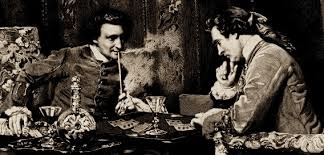
In the tale, brother and sister inherit a manor, Martingdale, which is supposedly haunted. strangechristmasgameMany years ago, original owner Jeremy Lester is playing cards with his friend on Christmas Eve. The clock strikes midnight, Lester’s guest leaves to go home. Out against the brutal elements of winter he wanders, but it is Jeremy that is never heard from again!

Has the winter doom invaded Lester’s home and whooshed him away?  Not exactly. When one reads further into the story, a different situation arises. But at this point, the story teases us with the “wintertime ghostly home-invader” scenario. However, it does address the Christmas ghost story theme of “game time gone ghostly.”

For sure, the dreariness of winter plays out symbolically within the story – within the house.  For instance, here is an excerpt from the book that points to this:

Altogether, Martingdale seemed dreary enough, and the ghost stories we had laughed at while sunshine flooded the rooms became less unreal when we had nothing but blazing fires and wax candles to dispel the gloom.

When summer ends and winter begins, brother and sister hear footsteps in the night, along with other strange noises. Is this the doings of the spirit of Jeremy Lester?  Read or listen to the story and find out for yourself. But one thing for certain – their home is haunted by ghosts that invade on Christmas Eve. However, the ghosts are not interrupting any Christmas festivities. Brother and Sister have been a wee bit too scared to be concentrating on Christmas.

Another thing to note; at the story’s climax, a snowstorm breaks out.  There hasn’t been such a storm for forty one years. –The last winter storm occurrs on the same night that Jeremy Lester disappears – on Christmas Eve.

This is a fun story. And it mostly meets my Christmas Haunted House criteria. Now, by all means, J. H. Riddell was under no obligation to adhere to the dictates of my half-baked analysis of Christmas haunted houses in literature. Afterall, I came up with them one hundred and fifty years or more after this story was published (with the help of others of course!)

I hope you give this tale a listen, a read, or both.  It’s a perfect story to ingest on a cold, winter’s evening.

Christmas Ghosts and Haunted Houses

christmas-ghost-story-3December is no time to give up the ghost! Quite the contrary! Rather, it is time to embrace the Christmas “spirit.”  This would be not the spirit of peace and good will toward men (although that spirit is kind of sweet, you have to admit!). Instead, I’m referring to you average, run of the mill specter that haunts the Christmas ghost story. Yes there are such ghostly tales. Surely you’ve heard the Christmas song sung by Andy Williams, “The Most Wonderful Time of the Year?”  Well check out this verse:

There’ll be parties for hosting Marshmallows for toasting And caroling out in the snow There’ll be scary ghost stories And tales of the glories of Christmases long, long ago.

Yes, Christmas is the season for ghost stories. At least it was back in them olden days. Colin Fleming in his article Ghosts on the Nog  goes so far as to call such a tale “The classic English Christmas ghost story”. Perhaps the most famous of them all is Charles Dickens’ 1943 classic novella A Christmas Carol, with Scrooge and the ghosts of Christmas past, present and future.

Well, now that I’ve established that the Christmas ghost not only exists but is also, in fact traditional, I’m going to go a step further. I’m going to make a case for the literary existence of “The Christmas Haunted House”.  I have not yet seen that term coined in any articles or literature, but I argue that certain traditions and ghost story telling rituals have given way to such a concept.  What is a Christmas haunted house?  I’ll try to answer that question. To do so, I must first delve into an historical analysis of ghosts, stories, Christmases and dark winters. So a delving I will go, laughing all the way, HA HA HA HA!

In the article Ghost Stories for Christmas at hypnogoira.com, Jim Moon reminds us of the various rituals that took place during the Germanic Yule and Roman Saturnalia festivals, and how some of the rituals of the ancient winter solstice later became associated with Christmas celebrations. There were fires and festivals to commemorate the shortest day of the year. Shortest day = darkest day.   Dark day? Hmm. Maybe “commemorate” is not the most appropriate word to use in this context.  Perhaps “offset” it a better choice. Yes.  The idea was to combat the darkness with lights. They would even go so far as to bring trees inside their homes and light them up. (Later to be known as the Christmas/Holiday Tree).  Although there is no evidence for the postulates put forth in the upcoming quote from the article, Moon presents the idea that winter stories of the supernatural originated during these ancient winter holidays.

Now it is assumed that during such ancient festivities, stories were told of gods and monsters which explained why the days would grow so dark, and our telling of ghost stories is an echo of these spiritual and religious recitations and rituals

Think about this. In the days before electricity, in the days of agrarian homesteads, resources aimed at warding off the cold and darkness were limited (at least when compared to today’s standards). Thus, “the dark” and “the cold” were pretty ominous things. Even during the festive solstice celebrations, the lingering darkness and the bitter cold continued to exert their powers.  These forces surrounded their fragile, festival fires, where the celebrants sought warmth and light.

Soon the fires would be extinguished. But the darkness and the cold temperatures would remain. (These are my words. Remember them – for I will come back to them later when I discuss The Christmas Haunted House.)


Thus, it seems only natural that these environmental conditions would extract some scary stories from the imaginations of the people of that day. Hence we have the term “winter’s tale.”

Keith Lee Moris mentions Shakespeare’s “The Winter’s Tale” in his 2014 article from the Independent.  Written in 1611, one of Shakespeare’s characters says, “A sad tale’s best for winter. I have one / of sprites and goblins.” Also of note is the book Saducismus Triumphatus . Referring back to Moon’s article, this book, written in 1681,  argues that  witches and spirits do in fact exist. That’s nice and stuff, but the reason I bring it up has to do with a fitting quote from the book. The quote is also referenced in Moon’s article. “These are not winter’s tales!”

In defending the legitimacy of magical witchcraft, the author uses the term “winter’s tales” to differentiate between fiction and what he proposes to be fact ( the witches). Thus, “winter’s tales” are similar to “Old wives’s tales”, or stories made up to explain a certain set of phenomenon. So what we learn from these two sources is that by the 17th century, the idea of a “Winter’s Tale” was common parlance, and it can be defined as a made-up story about dark, dismal and horrific topics.

By the Victorian Era, The ancient Yule traditions had merged with the Christian holiday customs, and “winter’s tales” evolved into Christmas ghost stories. Whereas societies of the 19th century were in a better position than ancient pagan societies to alleviate some of the harshness of dark winters, Victorian winters were still problematic. Moris mentions in his article that winter was the season that claimed the most lives. Antibiotics were not yet available and winters were very deadly.  Counteracting this wintertime misfortune was the joyous celebrations of Christmas. Gifts, dinners, drinks, games and….ghost stories!

Returning to the Ghosts on the Nog article, Fleming implies that author M. R James is the christmas-ghost-story-6-m-r-jamesmaster of the Christmas Ghost story. His ghost stories were published in the early to mid 1900s.  Though the stories were not about Christmas, they were written to be read on Christmas Eve. In fact, James read these stories to his colleagues and favored students by candlelight on the eve of Christmas. He even went so far as to describe the proper Christmas Eve ghost story-telling environment.  Guests should be well fed, full of eggnog, perhaps a little drunk.  It will be cold outside, but it will be warm beside the fireplace. Participants should be releasing their inner child. They should be ready to have fun and dispense with disbelief. They should try to scare one another with their ghost stories.

Let’s throw another “James” into the Frey. A few months ago, I reviewed Henry James’s The Turn of the Screw.  This is actually a story within a story. It begins in a setting similar to what M.R James described. (It’s tough “keeping up with the Jameses”) Friends are partying on Christmas Eve. They settle down, and one of the partiers begins the ghost story. The story is The “Turn of the Screw”.

Moris has an interesting observation in his article. He states:

“Winter’s ability to capture our imagination is at its strongest precisely when we are the farthest removed from its more harmful elements”
christmas-ghost-story4He goes on to cite examples, such as being “curled up” on a soft chair, besides a fire, all warm and cozy, while reading a ghost story. This protective environment is much like the setting of the Christmas Eve party that offers the activity of telling ghost stories. I’ll even go further and say this example applies to the pagan days of yore with their fireside tales.

BUT, (now this is a “big but” here) can you recall what I had asked for you to remember, further back in the article? In case you have forgotten, here it is again:

Soon the fires would be extinguished. But the darkness and the cold temperatures would remain.

I disagree slightly with Moris’s winter tale observation, and this disagreement is reflected in those sentences I had asked you to commit to memory. I might change Moris’s wording a bit. Here I go.

“Winter’s ability to capture our imagination is at its strongest precisely when we are the farthest slightly removed from its more harmful elements.”

I believe that winter’s effect on our imaginations is enhanced when its harmful elements are still near us. Imagine reading a scary book or hearing a ghost story while the dark night can be seen just outside the window, or the howling winds are to be heard underneath the crackle of the fire. Nature’s brutal elements are right there on the other side of the house’s walls. So close!  That, for me, makes for a creatively frightful situation. The recipients of the ghost story are safe – temporarily.  The fact that winter’s mighty roar is happening just outside adds to the “fun” tension. Perhaps the term “warmly vulnerable” is appropriate. The darkness and the cold temperatures are always there, just like they had remained with our pagan friends from a long time ago, with or without the fire.

One can expand on this situation and make it all the scarier. I shall be “the one” and expand I will! Let’s say, perhaps, that our frolicking friends are feeling “warmly vulnerable” during a ghost story session at a Christmas Eve gathering. Let’s remove the last visages of safety and allow winter’s symbolic doom to come inside. It’s warm. Festive. Have a drink. Merry Christmas! Fires. Games. Ghost stories. And then – real ghosts haunt the house. Frightful! This is what I would call A Christmas Haunted House.

Edgar Allen Poe’s poem The Raven hints at this. Though not a Christmas tale, the events of the poem occur on a dreary December evening. The protagonist is safe inside his chamber, except…(he asks) “Who’s that knocking at my chamber door?”  Death is wanting in!

Before this season is over, I will be reviewing two Christmas ghost stories that may contain these house haunting story elements, both of which are listed in Fleming’s article. The first is J. H. Riddell’s story “A Strange Christmas Game” – 1863. From the article:

 “…we have that idea of play again, only now it is the ghosts who are trying their hands at sport. Cards, as it were. A brother and sister have recently taken possession of a house willed to them, and the demise of their benefactor plays out like some horrible, woebegone mummer’s act.”

The second is “Smee” by A.M. Burrage – 1931. Again, from the article:

At this party, we’re playing a form of hide-and-seek in which the seeker advances upon the hider and says, “It’s me,” which, uttered quickly and breathlessly enough, becomes smee. It’s Christmas Eve, this is a big old rambling house, but one tiny problem: there’s an extra player who does not number among the guests.

 Finally, I will be offering a Christmas Eve ghost story of my own. I believe it meets my critera for a Chistmas Haunted House tale. It surely contains a threat from the outside that wants in. However, there will be a twist. I will post this story here at the blog.

Well, Happy Holiday’s everyone! As you prepare your homes for Christmas, don’t forget to invite the ghosts inside. They are definitely part of the Christmas tradition, and your homes will be ever so delightfully haunted during this “most wonderful time of the year.”


Review of The Haunting of Ashburn House

ashburn

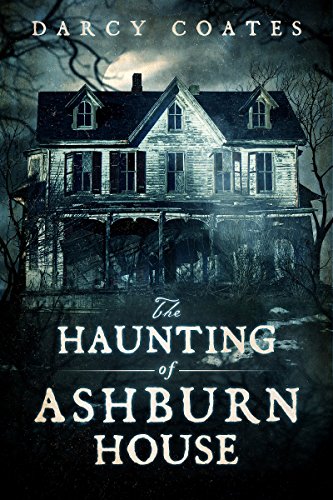
The Haunting of Ashburn House is the third book I am reviewing from the talented Darcy Coates.  I am now officially up-to-date with the “Haunting of” series. (The other two, in   order of publication, are The Haunting of Gillespie House and  The Haunting of Blackwood House.) Perhaps I shouldn’t use the word “series.”  Each book is a stand-alone story. However, there is a formula that persists in all the stories – a young female protagonist either rents or takes ownership of multi-floor house that ends up being haunted. In each case, she is not only new to the house but also to the community at large. In each house, there are mysterious items that pique the curiosity of the new occupants’. These items are related to the haunting that is to take place.

To clarify, I am not using the term “formula” in a bad way. The scenarios are the same, but the specific plot points vary from book to book with different facts and outcomes.  They are not without twists.  The Haunting of Ashburn House in particular does have an interesting turn of events.

Here’s a short synopsis.  Adrienne has inherited an enormous and ancient manor from her Great Aunt Edith, who has recently passed away. Little does she know that she has also inherited several odd duties that are necessary if she is to live safely at Ashburn House. What do I mean by “safely?” I mean – guarding against the paranormal dangers that will threaten her. Little my little, she comes to understand that the house is not normal. After experiencing a succession of terrifying happenings, she must make sense of the clues that surround her in order to stop the terror.  Some of these clues include messages that have been carved into walls and tables, an odd collection of candles, cautionary notes regarding the use of mirrors, old newspaper clippings of a tragedy that took place in the Ashburn House many years ago, and a mysterious grave on the property that has the most unusual inscription on the gravestone.

Coates excels at establishing mystery. The predicaments that Adrienne finds herself in captured my intrigue.  I kept turning the pages, all while encountering new clues and developments, which in turn caused me yet more page-turning anxiety. This built-in anticipation worked well at helping me to look past some occasional dull moments. There are several interactions between Adrienne and townsfolk, Adrienne and her cat, etc. that sort of halt the story rather than move it along.  There is unnecessary attention to certain details in several places; details that do not relate to the overall mysterious tone of the story.  Conversely, I would have liked there to have been more of a background story on Adrienne.  This would help readers to get better acquainted with the protagonist, thereby allowing for further empathy as she struggles through her terrifying situation.

But, as I have mentioned, there is much in this tale that holds the reader’s interest. Coates effectively casts her “foreshadows”; the dark mysteries that surround key items within and around the house. They lurk in between the lackluster elements of the plot and effectively beckon the reader to continue; to journey on until the mystery’s end.

Of the three books in “The Haunting of..” series, I like The Haunting of Gillespie House darcy-coates-300x206the best. It also happens to be the shortest of the three.  Perhaps I prefer Coates as a novella writer?  I would need read more of her works to be sure, and read more I will. (She has several other books about ghosts and haunted houses.  Check out her websiteThe Haunting of Ashburn House comes next on my list, followed by The Haunting of Blackwood House. However, all three are decent reads and I recommend them all.


Review of Haunted: Houses: A Collection of 12 Ghost Stories

haunted-houses-twelveTwelve stories. Twelve authors – Twelve tiptoeing excursions through the haunted houses of their minds’ creations. Twelve haunted house tales; of course I would want to read this.  I bought it the moment I saw the ad. And then I read it. Funny how that works out!

This is the fourth time that I am reviewing an anthology. Authors and editors often take different approaches when compiling a collection of stories. It is interesting to take note of the unique perspectives and varying methods that go into this undertaking.  The first anthology I reviewed is called The Mammoth Book of Haunted Houses by editor Peter Haining. It is a tome of cherished haunted house tales from gothic to modern. Each tale begins with a page that is meant to resemble log entries in a real-estate transaction book and the stories themselves are divided into themed sections, such as “restless spirits”, “ghost children” and even “sex and the supernatural”. Gathering and compiling such classic tales, while organizing them so creatively, had to be a Herculean task.  Therefore, I shall call this method the Mammoth method (I might have borrowed a word from the title!) The second anthology I examined is the David Morgan Ghost Series.  In this collection there are five novellas that are also sold separately. Author Frank Roberts has kindly compiled them into one book for convenience sake. It is a saga told in sequences, so I shall call this the series method.  The third anthology, The Haunting of Lake Manor Hotel (edited and compiled by Nathan Hystad) is an exercise in story collaboration. Hysted creates a scenario – a haunted hotel that rests on the shores of a mysterious lake, and authors write stories that playout within the framework of his backstory. I shall call this the collaboration method.

To what method should I attribute Haunted: Houses: A Collection of 12 Ghost Stories? Before I answer this question, let me describe the book. It is a sampler – it introduces various authors to readers with samples of their work. One story, “The Promise” by Shannon Eckrich, is a short prequel to a larger series. The books in this series are sold separately, of course. Another story, L. Sydney Fisher’s The Haunted Prophecy of Natalie Bradford, is actually one chapter from her novel of the same name.  Sarah by Rebecca-Patrick Howard is but one of several stories that are companions to her series Taryn’s Camera.  In short, these tales, and perhaps some of the others, are contingent upon a larger, more episodic, story.

As with all anthologies, I prefer some stories to others. Together, they average out to a rating that might be articulated as “enjoyable; a fun way to pass the time.” Only a few are what I would call “filling”, which I define as “the ability to remain; something that sticks with me.”  Therefore, because these are story bits that are pleasing and pedestrian, I shall call this anthologizing process the “appetizer sampler method.

Imagine a seafood sampler at Red Lobster – a decent sized platter of various entrees adding up to a hearty meal. This is NOT what this book represents. Rather, it is more like a taster plate of small portions of shrimp and calamari, this and that; everything’s tasty but not too filling.

I hope that readers of this review are not assuming that I am panning this book on account of my contrasting-menu-item analogy. First of all, I do recommend it, but I am calling it what I perceive it to be. It would be wrong to call a shrimp cocktail a lobster plate. A shrimp cocktail is a shrimp cocktail. Second, I would like to point out the stories that did make a lasting impression on me. A.P. Killian does an excellent job creating a house and environment filled with mystery and intrigue in Through the Doorway.  I was filled with suspense and sympathy as a family drags their father’s haunting past into the present in Rebecca J Powell’s The Ghosts of Past Are Present. The prequel and sample chapter stories (The Promise by Shannon Eckrich and The Haunted Prophecy of Natalie Bradford by L. Sydney Fisher, respectively), the teasers that they are, had me itching for more.

Twelve chilling tales, twelve samples from up and coming authors. If you’re in the mood for a literary appetizer, seek out this book.


Review of Insidious

“It’s not the house that’s haunted. It’s your son.”

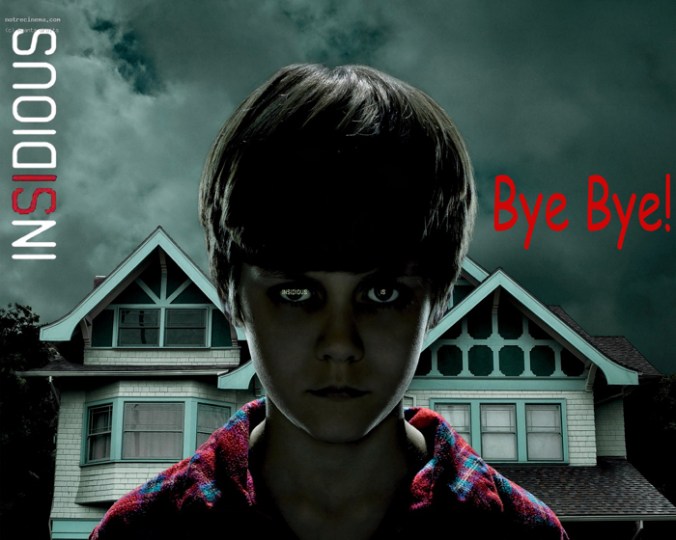
Really? Oh… well then! Since this is a haunted house blog, and because the house is not haunted, I guess this ends my review of Insidious.  Great movie – no haunted house. Goodbye now!

InsidiousBye


.

.

.

.

.


Oh. You’re still here. In that case, I guess I should say a little more about this film. The quote that leads this review is from one of the film’s characters, Elise Rainer; a specialist in the field of paranormal arts. She and her team come to the aid of the Lambert family. Young Dalton Lambert (age 7? 8?) enters a coma of sorts. Shortly thereafter, freakish things from beyond the grave begin to prance around their houses (they live in two of them consecutively, moving from one to another in a futile attempt to flee from the ghosts). Elise informs the distraught parents, Josh and Renai, that their son is not in a coma. Dalton is an astral-traveler, she tells them. When he sleeps, his soul leaves his body to go on mystic, otherworldly voyages. However, during his last trip, he strays too far and enters “The Further” – a realm populated by evil spirits. Here he is trapped. At the same time, other spirits, both evil and neutral, sense the soulless body lying there in the bed. They crave it! To inhabit such a body is to taste life once again. This is why there have been a lot of ghosts hanging around both of the Lambert’s residences. It matters not which house they live in; Josh and Renai have a haunted little boy.

Wow, I dug pretty deeply into the plot, didn’t I? I hope I haven’t unearthed too many spoilers. I’m guessing I have not, not by IMDB’s standards anyway. After all, their one-sentence summary is:

A family looks to prevent evil spirits from trapping their comatose child in a realm called The Further


Now, isn’t that sentence packed with a whole lot of plot?

Anyway, I will reveal no more plot intricacies. I will say that this is a great Insidious 2film. It is one of the better horror movies of the modern age. And though, technically, it’s not the houses that are haunted, this film has all the makings of a good haunted house flick. Before the coma tragedy and the hauntings that follow, the family goes through the normal concerns of adjusting to a new home. Isn’t this how many haunted house films begin? Insidious certainly has the haunted house props. The first house has a tall staircase and a spooky attic. The second has a long hallway with a grandfather clock at the hallway’s end that sort of stands in an eerie spotlight. There are plenty of places for ghostly beings to hide. Creating such hiding places in suburban homes seems to be one of specialties of Director James Wan. As he does for Insidious so does he do for The Conjuring. (Hint: “The hide-and-seek clap game.” Still confused? Well then, watch The Conjuring or read my review of it here.)  The styles of both films (and the sequel – Conjuring 2) are very similar, and pleasingly so. Oh, and I must not fail to mention the baby monitors!  Witness the terror a mother goes through when she hears voices inside a room this is supposed to be occupied only by her innocent baby!
There are only two things that annoy me about this film. These “things” are known as  “Specs” and “Tucker”. They are the two nerdish assistants of Elise Rainer. They constantly try to outdo each other with their skills as paranormal specialists. I get it – they are there for comedic relief. But I found their shenanigans distracting. For me their comedy went against the flow of the film.

Nerdy technicians aside, I love this film. It is creepy in its subtly and bold with its shocks. A must see for any horror fan.


Review of The Conjuring 2

the-conjuring-2 2

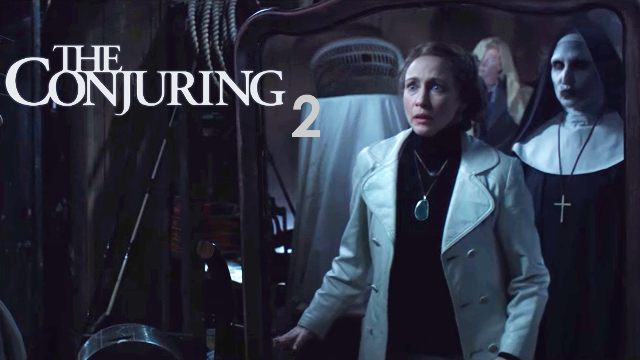
Demonologists Ed and Lorraine Warren heed their call and once again come to the aid of a family that is plagued by evil spirits. This time, their call takes them across the ocean. They pack their bags and leave their New England home, bound for “Old” England, where they are to investigate a phenomenon that has been described as “London’s Amityville.” The Hodgson household consists of a single mother, her four children, and one or two unwanted presences. Will the Warrens be able to rid their home of these unwanted guests? And, more specifically, will they be able to help Janet Hodgson – the young girl who frequently becomes possessed by this evil? Go see The Conjuring 2 and these questions will be answered. Until then, read the rest of this article for informative tidbits and opinions.

Oh good, you listened to me and continued reading. Let’s begin with some background information. For those new to The Conjuring series, the reoccurring characters of Ed and Lorraine Warren are based on a real married couple that investigated paranormal phenomenon back in the 1970’s and 80’s. According to wikipedia, the Warrens claimed to have investigated over 10,000 cases of “actual” or “potential” of supernatural activity. Does this mean that we should settle in for 10,000 movies? Probably not – that’s overkill. But the Warren case files have spawned several movies, including both Conjuring movies. The first film is based on the 1971 Perron Family case – ghosts and or/demons haunt the Rhode Island home of this poor family (click here to read my review of The Conjuring). This second film is based on the Enfield Poltergeist case, which documents moving furniture, overturned chairs and levitating children. The film shows all this and so much more. Other films loosely related to the Warrens are AnnabelleThe Haunting in Connecticut, and The Amityville Horror. While there are no references to the Warrens in The Haunting in Connecticut and Amityville Horror, The Conjuring 2 opens with Ed and Lorraine investigating the Amityville House after The Lutz’s have fled. In order to determine if there is an evil presence associated with the house, Lorraine uses her skills as a medium to experience the horrific murders that claimed the lives of The Defeos –the family that lived in the house before The Lutz’s. From the killer’s perspective, she comes to understand what happened that fateful evening while uncovering a clue she does not yet understand, for it is a clue that is linked to things that would occur later in the Hodgson house. This opening sequence is brutal, chilling and captivating all at the same time.

So, what did I think of the rest of the movie? Before I get into that, let me be honest about the-conjuring-2certain biases on my part. First, I prefer the ghosts and demons of films and literature to be somewhat elusive; their origins speculative, their nature not limited to the narrow parameters of “good” and “evil”. The spirits of The Conjuring films are evil demons as defined by the Bible. Adhering to tradition of well-known demon lore, we assume they will take possession of someone, mostly likely a young woman. We suppose that the possessed victim will at some point rant in a guttural, inhuman voice. We expect the demons to get a little testy when confronted with a crucifix – the symbol of “goodness.” All of these assumptions, suppositions, and expectations come true. Second, I favor unhurried and carefully crafted atmospheres of disturbances to the flashy and loud jump scares. Creepy over shocking, I say! The Conjuring 2 has a lot of jump scares for sure, more than its predecessor. For these reasons, it is doubtful that any films of The Conjuring series will make it to the top of my preferences list.
All this being said, The Conjuring 2 is a decent film with plenty of scares for everyone. While the film relies heavily on “jump scares”, they are done effectively and creatively. A person or object is on one side of the room and then suddenly, there s/he/it is right before the camera and this “jump” is unexpected. The ghosts and demons in this film manifest in scary forms. If you are the type of person that wants to see the phantoms that are doing the haunting, you will not be disappointed. And overall, the acting is good, the characters are sympathetic, and there are some touching moments outside of the realms of the scare factor.

I’ll let you be the judge as to what’s “true” about this film. In my opinion, it is fiction based on fabrications of truth. Ah but who am I? Maybe the events portrayed in this film are very real for some of you. If so, great – all the more reason to be scared. And isn’t that why we see horror movies in the first place – to be scared?


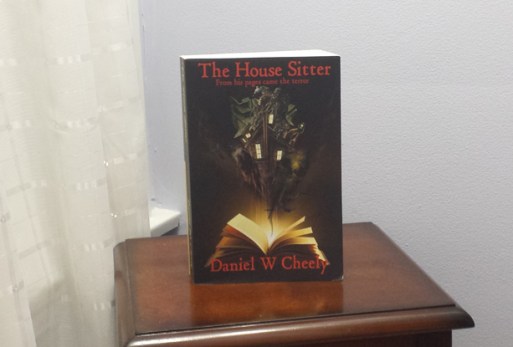
Thank you for reading this article.  If you enjoy my writing, please consider buying my latest book The House Sitter.  A writer/house sitter haunts a house with his stories. They haunt him back in return. Click on picture to see the book on Amazon

HOuseSitterUSe