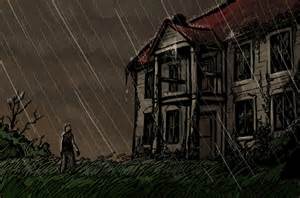
Review of 13 Ghosts

William Castle – what a fun guy, dontcha’ think? When I first reported on him, he was fixing it so that a skeleton would “emerge from the movie screen” and float over Ghost1  the heads of seated viewers. He called this the “Emergo” effect. The other night I decided to check in on Mr. Castle and see if he had done anything similar since then. Wouldn’t you know it? About a year after his emerging skeleton, he imbued movie goers with the ability to see ghosts. This effect he labelled “Illusion-O.”

The House on Haunted Hill is the second haunted house film that I reviewed. In that review, I describe how Castle, a great mastermind of publicity stunts , had distributed skeletons to movie houses that ran his film, instructing the theater operators to rig them up on downward angled wires so that they would Ghost2appear to float over the heads of movie goers during the pivotal scene where the skeletal remains of Vincent Price rise out of a vat of acid (allegedly!). Cool huh?   But his cool gimmicks did not stop there. They went on, film after film. When movie attendees went to the theater to see his 1960 film 13 Ghosts, they were given a “ghost viewer” which allowed them to see the same ghosts that the film’s main character saw when he put on specially designed glasses. In both Ghost3movies, the audience had a share of the scares that were inflicted upon the characters of the movie. With Castle, film became a platform for participatory art.
Before the film begins, William Castle appears on the screen. He is behind a desk in an office. A skeleton is taking dictation. He speaks to the audience and refers them to   Ghost4their ghost viewers. He explains that at certain times throughout the movie the screen will turn blue (remember, this is a black and white picture). When this happens, the audience is to hold the viewer in front of their face. Castle demonstrates with a ghost viewer of his own. The top of the viewer has a blue-tinted lens and the bottom part has a lens tinted in red.

Castle then says,

“If you believe in ghosts, you look through the red part of the viewer. If you do not believe in ghosts you look through the blue part.”
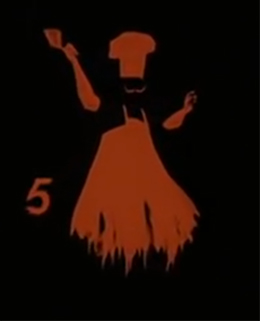
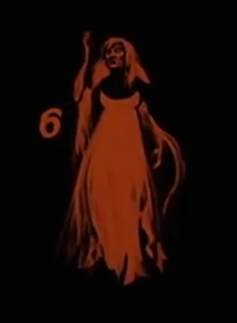
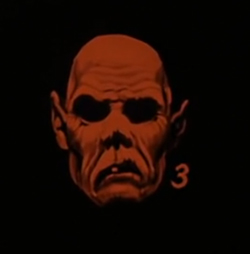
Ghost5                Ghost6           Ghost7

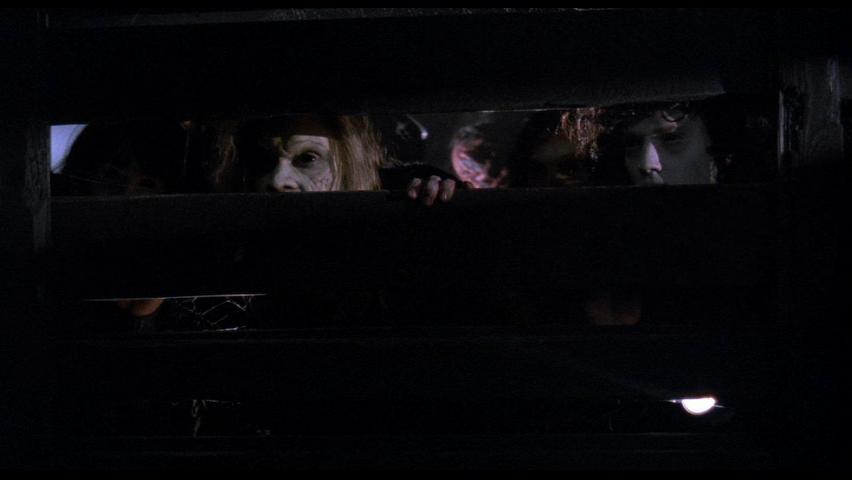
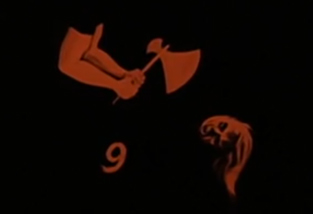
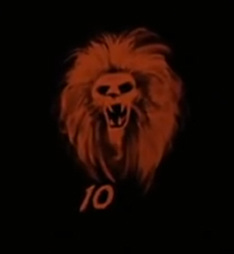
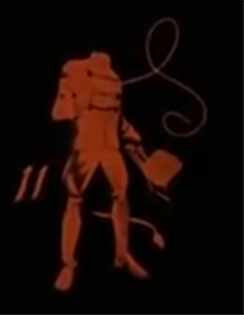
Obviously, the ghosts in the movie only appeared when one was looking through the red lens. Since the screen turned blue whenever the ghosts were featured, the ghosts became camouflaged when viewing the screen through the blue lens. Now, what happened when someone ignored the ghost viewer altogether and looked at the screen with his/her naked eyes? Did the ghosts appear? I have no idea. Being born in 1971 prevented me from witnessing this 1960 theatrical attraction. I can only assume that they did not. However, I can say that a ghost viewer is no longer required to see the ghosts of this film. They materialize in a fiery red tint. The screen Ghost8still turns blue as a caption appears at the bottom of the screen that reads “User Viewer.” But the naked eye is the only tool needed to see these creepy albeit cartoonish phantoms.
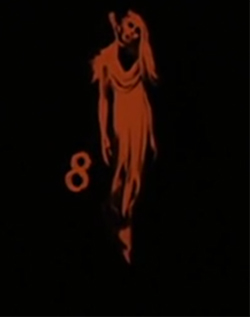
So, what’s this movie about anyway? The Zorba family is having trouble making ends meet. The repo people have come for their furniture. Poor Zorbas – forced to eat dinner on the floor!   Ghost9However their luck suddenly changes. (Or has it?) Patriarch Cyrus Zorba is informed that he has inherited a house (and a furnished house at that!) from his dearly departed uncle. So he moves in with his wife Hilda, his twenty-something daughter Maeda and prepubescent son Arthur. There is a caveat to this deal. The lawyer that handles the transaction warns the family that along with the house and furnishings, they have also inherited eleven ghosts. See, long before the formation of The Ghostbusters, there was good ol Uncle Zorba, who was able to capture ghosts Ghost10from around the world and then “store them” in the house. Uncle Zorba dies, presumably by foul play. His ghost remains behind, so in effect, the family has inherited twelve ghosts. Why then is this film called 13 Ghosts?   Because, legend has it that Uncle Zorba is going to seek revenge on the one who killed him. If he succeeds, this will raise the count to thirteen. Does this vengeful killing occur before the end of the movie? Watch it and find out!
Oh yeah, there is another “thing” of interest the family inherits. Well it’s not really a “thing” but a person (see how I put “thing” in quotes in the previous sentence? See?). They inherit a maid and low and behold, she is played by no other than Margaret Hamilton who is best known for playing the Wicked Witch of the West in The Wizard of Oz. In fact, throughout the movie, little Arthur Zorba refers to her as a witch. Do you think the scriptwriters did this intentionally to pay homage to her famous role? Of course they did!

Let’s see, what else can I say about this movie? I will describe it this way – imagine if Rod Serling became the writer for Leave it to Beaver. 13 Ghosts might be an example of the end product. The father wears his Mr. Rogers sweater over his white Ghost11collared shirt. The mother has an overly rigid hairdo that is very fitting for the June Cleaver type. The little boy who, although he never says it, has “golly gee” written all over his young, curious face. While there is no older brother named Wally, there is the older sister named Maeda. She is prettier than Wally, so I like her better. As they go about behaving like the average 1960 television family, they are accosted by ghosts. A meat cleaver flies into the air and just misses Ward Cleaver Cyrus Zorba. The Beaver Arthur witnesses a ghostly lion-tamer lose his head inside a ghostly lion. Surprisingly, he’s not really freaked out by this. Rather, he seems in awe and he tells his mother. June Cleaver Hilda Zorba responds with a “that’s’ nice, dear” – Ghost12or..something along those lines. In her defense, when Beaver Arthur comes to her with this story, she is preoccupied with making dinner, or doing some kind of kitchen work – you know, the things the mothers of television did back in 1960.
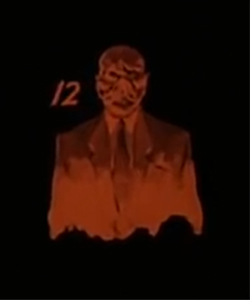
Okay, I’m having too good of a time poking fun at this movie. But the truth is – I love this movie! I love the Zorba family and the haunted house they lived in. I love the cheesy ghosts. And Ghost13even though I did not get to use the “ghost viewer”, I love that whole concept.

And I love you, William Castle. R.I.P. I look forward to one day seeing all the clever antics you have going on up there in the heavens!
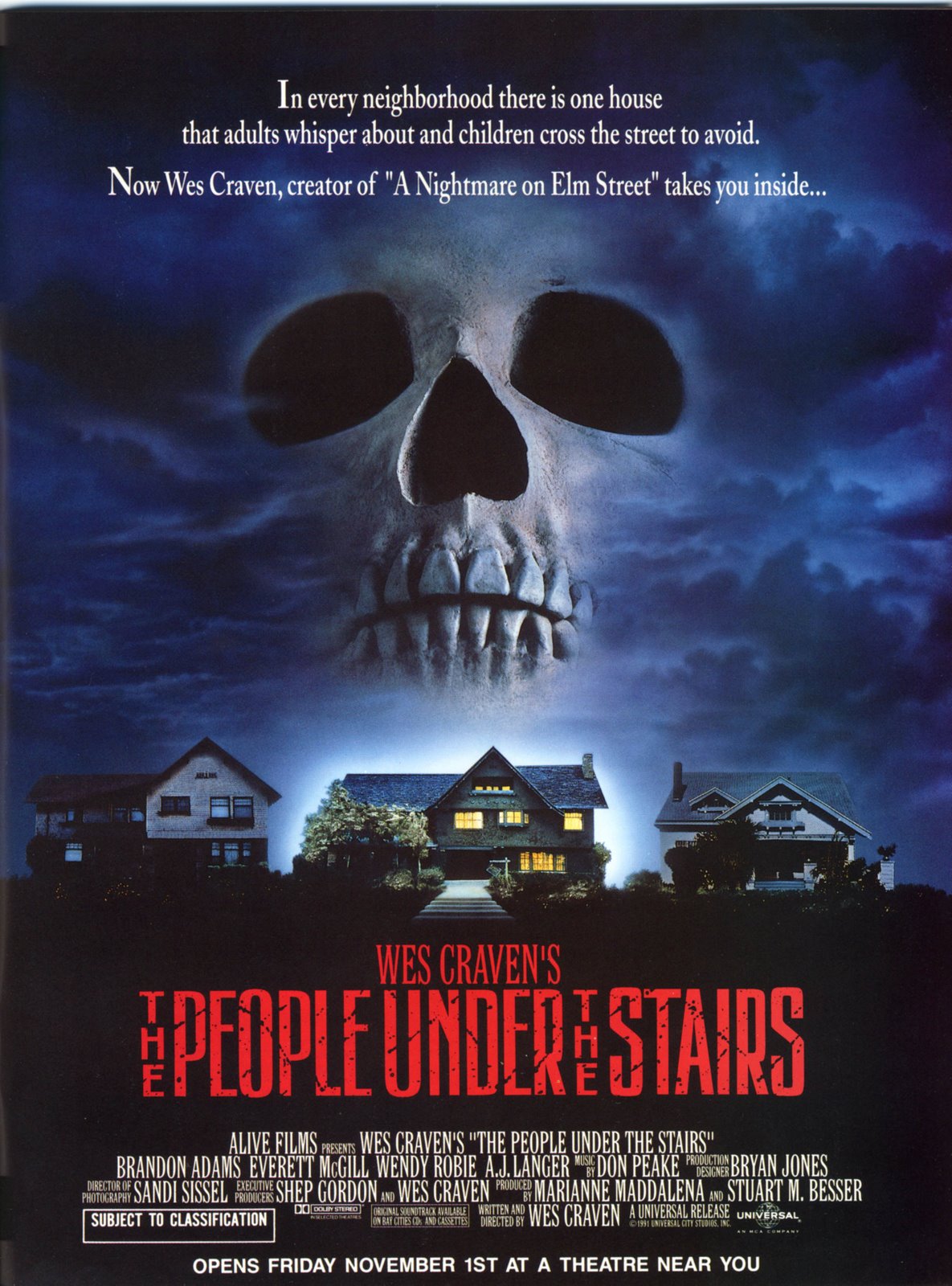
Review of People Under the Stairs

peopleunderthestairsWes Craven is well known in the horror genre. But I really don’t know enough about him to analyze his overall style. I did enjoy several of his Nightmare on Elm Street films (sorry, can’t say I enjoyed them all.) Last House on the Left was “okay” – heavy on shock, light on substance, but interesting in its own weird way.

Craven fans seem to enjoy his 1991 film People Under the Stairs. I did not. It is not the movie for me. It’s billed as a horror comedy, but it didn’t scare me and it didn’t make me laugh. On the plus side, it didn’t offend, sicken, or repulse me. What did it do for me? Not much, other than annoy me a little bit.

The story is as follows – the family of a young boy, Fool, is about to be evicted from their apartment in the ghetto. He and two adults decide to break into the house of their slumlords. It is rumored that the slumlords are in possession of rare golden coins and the three burglars seek to steal them. They break in, but they can’t break out. There is this state of the art security system that seems to work better at keeping people trapped inside than it does at keeping people out of the house.   There is a reason for this. The man and woman who live in the house, “Mommy” and “Daddy” Robeson, are crazy sadists. They have hostages, one of who is presumed The-People-Under-the-Stairsto be their teenage daughter. The rest are teenage boys. To be honest, I forget why the sadistic couple had brought them into their home in the first place. But one by one, they were all deemed “evil” and then castaway to a boarded up area underneath the stairs. Mommy and Daddy Robeson have three simple household rules: see no evil, hear no evil, speak no evil. Well at one time or another, these boys violated these directives, and they paid for it. I think most violated the “speak no evil” directive, because they had their tongues cut off. The “daughter” follows the rules, so she is spared from receiving the severe punishments.

There are numerous chase scenes where someone is hunting down Fool. The hunter and “huntee” constantly go in and out of secret passages. These passages can lead anywhere, and they do. Almost every room in the house connects to them. Sometimes Fool is chased down by the killer dog. Other times he chased down by Daddy Robeson, who dresses for the hunt in leather fetish gear. Just when we think the dog or daddy is defeated, no – they rise again! Maybe it was scary the first time the dog attacked. Not so much the second time. By the time the film got to the 14th canine assault (I honestly don’t know how many dog scenes there were – too many), I was annoyed. It was almost as irritating as listening to “Daddy” cock his pump action gun several hundred times.

This film is overdone – too many chases, a ton of overacting (mostly on the part of The Robesons); it is a ham fest.

At this point in the review, a reader might be thinking, “Dude, you are taking this film too seriously! It’s a comedy. It’s supposed to be over-the-top.” I guess I’m old school. If I want to watch a comedy where cartoon-faced villains chase housebound victims in and out of doors and passageways then I’ll watch Scooby Doo. Or The Three Stooges.

Don’t get me wrong – “ham” can be entertaining. It just wasn’t sliced and served properly here.

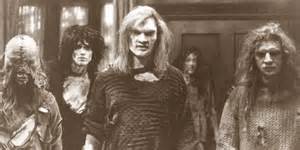
peopleunderthestairs3As for the “people under the stairs”, once they slow down and stop jumping around like zoo-caged monkeys, viewers finally get a chance to see how they look – like the cheesiest of all Goth rock bands – long hair, white faces. I’d rather have the Lost Boys. But that’s just me!

I know many people like this film. It’s entertaining and definitely different. In that way I can see where they’re coming from. But there’s a difference between “seeing” and “feeling.” I “see” how it can be attractive to some but I just don’t feel the love.

Review of The Red Church

TheRedChurch

Somewhere within the Blue Ridge Mountains of North Carolina The Red Church stands. A beast of Author Scott Nicholson’s creation haunts its surrounding community. Locals are found dead in the fields; their bodies mauled to pieces. It is tempting to blame mountain lions for such tragedies, but forensics clears these creatures. They just aren’t capable of doing the kind of damage.

There is another explanation. But it is rather farfetched. It is based on an old community ghost story involving the abandoned Red Church.   But ten-year-old Ronnie Day believes the legends. So does Sheriff Frank Littlefield. Both have seen witnessed strange occurrences at this church.

Think for a moment about this archetypal horror scenario: A beast or phantom nests within a hidden compartment of a familiar site. It could be a bat that dwells in the loft of a rundown barn – a bat that haunts the night! Or maybe it’s a raccoon that lives under your porch – watch out for those glowing eyes! More common is the raven that rests on the archway of the front door, or the troll that hides under the bridge.

Here’s a new one for you: how about a dark figure that appears inside a church’s belfry. It has wings and sharp claws. It has livers for eyes. Sometimes the bell rings when this phantom materializes, which is quite a feat since the church no longer has a rope to activate a bell. This is the legendary phantom of The Red Church. It is this phantom Sheriff Littlefield fears is responsible for the killings. Naturally the detective he works with is skeptical of this theory. But Littlefield has lost his younger brother to this beast many years ago when a prank at the Red Church went terribly wrong.

If this isn’t scary enough for you, there is creepy cemetery in front of the church. Also, there is a humongous dogwood tree that hovers beside the church. The ghost of a hanged preacher from long ago is known to materialize on a tree branch from time to time.

This is a chilling book. The reviews are mostly positive. However, you can’t please everybody, especially those who are easily offended. There is a strong religious theme to this book. The novel’s antagonist, Archer McFall, claims to be The Second Son of God. He reopens The Red Church and seeks to preach “his truth” – that Jesus is evil and he, Archer, is the true savior. There are some negative reviews on account of this “sacrilege.”   Strangely enough, there are negative reviews that go in the opposite direction, complaining the book is too “preachy” and that its hidden message is that “Jesus saves”. To both sides of the argument, I shout a loud and droning “Ohhhh please!!!!!”

I enjoyed this novel and I’m going to pay it a rather strange compliment – It’s a fun, cozy read. How, you may ask, can a novel that borders on “sacrilege” (“I thought it bordered on “preachy”. “I thought it…” Shut up! Your thoughts are stupid!)  be “cozy?” Furthermore, how can a novel about a bell tower phantom with wings and liver eyes make me feel “cozy?” For one thing, I’m a bit weird. Let’s get that out of the way. But there are other reasons. It’s a straightforward tale spun in the familiar setting of small town Americana. The characters are folksy but the ghosts are creepy. I can lie out in the summer and read this with a cool glass of lemonade or sit back indoors in the cool winter and take this book in with a warm cup of cocoa. It works on all fronts.

SNicholson

This is Scott Nicholson’s first book. (He now has over twenty novels). It is excellent for a debut novel. The reason for this is that Nicholson is obeying an old rule or writing: write what you know. Nicholson resides in the Blue Ridge Mountains and he is in command of his setting. In the nitty-gritty details of the story we see local politics in action and the god-fearing behaviors of religious folks. We learn of the speaking mannerisms of a chaw chewing farmer. We learn of the family clans. All this Nicholson writes with confidence. It’s his town and he’s welcoming us to it, which is another reason I say the book is “cozy”.

This is also the first novel featuring Sheriff Frank Littlefield. The second is Drummer Boy, which is about ghosts of soldiers that spill out from a cave on the eve of the annual civil war reenactment.  Drummer Boy is a good book as well, but I will not review it as part of this blog since it does not deal with a haunted house. However, I have read other Haunted House novels by Nicholson.  These are The Home and Creative Spirit.  I hope to write about these soon.

Review of The Legend of Hell House.

The Legend of Hell House, is considered by some to be a classic haunted house   movie.  It is based on Richard Matheson’s book Hell HouseMatheson is the author of several other books that were later turned into films, including The Shrinking Man, What DreamsMay Come and A Stir of Echoes. Alas, I have not yet read any of his hell-housebooks. I will fix that very soon, beginning with the reading of Hell House. I already know that I will enjoy the book much more than the film. I know it with in every haunted and demented bone in my body!  

That being said, I did enjoy watching The Legend of Hell House. Well I enjoyed most of it. Some of it? Nah, more than some. Definitely more. It’s just not the best haunted house flick out there. For instance, I prefer The Haunting to this film.

HellHouseRoddyMcDowel

Much of this review will compare and contrast the two films. This is because they are similar in many ways. In both films, a group of people occupies a haunted house as part of a scientific study of paranormal phenomena. Both films have four occupants: two men and two women. A male professor leads both groups. In each movie, two of the four occupants were selected to participate in the study on account of their natural sensitivity to paranormal activity. In The Haunting, Eleanor Vance has experienced telekinetic phenomena and Theodora possesses E.S.P. In The Legend of Hell House, Florence Tanner is a “mental medium” while Ben Fischer is the “physical medium.” As for the differences between the two “media,” your guess is as good as mine.

The Legend of Hell House is like The Haunting on – steroids? No, not quite. That would be today’s slash and gore fests. On – LSD? Closer, but that metaphor is too strong as well. Maybe it’s The Haunting on some high-grade THC-laced concoction. That’s what I’m going with and I’m sticking to it!

What do I mean by this? Well, mood-setting shots and chilling sound effects provide the scares of The Haunting, along with a story based on psychological drama. The Legend of Hell House has all of this as well and a lot more. But “more” does not equate to “better.”

Don’t get me wrong – I enjoyed all the haunting events that constitute the “more”.

HellHouseBedThis would include:

  • strings of ectoplasm emitting from fingertips (cool!).
  • silhouettes of statues engaged in kinky acts (freaky!).
  • bursts of telepathic activity that break dishes, topple tables and bring down chandeliers (wild!).
  • the human-shaped form underneath the bed covers (uh oh!)
  • the attack of the possessed cat (holy shit!)  HellHouseCatAni
  • pools of blood leaking underneath the shower door (bloody hell!)
  • corpses behind the walls (Encapsulating!)

The movie is filled with these terrifying scenarios. One after another, they come. There is never a dull moment. And herein lies a paradox: these fast paced scenes are the strengths and weaknesses of the film. On the one hand they establish suspense. What crazy thing is going to happen next?   On the other hand, viewers are never really given the chance to settle into Hell House and make it their two-hour home.   The Haunting gives its viewers time to absorb the Hill House and its inhabitants. The host, Dr. Markway, gives a tour of the house, during which the camera focuses in all the things that make the mood; the library, the nursery, the rickety staircase, the statues. While Hell House has the gothic furnishing and macabre décor, but much of it is lost in the commotion. Also, viewers get to know the characters of The Haunting well before the haunting happens. In The Legend of Hell House, viewers are still trying to figure out the characters’ motives long after all the scary shit hits the fan.

So there’s the good (the haunting events), the bad (the pacing), and… what’s the ugly? Answer – the ending. We finally learn the motive for the evil that lurks within Hell House. This is when I sat back and said “Seriously? You gotta be kidding me!” Yeah it’s that lame.

But understand, this is not a bad film. It’s just not great. It’s almost good – very close to being good. It definitely has its moments, and those moments are intriguing enough for me to recommend this film. Just don’t delve into this film with inflated expectations.

H.P. Lovecraft and Haunted Houses Part 2 – Houses as Portals to Alternate Dimensions

Lovecraft2Here is my second piece on the macabre author HP Lovecraft.  In the first article, I wrote that Lovecraft was not a teller of ghost stories.  Instead of retelling what is essentially the same story – a spirit of the departed comes back to haunt a house – Lovecraft develops uniquely twisted tales that churn out equally bizarre entities.  This is true for the three stories I reviewed previously as well as the two tales I am reviewing for this post: The Strange High House in the Mist and Dreams in the Witch House.

This is not to say that the inhabitants of his strange houses are prohibited from taking on some of the attributes of the   standard apparition. They may possess ghostly features that are familiar to readers of paranormal lore. In the two stories that I am reviewing in this post, entities appear and disappear. They walk within the sky.  And yet, some of these entities appear as deities rather than ghosts. (See Nereids and Tritons.)  Then there’s Brown Jenkin, who is a familiar that takes on an  appearance that is vastly different from the average, ghostly white spirit.

brown_jenkin_by_pawnattack-d30of05

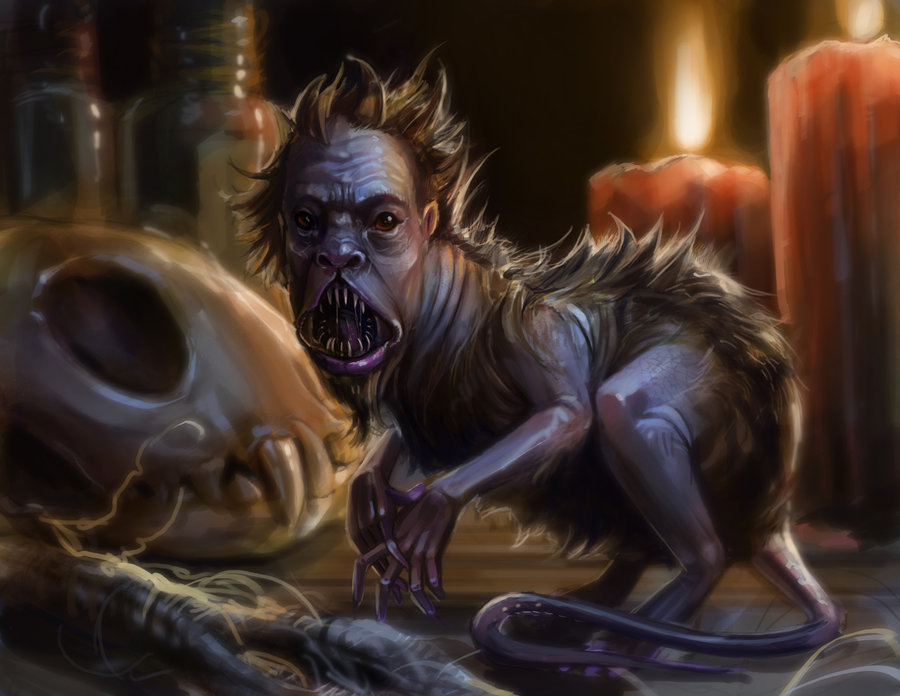
Witnesses said it had long hair and the shape of a rat, but that its sharp-toothed, bearded face was evilly human while its paws were like tiny human hands. It took messages betwixt old Keziah and the devil, and was nursed on the witch’s blood—which it sucked like a vampire. Its voice was a kind of loathsome titter, and it could speak all languages

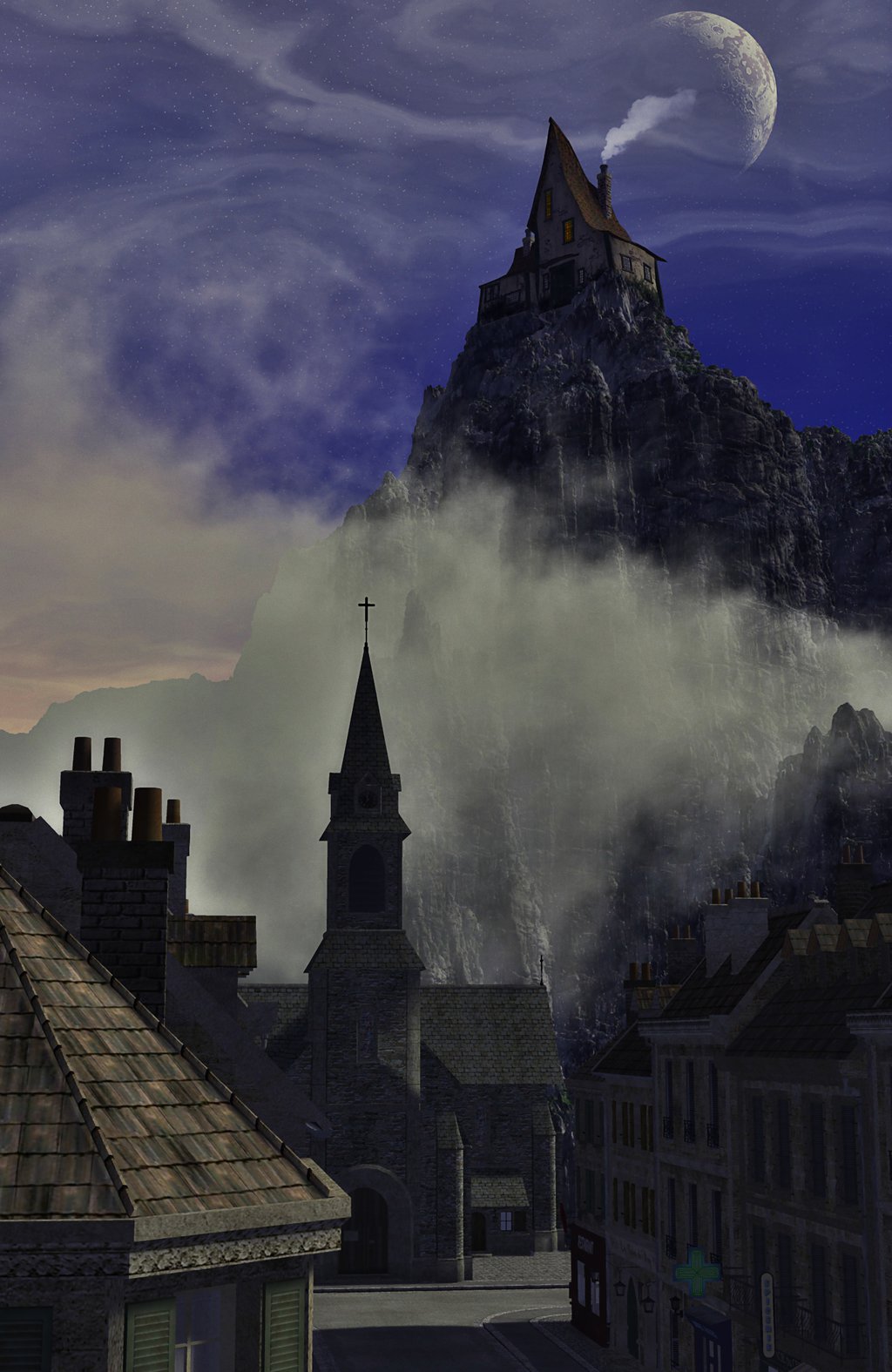
the_strange_high_house_in_the_mist_So once again, Lovecraft’s entities march to the beat or their own cadaverous drum. Ah but wait! There is something else that sets these two stories apart. Not only are the houses inhabited with beings of myth and the occult, but they also possess portals to alternate dimensions. “The Strange High House in the Mist” rests on top of a mountaintop where the front wall “stood flush with the cliff’s edge, so that the single narrow door was not to be reached save from the empty aether.” Nevertheless, “beings” do come-a- knocking; beings that materialize right out of the misty air of the sky, beings that invite a mundane man along on their heavenly parade. Within the bizarre architectural angles of The Witch House lurks an unearthly geometry that gives way to “spiral black vortices” that lead to the demon “Azathoth, which rules all time and space from a black throne at the centre of Chaos”

In a way, these houses can be seen as way stations on the edge of Heaven and Hell.  The mountaintop house opens its doors to celestial deities whereas the witch’s house unlocks demonic dimensions. However, “Heaven and Hell” is too simple of a dichotomy; analytically lazy.  Although frequented by immortal heroes of myth, “The Strange High House in the Mist” is not without its demons.  Dark shadowy creatures come to the house. Sometimes they knock on its door, but other times they try to sneak in through the windows.  In the case of Dreams in the Witch House, the pathway into the demonic dimension is not only open to evil or unrepentant souls. It is obtainable to the mathematical genius that can navigate within the geometric and physical laws of higher realms (although the protagonist does get pulled into this dimension unwillingly and repeatedly though a series or dreams)

What can be said about these houses is that they lead from an ordinary dimension to the extraordinary, whether for good or evil; whether by scientific or spiritual means.  Jim Morrison, based on the ideas of William Blake and Aldous Huxley, had this to say about his famous rock and roll band:

There are things known and things unknown and in between are The Doors

This is what the houses in these stories represent: doors that lead to the unknown. However, do these doors swing both ways? In The Strange High House in the Mist, the protagonist returns, but he his soul has remained behind. Is this a good thing or a bad thing? Read the story and decide for yourself. Read the Dreams in the Witch House as   well to learn of the fate of its protagonist. These are good reads. Challenging, heavy on the prose, but well worth it.


Review of We are Still Here

WE-ARE-STILL-HERE_Eloise-and-Fiona-Dagmar

So I found about this film via some post on one of the many horror groups that I belong to on Facebook.   It’s a very recent film and I don’t think it appeared in any major theater close to me.  I rented it through iTunes.

The promotional website looked appealing.  It packaged this film well, presenting it as a wholesomely modest effort, sparing overblown effects for a strong attachment to characters and setting.  I was looking forward to seeing a film that utilizes simple but creative techniques; techniques seemingly reserved for impassioned directors/crews that are working on a film with a limited budget.   I’d say this film met my expectations half way.  I’d definitely give it an A for effort. I feel as if I owe this film a certain liking, for its heart was in the right place.  Therefore I hope that Director Ted Geoghegan understands when I say in a heartfelt way that his film needs improvement.

We are Still Here takes place in the countryside.  Anne and Paul Sacchetti are grieving over their college-aged son who recently died tragically in a car accident. Trying to escape the past and seeking new beginnings, they move to a big old lonely house in the country.  But it seems as if their son is “still with them”, hauntingly so.  Paul offers something like “yes, he’s still in our hearts”.  But Anne senses there is more to it thaWE-ARE-STILL-HERE_Basementn that.  It’s as if his spirit has moved in with them.

Meanwhile, some creepy neighbors pay the Sacchetti’s a visit and tell them about the house’s horrible past.  The previous owners were burned alive. After a while, and after several disturbances, The Sacchetti’s invite friends of theirs to come stay with them. One of these friends is “gifted” and can commune with spirits.  Perhaps she can help them to figure out what is going on with their house?   It is later revealed that the house needs a family. Every thirty years, it releases its ghosts (of the previous owners) to extract vengeance on anyone who might be living there at the time.

This is Ted Geoghegan’s debut as a director for a feature length film. Thanks for the film, Ted. I did enjoy it. But let me offer some constructive criticism.

The establishing shots – very effective at setting the mood. This should not be understated. Still shots of the house at different angles, the countryside – all good. But they went on a few seconds too long.   The same holds true with the interior shots. Great camera work, especially that shot from behind the spider’s web! But again, the last several seconds of each shot should have been edited out of the film.

I liked the four central characters. I liked the charred ghosts. But I couldn’t get into the town’s folk. That scene at the bar – where all the patrons go silent and stare at the four outsiders – a little cliché’, don’t you think? In fact, this would have been a much better story if the town wasn’t dragged into the plot, for they were dragged somewhat awkwardly. This is especially true for those who die(?) early on (the electrician, the waitress). I have that question mark after die because I don’t know what happened to them. I think they died but I’m not sure. Things definitely happen to them but then they are just sort of forgotten about.

Ted, you have a nice, horrific house with chilling ghosts and four strong central characters – that’s all that was needed. Keep the ghostly revenge story but forget the town’s folk and their fear that if the house isn’t fed the ghosts will wander about into their lives. It only distracts from the finer points of this film.

I really want to like this film.  I appreciate Mr. Geoghegan’s love for the genre.  But I think he can do better.  Make he his next film will be one that I can love.  Is he going to direct another?  I don’t know, but if so, I’ll give it a shot.  I’m not going anywhere.  I am still here.

Review of Housebound

housebound  I found this film on Netflix. It is quirky, cute, and funny. And it’s a horror movie!  It is written and directed by Gerard Johnstone, one of the creators of the New Zealand sitcom The Jaquie Brown Diaries.  Being from America, I have never seen this show. But here’s what I suggest: Click on the preceding link. They say a picture is worth 1000 words, so look at the picture of the show’s star Jaquie Brown. This picture sums up what I believe is the tone of the show. Look at her silly yet serious expression. See the way she struggles with the video boxes. Now take one of the show’s creators and assign him the task of writing and directing a horror  movie. The result is Housebound. And interesting result it is!

Morgana O’Reilly plays the delinquent Kylie Bucknell who is arrested for robbing an ATM machine. She is sentenced to home-confinement in her mother’s house; (Oh no, not that! The United States prohibits “cruel and unusual punishment”, why can’t New Zealand do the same?) a house her mother claims is haunted. Here in her mothers’ house, Kylie is checked on often by security officers, counselors, psychologists, as well as creepy, ghostly things!

This film has received overwhelmingly positive reviews. However, some reviewers on Netflix say this film is neither funny nor scary. The humor is there, but because it isn’t blatant, these folks missed it. It is so cleverly stitched into the film’s fabric that it hides within the natural flow of the story. Not scary? Sure it is! But it’s a creepy and bizarre kind of ‘scary’, not the kind of scary for those expecting ghosts to suddenly pop out at you. (Although this sort of happens from time to time)I join the majority in praising this film. It’s not you average haunted house film. But who wants average when you can have original? And an original film it is!


H.P. Lovecraft and Haunted Houses

LovecraftI finally tore off the plastic that wrapped H.P. Lovecraft – The Complete Fiction in pristine newness. This classic-bound tome that I bought from Barnes & Noble sat on my bookshelf for a long time, waiting to be fondled – such a dirty, dirty book! I had several of Lovecraft’s stories in digital format, so there was no hurry to tear open this book and strip away its protective packaging. But I did not have his complete works. Not on my Kindle device, not on my Nook. I wanted to see if he had written any haunted house tales. The easiest way to check on this was to open the classic-bound book. And so I did.

The table of contents listed several possible haunted house stories. I read three of them:

  • The Picture in the House (Originally published in National Amateur –1921)
  • The Rats in the Walls (Originally published in Weird Tales – 1924)
  • The Shunned House (Also Published originally in Weird Tales – 1937)


LovecraftMan

Before I get into the specifics of these haunting tales, it would help to take note of a few things about the author himself.  What do I know of Lovecraft? He was a prolific horror writer of the early part of the twentieth century.  He wrote short stories and novelettes for various pulp magazines, including Weird Tales.  He did not achieve fame until after his death and he died in poverty. 

God, what I wrote seems pretty damn sad.  But I want to look at in another way, a way that is, shall I say, more inspiring? Lovecraft reminds me of today’s blogger and indie writer.  Fame is far away, but indie writers plug away at the keyboard, not for riches but on account of their “love” for the “craft” (“Lovecraft!” Sorry, I had to!).  Their work is displayed either in the blogosphere or at self-publishing outlets such as Kindle Direct Publishing at Amazon.com.  These writers network with other writers. The communities of writers read each other’s work and offer praise and constructive criticism.  And they have fun!

There was no Internet back in Lovecraft’s day. Perhaps the pulp magazine was the blog of yesteryear – the place for unknowns to share their work with the larger world. Or, at least, with that small portion of the larger world that sought out genre specific tales at a cheap price. Through these magazines and other journals, such as the United Amateur Press Association (ohhh but how “indie” sounds so much better than “amateur!”), Lovecraft shared his work. He corresponded with other such writers via handwritten letters and befriended them, even though they never met person to person. Ahh, such is the way with today’s indie writers, only the Internet makes the process so much easier.

As an indie horror writer, I knew I had to pay homage to Lovecraft eventually. So I will to so now. However, he was not a gigantic contributor to the paranormal genre. Ghosts are usually the key ingredients for any haunted house tale. But Lovecraft didn’t have that much to say about ghosts.

From the introduction of H.P. Lovecraft – The Complete Fiction:

As Lovecraft’s work progressed, he himself began eschewing traditional supernaturalism more and more. He had, in fact, never used such conventional tropes as the vampire, the ghost, or the werewolf…

…in his most characteristic work Lovecraft devised conceptions and entities entirely his own.

Lovecraft envisioned gigantic aliens, vengeful deities, ravaging sea monsters, and terrifying savages.  He plucked out the horrors within science, religion and civilizations and for the most part left the ghost behind to haunt the minds of other writers.  This being said, what then haunts the creepy old houses that sometimes show up in his tales?  The answer- very weird things!

PictureInTHeHouseThe Picture in the House – In this story, the house is haunted by a graphic book depicting cannibalism, a weird-bearded old codger, and a ceiling that drips blood.  A weary traveler rests inside a backwoods farmhouse.  He thinks it’s abandoned, until he meets its dweller – and unkempt, white bearded old man who at first commands the visitor’s respect. Later, he brings only terror to the guest as he watches his face contort in perverted ecstasy at a book depicting a butcher that has several human limbs hanging on the walls.  Then for the finally whammy, blood drips form the ceiling.

ratsinthewallsThe Rats in the Walls – What else might haunt a house? I know – how about rats in the walls? The protagonist moves into an ancient monastery where “indescribable rites had been celebrated there.” At night, the cats stare at the walls in fright. Why? The scurrying of the rats. Hundreds. Thousands. Maybe more. The cats hear them. The protagonist hears them. But the servants do not.   Eventually, the protagonist follows the sound down to the cellar. Then he follows it to even greater depths as he explores a passageway that is hidden underneath a stone altar, and this leads to a very horrible scene. Thousands upon thousands of human bones, all containing the gnaw marks of rodents.

TheShunnedHouse

The Shunned House – The haunter of this tale is perhaps the weirdest yet.  Sort of a vampire, but not quite.  Maybe a spirit, but that doesn’t work either.  Its substance is best described as a gas.  It flows out the chimney and makes strange images appear in the smoke. It takes on bizarre fungal forms on the earthen cellar floor.  It arises in the form fumes that take can overcome a person and transform his face into faces of the dead. But underneath the cellar floor it exists in a gelatinous form. Oh and it sucks the breath out of sleepers.  Yeah, I would shun this house too, I think.

There are more stories of cursed and doomed domiciles in my book and I look forward to reading them. Who knows what other kinds of bizarre creatures haunt the houses of Lovecraft’s tales!

Review of Bad Ronald

   Remember how moved Seinfeld’s Kramer was to be watching a movie that went directly to video?  (Hint: This fictional movie was about a lady in a coma).  As delightful as it is to be watching films that bypassed theaters, we must remember those poor, deprived souls of previous generations that grew up before the VCR was invented and could not watch lame direct-to-video films.  What did they do to satisfy such viewing desires?  They watched movies that went directly to TV.  One such made-for-TV film is Bad Ronald

Ronald is a teenage nerd with a penchant for fantasy that has an overprotective mother who is equally weird.  Ronald accidentally kills a girl who is making fun of him.  In order to escape prosecution, mother and son concoct a plan to conceal Ronald within the walls of their house. Can’t arrest and prosecute what you cannot find!  Mother gets sick and goes to the hospital, where she dies. Poor Ronald is left all alone behind the walls and he continues to live there when a new family moves in.

Bad Ronald was the ABC movie of the week back on October 23 of 1974. I was only three years old when this monumental event occurred, so I remember it not.  But I have a colleague that was about twelve years old when Bad Ronald aired and I thought surely he would remember watching this pivotal moment of television in the same way that viewers of the moon landing broadcast have never forgotten all that “one step for man” stuff.  Alas, he could not remember what he was doing the evening of 10-23-74.  In fact, he didn’t even realize this movie existed.  Imagine that!

Truth be told, this is an obscure film that has gained a following throughout the years. IMBD user reviews attest to its cult status. It was resurfaced within various waves of popular culture.  For instance, there is the 80’s punk band “Bad Ronald” that (Excuse me, ‘What’s that?’  This is an entirely different “Bad Ronald”, its name intended to poke fun at Ronald Reagan? Okay then, I stand corrected. I’ll just…. ‘What now?’. There IS a rap band “Bad Arnold” named after this movie?  Why don’t I just slowly back away from this paragraph and write my way nonchalantly into to next one.   Do dee doo dee doo dee dooo……)

Okay, where was I? Oh yeah, Bad Ronald – an interesting and offbeat film loved by many; surprisingly compelling for an early 1970’s made for TV movie.  Now, one might ask, what the heck does Bad Ronald have to do with haunted houses?  I tell ya what – I’ll show you how this film relates to the haunted house genre.  Let me restart this review another way:

The Wood family – mother, father, and three teenaged daughters – moves into a Victorian home.   The eldest daughter acquires a boyfriend who tells the family the dark history of the house.  As he eats dinner in the house at the Wood home he blurts out, “I never thought I would ever be here eating in this house.”  What did he mean by that?  Why did he stress “this” house? He then told them that the boy who used to live in his house killed his younger sister. Ronald was his name.

What became of Ronald?   No one knows.  The police had never found him.  As it turned out, Ronald was listening in on this morbid and frightening dinner conversation from behind the walls!

After this dinnertime story, the girls notice strange happening within their home.  They hear noises in the middle of the night – it sounds if someone is stumbling about the house.  Food begins to vanish from the refrigerator.  Someone had been tampering with the eldest daughter’s diary.  Some of the daughters are convinced that their new home is haunted.

One evening, when the parents and oldest two sisters are away, Ronald comes out of the walls and confronts the youngest daughter, who is scared out of her wits.  He declares himself Prince Norbert and he wants to steal her away and take her to his kingdom where she will be his princess.  Ronald had lost touch with reality.  He has gone quite mad.

Now does this film sound like a haunted house flick?   I’m guessing that some are still not convinced. Let me just say that for a long time I’ve wanted to see this movie. Finally I found it on dailymotion.com. The damn video got stuck every five minutes and needed a refresh. Then I was assaulted with ads. But I got through it. I wanted to see it so bad that I suffered through all the shit and spent well over two hours watching a 70-minute film.

Since I put up with all the annoying obstacles that tried and failed to prevent me from seeing this film, I at least have the right to view this film through whichever genre lens I choose. Though some will disagree, I choose to categorize this film as a haunted house movie.

If you can find Bad Ronald, watch it.  If you see it at the store, buy it.  It’s one of a kind.

Review of The Haunting of Hill House/The Haunting: Book Vs. Movie

The following article is a comparison between The book The Haunting of Hill House and the 1963 film The Haunting. To read about the Netflix Series: The Haunting of Hill House, click here:  The Haunting  of Hill House  – The Netflix  Series – What it is and What it isn’t  


haunting-of-hill-house-NOVEL 2

The Haunting of Hill House

Shirley Jackson

1953

Excellent book!


haunting-of-hill-house

The Haunting – Robert Wise -1963 – Great film!


Each deals with the same story.  Which is better?

The old adage is that the book is always better than the movie.   Quite often this is true -but never always. Tolkien fans will want to hang me out to dry for writing this, but I enjoyed Peter Jackson’s Lord of the Ring’s films more than Tolkien’s books (Hobbit films not included). On the other hand, I thought JK Rowling’s Harry Potter series were far better than the films.

So for me, it just depends.

About a week ago, I watched The Haunting again (saw it once about fifteen years ago) and reread The Haunting of Hill House – the book by Shirley Jackson that inspired the movie. Before going into the whys and wherefores of any possible preference for one over the other, let me address some possible confusion concerning these titles and another film of a similar name.

1950s – It was the decade of “Haunts” and “Hills”. Shirley Jackson’s The Haunting of Hill House novel came out in 1953, and  William Castle’s film The House on Haunted Hill premiered in 1959 (click here for my review of this film.) Please note – these stories have nothing to do with each other. Castle’s movie is NOT Jackson’s book adapted for film. The film version of Jackson’s novel is simply called The Haunting.   It came out in 1963.   Castle’s film has the word “Hill” in the title, just like the Jackson’s book.

Okay by now you’re thinking, “Ugh! Enough with the confusion! Just tell me what the damn story is about!”

Right. Well, it’s a about this house, see? And it has a history of death and violence associated with it. Dr. Montague is a professor of anthropology who wants to embark upon a scientific study of paranormal phenomena. So he rents out Hill House and invites three other people to live in the house with him and together they are to study any ghostly activities that might occur.

The tale focuses on house guest Eleanor Lance. She is the unreliable narrator, freed from a decade long burden of caring for her recently deceased invalid mother. She is quite neurotic and not prepared for the ghostly disturbances that Hill House will bring. Or maybe, in her own twisted way, she is very much ready for Hill House. Too prepared for her own good. I will expand on this later.


The book or the film – which wins? Each medium has its flaws. The film flattens out the supporting characters a bit. In the book house guest Luke Sanderson is a sociable man appreciative of tastes and pleasures, spoiled in his wealth, a reluctant hero, perhaps lonely. The film reduces him to a shallow cad. Likewise, Theodora of the novel is witty and adventurous, confident, free spirited and independent, sometimes compassionate and sometimes cruel. The film however focuses mainly on Theodora’s scorn. But this is the drawback of film in general when it comes to inserting book characters onto the screen. There is more room in a two hundred-page novel than a two-hour reel of film to round out the characters

As to the book’s faults, the dialogue and plot sequences are sometimes disjointed. Eleanor and Theodora are at each others throats at the end of one chapter, only to be locked arm-in-arm in friendship at the beginning of the next. The group as a whole will suffer through a horrifying haunted house experience, only to be laughing in camaraderie shortly thereafter as if they were vacationing at a spa. And yet, I understand this laxity of flow. The neurotic and insecure Eleanor is the central character and the story is unveiled through her unreliable thought processes.

But in the end, both platforms excel at establishing a mood and setting necessary to bring this haunting tale to life. The book does so with its poetic descriptions, tone and character development while the film captures the chilling mood with skillful camera work and brilliant art direction. The question then becomes – which of these modes of artistry better instills a fond sense for the chilling?

For me, it’s a tie.

The book has some fine moments indeed. The very first paragraph (which is always the most quoted) sums up the tone beautifully:

No live organism can continue for long to exist sanely under conditions of absolute reality; even larks and katydids are supposed, by some, to dream. Hill House, not sane, stood by itself against its hills, holding darkness within; it had stood so for eighty years and might stand for eighty more. Within, walls continued upright, bricks met neatly, floors were firm, and doors were sensibly shut; silence lay steadily against the wood and stone of Hill House, and whatever walked there, walked alone

Who or what is the “whatever” that walks alone? In the end, maybe its Eleanor? Maybe.

The book traces the haunting developments of Hill House from her skewed perspective and it does it well. It’s almost as if Eleanor herself is the ghost. From the beginning, Eleanor, trapped in arrested development  on account of her being forced to care for her invalid mother for many years, yearns for a life of her own. Ghosts to that, don’t they? Little by little, the house takes her over. She insists that she belongs at Hill House. And maybe she does? Haunted houses need their ghosts.

Toward the book’s end, she watches the rest of the occupants from afar; detached. Sometimes she is hiding on them – spying. Is she the topic of the conversation Luke and Theodora are having? No. So she moves on. Eavesdropping. She has the attention of no one.   She belongs not with them. Only with the house. And the house will have her at the end.

The film follows the slow dissolution of Eleanor as well, but to a lesser extent. Due to the limitations build into the film medium, it cannot develop the character as well as the book. Instead, it does what it can with the tools it has. It focuses a lot of attention to the house itself. And this focus is done artfully.

haunting-of-hill-house 2The establishing shots show the house in its totality. Slowly the contrast fades and the house dissolves into a dark, amorphous shape. Dutch angle camera techniques are used to give viewers a disoriented perspective of the innards of the house. The camera shakes when the characters climb a rickety staircase.   Then there are the props – the film is generous with haunted house décor. There are the wooden faces of children carved into the corners of the nursery door (creepy!), the giant statues of a saint healing lepers (mysterious!) the wallpaper of chaotic designs (unnerving!) and the enormous bedroom doors that seem to have an eerie face hidden in the etching-design.

Then there are the sound effects – the disembodied laughter, the whispering, and, of course “The booms”.   BOOM! BOOM! BOOM – as the ladies hold each other in fright – something is pounding on their chamber door!
Both the novel and the film come highly praised. It is a favorite of film director Martin Scorsese:

Director Martin Scorsese placed The Haunting first on his list of the 11 scariest horror films of all time

Likewise, Stephen King has great praise for the novel:

In his book Danse Macabre (1981), a non-fiction review of the horror genre, lists The Haunting of Hill House as one of the finest horror novels of the late 20th century and provides a lengthy review.

Maybe someone else can choose one over the other, but I cannot. I highly recommend both the book and the film.


Thank you for reading this article.  If you enjoy my writing, please consider buying my latest book.  A writer/house sitter haunts a house with his stories. They haunt him back in return.

HouseSitterCoverForHHGroup