Review of Ghost Story – Book Vs. Movie

MBDGHST EC005


Old, distinguished men in elegant attire sip their brandy and tell ghost stories. A mysterious woman unbound by time haunts successive generations of boys and men. The deadly consequences of secrets buried long ago are only just beginning to surface. All this and more make up Ghost Story, a novel by Peter Straub and then later a film by John Irvin.

In past reviews when I have compared a book to a movie, I have used a pseudo-ratio to show how books benefit from a structural advantage. I call this the “200 page/2 hour reel” ratio. Simply stated, there is more opportunity for story and character development in a book than a film. A film based on a book is often forced to take shortcuts, usually to the detriment of the story. At the same time, it is nearly impossible for a film to lay out all of the plot points of a story-heavy book such as Ghost Story unless we allow for a nine-hour film. (I guess that’s where a television mini-series comes to “the rescue.” Ah but this often backfires. But this is a subject for another article.) What does one do about such a dilemma?  Let’s ask Lawrence D Cohen, the screenwriter for Ghost Story.

Cohen is a masterful screenwriter who first “came to prominence” for penning the screenplay for the 1976 film Carrie, a fine film based on a book by Stephen King. In Ghost Story, just like with Carrie, he skillfully paves the road that leads from the book to the movie. Cohen and Director John Irvin know the limitations of the film medium and wisely do not attempt to exceed them. They carefully carve out a simpler yet equally fulfilling story from Peter Straub’s behemoth book. It has been suggested that film critic Roger Ebert prefers the film to the book. If this is so, I might just agree with him. Mind you, I said “might!”

Ghost-Story-BannerAs I alluded to earlier, Ghost Story is a long book. Both in scope as well as style, it owes a lot to Stephen King, from its epic quality of plot intricacies to its focus on small town characters and their foibles. In particular, Ghost Story bears a strong resemblance to Salem’s Lot.  Hank Wagner from darkecho.com  describes this similarity quite well, presenting quotes from Peter Straub himself to back up his claims:


Numerous readings reveal how much the book owes to Salem’s Lot. Straub has publicly acknowledged this debt, stating that “I wanted to work on a large canvas. Salem’s Lot showed me how to do this without getting lost among a lot of minor characters. Besides the large canvas I also wanted a certain largeness of effect. I had been imbued with the notion that horror stories are best when they are ambiguous and low key and restrained. Reading Salem’s Lot, I realized that the idea was self defeating.” On reflection, the debt to Salem’s Lot is obvious. Both feature small towns under siege from the supernatural. In both, the terror escalates until the towns are threatened with destruction — Jerusalem’s Lot is consumed by purifying fire, while Milburn is decimated. In each, a writer’s arrival in town seems to trigger disaster. Both writers strike up alliances with young teenagers whose lives are ruined by the terror, Ben Mears with Mark Petrie and Don Wanderly with Peter Barnes. Both forge an almost parental bond with their young allies, replacing those lost parents. In both, the evil lives on — Ben and Mark end up on the run, while Don, after ending the threat of Eva, presumably goes off to face her evil aunt.


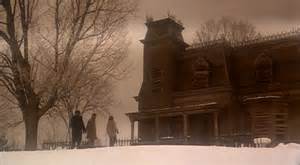
I would only add one more similarity – both novels feature a house that is a home or former home to the evil presences of these books. In fact, I need to make this addition, for these reviews are part of the Haunted House themed project and therefore, the stories I review must include a haunted house, even though most of the action in these stories take Ghost Story movieplace outside these houses. (For the record, I have found Salem’s Lot and Ghost Story on sites that list haunted house films and literature – so there!) But here is the take away – the story is too broad to settle on in with just a few characters at one location at a specific point in time.


Like with Stephen King’s The Stand and It, there are multiple characters with story lines that encompass more than a few pages. While the primary characters consist of the five old men that tell ghost stories (Collectively known as “The Chowder Society”), the writer/nephew of one of these men (Don Wanderly), and the “ghost” in her many incarnations, there are so many others – the promiscuous wife of one of the old men, the drunk plow driver, the cantankerous sheriff, thrill seeking teenagers, and on and on it goes. The story takes place in a snowy town in New York, but the book takes readers across the country as a large chuck of one of the plots (there are a few) unfolds in California. Oh yes, the town of Milburn has the obligatory haunted house. In fact there are several! The evil goes where it wants – haunting several abodes and businesses, including a movie theater that continuously runs the film “The Night of the Living Dead.” Several of the townsfolk fall prey to the evil. They become possessed, they become the objects of their worst nightmares; they die. And it doesn’t help matters any that a series of snowstorms shuts down the town. The people of Milburn are besieged on all fronts by so many forces.

I say, if you like Stephen King’s epic and character-heavy novels, then it is highly likely that you will enjoy Ghost Story as well. I know I did.

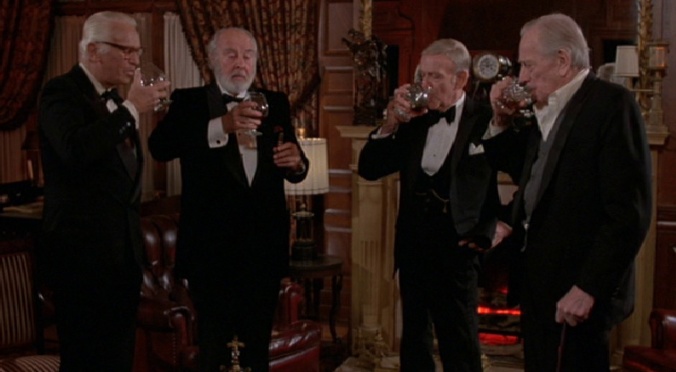
Now, how does one turn all this into a movie? By focusing on one central plot and abandoning the side stories. By letting go of most of the characters and centering only on a handful. And this work well, with a large part of the success coming from the suburb cast:

Douglas Fairbanks Jr      John Houseman                      Fred Astaire              Melvyn Douglas

ghoststorymen


It was the final film for Astaire, Fairbanks, and Douglas. Melvyn Douglas has so far appeared in two other haunted house movies that I have reviewed. (See The Old, Dark House and The Changeling.  Although I did not mention him in these articles.)

The film focus in on one plot – a young woman (as a ghost or whatever evil form you call it) returns from the dead to seek revenge on the four old men (Astaire, Douglas, Fairbanks and Houseman) who had killed her when they were young. This plot line occurs in the book as well but it is much more complicated. Normally when I do a book vs. movie review, I make a bullet-point list outlining the differences within each medium. I feel that is unnecessary here as I have already honed in on the most significant difference. Once that difference is understood and accepted (and accept it I do), an inventory of the nitty-gritty components of such a variance becomes pointless (In more ways than one: meaningless and “no bullet-points.” Get it?) The story that is portrayed is done with great care. It is better to minimize one’s focus to achieve a clear vision than to try and maximize the field of vision, only to achieve a blurry and unwatchable product.

As great as the book is, I find myself preferring the film (Or, I “might” prefer it to the book, as I said earlier). At times during my reading, I found myself lost in the tangled trails of plot. Yes, these trails do untangle and eventually lead you where you want to go, but still, it was a tedious experience at times. The film is straight forward and satisfying.

Not that I am against the complex – by no means. I enjoy books of great breadth and depth.

Perhaps such a comparison is unfair. It’s like comparing a plate of apples to a gourmet meal. It’s just that, as much as great as a gourmet meal is , sometimes I just want apples.

************************************************************

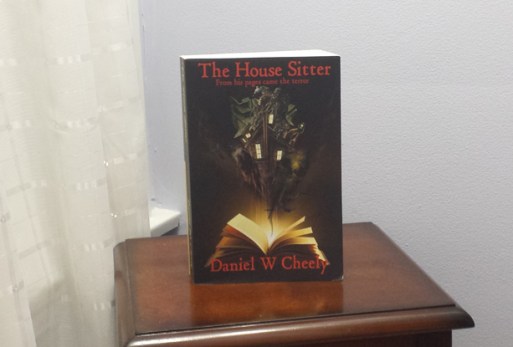
Thank you for reading this article.  I invite you to check out my latest book: The House Sitter
– A writer haunted a house with his own stories.

HouseSitterCoverForHHGroup

Review of The Changeling

ChanglingCoverGeorge C Scott portrays John Russell, a grieving widower that rents a historical mansion where things go “bump in the night.” Truthfully, it’s more of a “bang”, but it’s no less creepy. Searching to begin anew after tragically losing his family, Russell, a music composer, accepts a teaching job at university. With a new job comes a new life, new acquaintances – and a new home. New and scary. He has no idea what experiences are waiting for him; what mysteries he will help to unravel in The Changeling 

Most of the scares come from sounds, and effectively so. In the tradition of The Haunting, loud disturbances haunt the rooms and halls. Joining the audible haunts are the ghostly cries of a young child. The background music is quite chilling as well. But there are plenty of terrifying images to accompany these sounds and cries. These are largely the ghostly recreations of tragedies past. In one scene in particular, a ghost submerged in water cries for help; his cries rise to the surface in bubbles. This scene is an example of awesome editing and creative synchronization of visuals and sound. In another scene, a locket and chain rise up from the soil of a well like a slithering snake. A decent scene indeed!

The drawback of this film has to do with the back-and-forth change in scenery. Just when the viewer is settling into the dark and chilling atmosphere of this dark house, the scene awkwardly changes to a busy street on a bright morning of another day. Too much time is spent solving mysteries outside of the house rather than in the very heart of the haunting.

However the overall story is good and the resolution – the reason this film is called “The  the-changeling-1980Changeling” is intriguing indeed.   This isn’t the best haunted house film out there but it has its redeeming moments. It is definitely worth seeing.


Review of The Conjuring 2

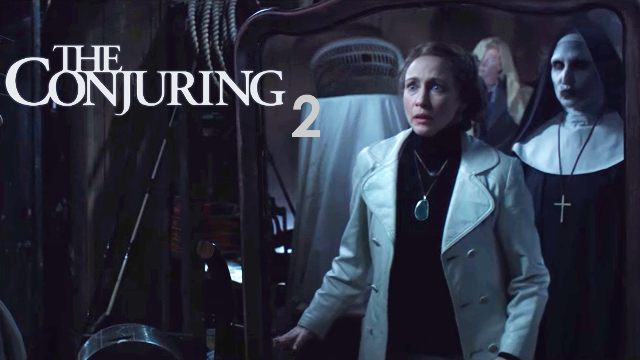
the-conjuring-2 2

Demonologists Ed and Lorraine Warren heed their call and once again come to the aid of a family that is plagued by evil spirits. This time, their call takes them across the ocean. They pack their bags and leave their New England home, bound for “Old” England, where they are to investigate a phenomenon that has been described as “London’s Amityville.” The Hodgson household consists of a single mother, her four children, and one or two unwanted presences. Will the Warrens be able to rid their home of these unwanted guests? And, more specifically, will they be able to help Janet Hodgson – the young girl who frequently becomes possessed by this evil? Go see The Conjuring 2 and these questions will be answered. Until then, read the rest of this article for informative tidbits and opinions.

Oh good, you listened to me and continued reading. Let’s begin with some background information. For those new to The Conjuring series, the reoccurring characters of Ed and Lorraine Warren are based on a real married couple that investigated paranormal phenomenon back in the 1970’s and 80’s. According to wikipedia, the Warrens claimed to have investigated over 10,000 cases of “actual” or “potential” of supernatural activity. Does this mean that we should settle in for 10,000 movies? Probably not – that’s overkill. But the Warren case files have spawned several movies, including both Conjuring movies. The first film is based on the 1971 Perron Family case – ghosts and or/demons haunt the Rhode Island home of this poor family (click here to read my review of The Conjuring). This second film is based on the Enfield Poltergeist case, which documents moving furniture, overturned chairs and levitating children. The film shows all this and so much more. Other films loosely related to the Warrens are AnnabelleThe Haunting in Connecticut, and The Amityville Horror. While there are no references to the Warrens in The Haunting in Connecticut and Amityville Horror, The Conjuring 2 opens with Ed and Lorraine investigating the Amityville House after The Lutz’s have fled. In order to determine if there is an evil presence associated with the house, Lorraine uses her skills as a medium to experience the horrific murders that claimed the lives of The Defeos –the family that lived in the house before The Lutz’s. From the killer’s perspective, she comes to understand what happened that fateful evening while uncovering a clue she does not yet understand, for it is a clue that is linked to things that would occur later in the Hodgson house. This opening sequence is brutal, chilling and captivating all at the same time.

So, what did I think of the rest of the movie? Before I get into that, let me be honest about the-conjuring-2certain biases on my part. First, I prefer the ghosts and demons of films and literature to be somewhat elusive; their origins speculative, their nature not limited to the narrow parameters of “good” and “evil”. The spirits of The Conjuring films are evil demons as defined by the Bible. Adhering to tradition of well-known demon lore, we assume they will take possession of someone, mostly likely a young woman. We suppose that the possessed victim will at some point rant in a guttural, inhuman voice. We expect the demons to get a little testy when confronted with a crucifix – the symbol of “goodness.” All of these assumptions, suppositions, and expectations come true. Second, I favor unhurried and carefully crafted atmospheres of disturbances to the flashy and loud jump scares. Creepy over shocking, I say! The Conjuring 2 has a lot of jump scares for sure, more than its predecessor. For these reasons, it is doubtful that any films of The Conjuring series will make it to the top of my preferences list.

All this being said, The Conjuring 2 is a decent film with plenty of scares for everyone. While the film relies heavily on “jump scares”, they are done effectively and creatively. A person or object is on one side of the room and then suddenly, there s/he/it is right before the camera and this “jump” is unexpected. The ghosts and demons in this film manifest in scary forms. If you are the type of person that wants to see the phantoms that are doing the haunting, you will not be disappointed. And overall, the acting is good, the characters are sympathetic, and there are some touching moments outside of the realms of the scare factor.

I’ll let you be the judge as to what’s “true” about this film. In my opinion, it is fiction based on fabrications of truth. Ah but who am I? Maybe the events portrayed in this film are very real for some of you. If so, great – all the more reason to be scared. And isn’t that why we see horror movies in the first place – to be scared?


Thank you for reading this article.  If you enjoy my writing, please consider buying my latest book The House Sitter.  A writer/house sitter haunts a house with his stories. They haunt him back in return. Click on picture to see the book on Amazon

HOuseSitterUSe

Review of Terror in the Haunted House (My World Dies Screaming)


terror_in_haunted_house_poster_02Let’s begin with the first several moments of the film. It begins with hypnotic spirals overlaid by the text “The first picture in Psycho Rama – The Fourth Dimension –Subliminal Communication.”

Next there is an establishing shot of a three-story house. Credits are rising in the air! (Likewise, according to the rock band Rush, “the sigh of Eth is rising in the air”. Check it out here! ) Then, ‘she’ speaks. She the narrator – she that is sharing her nightmare with us. It is a reoccurring dream of an old house that “stands like a moldering tombstone.” The camera zooms in on the front door. It opens on its own accord.  We the viewers enter, trespassing further into her nightmare.

Up the stairs we follow the unseen camera. Old portraits hang on the walls. Another door opens and we see a stairway leading to an attic. The narrator is very worried about what’s up there. Stairwell curtains dance to the whims of a draft. Scary. Terror! The hypnotic spirals return.  She screams!

That’s about as far as we need to go. Anybody who starts watching this film can stop at this point.  The rest of the film is an exercise in “suck-o-rama.”

Alright, fine, here’s some more info. It turns out that this nightmare house really exists, so the husband/boyfriend/whothehellcares guy takes this freaked out wife/girlfriend/Iforget woman to the house and they stay in it, seeking to unveil any clues as to why she keeps having this dream. This might have been her childhood house, I don’t recall, but trust me; it’s not worth remembering these details. The rest of the film is all talk and screaming.

Talk-Talk-Talk-Talk “EEEEEEEE!”  Talk-Talk-Talk-Talk  “EEEEEEEE!”


The mystery (none), the twists (yawn) the revelations (oh.) – all are smashed claustrophobically into the dialogue.  Every fifteen minutes or so, she the main character is screaming at something: a shadow, a mouse, a mirror, a clown, a hairpin, a can of soup. Okay, most of the preceding scares I made up. I don’t remember or care what she screamed about. All I remember was that it was annoying as hell. But these audile annoyances are soothing interludes when compared to the eye-irritating “visuals” that these filmmakers thought would be so innovative to flash on the screen. Yes, this is the “Pyscho Rama” – The “Fourth Dimension”,  the “Subliminal Communication”

Every so often, images of cartoonish faces flash on the screen. Here are some examples captured from the film:


They come and go in the blink of an eye, disturbing our sensitive corneas. They’re as welcome as flying pests at a picnic. What were the filmmakers hoping to achieve with these… things?  I personally have no idea. They didn’t frighten me.  And no, I don’t believe in “subliminal communication.” I did not succumb to mind control and I’m quite certain that I did not open my subconscious mind to demonic possession by absorbing the content within these annoying flickers.  Back in the 80s, certain pastors tried to tell me that whenever I would listen to the song “Stairway to Heaven”, a backwards message would enter my brain, rearrange itself to communicate “forwardly” to my subconscious and then deposit the damning words “Here’s to my sweet Satan” deep down in the bosom of my being. It was bunk then just as it was bunk thirty five years earlier in 1958, the year of this film’s release.

So – to recap. If you feel that you must  watch some of this film, set aside five minutes and watch the opening. It is a good opening. Enjoy the creepy mood but do your best to endure the “subliminal” flashes. There are at least two of them, maybe more, within these first five minutes. But that’s better than enduring ninety minutes of these incessant intrusions.


Ghostly Grounds: Explorations Outside of the Haunted Houses of Film and Literature


ExHauntedHouse


What’s spookier than exploring the inside of a haunted house? Answer: exploring the outside of the same house. Okay, maybe touring the grounds isn’t any more frightful than tip-toeing through the bowels and guts of a house possessed. But the exterior environment can be pretty darn frightening as well. Consider a painting of a haunted house and its surrounding environment. A full moon looms in the sky above the roof. The sky is painted dark gray. Bats populate the canvas air. There are bare trees with gnarled branches. And there are graves. They surround the house.

I’m sure most of you have seen a painting or drawing that resembles the above description. If you are a fan of haunted houses (and I’m sure you are otherwise you wouldn’t be reading this) then I’m certain that what you saw was delightfully chilling. It’s all about the atmosphere, see?   Atmosphere establishes mood, and one must be in proper form before stepping inside a haunted house, even if such an entry occurs only in the imagination. A creepy, external background effectively prepares a person for admission. You must be respectfully fearful and giddy with gloom! A haunted house surrounded by rainbows, posies and a sun-shiny orange background is sacrilege, I tell you!

This article will explore the exterior environments that are found in many haunted houses of film and literature. Such mediums go beyond the flat scope of a painting. As such, the external environment offers so much more than a means to establish atmosphere, although it succeeds in that area as well. The outer environment can provide clues to the house’s history. Secrets are often buried somewhere on the grounds. Nature’s elements foreshadow events that are to come to pass.

Grab your coat and put on your hiking boots, for we are about to trespass across the grounds of your favorite haunted houses. I have divided our tour into five categories with each category being representative of a particular area of “scare.”    By no means are these categories all-inclusive; these groupings are not representative of every possible external arena of fright. But I believe they consist of the most common “attractions” that surround haunted houses. Anyway, let’s go to it!


Oh the Weather Outside is…Frightful! ExStorm

Rainstorms! Blizzards! Fog! Oh dear! Nature’s wrath can definitely chill an atmosphere. However, frightful weather can also be a sign. Protagonists are never in for a mundane evening if they happened to be trapped within a story that begins with “On a dark and stormy night.” James Whale’s The Old Dark House is the epitome of the “stormy night quip”

(originally penned by Edward Bulwer-Lytton) . Travelers struggle along dangerous roads. The rain storm is causing mudslides. They are forced to take shelter in The Old Dark House. Though the owners are accommodating, they are mighty strange.

While severe weather often causes travelers to stay in a house they would normally avoid, it also traps them inside these frightful places. The Torrances knew they would be confined inside the walls of The Overlook Hotel in Steven King’s The Shining. It was Jack’s job to care for the place during the blizzard season. Of course, we readers (and viewers of the Stanly Kubrick film) knew there would be more terror to come for this family than a simple outbreak of cabin fever.

Then here is fog. What of fog? Fog has a way of capturing the essence of the unknown. Within its smoky haze there exists something – but what? The fog is highly symbolic and continuative of the mysteries that hover about in the house. For instance, an important clue towards understanding the dynamics of the Stewart family materializes right out of the fog in Alejandro Amenabar’s The Others.  The clue is Mr. Stewart himself, who went off to war and never came back. But there he is, underneath those haunting vapors that never seem to cease. It seems that they forever surround the grounds of the Stewarts’ manor.

Now, how about a bog within a fog? Protagonists John and Carole hear someone trashing about in the bog but they cannot see it. This phantom thrasher is also the phantom haunter of The House on the Moor – a book by author William Meikle.


 Anything’s Game on a Haunted Terrain!

ExElements


Be careful where you tread! Watch where you put your feet, for the ground you step upon may be cursed. Take for instance The Amityville Horror house. The book claims that the site on which the house is built harbors evil. But what of the “finer” elements that make up the grounds, such as the grains of sand on a beach. Can’t get much finer than that! Normally, one does not think of a sandy beach as a location for a haunted house. But The Elementals by author Michael McDowell teaches us otherwise. (Earlier, did I say that haunted house stories that are set against a sun-shiny orange background are sacrilege? I did, didn’t I? Well…The Elemental house doesn’t count, hee hee hee!) Surrounded by ever encroaching sand dunes, the house struggles against a mound that dwarfs it. As the sand spills into house through the broken windows, it pours into disturbing formations.

Remember, anything’s game on a haunted terrain! If a house is haunted, chances are that its surrounding terrain is all spooked-up as well. A beach, a field, a canyon, a garden – beware! One of the haunted houses in Author Anya Allyn’s Paracosm: Bleath: The Hauntings overlooks fields of wheat. Within these fields there are ghosts, and portals to strange worlds. If you’re ever combing the outskirts of Hollywood, I’d stay clear of Coldheart Canyon. It is the canyon that surrounds the manor of silent film star Katya Lupi. Author Clive Barker has filled this canyon with abysmal creatures; creatures that were spawned from the coupling of spirits with animals. Now, how about gardens?  Paradises of greenery. There is such a garden in Author C.M. Saunder’s Sker House. The problem is, it isn’t always there. Just because you partook of its Eden-like charm once doesn’t mean you will find it again. You just might go mad trying to relocate it.


Little House in the Big Woods? – This ain’t for you, Laura Ingalls!
ExForest

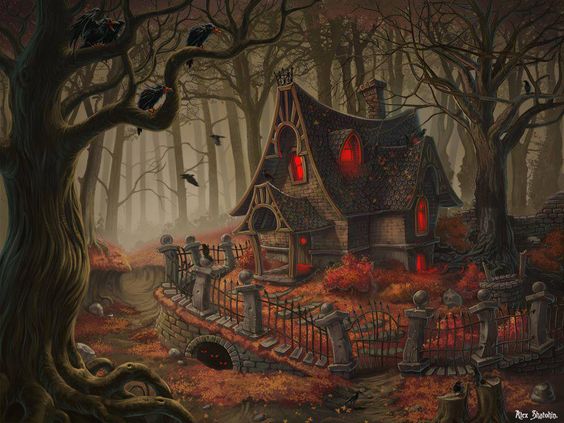
Think of the countless legends involving magical forests. There are the forests of Lord of the Rings saga – populated with its elves and talking trees (Fine! “Ents!). How about the forest at the edge of Hogwarts in the Harry Potter series with its giant spiders and centaurs? Go back, way back, to the tales of Little Red Riding Hood and her encounters with the wolf as she hiked the woodsy trails to grandma’s house. Or how about Hansel and Gretel and the witch’s house they stumble upon in the woods? Perhaps the last tale best fits with the theme of this article – houses and the terrains that surround them.

True, “forests” can easily fit into the previous category of “terrains of terror”, but since there are so many stories of haunted houses within forests, I felt it deserved a category of its own. The forests of myth are giant ecosystems of the supernatural. Cut off from civilization, mystical beings and deadly forces can thrive with little notice or interference from the larger world. What of a small house or hut that sits somewhere in the middle of this vast woodland of spiritual chaos? It is doomed. Or rather, it is susceptible to all the haunting forces that breed amongst the trees. Director Sam Raimi’s Evil Dead 1 and 2 illustrates this phenomenon. True, the demons materialize via chants spoken from a book within the cabin in the woods. But as the main character Ash Williams points out “It lives…out in those woods”. What is the “it”? The “It” is the evil force that spawns the soul-possessing demons that take over the bodies of the cabin’s inhabitants. Don’t believe me? Run away from the cabin and see how well you fare with the trees. They just might…well, watch the movies!

Then there is the house that is at the center of the madness of the woods. It is the reservoir to which all the terror must flow. In the Blair Witch Project (From Daniel Myrick and Eduardo Sanchez) three hikers are hopelessly lost in the forest. One just ups and vanishes. The terror builds and builds until finally they encounter a creepy old house from which they never return.

Finally, there are wooded trails that are perhaps extensions of a house’s hauntings. Think of this haunting as a giant hand – it surrounds the house within its grip. But the hand is several times the size of the house. The fingers spill over into the trails of the forests, damning them with ghosts, demons and all kinds of unnatural beings. I go now to the novel The Haunting of Lake Manor Hotel (edited by Nathan Hystad). As its name implies, the hotel is the subject of this collection of thirteen stories. The lake is also a centerpiece of these tales. The surrounding woods collect the ghostly remains that wash ashore from the lake; that journey outside of the haunted hotel. Possessed with witches, talismans, and strange dishware that are labeled with the names of body parts, this forest is not for the faint of heart. In Scott Nicholson’s Creative Spirit , artists gather in a manor for a creative retreat. The manor is indeed haunted, and the ghostly activities flow from the house and onto the old wagon trails and wooded pathways.


                                        Bodies of Water (Or , perhaps, bodies in water)

ExSea

Ah water! Fluid by nature, it has so many properties. Thus it can be so many things. Look into its pooling mass and you can see yourself in its reflection. Maybe, just maybe, within this reflection lurks a truth that otherwise goes unseen to the unreflective eye. In Edgar Allen Poe’s The Fall of the House of Usher, the “House of Usher” as revealed by the pool’s reflection is telling, especially as it applies to the relationship of the owners of the estate, Roderick and Madeline Usher. Sparknotes.com sums it up best:

“Doubling spreads throughout the story. The tale highlights the Gothic feature of the doppelganger, or character double, and portrays doubling in inanimate structures and literary forms. The narrator, for example, first witnesses the mansion as a reflection in the tarn, or shallow pool, that abuts the front of the house. The mirror image in the tarn doubles the house, but upside down—an inversely symmetrical relationship that also characterizes the relationship between Roderick and Madeline.”

Water seeks its own level – it conforms to the shape of its container. Given the chance, it will conquer its beholder. One must not remain inside a seaside cave for too long, especially during the tide. The Orphanage, a film by Juan Antonio Bayona, has such a cave. And it just might be inhabited by ghostly children! In The House on the Borderland by William Hope Hodgeson, there is a deep rift beside the house. Deep down, carved into the rift’s wall is a cavern. The protagonist decides to go exploring. Oh but there is water within the rift! It rises day by day and spills into the cavern on the day of our hero’s exploration. Not good!

When waters reach its own level, it conceals its depth. How deep does it go? Often we don’t know. Fathoms down, things are buried. History is hidden. Part of the reason for “The Haunting” of Lake Manor Hotel has to do with plague victims, their bodies unceremoniously thrown into the lake many years ago. Out of the depths from way back in time, they can return. How well does a lake hide the sins of the past? Sometimes very well, sometimes not. It depends what it returns. This situation is at the forefront of the movie What Lies Beneath (directed by Robert Zemeckis) and Stephen King’s novel Bag of Bones.

Let us dispense with the lakes and return to sea – an aquatic chasm of time and tragedies with a history too enormous for any generation to fully comprehend. Even the surface is but a platform of memories as vast as the sea itself. Not everything sinks. True, the treachery of men has pulled ships down to their watery graves. But the ghost lights of these ships remain and reflect off the waters. CS Saunders explains all this in great detail in Sker House, which is a coastal inn that absorbs many of the tragic memories of the sea.


 Prowlers and Growlers and the Ground-Bound
ExProwlers

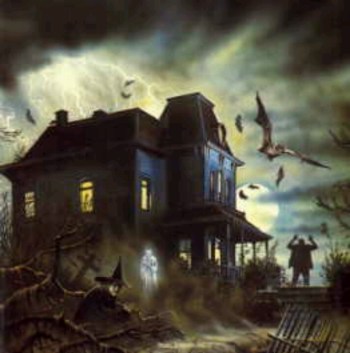
Beast or human, paranormal or not, watch for the things that prowl the grounds of a haunted house. Some are guardians. The gargoyles on castles and cathedrals, for instance, were there to scare away unwelcome guests. But some of these things bound to the grounds are just malevolent beings with nowhere else to go. In the film Cat and the Canary (Director: Elliot Nugent), for instance, the house guests must be wary of an escaped lunatic that just might be creeping around on the outside of the house. Rapping at the outside windows of The House on the Moor is a ghostly phantom. This is the same phantom I referred to earlier, the one that splashes about in the bog in the fog.

More to the point of guardianship, The hedge animals in Stephen King’s The Shining are not to be reckoned with. Yes it’s creepy when they sneak up on little Danny Torrence, but they can me much more deadly than that. After all, they out and out attack Dick Halloran as he tried to rescue the snowbound family.

Perhaps inspired by the gargoyle is The Bell Monster. It lives in the bell-tower on Scott Nicholson’s The Red Church It has wings, claws and livers for eyes. Mutilated bodies have been found on nearby roads and fields. These were Its victims.

And what are we to make of the herd of swine! With sharp teeth, crawling up from the cracks within the earth, they gather into an army and assault The House on the Borderland.


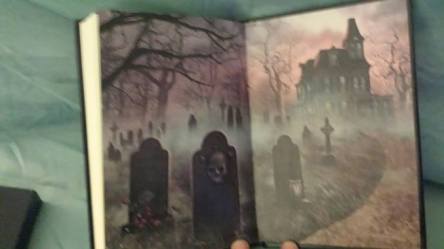
Don’t Wake the Dead! (They are sleeping underneath the yard)
ExCemetery

You knew this was coming. How can there be an article about the grounds of a haunted house without a cemetery category? There can’t be, so here comes the dead!


Lying underneath the mounds of soil are the former inhabitants of a house, or the once living/now dead congregation of a church. The obvious implications are that the ghosts of the buried dead have found their way inside the corresponding structure. That which remains does so to the fullest of intentions. To have a sprawling cemetery surrounding a house is to wrap a place forever in the spirit of the past. It’s only a matter of time before this figurative spirit breaks apart into literal ghosts bent on haunting the premises.

There is a churchyard in Scott Nicholson’s The Red Church. At one point in his novel, the ghosts in the graves rise to the sound of the church bell.

Some graveyards are not out in the open. Though connected in some way to former inhabitants of the nearby house, they are small and hidden away. This makes it more difficult for new occupants of a home to pinpoint the source of the haunting. Such is the case in the film The Others. There are three lone graves way across the fields some place. The weeds shelter them with the help of the groundskeeper. In the Haunting of Gillespie House (author Darcy Coates), temporary house renter Elle stumbles upon the house’s family cemetery. It is far away from the house, across the grounds and surrounded by locked gates. But she soon discovers that there are other ways that she can enter this cemetery, secretive ways.


ExTragic_ghostSo there you have it!

Houses by lakes and by sea and the things that come from their depths. Houses in forests and canyons and the things the hide within. Houses on shape-shifting terrains; monstrous metamorphoses. Houses built on unholy grounds, propped up in magical fields. Houses with neighboring corpses in their cozy graves, Houses that summons the demented and strange and set them loose on their terrifying grounds. Houses that weather terrifying storms and call forth the most brutal of nature’s elements to assist with their onslaught of horror.

These are the houses that are haunted inside and out. For every hallway spirit there is a ghost roaming the graveyard. Wandering around inside a haunted house can be terrifying. But fleeing the house does not guarantee one’s safety. You must get out and then run, run far. Far away from the house and all the things that surround it.
 

Review of The Orphanage

orphanage Thomas 2

J.A. Bayona (Director) and Guillermo Del Toro (Executive Producer) have joined forces and the results are phenomenal. The product of this union is The Orphanage – an exceptional haunted house film.

Free of cheap scares and senseless gore – The Orphanage relies on setting, story, and artful camera work. I love it when I can praise a modern film for utilizing the time-tested techniques of classic scare films. I will continue to distinguish the traditional “goodness” from the modern “blah” again and again until the creators of lesser films get the message. This film is in good company with other modern and relatively modern greats such as The Others (Alejandro Amenábar)  and The House at the End of Time (Alejandro Hidalgo). Spanish filmmakers seem to have exactly what it takes when it comes to creating haunted house films.

Back to The Orphanage.  Let’s begin with the environment. Set in a seashore atmosphere, with thrashing waves, seaside caves and a lighthouse just few waves away, The Orphanage effectively uses this striking setting to bring forth haunts. The ghosts of children lurk in the cave, the battering waves nearly captures a mother who desperately searches for her missing child, and the lighthouse, is it a beacon of hope?   The multi-level home, a former residence for orphaned children, has hidden rooms and buried secrets. Its long dark hallways seem to be calling out for ghosts.

Here’s a brief synopsis: As a child, Laura was an orphan who lived in residence hall that is the subject of this film. She was adopted and left behind several of her orphan friends. Many years later, the orphanage has closed down and the adult Laura sets out to reopen it as a home for disabled children. She and her husband and their little boy Simon move in and before they can set out on their goal of reopening the facility, strange things happen. The strangeness begins when little Simon tells his parents about his imaginary friends.

Consider such scenarios that are common in many haunted house films: children with sensitivities toward paranormal phenomena; a house haunted by ghostly children. These can be genuinely creepy scenarios so long as the film is done right. Take for instance a little girl dressed up in zombie-like fashion that jumps out with a deafening scream – I’m sorry but this isn’t creepy (Hello Amityville Horror Remake of 2005!) Scary perhaps, but not creepy, and I prefer the creepy.

To capture the creepiness factor, the lines between reality and a child’s fantasy must be ever so subtly blurred. There must be layers of terror lurking underneath the shield of innocence, with each successive layer becoming more and more disturbing. And what’s more innocent than childhood games! The Orphanage has several scenes where a game puts a chain of creepy events into motion. There’s the game where someone faces a wall and counts while a group of children slowly advance on the counter. They freeze when the counter turns around at intervals of five. Then there’s the game where the object is to solve a riddle by following a trail of clues. Something hidden in a dresser might lead to a note on a statue, and son on. Imagine these games played inside a haunted house where ghosts decide to join in the fun. Or maybe the ghosts are the makers of such games? The point is that this film successfully builds a bridge between innocence and terror and we the viewers walk this bridge in exhilarating trepidation.

Perhaps the creepiest element of this film is the child that hides his face underneath a sack with eyeholes cut out of it. He doesn’t have to jump out in front of the camera to create a scare. His mysterious presence is frightening enough. Who is this? Is it Simon playing some kind of game or is it someone else?

All this and I haven’t delved into the plight of Laura, Simon’s mother. After Simon, she is orphanage Laurenthe next in line to be the receiver of haunts. As a former resident of the home, she is best equipped to deal with the mystery that envelops the house and ties the whole story together. Is she up to the task?

There is a whole lot more going on in this film but I will say no more. Trust me when I sat that this is a great film. It is filled with mystery and suspense. The story is well written and, did I mention that it is creepy? I guess I did. It is creepy indeed!


Review of The Old Dark House


I like to “live it up” on Saturday nights. These days, I do most of my Saturday night “living” on my sofa, watching Svengoolie on MeTV . Thankfully, he’s a lively kind of horror movie host. Anyway, regular doses of Svengoolie have helped me to appreciate many of the old Universal horror films. Of all the horror classics, I have found I like Frankenstein and The Bride of Frankenstein the best. Coming in second (I guess third) might be The Invisible Man. Even after seeing it a couple of times, I didn’t realize that James Whale directed The Invisible Man. Whale, of course, is most famous for directing Frankenstein and The Bride thereof. I then wondered, since I love The Invisible Man, maybe I’m not merely a Frankenstein fan. Maybe I am a James Whale fan?

Whale has made four classic horror films, of which I had seen three. I was delighted to learn that the horror film that I had not yet seen was a haunted house film. The other night, I finally watched The Old Dark House. It did not disappoint.

When describing films that are overly saturated with elements of a certain theme, the phase “X for X’s sake” is often used. ‘Gore for gore’s sake’ or ‘Violence for violence’s sake’, you get the idea. I am tempted to use the phase “Creepy for Creepy’s sake” when describing the film, although I don’t mean it in a negative way. The Old Dark House doesn’t grab you by the head and smash your face down inside a pie of creepiness. Rather the creepiness is all around you from beginning to end, though it may not always be subtle. It OldDarkHouseis a simple story – a violent storm forces two sets of travelers to seek shelter at and old, dark house. The inhabitants of the house are quite strange, as would be expected. There are several subplots that arise, and some of these are awkward. But never mind, the purpose of the film is not to tell a thought-provoking story with a compelling plot. Instead, it is to revel in the art of the uncanny. It succeeds in its goal with dark and chilling atmospheres, crafty camerawork, and its effective use of shadows. Some of the characters are humorously unsettling, even by today’s standards. I would like to go more in depth and describing some of them, but that would require me to tread too far into the forest of spoilers and I don’t want to do that. Oh and there’s the screeching of the wind! Gotta love that!

Some of the visuals described above are signature styles of James Whale. If you have never seen any of his films, I recommend doing so immediately. For those who are familiar with Frankenstein (and who’s not?), you may be delighted to know that James Whale once again features Boris Karloff as a hulking, mute figure in The Old Dark House. I saw this film on youtube, and the recording is quite crappy. I have yet to see it on Svengoolie. I’m sure he could get a hold of a better print. Sven, would you get this film for me? You would, aww that’s just sweet!

A Review of The Babadook

 
babadook3Who is Mister Babadook?
He is grief, he is fear
He is bitterness, he is near.

Where does he come from?

He comes from pain.
He comes from a book
He’s sneaking to the surface
Come, have a look!

A family suffering. A grieving shrew.

                                             A boy dealing with a loss he never knew.

All of this and a pop-up book; here he comes – Mister Babadook.


The poem above is my “perspective-in-a-nutshell” for the fascinating film The Babadook. I did my best to mimic the writing style of  Mister Babadook – the fictional children’s book that is the subject of the film. Don’t worry, you don’t have to like my poem!

This piece is more of analysis than a review. Therefore, it is filled with spoilers. So reader beware! The Babadook is too deep of a film for me to just offer up a simple “I like this film because of its depth, mystery and special effects. (and yes I do like the film for these things – and so much more!)” It is begging for thoughtful analysis. Or maybe it’s just my analytical mind that desires such an examination. It is a film rich with symbolism, so much so that I cannot help but dive underneath the layers to see what is lurking from within.

This fright-filled tale begins with the back-story. While taking his wife to the hospital so that she may give birth to their son, Oskar Vanek perishes in a car crash. Six years later, widow Amelia and her son Sam struggle with daily living. Sam is overly imaginative and high-strung. He is a problem child who can’t be trusted around other children.  He succumbs to tantrums. He is afraid of monsters that might be living under his bed.

Amelia suffers all the stresses of being a single mother. Her son’s behavioral problems make matters worse. She has a difficult time maintaining any kind of support network. Her own sister avoids her. Her nephew just freaks her out.

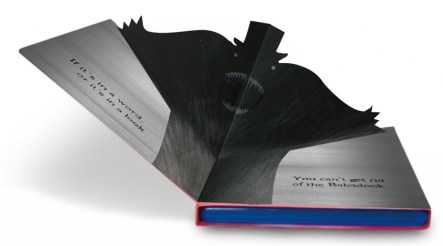
Mother and son like to read together in bed. One night, Sam chooses a book from the shelfBaBadook4 called Mister Babadook. It is a creepy pop-up book that features the cloaked shadow monster “Mister Babadook.”  On one set of pages, he pops up over the front door. He wants in.


Look at the pictures below to see some of the creepy words that fill the pages.


After the reading, Sam begins to see Mr. Babadook in various places inside their house. No one else can see him. Not Amelia, and not the viewers of the film. Not yet.  But soon.  Eventually, Amelia hears him knocking on the door. She hears him call out:

  “Baaa Baaa Dooook!”

She sees his form in the dark coat that hangs on the wall. She sees this black specter  everywhere. And when she hears him, we viewers hear him.  What she sees, we see. The film changes perspective, from the boy to the mom. When this happens, we descend with her into the pits of madness and witness Amelia’s breakdown. The Babadook possesses her. It wants her to take her son’s life.

BaBadook

So, what’s going on here? The “stuff of horror” in this film can be either literal, figurative or both. I vote for either of the latter two. Perhaps the phantom is real. Even so, there is symbolism lurking within his shadowy frame. It is undeniable.

The Babadook represents all the repressed feelings that dwell within the mother and son twosome since the death of Oskar Vanek. Up and until Amelia encounters The Babadook, Sam’s impressions of him are left to the viewer’s imagination. Perhaps this is because his fears, though no less real, are more vague. He never knew his father, but still he suffers from his absence. He lacks discipline and courage. Having a mother who is unbalanced and overstressed does not help his situation.  Sensing Amelia’s hesitations about being a mother, he feels insecure.

Amelia has never properly grieved. She has buried many emotions and they are bubbling to the surface. Sorrow and sadness are definitely part of the mix, but she possesses feelings that are much more toxic. She is bitter. Her husband died so the Sam might be brought into this world. She blames Sam for this. She even hates him at times. Through her eyes, we see the shadowy creature. We see it possess her, and this is when her bitterness is in full form. She tells her son to “Eat shit!” She even admits that she would have been happier had he died instead of her husband.

Although Amelia is behaving cruelly, Sam still loves her and comes to her aid. Together they defeat Mister Babadook.  But they don’t kill him. Rather, he flees to the basement of the house. There he stays.  Mother and son are happy at the film’s end. They love each other. Both have said some hurtful things to the other, but this is what can happen when a hodge-podge of negative feelings goes unchecked. The feelings fester and amalgamate and create a character that is foreign to the host that harbors such sentiments. People become monsters; unrecognizable abominations of their former selves.

BaBadook2 In the end, the fiend is still there. Amelia treads carefully into the basement. She feeds the monster, dispensing small portions of whatever it is that is mixed in with a bucket of worms.  The beast is hungry. It screams and threatens to attack. But Amelia succeeds in keeping it at bay. She revisits her nastiest of emotions every once in a while, but keeps them in check. According to Wikipedia, “opening a can of worms” is
 an idiom referring to a slew of subsequent problems and dilemmas arising from a decision or action

 It is risky to revisit certain emotional states. If these demons must be revisited, caution is essential. One must not overfeed them.

The Babadook is a great film. Thankfully, it lacks “high-octane” scares and gore. In its place there is good ol’ fashioned story-telling and mood development. Oh, and great artwork! Mister Babadook appears genuinely creepy.

Now, is this a haunted house film? I’d say so. Most of the terror takes place within the house. It would be a Type 2 Haunted House film – where the house is merely a stage for the ghosts to perform – rather than Type 1 –where the house itself plays a significant role in creating the things that haunt it.  (click here for a more in-depth examination of this delineation.) Plus, several lists of haunted house films include The Babadook – so there’s that!  (for instance, there’s this at flickchart.com )

If you can’t trust a list, than what can you trust?

Whether or not you think this is a haunted house film, watch it anyway – you will enjoy it. If you do watch it and disagree with my analysis, that is fine. So long as you agree that this is a very fine film! That is a must!


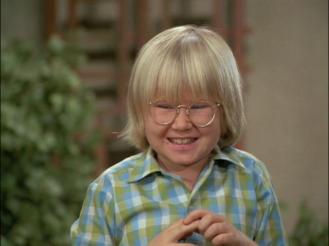
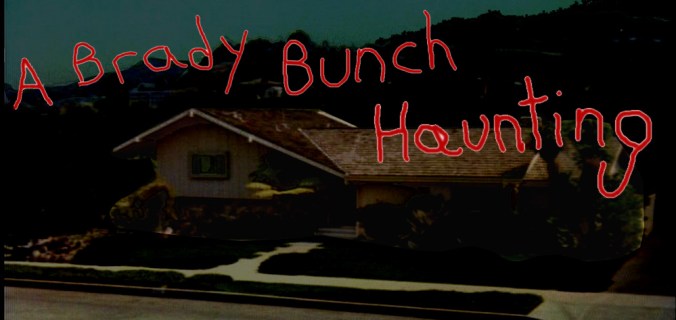
A Brady Bunch Haunting

ABradyBunchHaunting
Who grew up watching The Brady Bunch? I’m sure many of you have. I’m willing to bet that several millennials know what’s up when it comes to that “crew that somehow formed a family”  Not only has Sherwood Schwartz  saturated the airwaves with Brady bunches and brunches, Brady hours, Brady brides, Brady reunions and Brady holiday specials, but he has also penetrated the big screen with Brady Spoofs. (The third and final spoof movie, The Brady Bunch in the White House was actually a movie made for TV, but I bet someone watched in on wide-screen television, so my “big screen” description still counts!) I want to focus on the parody films. See, I would like to reignite this spoofy series with a film idea from yours truly (hint: that’s me!)  Sadly, Sherwood Schwartz passed away in 2011. Guess I’d have to seek out his next of kin to obtain all the necessary rights and permissions stuff. Is there a Son of Schwartz in the house?

Consider this post as my proposal submission. My suggestion is that the Schwartz family take into consideration my ideas for a potentially ghoulishly-groovy movie: A Brady Bunch Haunting. Perhaps The Son of Schwartz will stumble on to this blog and see this proposal. You never know!


Synopsis:

A family of six moves into the house at 4222 Clinton Way. Mr. and Mrs. Frank and Jane Lovingston, along with their three adorable children (Colleen – age five. Travis – age eight. Julia age fifteen) are in love with their new dream house. Jane’s mother Clara also lives with them and she is happy as well.  There is a large living room with an open staircase leading to a second floor with three charming bedrooms. There’s a spacious attic, a groovy kitchen that connects to a maid’s quarters. There’s also a gorgeous sitting room with glass doors that lead to a wonderful backward with a swing set.

There is just one problem – the house is haunted by the ghosts of the Brady’s (and Alice!)  Below are some possible haunting scenarios.


Davy Jones – Julia wakes in the middle of the night, goes down stairs, pulls out a Ouija Board and attempts to get in touch with the spirit of the late singer Davy Jones so that she may ask him to perform at her prom. Mrs. Lovingston interrupts this Ouija Board session and sends Julia to bed. The next morning Julia has no recollection of any of this, nor does she know who the heck this Davy Jones guy is.


The Phantom Football – Yard dwellers are in constant danger of being struck in the face by a phantom football that materializes out of thin air. On impact, a disembodied female voice cries out “Oh my nose!”


The Den of Advice Mr. Lovingston has no time for his son. Behind the living room is the former den of Mr. Brady. Right now, the room isn’t used for anything. Travis often wanders into this bare room. His mom overhears him talking to someone.

“Who are you talking to?” Jane asks.

“The R Ka Pet (architect).” Travis says. He helps me with my problems.”

Jane thinks Travis has an imaginary friend, until – she hears a man’s voice talking back to her son. He (Mr. Brady)  is saying, “Reason him, Travis. Calm, cool reasoning”


Random vase breakages – In the living room there is poltergeist-type activity. Vases suddenly break. When this happens, the disembodied voices of two young boys speak to each other. They say “Mom’s favorite vase.” And “She always says ‘Don’t play ball in the house’”


Picture of Jan While checking out her new bedroom closet, Clara uncovers an old picture of Jan Brady. She is freaked out because the picture looks exactly like she did when she was a young girl.

Later, when Clara encounters mirrors, she sees Jan’s reflection instead of her own. Both Clara and the Reflection-Jan scream in fright. Clara screams on account of the insanity of having a different reflection. Reflection-Jan screams because she sees what she will look like when she gets old. Clara has not aged very well. The thought of taking on her appearance scares her so.


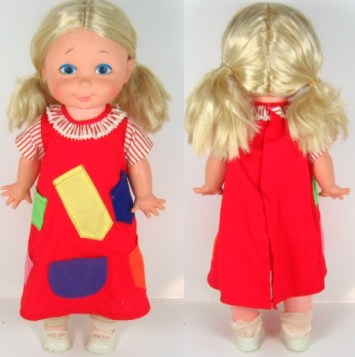
BBKKittyKitty-Karry-All  – Little Colleen lies in her bed, her arms wrapped around her doll. Suddenly, her doll vanishes. Where did it go?

There it is! It’s rocking back and forth in midair! Then, she hears the singing voice of a little girl: “Rock a bye baby, on the tree top..” Suddenly the ghost of Cindy Brady appears. Her ghostly arms are wrapped around the doll.  She whines, “I’m sorry, but this is not my Kitty!
Colleen screams as Cindy and the doll vanish. Later her doll will turn up in the dog house. Colleen will reclaim it but it will always disappear and turn up in strange places in unsettling situations (on one occasion, the doll is found hanging from the attic rafters with a knife stuck in its chest)

Every time the doll goes missing, a new doll takes its place in her bed. It is a “Kitty Karry-All”. Colleen is afraid of this mysterious doll. She breaks it and throws it away, but it always returns without any damage.


Alternate Kitty Karry-All scenario

 The night after the Cindy ghost whines about not having her Kitty Karry-All, Colleen wakes up inside Cindy’s arms. She has become “Kitty Karry-All.” The entire family including Alice stands around Cindy. They are smiling as Cindy says, “I have my Kitty back!”  Poor Colleen screams for help but it’s as if the Brady’s don’t hear her. The only response she gets is applause from the Brady’s as Cindy looks down at Colleen, smiles, and says, “I will never lose you again. I will keep you forever, and ever, and ever, and..


In bed with…Alice – While engaging in romantic activities with his wife,  Frank suddenly sees that the woman in bed with him is not Jane. It’s a goofy looking middle aged woman in a maid’s outfit.  “You can put your meatloaf in my oven now, Mr. Brady!” she says.  Frank turns away and looks again. He sees only his wife. How weird!


Ghost of Greg Poor Julia. Her attic bedroom is haunted. She is dragged out of her bed a la Paranormal Activity style.  Then she tied by her wrists and hung on the rafters.

The ghost of Greg then materializes and terrorizes her with – his guitar playing and singing

As he sings, “Clowns never laughed before” – the faces of killer clowns appear and start laughing at her.


When he sings, “Beanstalks never grew” – beanstalks sprout from cracks in the attic floor and wrap around her body.

BBVine


The voice in the suds – At strange times, the washing machine overflows and soap suds fill the entire room. This happens when the washing machine is not even is use! Sometimes, from inside the suds, a voice of a young boy is heard. It shouts “Mom!” Occasionally, the shout is followed by the concerned voice of a woman who says, “Ohh Bobby!”


BBOliverThe Boy inside the walls – Jane finds a little boy living inside the walls. His name is Oliver. He meets the rest of the family and tells them his story.

 “I have been living inside these walls ever since the Brady’s lived here. I locked myself away because I am a jinx. I thought that if I could go and live within the walls, then the Brady’s would be shielded from his bad luck.

I was wrong. The bad luck stayed with them. One by one, I watched them get murdered. Through the cracks in the wall, I watched as they all died.”

“Who killed them?” Frank wants to know. But Oliver can’t remember. It was too traumatic an experience.  But he says something really creepy.

“The Brady’s are still here. I sense them.”


The maniac butcher – Later that evening, Oliver eats dinner with the Lovingston’s.  They BBKillerSamare all sitting around the dining room table when all of a sudden, a terribly scary ghost appears.  He is holding a bloody meat cleaver.
Suddenly, Oliver remembers what happened on that fateful night.

“Sam the Butcher killed them! He went crazy after Alice dumped him.”

The Lovingston’s flee with Oliver, and they never return to 4222 Clinton Way ever again.


Review of Archie’s Haunted House (Archie & Friends All-Stars)


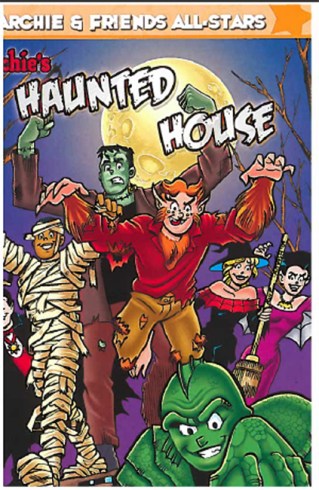
Archie Haunted House CoverThink real hard – what’s the scariest work within haunted house literature?

Think even harder – what is the funniest work of the haunted house genre?

Think harder than “even harder” – which haunted house book best captures the spirit of today’s youth?

Think so hard that your brain bleeds – which haunted house novel has the best graphic illustrations?

Tired of all this thinking? Good, because I am going to give your brain a rest by dumbing things down a bit as I get into the subject of today’s review – Archie’s Haunted House (Archie & Friends All-Stars), which, by the way, is not the crowning achievement for any of the above categories. Truth is, I don’t know which haunted house novel is the scariest, funniest, trendiest or “graphiciest” (the superlative of “graphic.” See I.. oh never mind, just read on!) But it’s not Archie’s Haunted House, but we love Archie anyway. Why? Because he is Archie! (circular reasoning notwithstanding)

Maybe some of you don’t know what an “Archie” is. Archie is the star of fictional comic book series about teenagers who do “teenage-ish” things in the small town or Riverdale. He’s been around since – My god! Really Wikipedia? Since 1941? And here I thought he was the byproduct of the late fifties and early sixties with all that soda- shop/sock hop kind of humor. The all-American teenage Archie, with red hair and all, had a side kick named Jughead, known for his laziness and addiction to junk food. Archie dated either blonde Betty ,the sweet, girl-next-door, or brunette Veronica, the snobby rich girl. Then there was Reggie the conceited one, Big Moose the dimwitted but good-hearted jock, Dilton the brainy nerd. The list goes on.

Archie has survived over the decades, has gone through various incarnations for multiple publications. As previously mentioned, there’s the “sock-hop” era Archie, there’s “Little Archie” (the teenagers as children), there was even “Christian” Archie. Archie tried (but in my opinion, failed miserably) to stay with the times. In the 1980’s he was saying no to drugs, in the 1990’s he was listening to grunge rock – you get the idea. In a parallel universe of Archie (the Life with Archie series),the Archie gang appear as superheroes, secret agents. They marry each other. In one story, poor ol’ Archie dies. But he lives in one of the other 2,343,120 Archie publications (number may be slightly exaggerated.)

As a birthday gag-gift, my friend and colleague gave me this haunted house issue of Archie from 2010. He knows I dig haunted house stuff and he also knows that I am familiar with The Archie comics. I read it and thought “why not ‘review’ it.” But the sum of the review is as follows – “It’s Archie” – more of that circular reasoning for ya!

In the first story, a costume store opens in Riverdale. The costumes are special in that the person who puts them on becomes what they are wearing. Archie is running around Riverdale as a werewolf, Reggie a vampire, etc. It takes nerdy Dilton to break the spell of these magical costumes and return the gang back to normal

The second story is about the oldest house in Riverdale. It’s supposed to be haunted, but Archie Haunted House - Forefathersthe city council sees it only as an eye sore and wants it torn down. But wait! Archie discovers the house is an important piece of history and wants it preserved. But wait again! It really does turn out to be haunted and Archie changes his mind and wants it torn down – after convincing the council to preserve it. Oh brother!
In the third tale, the girls are having a “girl-only” Halloween party and the boys come to scare them. It turn out that the boys become the ones who are scared when they mistakenly conclude that Veronica’s aunt is an axe murderer.

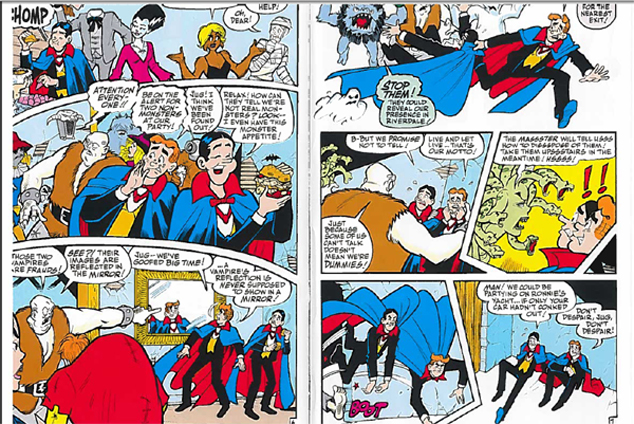
Finally, there’s my favorite story! Archie and Jughead, dressed as vampires, miss Veronica’s Halloween party, and so they are invited to another party – at a haunted house. In attendance are real monsters. There are mummy ladies and werewolf women, There are things with many eyes, there are ogres. There’s even a medusa. When these monsters discover that Archie and Jughead are not real vampires, they are in trouble!

Archie Haunted House - Monster Party

If you want to know the truth, I prefer the Archie comics of the 1960’s and 1970’s. My older sisters had a bunch of these lying around the house when I was growing up. I read em’ and dug em’. I cringe when the comics go out of the way to show how much they have moved with the times. In Archie’s Haunted House, Veronica and Betty discuss a Pearl Jam concert. In 2010 I think it would be a little late for that. Later, they succumb to a magic spell, and the writers compare the trance they fall into to the reactions the girls typically have after watching Brad Pitt on the screen. I would think B and V as teenagers of 2010 would go more for Robert Pattinson of Twilight. That would definitely fit – since these are horror-themed stories.

Ah but oh well. My colleague has told me that Archie comics have always thrown in references to real people and places aimed at referencing the “current times.” I’ll take his word for it; I just don’t remember the older issues being so obvious about it while simultaneously being a decade off track.

Anyway, this is a fun comic book. Not really scary, not “ha ha ha” funny, and I’m not sure who the target audience is. It can’t be today’s millennials, they won’t go for this. And I would guess that many middle-aged folks (like me) and beyond would prefer the older issues. The drawings are decent. That’s good, right? Despite the shortcomings, it’s an enjoyable read. I don’t know why. Oh wait, yes I do – it’s fun because it’s “Archie”

Archie Haunted House Nightview