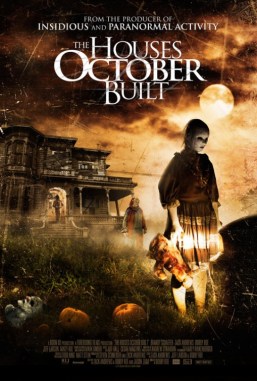
We’re still in October, right? Oh yeah, we’ve left that month of Halloween shenanigans long ago. We’ve already said our thanks in November, went a jingling all the way through December and then somehow ended up in a different year – 2016. Being that it is late January, why am I reviewing a movie about five friends on a road trip seeking out the ultimate Halloween attraction – the haunt to end all haunts? Shouldn’t I have reviewed The Houses October Built in, well, October? I suppose so. But perhaps, if anything, this January review of an October based film will help to take your mind back to a warmer season while you momentarily escape the bitter and miserable cold. Plus, there are no holidays on the immediate horizon. Yeah, yeah, there’s Valentine’s Day coming up around the corner, but who wants a pink-tinted day of lovey-dovey when they can be revisiting Halloween?
The Houses October Built is a “found footage” film, modelled after The Blair Witch Project. It’s the same plot formula – a group of kids go on an adventure, seeking to find the location of rumored site of terror, only to get in over their heads. In the Blair Witch Project, the site is a witch’s house in the middle of the woods. In The Houses October Built, the site is a haunted attraction that takes terror to the extreme. While touring the haunted attractions of Texas in their RV, they get wind of an attraction that is by invite only. It operates secretly and is not bound by rules, ethics and regulations. You know, those “killjoys”. But in the end, things other than “joy” might end up dead. Through word of mouth, chat-groups, email and Facebook, they come across clues that hopefully will lead them to their coveted destination. Little do they realize that the extreme haunt has already begun. They are being stalked by masquerading performers from the haunted houses they have frequented. These stalking occurrences happen repeatedly – from town to town, at this festival, at that campground, on this road, inside their RV. What is going on?
My impressions of this movie are perhaps as strange as the film itself. At first, I decided that I didn’t like it. But I kept thinking about the film, revisiting certain scenes in my head. So then I asked myself, “Hey self, if you dislike this film, why do you keep dwelling on it?” To answer the question, I had to reassess my evaluation. I returned for a second viewing and “skim-watched” the film. After this, I decided that I did, in fact, enjoy the film.
I’ll try to make sense of all this. Wish me luck – here I go!
Sometimes these “found footage” films rub me the wrong way, but not always. I loved Paranormal Activityand while I did not have a love affair with The Blair Witch Project, I didn’t hate it either. The filming of The Houses October Built was choppy. Too often the camera just shut down during some tense nighttime scene only for the film to pick up again the next day on a sunny road. But I get it. It’s supposed to mimic the video recordings of your average tourists on a road trip; unprofessional and at times random. But every so often I felt that it was too self-conscious as a “found footage” film. When the five friends converse in their recreational vehicle – sometimes the scene seems natural and sometimes it does not. Now and then I was left with an ever so slight taste of “Reality TV.” Just so you know, I loathe Reality TV as much as I loathe liver. This is partially due to the interspersing of filmed interviews with the proprietors of haunted attractions. During these interviews, they admit to the existence of “shady” goings-on among the backwoods actors. I guess I prefer the old style. I prefer a reel of storytelling film over chopped up “candid” videos that try to portray “real life drama.” For me, when a film makes no attempt to be anything else other than the piece of fiction that it is, the drama seems more real than a pseudo-documentary that tries so hard to “dramatize the reality.”
The Houses October Built does not always succumb to these trappings. But its overall style does become distracting at times. Now, how about I throw an oxymoron at you?This style of moviemaking enhances the scare factor when the friends begin to encounter the costumed haunters afterhours. The amateur video-capturing from these consumer-based cameras brings out more of the “freak” from these freaks. The cameras highlight them in an uncanny way.
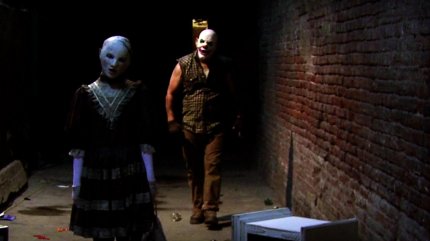
What’s scary about these encounters is this – we’re not sure if these costumed stalkers are merely role playing or if they are in fact surrendering to their horror show persona. Then we are left to ask – are the people that are behind the masks scarier than the monsters they are portraying? While the friends sit around the campfire, a man in white makeup appears from the surrounding woods. He says he works at the nearby haunt but he lives in the woods. There’s something creepy about him. He takes offense at one of the friend’s “backwoods” comment. Then there’s the clown who assaults them in a parking lot, claiming that they were improperly videotaping. There’s the girl with a porcelain face mask that wanders into their trailer. She sits, shifts her eyeballs, and does not answer any of their questions. She then screams and quietly leaves the vehicle. Weird stuff and there’s a whole lot more.
These freaks from the haunts – these are the things that stuck with me when the film was over. In this way I am plagued with the same set of circumstances as the five movie-makers. But not exactly – my life isn’t act risk. (Well hopefully not).
Overall this is a scary and very original film. At times the “found footage” format is distracting but at other times it helps to set a bizarre tone.
Now I shall digress into another topic. I ask myself, “Hey self, is this film appropriate for this blog?” And I ask you, “Does this movie qualify as a Haunted House film?” Definitely not is the usual sense. It is not centered on one huge house. There are no ghosts or paranormal phenomena. It’s a movie about the haunted houses that are the recreational attractions for the thrill seekers. But, a haunted house is a haunted house, right? You say “right.” I knew you would see it my way! So yes, self, this movie fits right into the theme of this blog.
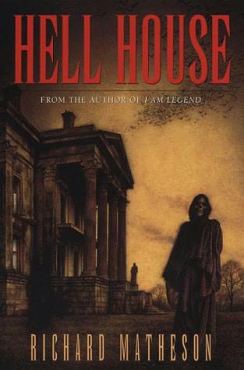
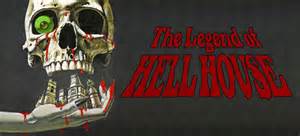
It was several months ago that I looked around inside Hell House through the eyes of director John Hough’s cameramen. I watched The Legend of Hell House and I found the experience engrossingly chilling. But there was much left to be desired. I decided to go deeper. I bought and read the novel: Hell House by Richard Matheson. The book was like a descending staircase; each page was a stair. Step by step, I went down into the depths of the plot and unearthed the complexity of the characters. I arrived at a place the movie couldn’t or wouldn’t take me. Upon finishing the novel, I watched the film again. Did I enjoy it more, less or the same? Let’s find out. But first, an overview of the plot as per the novel.
A rich, old, dying man is willing to pay big money to a team of scientists and psychics if they could prove, once and for all, if there is life after death – or not. I don’t know how one can prove a negative, but let’s not worry about this logical flaw. They have one week to conduct their study. Their “laboratory” is to be “Hell House”, which is described as “The Mt. Everest of Haunted Houses” (This line is from the movie. Is it also in the book? Gosh, I don’t remember!)
The team includes Dr. Lionel Barret, a physicist who dabbles in parapsychology, his wife/assistant Edith, psychic and “mental” medium Florence Tanner, and Ben Fischer, “physical” medium and sole survivor of a “Hell House” expedition that took place years ago. I’ll explain more about the “mental” vs. “physical” mediums later.
The history Hell House is one of drunkenness, orgies, murder, and on and on – you get the idea. At the helm of all this debauchery was Emeric Belasco. When the years of partying finally came to a close, all of the inhabitants of Hell House were dead. However, the body of Emeric was never found.
The four-person investigative team – all of them have experienced supernatural phenomena in the past. So when the house starts to act up, none are surprised or overwhelmed with great fright. Not at first anyway. But there is no disagreement – the house is definitely haunted. However, as to the question concerning the source of this haunting, there is bitter debate.
Dr Barret is a man of science. He theorizes that the human body emits EMR – electromagnetic radiation. This is “psychic” energy – energy created by thoughts and emotions. Due to the rather extreme nature of the house’s former inhabitants, a powerful energy field has remained in the house. Certain people that are sensitive to psychic phenomenon can then tap this energy. These would mediums such Florence Tanner and Ben Fischer.
Here’s a quote from the book. Dr. Lionel Barret is speaking:
Is it any wonder, then, that Hell House is the way it is? Consider the years of violently emotional, destructive – evil, if you will – radiations which have impregnated its interior. Consider the veritable storehouse of noxious power this house became.
Hell House is, in essence, a giant battery, the toxic power of which must, inevitably, be tapped by those who enter it, either intentionally or involuntarily.
While at Hell House, the team experiences many disturbances, including phenomena that is usually attributed to a poltergeist (tables are upturned, dishes go flying, etc.) Barret insists this is on account of Florence Tanner. She is projecting, perhaps unwittingly, her psychic abilities onto the environment. He does not believe in what he terms “surviving personalities”. In other words, there are no such things as ghosts. So he thinks.
Florence vehemently disagrees and is offended that the doctor is blaming her for the disturbances. Not only does she believe that spirits haunt the house, but she is also convinced that one spirit in particular is trying to communicate with her -Daniel Belasco; the son of the evil and manipulative Emeric.
Is the house really haunted by spirits or is there only one field of energy through which all of the supernatural events occur? Are they both correct or are they both wrong?
I won’t answer these questions but I would like to use this opportunity to point out how this book touches on a certain theme within haunted house lore that really fascinates me, and does so extremely well. It has to due with the nature of haunted houses.
There exists this dichotomy
A house is haunted because it has ghosts; the spiritual remains of the deceased. Since the ghosts exist, they have to be someplace, so they might as well shack up at a house. But they could be anywhere – a forest, a bus, etc. But when they’re in a house, the house is haunted. Remove them, and the house is no longer haunted. Case closed.
A house is haunted in and of itself. The haunting is inherent. There may or may not be ghosts. The house itself is in some way causing the paranormal phenomenon.
Some haunted house novels are all about the first scenario while others delve more into the second setup. Hell House presents both and lures its readers on a mysterious journey as they wonder which situation best describes the haunting of Hell House.
*********************
So what of the film?
I’d say maybe I enjoyed it a bit more the second time around, but this is because I had a better understanding of the story, thanks to the book. Whereas I did see the ideological conflict between Dr. Barret and Florence Tanner on first viewing, it was less obvious and more confusing. While I knew Dr. Barret was a believer in the paranormal (he witnessed the formation of ectoplasm for Christ’s sake!), I didn’t understand his specific viewpoints as they related to the field of science until the near end of the movie. Also, the book cleared up the differences between a “mental” and “physical” medium. (See readers, I told you I’d get around to explaining this. You thought I’d forgotten!) Florence Tanner is a mental medium. She can feel the presence of evil. She can understand the thoughts and emotions of spirits (or maybe the thoughts and emotions that were left behind). However, she is surprised when physical objects move after her sittings (when she goes into a spiritual trance). This shouldn’t happen because that kind of disturbance should only occur with “physical” mediums.
The film fails at explaining the finer points of the plot. And the ending is very abrupt and awkward. The book does a much better job of summarizing the final events and solving the mystery of Hell House. In order to enjoy the film, just forget about nitty-gritty details of the story and just absorb the haunted house atmosphere. Look at it from a more simplistic point of view and think of it only as a story about four people who are trying to survive a stay at a haunted house and leave it at that. From a visual perspective, including all the props, decorations, furnishings, the film succeeded in creating an eerie, gothic-style haunting.
I wasted too much time comparing The Legend of Hell House to The Haunting. Admittedly, they are similar in some ways but they each have their own identity. I like The Haunting better than The Legend of Hell House but this should be a “never mind.” I saw both films early on in my Haunted House project, viewing The Haunting before The Legend of Hell House. Perhaps I was too attached to The Haunting. I treated it as my “first love” and would compare my next relationships to my first haunting embrace. That is a “no-no” in the world of dating and love, so I guess it should be off limits for enjoying haunted house films as well.
If you’re looking for a haunted house novel that strays from tropes and formula, you’ve come to the right place. If you’re looking for a unique style, settle on in, author Garrett Cook’s A God of Hungry Walls will see your quest for distinctive writing and raise you twenty!
But – If you’re looking for a quaint tale of chilling yet delightful specters, go away. These walls don’t want you and you will not want to read about what goes on inside of them. If you are easily offended; if graphic depictions of sexual acts disturb you, if you find vulgar language upsetting, then run like hell. Likewise, if you are unable to digest descriptive accounts of torture, stay away – stay far away. Do not enter the confines where there is a God of Hungry Walls. You will not like this god.
The story is told in the first person – the almighty capital “I”! Who is behind this “I”? Well let me say that the narrative is from the viewpoint of whatever it is that does the haunting. Perhaps it’s the house itself. Its power is great; it exceeds the limited scope of your average ghost or demon. It is the master of all that goes on within its walls. Often It refers to its occupants as ‘toys from the toy box’.
Four college-age students share the house – two young men and two young women. It manipulates them, locks them together in sexual intimacy; often times perverted with a touch of sadism. Okay, there’s more than a touch, more like a hard slap! Then, we see that the house is messing around with other occupants; such as a serial killer doctor and a tortured girl who lived in a cage like a dog. Where do these occupants suddenly come from? They were there since the day they died within the walls of the house (long before the college kids acquired the place). They belong to the house and It can toss them into being whenever it wants.
Admittedly, I didn’t always know where the story was going. At certain parts I was left thinking “what is the author getting at there?” But maybe I wasn’t meant to understand it all. After all, I am following the lead of a mad, mad force. The “mad” have no rhyme or reason. They are insatiable, always “hungry”, hence “The God of Hungry Walls.
A lot of the book is subject to interpretation. Certain names/concepts come up, such as “Closetsong.” What is that? In the end, I think I figured it out. But maybe my understanding will be different than yours, or the authors, or even The God of Hungry Walls.
For those that can pass the tests that I have outlined in the first two paragraphs of this review, I recommend giving this book a read. It certainly won’t be boring, that’s for sure.
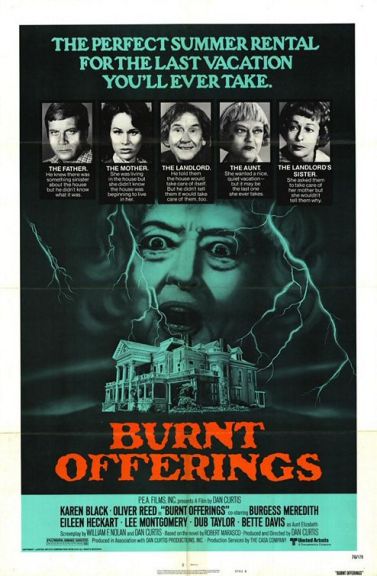
I remember seeing Burnt Offerings on television when I was about ten years old. Certain images from the movie stayed with me all these years. One such image is the movie’s prominent haunting figure – a creepy looking hearse driver. His clothes, cap and even his glasses, are black; the appropriate color for a funeral. However, he dons an inappropriate smile, as if death is something delightful. Was he a ghost? Was he death itself? I couldn’t remember. Then there is the long row of photographs in the attic. Some sepia toned, some in modern color. Who were these people in the photos?
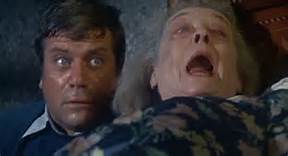
There are also certain scenes that replayed in mind from time to time. Our old friend the hearse driver bangs at the chamber door, frightening a dying old lady. He barges through the door with a coffin and his signature creepy smile.
I also remembered layers of bricks breaking away from the house; the house shedding them the way a snake sheds its skin.
Yes sir, I thought it was quite the movie back in 1981. But would I feel the same way about this film as an adult? I wanted to find out. So I watched this on amazon.com last Sunday night. I was not disappointed. It was a good film when I was ten years old and it remains a good film at the ripe, young age of forty-four!
What I like most about the film is the overall theme. My favorite type of haunted house movie involves a house with a mind of its own; a house that acts independently of or in equal collusion with any spirits that may haunt it. Burnt Offerings “offers” viewers such a house. In return it asks for only one simple thing – the life force of the current occupants. Of course, we who sit safely in our homes cry out “it’s a deal!” Because we love such things! And the house benefits as well – it rejuvenates.
Oh don’t get all sour cause I’m treading into spoiler land! Any astute viewer should figure this out within the first thirty minutes of the film.
Ben and Marian Rolf (Oliver Reed and Karen Black), along with their twelve year old son David (Lee Montgomery – hey, did you know this kid played in a movie about a boy who befriends a pack of killer rats? Well now you do – The movie is Ben) and Ben’s elderly aunt (Bette Davis!) lease a house for the duration of the summer. The rent was just too cheap to pass up. But on the first day, the elderly brother and sister that own the house (played by Eileen Heckart and Burgess Meredith) explain the main catch – they will have to care for their elderly mother that lives in the attic. Oh but she’s not a bother, they say. She never comes out of her room and all that she would need is tray with a meal placed beside her door at the appropriate meal times.
This is one of those films that have many moments that are subject to interpretation. I still don’t know the identity or composition of that scary hearse driver dude. And there is something about that brother and sister, The Allardyces, that will have viewers wondering. Oh and the ending, what did it mean when he opened #$% $*$* and saw &*^^ as the *^ !@#$% and then ended up being &*&*# & out the *#%$@# ?? (Yeah, I’m not going to totally spoil this film for ya, so ya have to bear with the font symbols.)
Speaking of the Allardyces, Burgess Meredith has a brief but commanding role. He is awesome!
This film is based on the 1973 novel of the same name, written by Robert Morasco. I haven’t read it, but I’m betting the book is mighty darn good as well. I will read it, but for now, I will just live with the experience of this movie. It’s a pretty good experience after all!
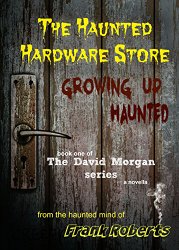
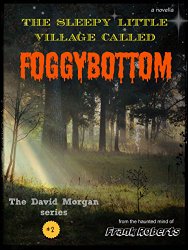
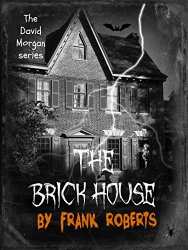
Houses in need of love and renovation – historical tales surrounding such houses and the ghosts that come with them. This is what readers encounter in Frank Robert’s anthology: Ghost Stories: 5-Volume Set (The David Morgan Ghost Series)
David Morgan has a love for old buildings; churches, stores, theaters, houses, inns, etc. He sees the beauty that lies hidden underneath the savagery of time. Being a skilled carpenter and all around handy man, he embarks upon projects to restore these buildings to their original state, preserving the historical value, quirks and all. Now you can’t go through the process of demolishing and reconstructing such historical buildings without churning out few ghosts! Exhuming spirits is all part of the job; it comes with the territory. And there is no better man for the job than David Morgan. Ghosts have been visiting him ever since he was a little boy.
I can tell you one thing: Author Frank Roberts had fun writing these stories. I have never met the man and no, I can’t read his mind. But I can (and did) read his work and it is clear that he is at home in these tales. He loves the building restoration business and all that comes with it – the blueprints, the multiple parties that are involved in the planning, the camaraderie of the workers while on the worksite. Likewise, he enjoys learning about local history. His invented accounts of community life from eras long gone are quite intriguing; readers learn what gave these fictional buildings life. Finally, he loves a good ghost story, as do I. And there are plenty of interesting ghosts floating about in his stories.
Sprinkled throughout the pages are themes of Americana. These include customs and traditions, such as Memorial Day parades and Fourth of July picnics. But when hosting such events, watch out! You never know if a ghost of a soldier might show up to give salute, or if a ghostly brass band starts to perform deep into the nights preceding the celebration. Then there are accounts of early colonial life and the struggle to forge out an existence in the harsh elements. Harsh times can produce some violent characters, and don’t be surprised is these characters reappear a century or two later. In one story, David is called upon to restore an old-time theater that, when completed, will be running the classics, such as Laurel and Hardy films. All will go well so long as his restoration efforts are not upstaged by a deceased actor from the days of yore!
As previously mentioned, the ghosts in these stories are alive and colorful! (Well, maybe not “alive” but you know what I mean.) There is a ghost of a little girl that resides in a tree. There are spirits trapped inside mirrors. There are vengeful ghosts that seek to harm the living. And let’s not forget the spirit of a dog and the ghostly antics of a deceased monkey!
As intriguing as the spirits in these stories are, it is thespirit OF these tales the captures the reader’s interest. This “spirit” is made up of everything I have written above – local histories, Americana, and a deep seeded love for the material.
There are some drawbacks to this series. It would benefit from another round of editing in all areas: grammar, style and content. In numerous places throughout these tales, the plot derails. This is especially true when the stories come to completion; some of these stories “end” but do not “conclude.” Readers are left with loose ends, and in one case in particular my sole reaction was along the line of “WTF??” Too often, the narrative gets bogged down in the nitty-gritty details of building reconstruction. What is written is fine for readers who are fans of the home remodeling show “This Old House”, but for lay people with little knowledge of carpentry, the narrative can get a bit daunting. Finally there are frequent instances of typos and awkwardly constructed sentences.
Now get this; I choose not to take off too many points for the grammar errors and occasional dents in the story structure. Being an indie author myself, I know how difficult it is to have a book edited. I have heard that one should NEVER edit their own work. However, sometimes “one’s own self” is all that a struggling writer can afford when it comes to editing. Hell, I’ll bet those reading this blog entry have stumbled across some typos that I have made.
So I ask prospective readers to give these stories a chance in spite of the imperfections. They come from the author’s heart and soul, and these are two wonderful places for any story to originate.
These five stories are published both as separate books and as a collection. I have already posted the link for the collection in the first paragraph. Below are links for each individual story.
The Haunted Hardware Store: Growing Up Haunted (The David Morgan Series Book 1)
The Sleepy Little Village Called Foggybottom (The David Morgan Series Book 2)
The Lost River Town: Fiona’s Tree (The David Morgan Series Book 3)
The Haunting of Old Liberty: Where Not All Performances are Live (The David Morgan Series Book 4)
The Brick House: The Curse of Hope Island (The David Morgan Series Book 5)
Frank Roberts frequently visits and posts at my Haunted House Facebook page. Stop by and say “Hi” to Frank! (And like my page if you haven’t don so already.)
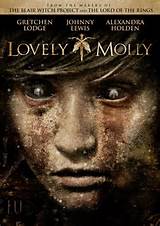
Of all the haunted house movies I have reviewed, Lovely Molly is by far the most disturbing. There is madness. Rape. Murder. Sounds like a standard horror movie so far, eh? Um, not quite. There are films that deal with these same horrific themes, but by the movie’s end, any disquieting feelings on the part of viewers are left behind in the theaters or concealed within the DVD box. However, there is this raw quality about Lovely Molly that allows it to hammer those brutal themes deep into the psyche like nails into the coffin.
With your average slasher film, murder is part of the “game” and the remains of victims are often sprawled about in a way that is mimicked by Halloween yard decorations. Lovely Molly shows close ups of a murdered victim – body bloated, draping arms of a purplish hue, sightless eyes wide open…still open…not going to close.. ever. Insanity has become comical with the likes of Jack Nicholson in movies such as The Shining (Heeeeeere’s Johnny!). There is nothing humorous about poor Molly’s plight into madness. There are the non-erotic nude scenes with Molly in near fetal position; vulnerable, beyond help. When it came to certain scenes where she acted out violently, I had to turn away from the screen. Then there’s rape, never a subject to be taken lightly. While there are no scenes of forced penetration, the implications of such brutal acts are there and they are just as unsettling, perhaps even more so.
All this said, this is well made film. Admittedly, it’s difficult to watch. It is NOT for the timid or easily frazzled viewer. I’ll be honest; I was not in the right emotional state when I began watching this movie. I had to turn it off. I continued it the next day.
It is directed and partially written by Eduardo Sanchez, the same guy at the helm of The Blair Witch Project. So yes, a good part of the film is shown through the eyes of a video camera operated by one of the movie’s main characters. Ah but relax all you Blair Witch Project haters, the camera doesn’t shake! Not one bit.
On the surface, the story is simple. Newlyweds Molly and Tim move into Molly’s childhood house. It is haunted. But by what? This is where the story gets more complex. It is Molly that is on the receiving end of the terror. Her husband and sister cannot figure out what is troubling her. Is she haunted by hallucinations? A tormented past? Ghosts? Demons? Or all of the above? The film leaves this vague, appropriately so. An unknown assailant is one of the scariest of all tormentors. Isn’t that what fear is all about anyway, the apprehension of the unknown?
Another terrorizing agent of equal stature is one’s own mind. For me, the manifestation of fear is most traumatizing when the object of such fear originates from your own head. It is terrifying when reality is deemed untrustworthy. One’s own traumatic confusion about the “objective” world is far more frightening than a ghost that is visible to all.
However, I don’t mean to imply that ghosts and/or demons are absent from this film. All I’m saying is that maybe they’re there and maybe they’re not. Or maybe they are present in a figurative sense. It’s up to you to decide.
Everything I have written so far is based exclusively on the film. The DVD comes with extra features. There are four short segments. I recommend skipping these. They are tempting to watch on account of the film being vague. To alleviate confusion, I went for the bonus material. Bad mistake! The bonus material removes all of the mystery from the film. How does it do that? I’m not gonna tell ya, cause then it will be me that ruins the mystery. I am not, nor have I ever been a “ruiner.” Trust me, just skip it.
Since this is a brutal and disconcerting film, it’s difficult to call it ‘enjoyable.’ None of it was “encased in ‘joy.’” But it is a decent film and I recommend it for those who can withstand it. It’s not a film for everyone.
**** Here’s an interesting side note. The soundtrack for the film is composed by Tortoise. This is a Chicago based indie/post punk band. My friend is really into them but I confess that I am not that familiar with them. After seeing this movie, I am still unfamiliar with them because for the life of me, I can’t remember any music in the film. And, there appears not to be a soundtrack that is for sale. So I don’t know how I can ever hear what Tortoise did for this film. Boo hoo! I guess I’ll just explore their standard studio albums.
When I heard that the writer and director of Pan’s Labyrinth was writing and directing a haunted house movie, I got excited. I looked forward to seeing the latest film from visionary Guillermo Del Toro. I couldn’t wait to see “his” ghosts; freed from his imagination and set loose on the big screen. To these ends, my wishes came true on Tuesday night, Oct 27. My visual appetite was satisfied, as was any desire I had concerning flair. It was a stylish film indeed. But alas, something was missing.
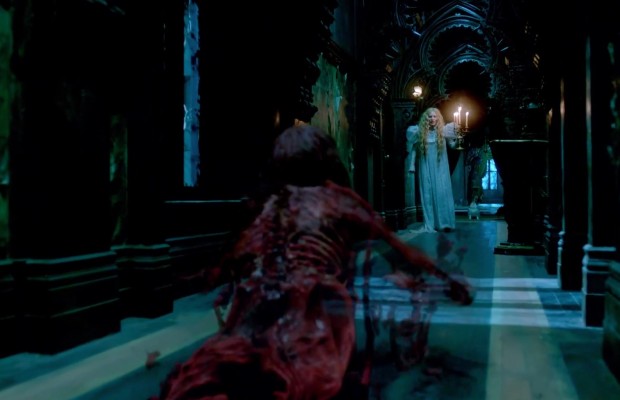
Let me being with what I liked about Crimson Peak. I liked the atmosphere. I liked the gothic manor and all its intricacies, seen and unseen. I liked the winding staircase and cage-like elevator. I like the unfinished roof and the atmospheric snow that flowed continuously into the house like background waterfalls. I loved all the props – the candelabras, the portraits, the piano. The music is appropriately haunting. The ghosts are great. Silky and spooky; they are like no ghosts I had ever seen on the screen.
I liked the overall tone – the Victorian/Edwardian formality in dress and speech. The film transported me out of the theater and into a different time period without any turbulence. It was nice to see a shout out to those glorious horror films of yore.
And the film is rich with symbolism. It’s poetic.
So much is good about the film. So it disheartens me to say that I left the theater feeling slightly underwhelmed. Why is this? It was the slow and unpromising plot. Actually, cancel that word “unpromising.” It was promising. The problem was that it made promises but failed to deliver upon them.
It teased out mystery where there was none. It built up false suspense and while the story didn’t leave viewers hanging, in the end it seemed to shrug apologetically for the fact that there was never a reason to hang at all.
It is difficult to provide examples without trudging into the storyline. But I don’t want to reveal too much, although the risk of spoiler contamination is very low. The young and handsome Thomas Sharpe arrives to New York from England with his sister. He is an opportunist and he tries to convince Carter Cushing to invest in technology that he has developed for mining clay. Carter turns him down. So Thomas and his mysterious sister will go back England, but not until Thomas woos away Carter’s daughter Edith. Carter does not trust Thomas. He says that there is something unlikable about him but he can’t explain what it is. But at least Thomas is friendly and charming, unlike his sister who is cold and expressionless. Thomas marries Edith and the three return to England to live in the spooky old mansion on top of Crimson Peak.
Here’s a hint as to how the suspense works in this film: if a character has a hunch (like Carter has with Thomas), he is probably correct. If a person appears evil, the person is evil. If there were a butler in this film, then the quip “the butler did it” would surely play out (There is no butler in this film.)
One might say, “Okay, so it’s a straightforward film. What’s wrong with that?” What’s wrong is that it starts viewers out on arcane paths, only to merge them into a plain old narrative of narrow storytelling. If you want to tell a straightforward, what-you-see-is what- you-get story, that’s fine. But don’t lead the viewers on with secrets and hidden histories. There are many examples of this kind of leading, but I won’t mention them, because I guess even a letdown can be a spoiler.
Imagine receiving a present. Not only is the wrapping paper beautiful, but there are bows and bells and pieces of candy attached to the box as well. Peel away all this and you find that the design of the box is appealing too. Inside the box there are decorative tissues and fluffy coverings that feel soft against your fingertips. Remove this covering and you find – tube socks. Happy Birthday. If this were a terrible movie with absolutely no depth, then my analogy would be a bit different. It would entail dazzling wrappings on a crappy, empty box. But it’s not terrible, it’s just, well, it’s tube socks.
Let’s end on a mostly positive note as I focus in on the ghosts. I’ll call this the “good, the blah, and the good again”
The good – The ghosts looked good. The CGI worked to the film’s benefit. The ghosts didn’t come off as cartoonish. They looked genuinely creepy.
The blah – We didn’t learn much about the ghosts. They were just sort of “there”, part of the background. Yes they scared the wits out of poor Edith on several occasions. But they didn’t contribute all that much too the overall workings of the story.
The good again – Kudos for allowing viewers the time to take in the ghosts! They didn’t flash rudely on the screen as did the ghosts of other modern ghost movies such as The Haunting of Connecticut and the remake of Amityville Horror. Rather, they traversed slowly and creepily. They peered around walls. They peaked out of closets. THIS is what “scary” is all about.
So that’s about it. I really, really, wanted to like this film. And I guess I did, but I just couldn’t bring myself to love it.
The Cat and the Canary features a dead millionaire, greedy relatives, a strange maid, a psychotic killer and…Bob Hope? Yeah its got all “them peoples” along with a creepy old house, a coveted inheritance, murder and mayhem, and a lot of hilarious one-liners from the nervous yet witty house guest Wally Campbell. You guessed it; Campbell is played by Bob Hope. It’s horror mixed with comedy.
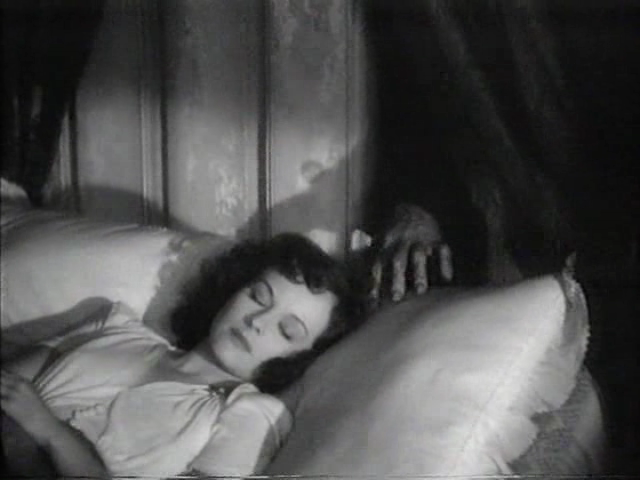
Here’s the nuts & bolts of the story. The late Millionaire Cyrus Norman did not trust his heirs. No he did not! So he had these weird ass conditions concerning the distribution of his estate. The reading of the will does not take place until ten years after Cyrus’s death per his wishes. When that ten year anniversary finally comes, the prospective inheritors gather together in his huge home in the Louisiana bayous for the midnight will reading. Along with the lawyer and the maid, there are also three women and three men. The six are the last remaining descendants of Cyrus and candidates for the passed down fortune. One of the women , Joyce Norman, played by Paulette Goddard (former wife of Charlie Chaplin) wins the prize. But there is a catch – which brings us to the second odd stipulation of the will. If the sole heir, who in this case is Joyce, is proven to be mentally ill within 30 days of the reading of the will, then her claim to the fortune is forfeited and Cyrus’s estate gets passed down to a second heir. The identity of the second heir is withheld; the papers are protectively sealed in an envelope that remains in the possession of the lawyer. Now, we viewers know that there will be a mad rush to drive poor Joyce insane, and that this rush won’t be extended over a thirty day period. The tricks and misdeeds against the woman will all take place within the house over the next several hours by one or more of the scheming others that are desperate to lay claim to the inheritance. See, they are stranded there. They all came via paddle boat on the rivers of the bayou. The boat guy won’t taxi his boat after hours, so they all must spend the night in the creepy house. Spoooooky!
Oh yeah, the creepy maid says there are spirits in the house.
And oh yeah again, there is an escapee from the asylum running around the property.
And oh yeah for the third and final time – wasn’t that funny how I linked the words “ten years after” to the famous rock band of the same name? Back up there at the beginning of the second paragraph, I linked….oh never mind! Read on.
This movie is a remake of the 1927 silent film of the same name. Furthermore, both films are based on the 1922 play by John Willard. The play reveals the reasoning for the title of the story. Cyrus West (not “Norman”, in the play his surname is West) says of his relatives, “(They) have watched my wealth as if they were cats, and I — a canary”.
I really don’t have much more to say about this film other than that I enjoyed it. But I must confess – this is the first Bob Hope film that I have seen. His humor might be dated, but to me it is fresh. In the film, the maid says to Wally (Bob Hope) something along the lines of “I sense spirits all around you” to which Wally says, “Can you grab a few them and throw them in glass with ice?” THAT is funny! Yes it is, don’t argue with me! Without Hope, this film would be only be so-so. Sometimes you just have to have “Hope!”
Here’s a side note: I saw this film on Saturday, Oct 17, 2015 on Svengoolie on MeTV. Sven’s the guy that shows me many of these old time haunted house films. I love “Da’ Sven” and you should love him too!
Do you have MeTV in your area? No, it’s not a cable station. It’s a regular station on terrestrial television. You over here, do you have MeTV? You don’t? Aww, I’m sorry. But wait you..over there… do you have access? You do? Great! Turn on Svengoolie on MeTV’s Super Sci-Fi Saturday night!
It seems as if every few weeks, there is a mass shooting. Every news cycle seems to contain some account of a guy who mows down several people with a gun. I have often wondered, “Did mass shootings like we have today occur ten or twenty years ago? Thirty of forty years ago?” I guess the answer is – yes they did occur, but maybe not with such a high frequency.
There was one such shooting in Amityville, NY back in 1974. Twenty-three year old Ronald “Butch” DeFeo Jr slaughtered his family with a .35 Marlin Rifle while they slept in their beds. He killed his parents along with his four siblings, ranging in ages from eighteen to nine. Ronald DeFeo currently resides in Green Haven Correctional Facility in NY where he is serving several life sentences.
What does one make of such a tragedy? The answer is: Movies, books. In short -The Amityville Franchise. I’m sorry to put it so bluntly, but it is what it is. In one platform or another, millions of people have come to know the haunted house that is the subject of The Amityville Horror. There were several books on the subject and many more movies. Too many movies. There have been fourteen for heaven’s sake!
The tragic tale of the DeFeos is true. It’s what happened afterward that is subject to speculation. What happened in the house a year or so later after the murders varies from source to source. Any understanding of what may or may not have occurred at 112 Ocean Drive is also contingent upon one’s belief in paranormal phenomena. If you believe in ghosts and demons, then it is quite possible you can believe the accounts of George and Kathleen Lutz who lived in the Amityville house several months after the murders took place. If you don’t believe in such entities, then it’s easier to dismiss their story as a hoax.
As far as ghosts and demons are concerned, I remain safely neutral. I’m not saying I disbelieve but, well, there just haven’t been too many occasions where a spirit has gone a floating across my path! Or, as my dad used to say when I asked him if he believed in ghosts, “Nah! I haven’t seen one of them in years!” In other words, I am not here to verify the accuracy of this tale. What I am going to do is judge the content and scariness of the story and not how well it translates into this thing we call “truth”. However, toward the end of the review, I will bring up various articles that aim at getting at “the truth” because the search for the facts are indeed a tale unto itself and part of the larger story.
The basics of the story are this – George and Kathleen Lutz, along with Kathleen’s three children, move into the DeFeo house. 28 days later, they flee, leaving behind all their possessions. They claim to have fled demonic activity. It is implied that the demonic manifestations that haunted them are the same forces that drove Ronald DeFeo to murder his family. After a while, they had their story published in a book written by Jay Anson. Following this was the 1979 movie.
I will begin with the book, then go on to review both the 1979 and the 2005 movie
Warning: There will be major spoilers ahead
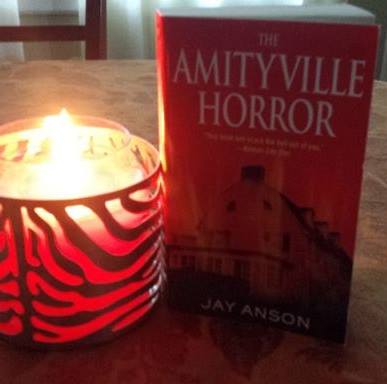
Amityville Horror the book – by Jay Anson and George and Kathleen Lutz
Before reading the book, I was told that it would be much scarier than the movie. It had been a long time since I had seen the film, maybe thirty years or more. I don’t remember the film being all that frightening. Of course, I had seen it on terrestrial television; it was heavily edited. Finally, two weeks ago, I saw the uncut, original film. It was pretty creepy, but would the book be better?
Answer: yes. I do admit that I wasn’t super impressed with the first few pages. It reads like a logbook polished up with narrative. There are a lot of dates and times, sentences like “They moved in on December 23.” But this is the prologue, and it is necessary in order to summarize the timeframe. The rest of the book captures this timeframe in detail, day by day. It is a diary detailing the supernatural disturbances that haunt the Lutz family for 28 days as they try and fail to make a home out of colonial house on Ocean Drive.
The disturbances increase in both intensity and frequency until they have no choice but to flee.
The book also chronicles the plight of Father Frank Mancuso. He arrives at the Lutz’s early on to bless the house. Upon arrival, he is overcome with a sense of dread. He feels deathly ill. And he hears a voice that told him to “Get out!!” After this, Father Mancuso is plagued with a serious flu. It gets worse whenever George Lutz tries to contact him. When he calls, static often disrupts the conversation and the line goes dead. Then the flu symptoms increase in severity. Blisters appear on his hands.
Some of the disturbances that the Lutz family experienced include:
Cold spots
Unwarranted psychological stress
Windows opening and closing
Doors being ripped from their hinges
Gelatinous mass dripping from walls
Toxic smells
Ghostly figures
Here’s a breakdown on how the house affected some of the family members individually:
George Lutz – He is cold all the time, even when the house is warm. He is irritable, withdrawn, avoids going into work. He hears things, such as an invisible marching band traipsing through his living room. Prone to nightmares. His body levitates while sleeping.
Kathy Lutz – Felt the presence of a woman. On several occasions, felt ghostly arms wrapped around her; hands pressed against her shoulders. Saw her body mutate into that of an old crone. Her body also levitates while sleeping.
Missy Lutz – Befriends a demonic pig named Jodie. George catches a glimpse of this pig through the window. Kathy sees its glowing red eyes
The book also has diagrams of each of the three floors of the Amityville house.
All in all, it is an excellent and scary read. And yes it is much scarier than the film, but the movie is pretty scary as well.
Amityville Horror the Movie – 1979 – Directed by Stuart Rosenberg
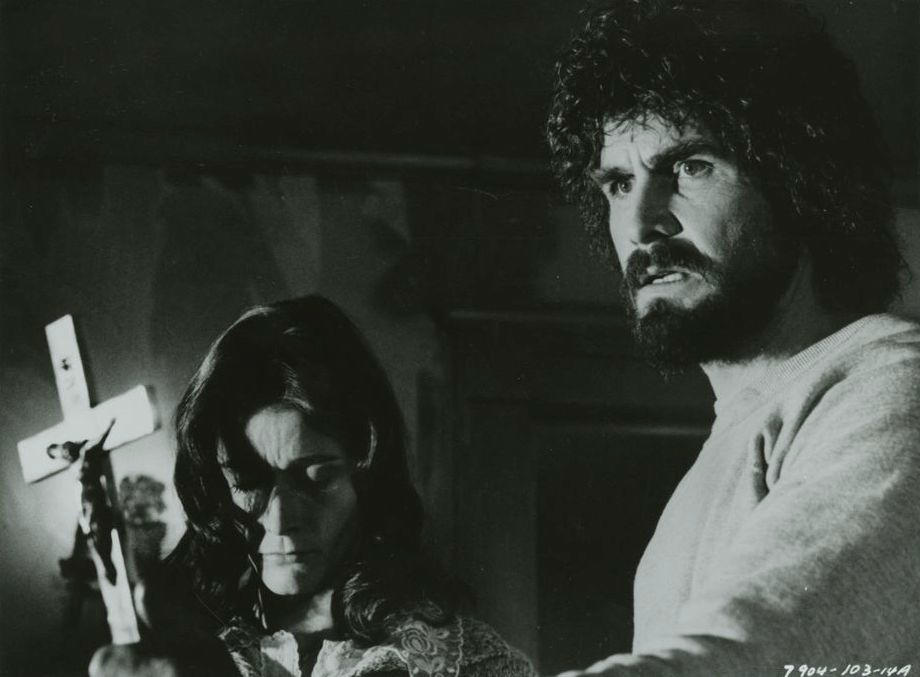
On Rottontomatoes.com, this film only has a 24% approval rating among critics. This surprises me. The Amityville Horror certainly isn’t the best haunted house film out there, but it’s not so bad. In fact I’ll say it’s “pretty good,” so long as “pretty good” stands for slightly less than “good.” The establishing shots of the house are excellent. Who can forget those creepy attic windows that look like jack-o-lantern eyes! I love the background music. Now-a-days, creepy music is often replaced by the sounds of electronic jolts and thuds. Nothing tops mood setting music such as this:
Who can resist those singing children and their haunting “la la’s”?
The book is better, but the film stands on its own. There are several differences between the book and the film and I will outline them later in the review. The book is able to cover more ground, but that is to be expected since the book has 300 + pages compared to the film’s 2 hours of footage. What the film is able to capture with its limited amount of time is done reasonably well. The mood is eerie, the characters are mostly well developed, especially Rod Stieger as Father DeLaney. Katherine Lutz’s character could have used a bit more development.
Amityville Horror the Movie – 2005 – Andrew Douglas
Yeah, this film isn’t all that good. I was enjoying it in the beginning and accepting of some of the “modern renovations.” I get it. People don’t have imaginations anymore. If a film is to be about ghosts, people want to see the ghosts, and they want them quick. So unlike the first film, there are a lot of shots of ghosts. Or should I say “flashes of ghosts.” They come and go quickly like a fast food meal. I enjoyed seeing the ghosts. I really did.
But as the film moved along, things went too fast. Too much noise and chaos, too much “in your face.”
Here’s something I have to mention. In the first film, George has an awesome line. In response to how he feels about purchasing a house where a mass murderer occurred, he says, “Houses don’t have memories”. He is proven wrong, but that sentence says a lot. Change the “don’t” to “do” and you have a four letter sentence that compacts so much and describes haunted houses to a tee. In the 2005 film the line is, “Houses don’t kill people. People kill people.” Cringe time! Save that slogan for the NRA.
Here are the different ways each medium deals with some of the story’s main themes:
Psychological Profile of family:
Book – Whole family is on edge, psychological strain. Both George and Kathy hit their children. Kids are restless
1979 film – Mostly focuses on George. House works on him, making viewers think he might kill his wife and children in the same way that Ron Defeo slaughtered his family.
2005 film – George goes insane, becomes psychotic. It is the George Lutz of the 1979 film on steroids. A major rip-off of The Shining if you ask me.
Father Mancuso
Book – Blesses house, hears “get out”, gets violently ill, flu and rashes. When he gets better, he talks to George and gets worse again. Often calls to George are interrupted with static
1979 film – Has a different name. Comes to bless house, attacked by flies (Flies don’t harm him in book). It’s Kathy that reaches out to the Father, not George. Father ends up going blind and left for a shell of a man
2005 film– Very little coverage of the priest. Blesses house, attacked by flies. Won’t come back. Phone calls back and forth are removed from this film.
Jodie
Book and 1979 movie – Imaginary friend of Missy, turns out to be real but only Missy can see her. Jodie is a pig. A demonic pig.
2005 movie – Jodie is a young girl, presumably a young sister of Ron DeFeo. Guess having a pig as a friend is too weird and abstract for the 2000 years, so in comes the little girl. “Bring back the pig.” I say. Now in the 1979 film, the pig is never shown, accept for the two glowing red eyes. In the 2005 film the little girl Jodie is shown several times. Still I vote for the unseen pig.
Babysitter
Book – there is no babysitter in the book
1979 film – Brief coverage of babysitter. She wears a dental retainer that covers half of her face. Jodie locks her in closet.
2005 film – Bigger deal of babysitter. She is a trampy stoner, and she teases her 12 year old boy seductively. She too gets locked in closet by Jodie.
Basement
Book and 1979 film – a secret red room is discovered. It emits bad vibes.
2005 film – more than a room. Passageway where George gets experiences flashes from the far back past. Indians were tortured in these hallways –tortured by a satanic priest named Ketchum.
Visual manifestations
Book – Pig and White hooded figure
1979 film – less visual manifestations than book. Mostly just eyes (red dots out window)
2005 film – Many- of Jodie the girl, of tortured Indian souls, of Ketcham.
So, is this a true story?
After the Lutz family fled the house, several paranormal teams investigated the house, including the famous Ed and Lorraine Warren. All of them claim to have felt some kind of unnatural presence. However, others have doubts. Locksmiths have investigated the house and have determined that the doors did not come off the hinges in the ways that the Lutz family has claimed. Also, in regards to the history of the house, long before the DeFeos – a history that is documented in the book – not true. The book claims that the house rests on a site where Shinnecock Indians had abandoned the mentally ill. But Shinnecock historians say this is false. Testimony from the real Father Mancuso has been sketchy.
It has been suggested by William Weber, lawyer for Ronald DeFeo, that the whole thing was a hoax. He said that he and the Lutzes concocted the story and were going to publish the book, but in the end, the Lutz’z sought Jay Anston to write the book.
On the other hand, Anston believes the story. In an afterword he says that there are just too many intricate details that couldn’t be made up. George Lutz died in 2006, but a year before his death, he stated in an interview that what happened to he and his family in the book was true.
In repsonse to some of the websites seeking to discredit the Lutz’s, George had developed his own sites:
The first leads to a page showing the house. When clicking on the links, there is a white screen with an internal server error. The second site leads to Yahoo – in Japanese!
What’s going on? Is it like with the phone line static – interruptions happening all over again? Are the demons fucking with George once again, preventing him from reaching out?
Whether true or not, the ghost story of Amityville Horror is indeed a good one. If it’s false, it is then a shame that the lives of the DeFeos were so exploited – real victims of murder – their tale being only a back story for a fiction Hollywood tale. When I think about it this way, I feel bad for even giving The Amityville Horror a moment of my time. But then again, tales will arise from tragedy, both real and fictional. There would be no Count Dracula without the real life Vlad the Impaler. So I suppose a good story is simply that – “a good story”, no matter where it comes from.
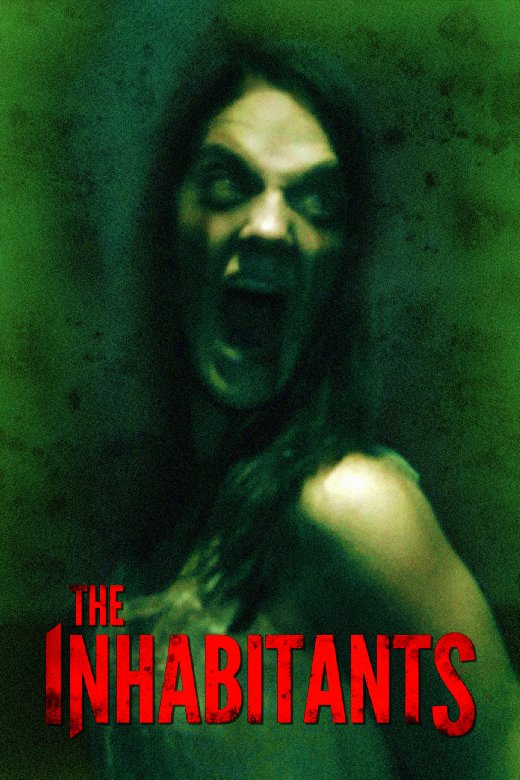
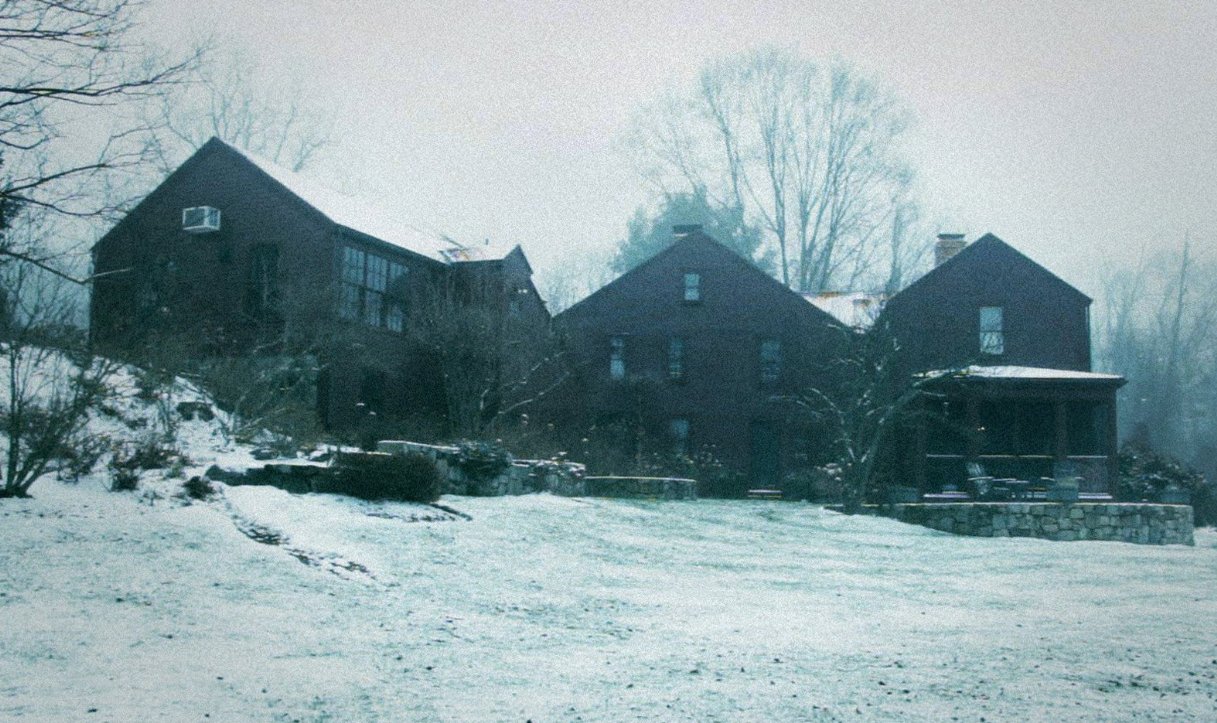
A young couple, Dan and Jessica, purchase a Bed and Breakfast. Their new home is one of the oldest houses in New England. It comes equipped with furniture. Some of it is rather strange, such as an antique birthing chair with blood around the seat’s rim. But they will soon learn that there are far stranger things occupying the house than bloody chairs. There are others living in the house. Excuse me, did I say “living?” Cancel that, for these occupants are no longer alive. These occupants are The Inhabitants.
The Inhabitants is an indie film from brothers Michael and Shawn Rasmussen, writers of John Carpenter’s The Ward. Admittedly, there’s nothing new going on in this film. It’s a familiar concept: a couple moves into a new house – there is something strange about the sellers – the couple tries to adjust to the new living arrangement and then spooky stuff transpires. Before anything real frightening happens, there exists the kind of foreshadowing that is common in haunted house film. Library books reveal the Inn’s history of witchcraft and murder. Yokels call the place “the witch house. Dementia-stricken Mrs. Stanton, former Inn owner, makes enigmatic remarks to the couple. (“Please take care of the children!” What children? The couple is childless!)
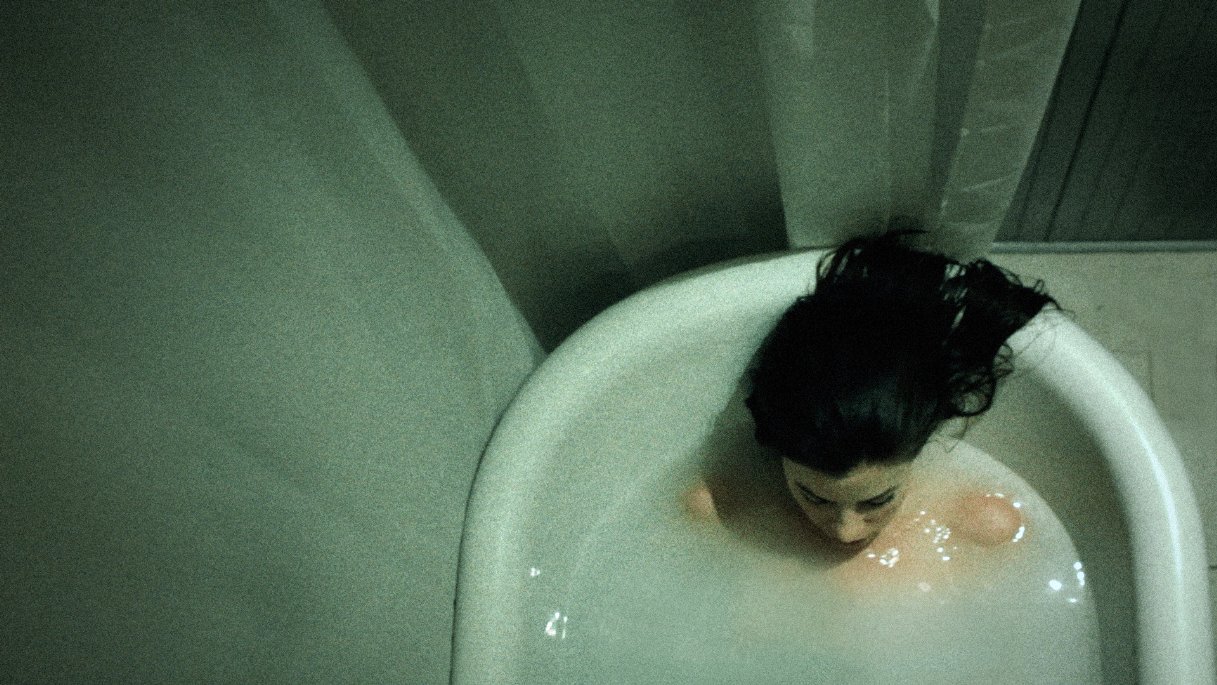
Despite the formulaic plot, the film works. It accomplishes what it sets out to do, which is to tell a creepy haunted house story on a limited budget with a minimal number of actors. The film uses its resources effectively and doesn’t try to needlessly branch out into story areas that are beyond its scope. For me this is better than a project with an unlimited budget that tries its damnedest to show off just how much resources it has by tossing in every technological effect known to man. The film does have its dull moments, but it’s effectively creepy and it captures the viewer’s interest. The filming of the house’s interior is done well. There is some interesting camera action; such as the shot of a bathing Jessica and her long and draping black hair disappearing over the tub’s edge as her body sinks underwater.
I recommend giving this film a watch. It may not exceed your wildest expectations, but it is creepily entertaining.
 We’re still in October, right? Oh yeah, we’ve left that month of Halloween shenanigans long ago. We’ve already said our thanks in November, went a jingling all the way through December and then somehow ended up in a different year – 2016. Being that it is late January, why am I reviewing a movie about five friends on a road trip seeking out the ultimate Halloween attraction – the haunt to end all haunts? Shouldn’t I have reviewed The Houses October Built in, well, October? I suppose so. But perhaps, if anything, this January review of an October based film will help to take your mind back to a warmer season while you momentarily escape the bitter and miserable cold. Plus, there are no holidays on the immediate horizon. Yeah, yeah, there’s Valentine’s Day coming up around the corner, but who wants a pink-tinted day of lovey-dovey when they can be revisiting Halloween?
 being stalked by masquerading performers from the haunted houses they have frequented. These stalking occurrences happen repeatedly – from town to town, at this festival, at that campground, on this road, inside their RV. What is going on?
 What’s scary about these encounters is this – we’re not sure if these costumed stalkers are merely role playing or if they are in fact surrendering to their horror show persona. Then we are left to ask – are the people that are behind the masks scarier than the monsters they are portraying? While the friends sit around the campfire, a man in white makeup appears from the surrounding woods. He says he works at the nearby haunt but he lives in the woods. There’s something creepy about him. He takes offense at one of the friend’s “backwoods” comment. Then there’s the clown who assaults them in a parking lot, claiming that they were improperly videotaping. There’s the girl with a porcelain face mask that wanders into their trailer. She sits, shifts her eyeballs, and does not answer any of their questions. She then screams and quietly leaves the vehicle. Weird stuff and there’s a whole lot more.
 It was several months ago that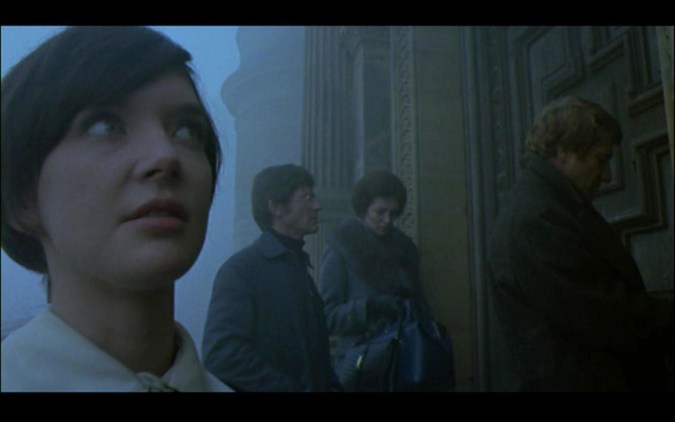

 I remember seeing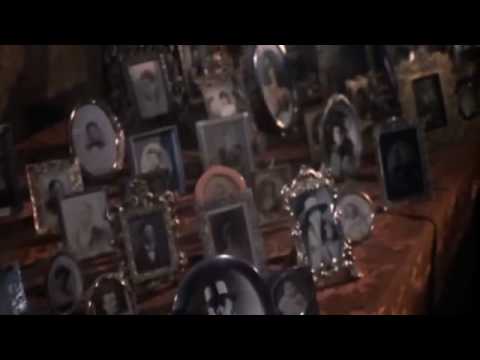
 old son David (










 The Books of Daniel