Hey all, Happy New Year! A very timely wish if I do say so myself!
(Hypothetical Reader:Um, New Years Day was like, four weeks ago. We are too far into the year for that kind of greeting. You’re late, bro!)
Never too late to fulfill a resolution! Remember that time I reviewed the short two movies from Japanese TV, Ju-On: The Curse and Ju-On: The Curse 2 and I promised to review the full-length film that continued the Ju-On series? Lately, I’ve been getting several hits for those reviews at this blog. Since that is the case, I’m going to review the feature length film that arose from these “Curse” movies. So… resolution fulfilled!
(Hypothetical Reader: Dude, that was two years ago when you wrote those reviews and made that pledge. How long does it take you to make good on your promises?)
It does take me a while , doesn’t it? I hope you don’t hold a “Grudge” on me! (Get it? Ha Ha Ha!) But I’ll tell ya, the kind of grudge at work in the 2002 Japanese film Ju-On the Grudgeis not to be trifled with. It is scary and deadly. It affects the innocent – people that had nothing to do with whatever offense it was that spawned such a grudge, those unfortunate ones that happen to be at the wrong place at the wrong time. That “wrong” place is a house in Nerima, Tokyo. The “wrong” time is anytime after a certain murderous tragedy took place on the premise. See readers, this affliction that haunts and claims the victims of this movie is more of a “curse” than a “grudge”, although I’m told the English translation of “Ju-On” is “Curse/Grudge”. A “grudge” , as per the movie, is negative energy in action; or, in reaction. Let’s assume there are scientific laws governing a body of supernatural physics. There is a steady harmony of body and spirit, life and death. The living go about their business and the dead stay dead, their spirits at peace in whatever plane of afterlife existence there happens to be. A horrific tragedy perpetuated with evil intentions can upset this balance. Evil and horror beget evil and horror. In the film, the negative energy is attached to a house, where a mother, her little boy, and the family cat had been savagely murdered by a jealous husband/father. Those who enter the house are susceptible to the negative energy that exists in the wake of this tragedy. It attaches to them. Can they rid themselves of this negative energy by leaving the house? Fat chance! “The Grudge” is part of them now and it follows them wherever they go. Go to work and it will haunt the office. Go to school and it will be there too. Go home? That home will now be haunted.
How do you know if you’ve been affected by this grudge? Well, if suddenly, there just happens to be this strange, creepy little boy with bluish skin running in the halls of your home, then the grudge is imminent. This creepy boy might open his mouth in a circle and release a disorientating creaking sound. Or he might mew like a cat. You might also encounter a young, undead woman crawling down the stairs, bending her limbs in unnatural ways. The boy would be Toshio, the woman Kayako, the ones murdered by their father/husband. The murdered cat is there too, mewing from Toshio’s mouth, or from the phone. Be careful of the calls you accept. If these crawling, creeping undead things catch you, you are toast. Your body will become theirs and will disappear from mainstream life. You will become such an abomination.
We the viewers of this film witness such an unfortunate scenario play out near the film’s beginning. A family owns/occupies the house that once belonged to the murdered family. The aging mother-in-law is no longer mentally fit to care for herself. She sits on the floor and mostly does nothing but stare vacantly.. This is what “The Grudge” did to her. A woman from social services pays her a visit , checks on her well-bring. Where is the old woman’s son and daughter-in-law? “The Grudge” has already claimed them. And the poor lady from social services, she will be taking a ghost or two home with her.
Ju-On: The Grudge is divided into several segments. Each segment, each story, focuses on a different character; all are victims of “The Grudge”. Every story is named after the character that receives the focus. Ju-On: The Curse 1 & 2 follow the same format but mercifully, Ju-On: The Grudge presents these stories (mostly) in chronological order. “The Curse” movies don’t, and it’s a real pain in the you know what trying to figure out what’s going on. I do admit, however, that this out-of-sequence story telling adds an unsettling element to what are intentionally disturbing films, so in this way they provide a continuity of mood.
Is it necessary to watch Ju-On: The Curse 1 & 2 before watching Ju-On: The Grudge? I say no. Ju-On: The Grudge does a quick rehash of some of the events in the previous two films, enough to keep viewers up to speed. But the earlier films devote more detail to story of the tragedy that began this whole curse/grudge business. They are most certainly worth viewing, but Ju-On: The Grudge is the best of the three. It is the culmination of “The Curse” films. The effects are better, the undead things are creepier, and it just seems the most confident of the three. I believe “The Curse” movies were accidental hits for director/creator Takashi Shimizu. Because of this, perhaps he had more of a budget, studio cooperation, etc. when it came to making Ju-On: The Grudge.
Ju-On: The Grudge makes my list for top 50 horror movies of all time. I believe it’s either in the teens or the twenties, I’d have to recheck. Oh fine, I’ll check right now. I’ll find the link to the list and….here it is – Top 50 horror Films. Oh! I see now that I have it at #32. Well, it makes the list and that’s what’s important. It’s a great film and like other Japanese or Korean Horror films, it achieves scares in a way that Hollywood horror films struggle with. This film (like several other Asian horror movies) has a built-in flair for all things creepy. Maybe it’s the detail devoted to the ghosts, or maybe it’s the wise abandonment of cliché plots and over-hyped character types. Perhaps it’s the balance of mood and in-your-face scares. Whatever it is, Ju-On: The Grudge works well.
Ta da! I have finished my review of Ju-On: The Grudge. Did I do good?
(Hypothetical Reader: You do know there are more movies to the series, like Ju-On: The Grudge 2, and several others. Are you going to review them?)
Yes I know of these. I didn’t watch them, so probably no.
(Hypothetical Reader:Also, there is the American version, also directed by Takashi Shimizu, simply called “The Grudge.” Shall we expect a compare and contrast article soon?)
Sigh! I didn’t see the American version. I should watch it and…will I write about it? Oh I don’t know! I really don’t. Oh please, for now, just let me be!
Stop the holiday press! (Is there such a thing?) Put those ornaments back on the tree right now. Return those vines of ivy to the banister. Rehang those stockings and regurgitate some of those “Ho Ho Ho”’s you swallowed on the 25th, cause I got one more Christmas-themed post for you! It is a book of Christmas ghost stories – Ghosts of Christmas Past – A chilling collection of modern and classic Christmas ghost stories.
Published in 2017 in Great Britain, the stories within are from various years. Some date back to the 1800s. The book includes a story from M.R. James, whose name is synonymous with “The Christmas ghost story.” His stories were published in the early part of the 20th Century. Other stories in this collection are as recent as 2014. It is refreshing to see that the traditional Christmas ghost story lives on. I thought it was a thing of the past, as the book’s title suggests. (Not really!)
Telling ghost stories on Christmas Eve – I didn’t know there was such a tradition until 2015 when I saw an article floating around on Facebook (floating like a ghost – Booooooo!) A year later I wrote my own article on the subject. Now in 2018, I see the subject of “The Christmas ghost story” all over social media. Yay Internet! Still, I didn’t know there were modern stories; I thought that “Christmas ghosts” were phantoms of a bygone era. I’m glad that I was wrong.
In my 2016 article Christmas Ghosts and Haunted Houses I briefly describe the evolution of the Christmas ghost story, then go on to make a case for “The Christmas Haunted House”. A Christmas haunted house is usually haunted on Christmas Eve. It is the setting of festivities; friends and family gather there. The haunting takes place after the feasting and frolicking, or in some cases, it interrupts these activities. The haunting is symbolic of the cold and dreary winter that exists outside the window. If it is not symbolic of the cold and darkness, it is at least a reminder of these conditions. End of the year holidays, with all the lights and cheer, are there to counteract the harshness and darkness of winter. This was most certainly true in the ancient yuletide tradition of winter solstice. Winters were harsher, darker, and more deadly. When the lights go out, when the festivities come to an end, the darkness remains. Scary “winter’s tales” emerged from this, and the telling of such tales evolved into the telling of ghost stories on Christmas Eve. Safe inside a house, beside a warm and blazing fireplace, the ghost stories are fun….but…even today, darkness is right outside. So close….so….what if a real ghost joins the party, escaping from its prison inside these fanciful tales?
Much of the literature revolving around Christmas ghosts are stories within stories. A group gathers in a house on Christmas Eve to tell fanciful ghost stories to pass the time on such a cold winter night. Often one of the storytellers relays a “true” ghost story. Fantasy becomes reality. And “reality” has always been there, lurking outside of their protective indoor setting. Now it is inside.
For the record, not all Christmas ghost stories involve haunted houses. But many do and I love it, because if you haven’t noticed , I’m a haunted house kind of guy! Are there any Christmas haunted house stories in the book that is up for review, Ghosts of Christmas Past? Answer: Of course! What a silly question, for this is a haunted house kinda blog! And it is these stories that I will single out , not that they are better than the “houseless” stories but because they fit the theme of this blog. However , do they conform to my criteria of what makes a “Christmas haunted house” story? Sometimes they do.
To my dismay, authors both past and present never said, “Hey, there is or will be this Daniel Cheely guy, and he says Christmas haunted houses have to be written such-and- such a way, and I must write my story accordingly.” In other words, the specific details of my “Christmas haunted house” criteria will not always play out in every story. I know, awww! But I will say this; most of the haunted house stories in this book that I am about describe feature a noticeable dichotomy: the happenings inside the house vs. the happenings outside the house. To go from one to another, from out to in or in to out, is to transcend into the supernatural in someway. Things outside peer in, spirits in the home vanish when exiting the house. To some extent, these observations reflect the themes of 1) warm/cozy inside – 2) cold, dark and scary outside, and the convergence of these two states. Don’t you agree? Maybe you will be able to answer this question when I go into more details about the stories. And I will do that. Right now!
Warning! There will be spoilers!
Dinner for One – by Jenn Ashworth – first published 2014
This story is told from the ghost’s perspective. The ghost haunts his/her wife/partner on Christmas. The gender of the ghost is not revealed and the official status of the relationship is unclear, although it is assumed these two were once lovers, back when the ghost inhabited a living body.
The ghost rearranges things in the house, sets the table for dinner, and gets irate when the former lover fails to acknowledge the ghost’s efforts. The angry spirit throws the plates/glasses on the floor. See, the ghost doesn’t realize that it is dead. The doings of the ghost – this troubles the lady of the house, understandably so.
Meanwhile, the surviving lover spends much time outside the house. She stands over a bed of rocks. It will be revealed that the body of her former partner lies there. She had killed him. Poor ghost, it’s body thrown out of the house, buried under the earth. Poor former person – tossed out of the world of the living. All it wants is to live, to spend Christmas with its former lover. And so, it returns to the house and, unknowingly, haunts it.
The Shadow– by E Nesbit – first published in 1905
Ah, a classic Christmas ghost story! It fits the classic is formula. A group of a young girls, on Christmas Eve, gather in a sleeping chamber in a house they occupy to share fanciful ghost stories. They invite one of the household maids into the room and ask her to tell a ghost story. She is shy, somewhat reluctant to share her story. But she gives in.
The maid’s tale is a true one. She once visited the house of two friends, a married couple. The wife is sick in bed, so she spends most of her time in the company of the male friend. All the while both are haunted by a presence, a shadow. This shadow is symbolic of…something. Something that hides underneath. Underneath what? Just underneath.
By the time the maid finishes the story, the presence is inside the chamber. A tragedy occurs, a tragedy that ties one of the girls to the accounts described by the maid.
In their protective environment on Christmas Eve, the girls had shared made-up stories. Then a horrid, truthful tale penetrates their security. The safe house has been haunted.
This Beautiful House – by Louis De Bernieres – first published 2004
A man returns to his childhood home every Christmas Eve. He always stands on the grounds, observing the outdoor setting, reflecting, taking in the serenity. He likes to remember the past Christmases that took place inside the house and relive all the cherished memories he had with his family. Often, the man can see them in the house, through the windows, he witnesses activity inside.
One by one, various family members come out to greet him. Mother and father, sisters or brothers, uncles. They plead with him, but whether their pleas are for him to come inside or for him to just go away, it is not clear. But the man never enters the house and he doesn’t go away until he is ready.
A tragedy caused all these family members to perish inside the house many years ago on Christmas Eve. Even so, the man knows where to find them, every year on the anniversary of their deaths, he sees their ghosts. Is he a ghost as well? A ghost that is unwilling to join his family in death where he belongs? Is he reluctant to attend an eternal Christmas party inside the house?
Inside. Outside. The meeting of these two sides and what happens or doesn’t happen on the crossroads. This is what this story is about.
The Ghost in the Blue Chamber – by Jerome K. Jerome – first published in 1891
Another classic story adhering to the classic formula. This is somewhat of a humorous tale. A man tells a ghost story to a group of people that are gathered at his house on Christmas Eve night. It is a true story. He claims the blue chamber of his house is haunted by a murderer and his victims. When he was alive, the murderer had a pastime of killing musicians (See, I told you this was humorous . Laugh! Ha ha ha!). He tells the group the details of all the murders.
After the telling, the man’s nephew insists in sleeping in the blue chamber. That night, the ghost of the murderer visits the nephew. Both men, nephew and ghost, pass the night with chitchat and pipe smoking. Soon it is time for the ghost to leave. All ghosts must return to the cosmos before dawn, after all. The nephew walks the ghost out the door and down the sidewalk. Soon he confronts two truths: 1)the ghost is no longer by his side 2) The nephew forgot to put on his pants before going outside.
There is not much more to this story. I can’t find any symbolism within. So, how about my whole “inside/outside” dynamic? Does it play out in this story? Well, the ghost is there in the house. When he leaves the house , when he goes outside , he disappears. So there’s that. And…that’s all I got.
The Lady and the Fox – by Kelly Link – First published in 2014
This is my favorite of the bunch. It is more a story of fantasy and wonder, though it is a little creepy and somewhat ghostly. It is a modern fairy tale. Young Miranda, a little girl, enjoys spending Christmases with The Honeywell family. Elspeth Honeywell is her godmother. Her son Daniel is like a step-brother to Miranda. Over the years he will become more than that, off and on.
Miranda lives with an aunt. Her mother is in prison and probably will be for life. It seems as though the Honeywells have custody of her only at Christmas time. One Christmas Eve, while a large gathering of Honeywells party it up at the house, Miranda sees a strange man peering into the windows from outside. She goes out to meet him. She discovers he is a Honeywell…from a different time period. He dresses in 17th century outfits. No, he is not a ghost, he insists. His name is Fenny, an no, he can’t go inside the house. This isn’t allowed. He wishes the little girl would just go away and leave him alone.
Year after year, Miranda meets Fenny outside the house on Christmas Eve. He eventually warms up to her. He comes with the snow. She ages, he does not. Never does he come inside.
Miranda is a young woman now. She grows to love him. To want him. And he her. She will literally hang on to him to prevent him from disappearing.
Who is Fenny if he’s not a ghost? He is, after all, solid. I failed to mention that before. I am mentioning it now. Perhaps Miranda craves that which is “solid”, a solid relationship , a solid understanding of how she fits into the Honeywell family. Her relationship with her mother is far from solid. The prison system does not allow her to see her. Her relationship with Daniel is confusing. She feels more at home with the Honeywells than she does at her aunt’s place. Is Fenny the physical incarnation of Miranda ’ s desire to belong? And will Fenny ever come inside? Will Miranda ever rid herself of the feeling that she is always on the outside, looking in? Outside. Inside.
Outside the Christmas house. Inside the Christmas house. The places in between the inside and outside, the places that fuel the supernatural. These are the themes I have noticed in these stories. These themes relate to my observations concerning Christmas haunted houses in literature – fragile safety zones that are in no way impermeable to the dark forces that lurk outside in the darkened night of winter.
As a reminder, these are not the only stories in the book. I have covered less than half. But these are the Christmas haunted house stories. I recommend buying the book and reading all the stories. Some are better than others, but this is always the case with anthologies.
Thank you for reading this article about Ghosts of Christmas Past, especially since Christmas has passed (See what I did there?). I wish you a happy post-Christmas. May your home receive the leftovers of the Christmas ghost. May they haunt your house – inside and out.
Interrogation time! Where were YOU the night of October 27, 2018? If you had any sense, you would have been snugly wrapped in a blanket on your sofa with your TV tuned to MeTV. That Saturday night in question, Svengoolie, America’s beloved comedic horror movie host, was showing William Castle’s entertaining movie 13 Ghosts. I’ve brought up Svengoolie several times at this blog. Several of the classic haunted house films I’ve reviewed I first saw on his show, including The Uninvited , The Ghost and Mr. Chicken , Hold that Ghost, and several more. But of course you know that, since you are a regular visitor of his page, isn’t that correct, reader? (The interrogation continues!)
Truth be told, I don’t always have the kind of sense I called for in the preceding paragraph. I did not tune into Svengoolie on the date in question. I was at a Halloween party . But us folks in the Chicago area get to watch a rerun of his show the following week on Saturday morning. It was at this time that I turned on Svengoolie and watched 13 Ghosts. I had already seen the movie and had written about it (See 13 Ghosts review)but it was worth a revisit. Especially since I am writing about it once again.
During the show, Svengoolie brought up the 2001 remake of the movie. He showed viewers a promo picture from the film and invited his audience to check it out, mentioning something positive about it, but I can’t remember his exact words. Is this modern incarnation, titled Thir13en Ghosts (note the unique spelling!) worthy of his praise? I say “no”, but who am I? And Sven is too nice, in my opinion, to trash anyone’s work.
Here is a synopsis that can be applied to both films. A father/patriarch is having serious trouble making ends meet. In a stroke of timely luck, his long lost Uncle passes away (whoopie! Yay!) and Dad inherits a mansion. He can move his family into the new home. Oh but there is a “catch”, or several “catches” – The dead uncle was a collector of ghosts and these apparitions come with the new house. He caught them from various places around the world. Either eleven or twelve ghosts inhabit the house depending on the version of the movie (this discrepancy will be explained later). By and large, these ghosts are invisible, but the dear old dead uncle discovered a way to make these ghosts more sightly. He developed these special glasses that, when worn, allow the mundane living human being to see these scary phantoms.
Now, I have mentioned that the number of ghosts range from 11-12. So, why are these films called “13 Ghosts/Thir13en Ghosts?” It is the thirteenth ghost that spawns the mystery of these films. There is “the prediction” that “there will be” a thirteenth ghost by each film’s end. Whether this prediction comes true varies with each film.
So, what are the differences between the films? On the one hand we have an old fashioned, kooky film with an old school Leave it to Beaver type family with a Ward Cleaver type of dad, a housewife mother, and teenage daughter and curious little boy. On the other, we have a modern family, with a widower raising his young boy and teenage daughter with the help of a sassy African American babysitter. The ghosts in the original film are cartoon animations superimposed on the screen. The ghosts in the remake film are actors made over in ghoulish and gore-ridden get ups. The second film has state of the art production . Not so with the first film. The original movie was shot in black and white, the modern in color. Finally, the 1960 flick uses that old fashion ghostly groan that grandpa might use to scare his grandchildren (ooooooooooo! Groooooooan) and the 2001 movie shows viewers a lot of state-of-the-art blood and guts.
These are just some of the differences between the films. Let’s go further and get into the nuts and bolts of plot and style. Once we do so, we will see that these are two very different films.
13 Ghosts (1960)
WARNING: SPOILERS ARE COMING!
As previously mentioned, both movies feature a special pair of glasses that allow its characters to see the ghosts. But it was the original film that gave the movie audience the same opportunity. Back in the day, theater attendees were given a “ghost viewer.” It had two lenses, on blue and one red. Periodically, the screen would turn blue. This was an indication that ghosts were about to appear on the screen. Or were they? See (or not to see), the film begins with a short commentary spoken by Director William Castle. He speaks to the audience members that do not believe in ghosts and tells them to look through the blue lens. When doing so, they would not see any ghosts. However, he instructs those moviegoers who do believe in ghosts to gaze through the red lens. They would see the ghosts. So basically, the audience had to look through the red lens to see the ghosts that haunted the house in the film.
Here is the intro to the film:
This whole nifty ghost-viewing experience was the main point of this film. It was a kind of audience participatory art form, and of course, a marketing gimmick, for which William Castle was the master. The plot takes second place to this. But it’s not such a terrible plot! It’s not all that great either, but….hey! The film has ghosts! Boo! Yay!
Benjamin Rush, the attorney for the late Plato Zorba, the Dead Uncle who bequeathed his estate to his nephew, takes care of the property transfer and brings the nephew and his family into their newly inherited home. He warns them about the ghosts but the family doesn’t believe him…until they witness the ghostly activities for themselves. Objects move on their own accord. Through the special glasses, they see the ghosts. Quite the variety these specters are! There is an Italian chef that likes to toss knives around in the kitchen. There is a ghostly lion that comes equipped with a headless lion tamer. There’s a fiery skeleton and many others. As to the whys and wherefores regarding Plato Zorba’s collection (just what in the heck did he want to do with these ghosts?), the details are unclear as the movie never fully explains this. But never mind, remember: plot is second to the ghost-viewer gimmick.
The family treats these ghosts as a nuisance, albeit a dangerous annoyance. But what can they do? They have nowhere else to go, so they are forced to put up with Uncle Zorba’s collection of eleven ghosts. Ah, but there is another ghost in the house. It is the spirit of Uncle Zorba himself. It is revealed that ghosts remain on earth when they have unfinished business. Plato Zorba certainly has some loose ends that need tying. For one thing, he didn’t just die, he was murdered! He needs his revenge. The murderer is to be “the 13th Ghost” He or she will die in this house. Now who could it be?
As it turns out, Dear ol’ dead Uncle Zorba left an enormous amount of cash behind. It is hidden somewhere in the house. The murderer wanted the money. And s/he is still hunting for it. Could the murder be the spooky ol’ witchy maid? She too comes with the house. And she is played by Margaret Hamilton, most famous for her portrayal of The Wicked Witch of the West in The W izard of Oz. She leads a séance at one point as the family tries to contact the spirit of Uncle Zorba. A prime suspect, don’t you think? If you think so, you are wrong. It is the lawyer, Benjamin Rush, who is the murderous villain. And he will get what’s coming to him. No, not the money. He will die in the house and become the 13th ghost.
In the end, the family finds the money and they are happy. Uncle Zorba is no longer earthbound, since he has his revenge. From that point on, the house is clean of ghosts. Why the rest of the ghosts pass on is anyone’s guess. Remember: Ghosts before plot. Keep repeating that: Ghosts before plot -Ghosts before plot -Ghosts before plot -Ghosts before plot.
Thir13en Ghosts – 2001
WARNING: SPOILERS ARE COMING!
The ghost hunter, a.k.a the rich uncle, goes by the name of Cyrus Kriticos in this movie, which begins not with the family that is about to inherit his house, but instead kicks off by showing the great extremes to which Cyrus and his team of merry ghost hunters go to in order to capture a ghost. Cyrus is not dead yet, but he will be after the ensuing carnage (Or will he be?). This carnage take place in a junkyard. This ghost is like a wild animal and he resists the hunt. There are explosions, shouts, zaps, flashing lights, giant walls of cars that come tumbling down. In the end, the ghost is caught. But oh no, Cyrus dies in the aftermath of the hunt. (Or does he?)
Arthur is the down on his luck nephew. Just like in the original film, a lawyer by the name of Ben informs Arthur that his Uncle Cyrus has died and that he has inherited his house and all his wealth. Yay! Arthur moves his family to the new home, and what a home it is! It resembles the kind of structure Indiana Jones might encounter – there are chambers and hallways everywhere and they are separated by glass panels that open and close via a machine involving wheels, gears and levers. Lawyer Ben is there to show them around, to get final papers signed, etc. Oh yeah, there’s this annoying “Dennis” dude there as well. He is posing as a power company inspector, but he is really an “empath” that is super sensitive to the presence of ghosts (he screams ever so annoyingly when he encounters them). He used to work for Cyrus and he is there to warn the family of the 12 ghosts that haunt the house.
The ghosts are locked in glass wall prison cells down in the basement. There are phrases written in Latin inscribed on the glass panels which, due to some kind of magic, act as barriers and prevents these ghosts from passing through the glass. Now, remember how I mentioned that in the original film, there were sacks of cash hidden in the house that the lawyer wanted to steal? That was a major plot point that moved the story toward its finality. Well in this movie, the cash is also there and Lawyer Ben wants it just as much as Lawyer Ben in the original film, but this is a mere subplot that gets resolved in the first 30 minutes. Ben wanders to the basement, finds the cash while inadvertently striking some lever or button which releases the ghosts from their prison cells.. He meets a quick end when a sheet of glass slides down from the ceiling and cuts him in half. Bye Ben, your screen time is done.
Meanwhile, the house seals itself off and the occupants are trapped inside. Annoying Dennis explains that “this isn’t a house, it is a machine”. It was designed for a grand ritual that will take place at the movie’s end. The ritual involves a spinning platform, shifting walls and panels, ghosts and so much more – oh my! The family ends up in the basement, and the horrific looking ghosts chase them, fight them, and kill poor Dennis. And guess what? Uncle Cyrus is there too! No, he’s not a ghost – he never died! He had faked his death for some very nefarious reasons.
Uncle Cyrus wants his nephew to be the 13th Ghost. Now why does he want something like that to happen? Well, it’s all part of a plan. As an occultist, he follows the Black Zodiac. The 12 Ghosts represent each Zodiac sign, which is vastly different from the signs we learned from astrology. Instead of Pisces the fish and Taurus the bull, the black Zodiac gives us Torso , a ghost with missing legs, or The Angry Princess – the ghost of a young woman who commits suicide. All 12 are needed, plus one more – in order to open the gates of Hell, or achieve some sort of hellish power. The 13th ghost must come from someone who is willing to sacrifice his life for the love of others. And so…..at the end, all 12 Ghosts are lined up obediently on the edges of a spinning circular platform. Arthur’s children are caged in the middle of the circle. To free them, Arthur must sacrifice himself. Gears are turning, walls are shifting.
But this ritual fails in the end. Cyrus dies, the children are freed, huggies and kissie for everyone, and the maid ends the movie on a sassy note, saying something to the effect of “I don’t get paid for this shit! Dealing with all these ghosts, I quit!” Ha Ha Ha Ha Ha Ha Ha Ha!! Let’s laugh again, Ha Ha Ha Ha Ha Ha Ha Ha!!
What “those other” folks might say
So, which film is better? For me it’s the classic William Castle version. But many will disagree. I have seen a comment somewhere out there in Internet Land that the original film “hasn’t aged well.” I’m guessing many viewers agree. I suppose the superimposed cartoon-style ghosts look too silly for modern viewers. There are scenes where objects float in the air, and yes, this type of antic is used in many comedy films such as Abbott and Costello Meet (Whoever). In other words it looks more funny than scary, and 13 Ghosts was never intended to be a comedy. Perhaps the family that is at the center of the plot is too hokey with their “Leave it to Beaver” style camaraderie and their unrealistic reactions to the situation. They treat the whole affair as if their house was infested with insects instead of ghosts.
The modern film moves faster, that’s for sure. Its ghosts look more deadly, more real. It is filled with non-stop action and a whole lot of pizzazz. Many viewers like this sort of thing and so it would be the second film that strikes their fancy. Filmed in high tech color with bright red blood, it is more entertaining for hue-spongy eyes than a screen of “dull” black, whites and grays.
Here’s what I say!
Sure the original film is hokey, as are most William Castle films to some degree. But gosh darn it, it is a fun film, just like Castle’s “House on Haunted Hill” is a fun but hokey film! I didn’t mind the dated technology that made these ghosts possible. Cartoonish – yes. Scary – for me, a little bit! Although today’s viewers, myself included, are deprived of what Castle called “The Illusion-O Effect” (wearing the glasses to see the ghosts on the screen), I still like the concept. What a fun and creative way to promote and deliver a movie! I’m not saying that 13 Ghosts is a great film, but it is good. And it’s fun!
Now how about this 2001 remake? I was annoyed at the very beginning and this annoyance progressed like a building headache. Too much motion, too much action, too many flashing lights, too much damn noise – all within the first few minutes. This trend continues with the “machine house” and its jump-scare ghosts. While they look gory and scary, they are always accompanied by flashing lights and loud jolting noises. Watching this film is like being inside a pinball that crashes against bumpers and lighted alarms as it travels the downward slope toward the gutter. I don’t want be trapped in a pinball machine when I watch a movie.
In my review of the modern House on Haunting Hill film, I am a bit forgving for its excessive flare and over-the-top style. One of the reasons for my pardon is that the film is a remake of a movie that was never intended to be a cinematic masterpiece, so any deviations from the original style are not that unwelcoming. In the end, both films were exercises in entertainment and do not take things seriously. Does Thir13en Ghosts 2001 take itself seriously? No. Is the original film a cinematic masterpiece. Definitely not. So I should apply the same standards for this critique, right? Answer – NO! If the modern film had turned down the noise, did away with a third of the flashes, and just slowed the fuck down, then maybe I could enjoy it better for what it is – a jump-scare, special effects extravaganza, which is not necessarily a bad thing when done right. But here it is done wrong. Too much, too much, too much!
There is one scene that moves at an appropriate pace. A teenage girl is in the bathroom and she calmly reflects in the mirror. The ghost of The Angry Princess stands next her but goes unseen (teenage girl is not wearing her ghost viewing glasses). The ghost does not like what the mirror shows her. She sees a disfigured face. In the bathtub, the teenager refreshes herself with clear, cool water. The Princess sees only a tub of blood. This scene, while bloody and gory, is good. It allows the viewers to feel something, to absorb some of the story. If only the rest of the film was like this.
As for the plot, I enjoy the simple story of the original movie.. I don’t know why these modern remakes insist upon explaining the hauntings with over complicated plot devices. A machine house designed to somehow extract “something” from 12 spirits that will somehow unlock some dark secret power, all by using machinery with a design that would stump the greatest of engineers – this is just absurd and I would rather have the cartoon ghosts just appearing here and there to say “boo!”
Here is how I grade these two films:
13 Ghosts (1960) – C+
Thir13en Ghosts – 2001 – F
Now, let’s see how Rottentomatoes.com scores these films:
While both the critics and the audience give low scores to both films, the audiences tend to favor the modern version over the original. For the critics, it is the opposite. I guess it’s “the audiences” that might agree with what I wrote in the section “What “those other” folks might say” while maybe the critics would agree with what I wrote in the section “Here’s what I say!’
If you have not seen these films, go ahead and do so, compare them, and make up your own mind as to which film is better.
Who can survive the night in the House on Haunted Hill? There have been many tragic deaths within its confines. Those of us with an appetite for haunted house stories know that a house with a deadly history foreshadows future doom for those story characters that choose to roam its rooms and corridors. Why oh why do these people embark upon such a journey? For fun and games?
Someone is making a game out of this situation. An eccentric rich man is willing to pay large sums of money to anyone that spends the night in The House on Haunted Hill…and survives. He decides to host a birthday party for his wife at this house. A strange party this is, for the guests are strangers to him. These strangers are the contestants in his deadly game of survival. Why is he doing this? That is the mystery, but viewers learn early on that he is very suspicious of his wife. She has tried to murder him on past occasions. Is all this a scheme to extract some kind of twisted revenge on his wife? Will she, once again, try to murder him and do so before the night is through.
In the first release of this film, there is a skeleton that rises out of a vat of acid to prey on people. In the second release of this film there is a chamber designed to rid a mental patient of his/her schizophrenia. But the inverse is also true – it can drive a sane person insane. Get ready folks, there is a lot of weird things afoot in these two different versions of the movie The House on Haunted Hill .
Welcome readers to my second compare and contrast article concerning classic haunted house films and their respective remakes. I hope by now you have read the first article: The Haunting 1963 Vs. The Haunting 1999 – Which Film Wins? If not, click on the link and read, read read!
The films in the preceding article are based on Shirley Jackson’s novel The Haunting of Hill House. Though the films in this article share a name that is similar to the novel (“Hill House” vs. “Haunted Hill”), they are of different species and should not be confused with “The Haunting” movies. Let’s compare the two original films, (The House on Haunted Hill and The Haunting), in brief. The House on Haunted Hill(1959) by William Castle is by no means the definitive haunted house film. In my opinion, that description belongs to the Robert Wise’s The Haunting (1963). Castle’s film possesses not the pristine creepiness of Wise’s film. The Haunting is for the serious student of spooky cinematography – The House on Haunted Hill is a fun popcorn film filled with gimmicky scares. I like The Haunting considerably more than The House on Haunted Hill, but truth be told, Castle’s film is entertaining, so please don’t think I am panning his film. It too is enjoyable in its own way
Look what I’m doing – this is supposed to be an article about the similarities and differences between the two House on Haunted Hill films, and here I am instead devoting much attention to the differences between The House on Haunted Hill (1959) and The Haunting (1963). Why am I doing this? All will be explained in the chart below:
Where:
A = The Haunting (1963)
a = The Haunting (1999)
B = The House on Haunted Hill (1959)
b = The House on Haunted Hill (1999)
The likability gap between A and a < B and b. Such a variance can best be explained by an overall categorical comparison
See, now everything is explained!
(Hypothetical Reader:“I don’t know what the fuck you are getting at! And will you please use plain English and ditch the mathematics?)
What I’m trying to say is that I prefer The Haunting of 1963 so much more than its remake. While the original House on Haunting Hill film is significantly better than its remake, The House on Haunted Hill of 1999 isn’t altogether terrible; it is better than The Haunting of 1999. I am more forgiving of the style and content changes that earmark the modernized version of The House on Haunted Hill. The reason for this pardon has to do with the laxed tone of the original film. The House on Haunted Hill/1959, though not technically “horror comedy, is silly at times. It “makes” fun, and therefore, the gesture can be reciprocated. We the viewers are allowed to “make fun” of it while enjoying the movie at the same time. By the same token, The House on Haunted Hill/1999, while seriously flawed, is also a fun film. It doesn’t take itself as seriously as The Haunting/1999. Because the original film is gimmicky by intentional design, the remake is bequeathed certain liberties in the name of fun or even absurdity. The Haunting/1963 does not call for such directional change, and yet its 1999 remake awkwardly pursues a different path to the point of identify confusion. Is it attempting a serious, gothic-style haunting or is it settling for a hammy display ghost-centered theatrics? It doesn’t know. Meanwhile, even though I enjoyed The House on Haunted Hill/1959, it cannot compete with the masterpiece that is The Haunting/1963.
Here is another chart that utilizes a grading scale to explain my preferences:
The House on Haunted Hill/ 1959 – B+
The Haunting/1963 – A
The Haunting/1999 – D
The House on Haunted Hill/1999 – C-
Let’s see if rottentomatoes.com critics/audience feels the same way.
The House on Haunted Hill/1959 – Critics score – 92% / Audience score 72%
The Haunting/1963 – Critics score – 87% / Audience score 82%
The Haunting/1999 – Critics Score: 16%/ Audience Score 28%
The House on Haunted Hill/1999 – Critics Score: 29%/Audience Score 42%
Wow, the aggregate of critics prefer the The House on Haunted Hill/1959 to The Haunting/1963. But the general trend regarding the modern films seems to agree with my preferences. So there!
Okay, let’s move along and find out what these two “House on Haunted Hill” movies are made of!
The House on Haunted Hill – 1959
To appreciate the “silly yet scary” tone of this film, one must understand something about the film’s director and creative marketer, the late great William Castle. I’ll give you a couple of “somethings.”
Castle was the master of marketing gimmicks. These gimmicks played out at the theaters where his films were shown. These manufactured stunts related to certain scenes in the film. For instance, during his film The Tingler, about a centipede-like creature that attaches itself to the human spine and causes a tingling sensation, Castle equipped certain theaters with vibrating chair device that caused viewers backs to tingle. In his movie 13 Ghosts, viewers were given special glasses to wear if they wanted to see the movie ghosts. (This movie will be featured in my next compare/contrast article).
Did he have a gimmick for The House on Haunted Hill? You bet he did! Remember at the beginning of the article when I referred to a skeleton that rises out of a vat of acid? Well, in select theaters, he arranged for a skeleton to slide across a hidden wire over the heads of seated viewers. What fun!
Think of William Castle as a prankster that pulls off cheesy yet scary pranks. We all had that relative that threw a sheet over his head and jumped out of a closet with a “boo!”. In retrospect, that’s cheesy, but the trick scared its victims and ended up being a whole lot of fun. This is what his films are like. They are also filled with mystery and creative twists. Think Scooby-Doo (but the mastermind is not always Old Man Crowley!) . The House on Haunted Hill follows this criteria. It’s mysterious, scary, and delightfully cheesy .
The rich eccentric, Frederick Loren is played by Vincent Price. As usual his performance is brilliant. Without him, my rating of this film would drop by a grade and a half. The way he goes at it with his wife Annabelle, played by Carol Ohmart . ..growwwwwwwl!!
Frederick makes sure to inform his guests that they have until midnight to change their minds about spending the night. At midnight, the servants leave and lock the doors, sealing all guests inside until dawn. For protection during the long night, he “gifts” each person a gun. The guns are “gift-wrapped” inside a tiny coffins. What could possibly go wrong with this scenario?
The most annoying character is Watson Pritchard (played by Elisha Cook Jr.) He owns the house but doesn’t reside in it. He is the one that knows about the history of this house and he is terribly frightened of it. But he is in need of money and hopes to win the ten thousand dollars that Frederick promises to each surviving guest. Throughout the movie, he plays the scaredy-cat and carries on in an irritating , squeaky voice. In addition, his pervasive facial expression of cartoon fright gets old real fast.
Guest Nora Manning (Carolyn Craig) receives the brunt of the haunting. She finds a severed head in her bedroom. She sees ghosts and witch-like figures here and there, around this corner, outside this window. (The “floating” witch-like character looks like on of those carnival fun house dummies.) During her stay, she finds a love interest, one Lance Schroeder (Richard Long). He looks out for her and tries to calm her.. How sweet!
During the night, Annabelle (Fredericks wife) is found hanging over a stairwell, a noose around her neck. At first the group thinks it’s suicide, but there is a doctor among the guests. He examines the body and decides, due to the way she had been hanging, she couldn’t have done this to herself. Someone had murdered her. But who?
Initially, Frederick is the suspect. After all, the guests learned how much he despised his wife. But Frederick objects, insisting that one of them had murdered Annabelle. In the end, no one is sure what to believe and they all suspect each other. So, in this type of situation, for everyone’s safety, what is the best course of action? At the doctor’s suggestion, everyone retires to their own personal bedrooms. The one who breaks this rule, the one that might decide to take a late night stroll, is quite possibly the killer. I wonder if this film began the “we all most separate” trope that is pervasive in horror films. Maybe not, but the separation plan as specifically laid out in the dialog is patently absurd. Oh well, on we go with the rest of the movie.
Now, here comes a Twist! Let’s do it! (MAJOR SPOILERS AHEAD!!!!)
The body of Annabelle lies on a bed. The doctor has left his room. He approaches Annabelle. Surprise! She is not dead. She and the doc are lovers and have been planning something nefarious. See, they have been haunting the house, purposely scaring the shit out of poor Nora, hoping that in her frightened state, she would shoot Frederick, thinking he is the murderous, evil facilitator of the house haunting. They arrange for Nora to encounter him down in the cellar by the vat of acid in a situation where she would mistakenly think he was there to kill her. The plan works! She shoots him! He falls over and she runs away.
The doctor then descends to the cellar to get rid of the body of Frederick. He pulls the corpse toward the vat of acid, intending to throw him inside, where the acid would eat away at his skin and guts, reducing him to bones. The screen goes dark, there is the sounds of a scuffle.
Hey readers, how about we do another Twist!
Annabelle makes her way down to the basement. The skeleton of Frederick rises out of the vat of acid and chases her. His evil voice accompanies the chase. The skeleton leads her to the edge of the vat. Its boney arm reaches out to her. She fall in!
And yet another twist! (No Chubby Checker this time. Sorry!)
The real Frederick comes out of the shadows. He had been operating the skeleton with wires, making it move. He was never dead either. The gun he had given Nora was filled with blanks. When the Doctor was moving “his body” and the screen went dark, Frederick had stopped playing dead and fought the doctor and pushed him into the acid vat.
In the end, he gets away with killing his wife and her lover. A nice happy ending! Yay!!!!!!
Forty years after the original movie, society is blessed with – this. The “this” is that which I am about to describe. Oh, I should knock off the mockery, for as I have already stated, this remake isn’t all “that bad”. It’s just bad, without the “that”.
In the original film, the backstory concerning the house is given, but not in great detail. Seven people had died in the house before the events in the film. All of them had lost their heads. The whys and wherefores concerning these head losses are not given. Nor do we know if the backstory is even true. It might just be the wild imaginings of that annoying guy. In the modern version, the backstory is central to haunting. In this version of the story, the house on haunted hill was once an insane asylum. The doctor who ran this institution was not a very nice guy. (Not even a little nice? No!) What made him “not nice?” Well for one thing, he operated on patients without using anesthesia. That’s not very nice. The film shows him with a patient on the operating table, who is twitching in pain as the “not nice” doc rips out some of his organs. There is a nurse or two there as well, perhaps another doctor, and they are all cruelly taking part in this operation. This kind of thing is common parlance here at this asylum – the patients are the doctor’s guinea pigs.
One day, the patients rise up. They kill the doctor and his evil staff. While the carnage ensues, the place goes on automatic lockdown. Steel barriers seal off all the doors and windows. It’s an automatic thing, controlled by machinery. The insane people set the place on fire. But they can’t get out! So, they all die; doctors, staff and patients. Hmmm, I wonder is such a tragedy will cause some kind of haunting later in the film, when once again, a rich eccentric will invite complete strangers to this “house on the hill” for his wife’s birthday party? The answer – yes!
While the original film is marked with gimmicks and sideshow scares, this film is filled with – gore, gore, gore! I have already mentioned the operation scene. But there is more in store than what was shown as the backstory. There are a lot of flashing lights, buzzing sounds, and mechanical zaps! Parts of the movie remind me of any opening sequence for American Horror Story, whichever season.
The rich eccentric (played by Geoffrey Rush) goes by the name Stephen Price. I like how is character is named after the great Vincent. Throughout the movie, they simply refer to him as “Price.” They even make him look like Vincent Price a bit with a similar hairstyle and thin mustache. Price is an amusement park mogul, and there is a cool scene at the beginning of the film involving a roller coaster. Anyway, the set up is the same – Price is at odds with his wife Evelyn (played by Famke Janssen). They would like to kill each other, if only there was a way!
The screen chemistry between Rush and Janssen, I must say, is pretty good. Maybe not quite up to par with Vincent Price and Carol Ohmart team, but still they put on a good show. Once again, a birthday party is planned for the wife at a haunted house. Guests will be paid a million dollars if they can last the night. In the earlier film, the reward was ten thousand dollars, but that kind of money doesn’t go very far in 1999. Oh already, there is a twist! The computer erases the guest list and creates an alternative list. This doesn’t happen in the first film. What is going on? (Hint: Ghosts are playing around. Oooooooo!)
Four guests arrive at the house, lead by a fifth person – Watson Pritchett (That’s almost the same name as the charter he is playing from the first film, which is Watson Pritchard, according to Wikipedia). He is the one granting everyone access to the house. He owns it but refuses to live there. He doesn’t even want to be here tonight. He knows about its past and knows that it is haunted in a very deadly way. This Watson is less annoying than the one in the original film. This one is kind of funny in an entertaining kind of way. The other guests include a doctor dude, a pilot dude, a journalist dude-et, and a secretary dude-et. Of course Price and Evelyn are there and….let the games begin!
Watson wants to get the hell out of there. He doesn’t plan on spending the night. But oh no, the automatic lockdown kicks in. Doors and windows are sealed. Who did this? Is it Price? Evelyn? Or…the ghosts? (Hint: it’s the ghosts). So the cast of characters need to figure out how to get to the controls that operate the barricade and deactivate it. On the way toward the machinery, they pass a lot of torture devices.
The same basic plot of the original film plays out here in pretty much the same way. All guests are given guns. Evelyn if found dead, not by hanging, but someone had the gall to strap her to an electroshock machine. Price is blamed and they lock him in the chamber that “Makes an insane person sane, and a sane person crazy”. Ahh, I don’t feel like describing the chamber, so just see the film to see what that’s all about. But- eureka! Evelyn isn’t dead. The doctor guest is in cahoots with her. They want Price dead. Eventually Price is freed from the chamber and is shot dead. Oh no he isn’t! He is wearing a bulletproof vest. He and his wife then physically fight each other, but both ended up being destroyed by – the ghosts.
Alas, there is no skeleton rising from a vat of acid in this version of the story. The modern movie replaces those sideshow special effects with, once again, the wonders of computer graphic images. Back in high school, did you ever learn about the four types of conflict within the short story? If memory serves me correctly, they are:
Man vs. Man Man Vs. Nature Man Vs. Himself Man Vs. Society
(Sorry for the sexist terminology, this is how I learned to refer to this conflicts)
Well now there is a new one:
Man Vs. CGI Amorphous Blob of Spirits. (That’s what the thing at the end of the movie looked like to me anyway – one shadowy blob consisting of hundreds of spirits)
In a similar manner as The Haunting 1999, it is this CGI Monster of Spirits that is the bad guy. Why oh why are they so mad at these guests that they want them dead. Well, remember when I mentioned that the computer had swapped one guest list for another? As it turns out, the ones invited via the phantom computer operator are descendants of the staff that ran the evil insane asylum. The spirits need their revenge, don’t they? So once again, just like The Haunting 1999, the writers felt the need to tie the characters to the backstory via familial relations that were kept secret. Oh my!
And so….
There is one area, in my opinion, where both films fail. And that is – creating an establishing shot of a large, creepy haunted house. The “house” in the 1959 film looks like this:
Kind of a random array of blocks and squares if you ask me. Following suit, the 1999 film uses an establishing shot that invokes no real sense of “haunting:”
It looks more like something out of a Star Wars movie.
Be that as it may, The House of Haunted Hill 1959 is a good film, not necessarily great. The House of Haunted Hill 1999 is a tolerable film, so long as one is not offended by gore and noise. The second film has its fun moments, but it should not be on anyone’s top 50 list of great horror films. Maybe not on any top 100 list either.
Both films invoke humor, and humor is a good thing, right? I mean, we all need to laugh. The original film is comfortable with its gimmicky status and doesn’t try to be anything else. The second film, though overblown with effects and filled with unintentionally cheesy story arcs, doesn’t take itself too seriously, and that is a good thing too. And what a great way to end this article, on a “good” note.
I’ve been getting a larger than usual number of hits at this blog lately. Sometimes WordPress records the search words that lead people to my page. Some of the “search phrases” as of late are as follows:
is haunting of hill house the same as the book
the haunting versus the haunting on hill house
how does the haunting of hill house tie in with the haunting
the haunting of hill house same like the book
can hold my pee and peeing alot (Don’t know how this searcher found my page about haunted houses with this!)
In short, visitors are searching for clues as to how the new Netflix series The Haunting of Hill House ties into either:
Shirley Jackson’s book by the same name, OR
The Haunting, which is the movie that is based on Jackson’s novel.
Search engines have led them to my site, which features articles and reviews of both the movie and book. But alas, visitors have found no information about the Netflix series – until now!
I appreciate the extra traffic. To show my appreciation, I will answer some possible FAQs about the Netflix series. I just started watching it: I have seen the first five episodes. In an article I wrote about the movie The Haunting, I express doubt about the whole idea of turning Shirley Jackson’s novel into a miniseries. (The link to this article is at the end of this piece) However, now that I am halfway through it, I can honestly say that I am hooked. I love it! The show is very very good!
Let me begin with what the series isnot. It’s not a sequel to the book ( or movie). It is not a prequel either. It is not a crossover , it is not a spinoff; it exists in a story universe of its very own. What it does do is utilize the same character names of the book and it recreates several parts/scenes of the book/movie within an entirely different context. Admittedly, the series is a bit confusing with its constant jumps in time and non-linear storytelling. Do yourself a favor – don’t try and figure out how the Nell of the series has become or was once the Nell of the book. Same goes with Theo. The characters of the series are very different than the characters that are portrayed in the original story (though not entirely different This will be explained later). Please don’t add to any existing confusion by trying to tie the characters of the series to the book. It just won’t work. There is no prevailing story arc that flows from the original incarnation to this latest manifestation.
Before I delve into what the Netflix series is, I first need to explore “the is” of the original story, the story that came from the brilliant mind of Shirley Jackson. The movie The Haunting (1963) follows Jackson’s book pretty closely, so for the purposes of this article I will treat both the book and the film as one in the same (although in another article I write about the differences between the two mediums and their versions of the story. The link to that article is posted at the end of this piece.)
Dr. Montague (Named Dr. Markway in the film, but who cares) recruits two people to take part in a study that aims to investigate the paranormal activity that has been rumored to be rampant at Hill House. Both participants have an affinity toward the supernatural in one way or another. Theo, the brash bohemian and implied lesbian, has ESP, can read minds, etc. Eleanor Vance was once the victim of poltergeist activity – stones showered down on her house when she was a little girl. Dr. Montague hopes that Hill House will be more likely to display paranormal activity in the presence of people that are attuned to the supernatural.
The two ladies join Dr. Montague for a prolonged stay at Hill House. Also there is Luke Sanderson. He is due to inherit Hill House and he too stays with the trio at the house . He doesn’t believe the ghost stories but he is taking part in this study mostly to protect the interests of his future property .
Hill House has a history of madness and unexplained deaths. Built by one Hugh Crain, two of his wives lost their lives in the house or around the property. His daughter Abigail lived in the house from birth to death. She occupied the nursery the whole time. She died as an old lady , who called out to her caretaker in the middle of the night. The caretaker did not come to her assistance and , unaided in her ailment , Abigail passed on. The caretaker would later hang herself beside a spiral staircase.
The team of four witness several supernatural occurrences. They stand in cold spots, they observe doors that won’t stay closed, they hear loud banging noises against the walls. But it is Eleanor that receives the brunt of the haunting. Even so, she is drawn to Hill House, and Hill House is drawn to her as well. It wants to keep her inside. Forever.
That is the classic story in a nutshell. So, what’s the modern series all about? It’s about a family -The Crain’s (the same surname of the original Hill House occupants in the backstory of Shirley Jackson’s novel). They stay at Hill House for a summer. There is Hugh the father, Olivia the mother, Shirley the eldest daughter (approximately twelve-years-old) and her younger siblings: Steve (Maybe age eleven?), Theo (age ten?) and the two young twins Luke and Eleanor (approximately 5 or 6 years old ). See what they did here? They use the names of the characters from the original story. While the series gives them similar traits as the original characters, they are different people in different contexts. In the original story, Luke, Theo and Eleanor are strangers to each other until they met at Hill House. In the series they are siblings.
Most of the family members have experienced some kind of ghostly disturbance during their stay at Hill House. After a tragedy , the family flees the house. The series juxtaposes between several time periods. We see the kids as grown ups.. As adults, they suffer through various life dilemmas and troubling psychological problems. Most of their problems can be traced back to that summer spent at Hill House. See, “the haunting of Hill House” follows the kids into their adult years . It is like a hand, and though most of the family has escaped Hill House’s palmy grip, Its fingers stretch throughout the years, pointing its horror in the survivors’ direction, poking at their daily lives. Even in their adult lives , they are haunted by ghosts.
The Netflix series is creepy , dark, and very morbid. In other words , it’s great! And, it creatively reimagines some of the classic scenes, fitting them into updated contexts. Waking up in the middle of the night to feel a phantom hand holding your hand – this scene plays out in both the series and book. Finding graffiti on the wall of Hill House that reads “Welcome Home, Eleanor”, this happens in both mediums. Breaking out into a dance before some creepy Hill House statues – yep, this scene can now be considered both classic and modern. The “Hill House” of the series has many of the same features of the Hill House of the 1963 movie, including a large gate at the beginning of the driveway, and the “twisted” spiral staircase. Both Hill Houses feature rooms that are locked – for the safety of the inhabitants. The caretakers, Mr. and Mrs. Dudley, are featured in both the series and the book. But again, please remember, these are recreations of the famous scenes, not repeats, not meant to tie directly into the happenings of the original story. These are what they call “easter eggs”; features that pay homage to the earlier works.
Like in the book, the Theo of the series has a talent for “knowing things”. In the original story, she reads minds and knows the cards of another card player. In the series, she touches things (and people) and suddenly she gains knowledge about the object of her touch. While her sexual preference for women is only implied in the original story, she actively seeks out female sexual partners in the series. As in the book, Hill House “calls” out to Eleanor (Nell). When they are children, Luke has an imaginary friend – Abigail (possibly a ghost?) Abigail is the daughter of Hugh Crain in the book/movie, the one who spends her whole life inside the nursery.
There are plenty of other similarities and references to the original story within the series, but I won’t go into them all.
If you are already a fan of the Netflix series but have yet to watch the movie The Haunting (or read the book The Haunting of Hill House), I encourage you to do so, then you yourself can discover the ghosts that crossover between the mediums .The movie is a classic and the book is a very intriguing read. Likewise, if you are fans of the film and the novel but are hesitant to try this modern reimagining of the story, I strongly suggest that you let go of this hesitancy and climb on board. You won’t be disappointed.
As promised, here are the links to articles and reviews that I have written about Hill House, The Haunting, and other good stuff:
1) An article comparing the book The Haunting of Hill House to the 1963 film The Haunting:
This is an article comparing the film The Haunting (1963) to its remake, The Haunting (1999). To read an article about the Netflix series: The Haunting of Hill House, click here:
What you are about to read has been made possible by the brilliant Shirley Jackson, the late author that gifted the world with her ingenious novel The Haunting of Hill House back in 1953. This novel revolutionized the ghost/haunted house genre and influenced authors such as Stephen King. Without The Haunting of Hill House, The Shining wouldn’t exist. Very soon, Netflix will be airing a miniseries that bares the same title. It is to be a “modern reimagining” of the classic, according to Deadline.com. Those two words scare me. We have already had a modern reimagining back in 1999 with the film The Haunting . It didn’t go over so well. To be clear, this 1999 film was not an adaptation of Shirley Jackson’s novel. Rather, it is a remake of a 1963 film by the same name. The Haunting of 1963 is an adaptation of the novel and this film is critically praised.
I first saw The Haunting (1963) when I was around six-years-old. I didn’t know what was going on with the story, but I loved watching characters react to the phantom sound – a loud banging on the walls. Scary stuff. I saw it again in my twenties and I wasn’t impressed. What did I know, I was a culturally illiterate bar-hopper in those days. I saw it again several times after I “matured” (I reek of this maturity stuff. I’ve given up farting!) and after each viewing it only got better. I love this film.
I failed at my first attempt to see The Haunting 1999. Believe it or not, the theater was sold out. Eventually I did see it and I thought it was “okay-ish.” I mean, it looked good on the big screen. So many cool special effects! I have come to learn that special effects, a common feature of a big budget movie, can ironically “cheapen” a story.
Over the years, I had forgotten the details of the 1999 film. It didn’t have a lasting impression on me. However, that BOOM BOOM BOOM on the walls from the 1963 film stayed with me since childhood. Even during my close-minded twenties, the film was still percolating within me, though I would not have admitted it.
In this article, I aim to compare and contrast the 1963 and 1999 versions of The Haunting. By doing so, I am fulfilling one third of a promise. In my preceding blog post I stated that I would compare three classic haunted house films to their respective remakes. I start down the road of promise fulfillment with The Haunting. I will continue the journey with The House on Haunted Hill in an upcoming article and then wind down with 13 Ghosts. But first things first – The Haunting!
As evidenced in the review sites in the chart above, the popular consensus is that the classic film is the superior of the two. The modern film has been criticized for its heavy reliance on CGI effects used to the detriment of the story. Also, the 1963 film is closer to the book. The 1999 film strays in odd directions to the displeasure of the fans of Shirley Jackson. With all this I agree. But let me elaborate on this further. Details matter! Let’s get to those details!
Beware – There will be spoilers!!!
The Similarities Between the Films
Here is a plot summary that can be applied to both films.
A scientific investigator invites a team of three to stay at Hill House as part of a study. The team consists of Eleanor Lance, Theodora, Luke Sanderson and the investigator who heads the study. Hill House is a haunted house.
Eleanor is a young woman who has led a secluded life. Most of her adult life has been dedicated to taking care of her invalid mother. She very much welcomes the invitation to stay at Hill House, for she is anxious to start a new life; a new adventure. She has self-doubts and is unsure of her place in the world. Theodora, who goes by “Theo”, is assertive, and somewhat brash. Hill House is an excessively large mansion with an abundance of “Haunted House Décor”: Creepy statues, staring portraits, winding staircases, large fireplaces. The garden has some very life-like statues. There is a rickety spiral staircase made of metal; very unsafe for climbing.
On the grounds of the Hill House property, there is a stretch of road that leads from the house to the main street. The caretaker of Hill House, Mr. Dudley, mans the front gate. He is quite cantankerous and he initially refuses to let Eleanor in, even though she is expected. Mrs. Dudley is equally unwelcoming. She takes care of the inside of the house. She cooks the meals but makes it clear that she will never stay after dark. She and her husband will go home, in town, which is miles away. The house guests will be alone, at night, in the dark, and will not be able to call anyone for help.
At some point in the movie(s), viewers learn a bit about the backstory of Hill House. It was once owned by one Hugh Crane. The story of Crane’s family is one of tragedy, involving deaths and suicides that take place inside the house. The story also consists of sad circumstances related to children.
Now, here be some of the stuff of “the haunting”
Eleanor and Theo are awakened in the middle of the night to loud noises; it sounds as if something is banging against the walls
Graffiti mysteriously appears on the walls. The words on the wall read “Welcome Home, Eleanor,” or, something to that effect. Who is to blame for this? The guests accuse each other. Even Eleanor is accused of writing the message, perhaps as a way to attract attention.
Eleanor is the one that is most susceptible to “the haunting”. The house seems to take possession of her. At one point, she wanders off, as if in a trance, and climbs the rickety staircase. During her climb, the staircase becomes unhinged and other guests have to risk their lives to help Eleanor down.
I’m sure there are other similarities, but I believe I have highlighted the main ones. Let’s get to the differences – do some slicing and dicing. How fun!
The Differences Between the Films
Black and White Vs. Color
The original film is shot in black and white. The modern film is done in color. Does this make a difference? A huge one, which will be explained at the end of the next section.
The Setting – Hill House Itself
The original film does a very nice job of setting the scene and cinematically propping up the creepy atmosphere inside the haunted house with careful details. From the designs on the walls to the angles of the doors, this fictional, if not improbable house seems real, almost as if one could reach into the screen and feel the grooved texture of the bedroom walls.
The remake, on the other hand, goes to great lengths to portray a house that could only exist in a fantasy world. It’s as if the makers of this film examined the intensity of style of the house in the original film and magnified it by a thousand. The doors that separate rooms are like barricades built to withhold a battering ram. They are, perhaps, sixty-seventy feet tall and thick as a fortress wall. And yet, the house guests push them open with the same ease as a movie cowboy passing through the swinging doors of the Old West saloons. The Hill House of the original film features very large and ornate fireplaces.The modern Hill House has a fireplace so huge that it is like a room in and of itself. Bigger is better? Ah…no.
Both films feature similar rooms, such as Eleanor’s large bedroom and the beautiful garden. But the 1999 film it isn’t satisfied with the rooms the 1963 film had to offer. It felt the need to add rooms and attractions ,such as a flooded library, where books sprawled on the ground are used like stepping stones to cross a river (this makes no sense) and a spinning room with mirrors and carnival music, I guess intending to mimic a giant carousel (there are no horses!).
All in all, the filmmakers decided to produce a house that would be an awesome attraction at Disney World, but in the end their creation fails to provide a genuinely scary atmosphere. It is too grand, too cartoonish; the overall backdrop is far too distracting. It is also too colorful, making a fan of the classic film yearn for the simple yet very effective style of the black and white photography. With shadows and gloomy grays, the Hill House of the original film represents the beloved gothic-style haunted house. Alas, no so with the modern. Instead we get some kind of indoor amusement park.
Initial premise/Story Setup
While the most general premise remains the same in both films (four people, two men and two women stay at a haunted house as part of a scientific study), the details are significantly different. In the original film, Dr. Markway is an anthropologist/parapsychologist determined to prove that supernatural phenomena is real. To him, it is an unexplored realm of science, and is only scary because it deals with the unknown. Just as early civilizations were fearful of the possibility that the world could be round, people in the modern day and age are scared to think about the existence of ghosts.
On a mission to collect evidence of paranormal activity, he invites two women to stay with him at a house that is supposedly haunted. Yes folks, the house is Hill House. The women are chosen on account of their past and present experiences with the paranormal. Theo has ESP and Eleanor had been subjected to poltergeist activity when she was a small girl. Supposedly, a haunted house is more apt to display ghostly manifestations when it is inhabited by people with a natural affinity toward the paranormal.
Luke Sanderson is the nephew of the heiress to Hill House. The heiress is an older lady who lives offsite. She insists that Luke be there while the investigation is underway to protect the interests of the family property. Luke will inherit the house when his aunt passes.
The modern film convolutes this whole setup. Dr. Marrow (his name has changed) is a scientist that studies fear. On a false premise, he invites three people to participate in a study that he claims is about insomnia. Eleanor, Theo, and Luke show up at Hill House to take part in the study (Luke is a participant in this scenario , not an heir to the house). Dr. Marrow arrives, lies to them some more about “insomnia”, and spreads a rumor that a woman killed herself in this house. He wants to test his subjects reaction to fear and hopes they will frighten themselves with their imaginations. Hill House is chosen for the site of his experiment on account of its overall creepy environment and arcane architecture. Everything backfires when the house turns out to be truly haunted.
Why did the screenwriters of this modern film make this change ? I have no idea. Perhaps just to set it apart from the original story. To me, this modern twist makes the story unnecessarily complicated and strips away much of the mystery.
Characters/Actors
As mentioned, Luke Sanderson is an experiment participant in the modern film and not a relative interested in protecting the interests of Hill House. Truth be told, I don’t like the way either film portrays this character. Played by Russ Tamblyn in the first film, Luke is a self-serving cad. However, his “caddish” ways are overdone. With every single piece of furniture or decor, he vows to one day use it for some outlandish purpose, like turning the library into a nightclub and having chorus girls dance down the wobbly staircase. While he is a scoundrel in the book, he is at least a more believable one, more human. However, I will take the 1963 Luke Sanderson over the 1999 Luke played by Owen Wilson. This actor just annoys the hell out of me. He spends most of the film telling bad jokes and getting on the nerves of the women. He is terribly miscast.
Catherine Zeta Jones as Theo seems like it might be a good choice, but she does not do to well either. Claire Bloom plays Theo in the 1963 film and she is more believable as the bohemian, perhaps closet lesbian. Jones often seems as if she is just reciting lines and forcing emotion.
I enjoyed Richard Johnson’s performance as Dr Markway more than Liam
Neeson’s role as Dr. Marrow. Johnson as Markway seems more realistically passionate about the subject of his study. Maybe this is because the script allows him to be up front about his research and he shares his ideas with his study participants. Liam is a great actor, so perhaps it is the overall writing that mars his performance. He is at times interesting to watch in this film. But, well, Richard Johnson does it better.
Here in this section, I should mention that in the 1999 film, Dr. Marrow has two assistants. They are there at Hill House in the beginning. One assistant hurts her eye, the other assistant puts her in a car to take her to the hospital , and then there are none. No assistants. No more screen time. Two totally useless characters that don’t contribute to the story in any way.
Finally, there is Eleanor, my sweet sweet Eleanor! This modern film treats you so poorly. It does so by trying to give you strength in the wrong places. You are a very vulnerable person and I love you just the way you are. When your character becomes confident and self assumed, I weep. Seriously though, The Eleanor of the book and the original film is neurotic, emotional, delusional, needy, and yet she is adventurous and does a good job at standing up for herself. In the original film, Julie Harris (Eleanor Lance) is superb at taking all these traits and bringing them to life on the screen. Alas, Lili Taylor (Eleanor in the 1999 film) does not do so well with this. One second she is vulnerable and the next moment she is self-assured and very centered. Taylor seems confused as to how to play this role. Again, much of this confusion should be blamed on the story. In this updated version of the story, Eleanor becomes the hero, the solver of mysteries, the only one that can figure out what Hill House is all about. This is blasphemy! No one should figure out the mysteries of Hill House. It cheapens the story and steals away from the allure of the house. The Eleanor of both the book and the original film slowly allows Hill House to possess her. Much of this possession is psychological. There is very little psychological horror in the modern film. It is painfully literal at all times.
Okay, are you ready to get into the meat and guts of the haunting? Of course you are! Let’s see how each film is substantially different in this regards.
The Nature of the Haunting
The original film deals with an arcane house with a lurid history. Hill House had preyed on past inhabitants, killed some, drove others mad. The past is often a good predictor of present and future occurrences, and this theory holds true in this film. The film makes use of the famous opening paragraph of The Haunting of Hill House. Among the lines are the words
“Hill House has stood for 90 years and might stand for 90 more.” Hill House has endured as a haunted house for a long time and it will continue on this way throughout the years to come. Why is Hill House haunted? This question remains a mystery, appropriately so. Why are certain people such as Eleanor Lance so attached to Hill House and why is the house mutually attracted to her? Again, the answers are reassuringly vague and perhaps only available to those that can mine the fields of the subconscious that connects the house to the woman. This postulate assumes that Hill House has a conscious. And I do believe that it does.
The haunting manifests in subtle and not so subtle ways. The banging on the walls, the writing on the walls are pretty obvious. But it’s Hill House’s hypnotizing effects on Eleanor that point to its true power – the way it causes such an otherwise frightened woman to feel at home in its confines, causing her to dance before one of its statues, to climb to its highest peak, risking her life on a rickety staircase while doing so. This interplay between house and human sets a mysterious tone and makes for some serious haunting.
The modern film takes a different approach. It begins with an incomplete backstory that unfolds as the film progresses. What is revealed is the key to “solving the haunting”. Eleanor figures it all out and rids the house of its evil while freeing many trapped spirits in the process; freeing the spirits of dear sweet, innocent children!
In the original story, Hugh Crane attempts to bring his wife to Hill House. She never sees the house.. Her carriage overturns on the road to the house. He remarries, but his second wife dies inside the house with a tumble down the stairs. Hugh is a traveler and he dies abroad, leaving behind a child daughter, Abigail, to be raised be servants in Hill House. The child is sheltered and remains in the house , unmarried, until she is an invalid old lady, still using the nursery she was raised in as her bedroom. One night, Abigail calls out to her caretaker, but this companion is busy entertaining a gentleman. Neglected, Abigail dies and soon after, the companion hangs herself in the library. All this does not necessarily cause any future hauntings. Instead, these tragedies are pieces in a large patchwork of some kind of haunting that has been and will continue to be. In the remake, the spirit of Hugh Crane is the mastermind of all things evil at Hill House. When he was alive, he murdered his wives and kept children as worker slaves. The spirits of the children haunt the house too, and it is up to Eleanor to free them and defeat Crane. As it turns out, the good spirits of Hill House had called Eleanor, pretending to work for the professor , and invited her to take part in the study. Why Eleanor ? Because, it is revealed that she is a descendant of one of the women killed in Hill House . As Charlie Brown says, “Oh Good Grief!”
Isn’t it better for the nature of the haunting to be a mystery? Isn’t it better to imply a psychological connection to Hill House rather than to absurdly assign a link from heroine to house via a eureka moment of familial revelation? The stronger link is in the first film, and how Eleanor is like Abigail, both sheltered women from distressed families. Or how she is like the caretaker. It is revealed that Eleanor too ignored her mother’s cane-banging cry for attention, which ultimately resulted in her death. And in the end Eleanor will be like Crane’s first wife, dying on Hill House’s road. Crane’s wife was on horse and carriage arriving and Eleanor was in her car leaving. Perhaps Eleanor joins Hill House because – they are one in the same. Eleanor has “housed” very similar tragedies, so in a way she and Hill House share a similar soul. Ah, but this is just a spur of the moment theory that came to me as I was writing this paragraph. But this off-the-cuff theory illustrates the power of the original film – it stimulates wonder and allows for many interpretations. The latter film has not this power. Nothing is left to the imagination. As an example, the modern film has to show on screen ghosts, displaying the latest in CGI technology (latest for 1999 anyway). All the ghosts are literal, spirits of the dead. Boring! The 1963 provides better scares with implications. We see the fright on the actors faces. No need for this in the 1999 film. Instead viewers see the subject of the fright (the CGI ghosts), allowing the actors to just look dumb.
Is there anything good about the 1999 film?
The modern film is visually appealing. For me the visuals steal from the story, but if you are one of those that don’t give a rat’s ass about story or characters and just want a haunted house film where you can sit back and say, “Oh man, that ghost looks cool!”, then you might enjoy this movie. In particular, there is a scene where ghosts evolve from a white curtain that blows in the wind. I enjoyed this CGI in action. I admit, I sat back and said, “Oh man, those ghosts look cool!”. Also there are children’s faces carved into a piece of wood work. Their facial expressions change and the direction they stare in changes as well. Some of the special effects are well done and very creepy.
Final Word
I remember watching film critic Roger Ebert review The Haunting 1999. He went through a list of criticisms to finally pivot and mildly recommend the film. His soft recommendation was on account of the entire haunted house atmosphere. He felt the film succeeded in this way. At the time I agreed with him. I don’t anymore.
The modern film presents a visually creative haunted house , I’ll give it that. And I just love those ghosts that materialize from the curtain. But these things are not enough for me to recommend the film as a whole. I’m sorry. I just hope the upcoming Netflix series is a far better reimagination than the The Haunting – 1999
What is the most definitive haunted house of fictional literature? Many might say that it is “Hill House”, that mysterious mansion that haunts poor Eleanor Vance in Shirley Jackson’s novel “The Haunting of Hill House.” Certainly, Hill House is worthy of such a title. After all, the novel that spawned it went on to influence many if not most of the haunted house novels of the later part of the twentieth century, including Stephen King’s “The Shining” and Robert Morasco’s “Burnt Offerings”. Jackson has another story in her catalog of works that centers around a gothic style house. The story is dark and disturbing; the stuff of nightmarish fairy-tales in their original form before Disney waters them down with singing birds and colorful princesses. It is also charming (though there are no singing birds, there is a very observant cat!), funny, and quite absurd. It’s sort of a Poe-Meets-Kafka kind of piece. This novella I refer to is We Have Always Lived in the Castle.
As I alluded to at the end of the preceding paragraph, We Have Always Lived in the Castle is many things. But, is it a haunted house story? Some say that it is. It makes the Goodreads list of Best Haunted House Fiction that Isn’t The Shining. At the time of publication, it sits at #5 on a list of 185 items. Impressive.
There isn’t anything supernatural going on in this tale. But I argue that this novella is indeed a story about a haunted house. Jackson herself was haunted; haunted by insecurities; haunted by a standard of lifestyle that was forced upon her, a lifestyle which she couldn’t, nor wouldn’t, abide by. Underneath the surface of her novels, Jackson writes about the things that haunt her. So when she writes about houses, the things that had haunted her infiltrate the houses and the characters that occupy them. The fusion of house and people, this whirlwind of forces, is what truly haunts her fictional manors. Let’s explore these matters in more detail. I’ll begin by a brief analysis of “the haunting” that afflicts “hill house” and then delve into the things that haunt the family that has “..always lived in the castle”. In the end, both houses, and the stories themselves, are haunted by Shirley Jackson herself. She haunts houses in ways no one else can.
What is Haunting “Hill House”?
It is the author’s writing style that elevates The Haunting of Hill House to such a high standard. Jackson’s description of scene blends well with her poetic storytelling. She writes with a psychological pen that inscribes a disturbed persona into her characters; a persona that seems to evaporate into the house that surrounds them, thereby lending to the house a personality that is usually reserved only for sentient beings. In a similar manner, she transfers her own personality onto the page, allowing for the passage of her very own personal demons, from her soul to the story. An article from The New Yorker describes Jackson as “one of the twentieth century’s tortured writers”. Her mother had admonished her for her lack of feminine qualities, for not being “pretty”. She even went so far as to tell her daughter that “she was the product of a failed abortion”. Thus Jackson struggled with two competing identities. She saw herself as an ugly duckling, lacking grace and femininity, and when she married a man who constantly cheated on her, at least she “was married” and fulfilling her womanly duties. However, she rebelled against convention. “She grew fat…she ran a bohemian household…she dyed the mashed potatoes green..” Shirley Jackson was an outsider, mistrustful of the larger world. The characters in her novels are very much the same way. They are insecure misanthropes on the one hand. But, in some ways, proud of their oddities.
The protagonist of The Haunting of Hill House is Eleanor Vance. Eleanor is a young woman who grew up in a very sheltered environment, confined to a life of caring for her ailing mother. She is insecure, lacking worldly experience, and it is not until she stays at Hill House, which is quite possibly haunted by supernatural entities, that she “comes to life”. As the novel progresses, she becomes more attached to the house. In this odd house with its bizarre architecture and mysterious happenings, she forges a sense of belonging.
One of the pervasive themes in The Haunting of Hill House is the notion that, perhaps, the supernatural manifestations that are witnessed by several other occupants actually stem from Eleanor’s own psychic mind. In many ways, Eleanor represents Jackson. Both women, haunted by a troubled past, carry over these hauntings into worlds of their own, worlds of their making.
What Kind of Ghosts Have Always “Lived in the Castle”?
To me, there is meaning to the title We Have Always Lived in the Castle. The story is about a family that is at odds with the rest of the world. It’s about a young girl affectionately known as “Merricat.” Merricat was always a weird one, suspicious of those that could not understand the inner-workings of her fanciful mind. Even after a horrific tragedy, there is something about the the characters of this novel that remain “untouched.” They go on living in their own world, sheltered reclusively inside a big old house. There is something about them, about Merricat, that seems to have been…well, it just seems that they have “always been.”
“The Castle” is a large manor owned by the Blackwood family. It stands in a wooded area that separates its surrounding property from the paths that lead to the nearby village. In addition, there is a flimsy fence of sorts that marks the Blackwood territory. But the most effective barrier is a psychological one. The Blackwoods are one of several prominent and historical families in the area. Very secretive and seclusive, backed by historical legend, the villagers keep their distance.. They know them only through gossip and legend. They don’t dare tread on their turf. Especially in the aftermath of that horrifying tragedy that occurred only recently, a few years back.
Most of the Blackwoods have recently passed on. They were murdered! Mother and Father, Aunt and Brother died of arsenic poisoning. This poison was mixed into the sugar. Survivors of this tragedy include the ailing Uncle Julian, Older Sister Constance , and young tween sister Mary Katherine (Merricat). Constance was accused of poisoning/murdering her family, arrested, and tried in court. Eventually she was acquitted of all charges. But in the court of public opinion, in the minds of the villagers, she is guilty as sin.
The truth about how the family is poisoned remains a mystery until the near end of the story. Until then, readers get to know Constance, the seemingly selfless caretaker of the house and what’s left of the family. She delights in cooking and gardening, waiting on old Uncle Julian. She keeps the place orderly and beautiful. But she is homebound, afraid to tread beyond a certain marker on their property. Uncle Julian is witty and entertaining. But he is slowly losing his mind to dementia. Finally there is Merricat. She is very imaginative and her mind churns out alternate places for her family to live, places such as the moon! She adores her older sister , cherishes the house , but despises the people in the village. In fact, she pretty much has it in for everyone outside her family. She keeps her house safe by burying token items in special places around her property. She seems to believe that by doing so, she is invoking some sort of charm.
So, I have stated that the Blackwood House is haunted. What haunts it? Answer – the survivors of the poisoning. The trio of occupants are ghosts clothed in flesh. Think about this. Ghosts linger inside a house after a deadly tragedy. Ghosts forever dwell in a momentary state of affairs, often repeating the same activities over and over. These ghostly attributes describe the remaining Blackwoods to a tee. They exist in their own little world, often oblivious to the affairs outside their walls – outside the castle. Merricat is the only one that wanders into the village to fetch needed supplies. Her very presence inside a store disrupts the environment and puts the shoppers and merchants in a state of uneasiness. They would rather the ghost stay in the house where it belongs. Speaking of the house – it is also at the center of many conversations. Villagers fear it, tell stories about it. Sometimes out of morbid curiosity, they dare to approach it. A house that triggers such behavior has to be haunted.
Just as Shirley Jackson herself haunts Hill House, she also haunts the Blackwood House. I see her as Merricat, proud of her idiosyncrasies and distrusting of those who choose not to understand her personality. But she is also Constance, always trying to please, trying to be the dutiful woman. (It should be noted – While Jackson obviously possesses the soul of Eleanor in The Haunting of Hill House, her character can also be found in another of the book’s female characters. This would be Theodora, daring in her forwardness, given to bohemian ways, and challenging the definition of femininity.)
All in the Haunting
Goodreads reviewer Madeline sums up the haunting elements of We Have Always Lived in the Castle this way:
Simply put, We Have Always Lived in the Castle is the story of how a house becomes haunted. It’s a ghost story without ghosts – or, more accurately, a story of how a person becomes a ghost.
Her summary is spot on. Throughout the book, characters fade from the world stage and become the stuff of legends, of ghosts. Shirley Jackson has a knack for bringing out the ghosts from inside the living. She does this by creating an ethereal environment that welcomes these ghosts, fosters them, and gives them a home. In an eerie, odd house, these characters can be who they were meant to be. It’s a place for them to be themselves – it’s their own little world. Jackson, I believe, was in her own little world when she encapsulated herself in the writing process. I would venture to guess that she seemed most happy inside this capsule. And her ghost will forever remain inside her stories. Gleefully.
As summer winds down, so does this season’s theme; this blog will no longer be “subletting” haunted apartments. For the time being, you’ll just have to go directly to the story creators in order to vicariously reside inside their suites of terror. But don’t be so down in the mouth; I still have one more apartment complex for you to check out! Are you feeling adventurous? I hope so, for we are going to the other side of the world. Off to Japan we go, into a suburb of Tokyo. (For those Blog readers already residing in Japan, look on the bright side – travel expenses will be minimal!) We will also travel through time back to the 1980s and visit an apartment building that is situated beside a cemetery. Get ready readers as I review Japanese author Mariko Koike’s book, The Graveyard Apartment: A Novel , which was first published in 1986 under the title Bochi o miorosu ie. Translated by Deborah Boliver Boehm in 2016, the book has been available in English for two years now. Please take advantage of this English translation, folks. It’s a delightfully creepy story and I am grateful that it is being shared with the larger world.
After a summer that was very much immersed in the psychological horror from Roman Polanski , we turn now to an apartment complex that is haunted by good ol’ fashioned sprints. Don’t get me wrong – I loved Polanski’s Apartment Trilogy, (read about them here, here, and here), but it is time to move on to other things, malicious things! These malicious spirits that haunt Koike’s apartment complex are of mysterious origin and consistency. But these forces are very powerful; they have the ability to strike a person dead from afar! I won’t compare these supernatural forces of to the demonic entities that roam about in the apartments of Jeffery Konvitz’s novels. Apples and oranges, my friends. The Konvitz novels (The Sentinel and The Guardian ) succeed as mystery thrillers, thick with plot and doused in conspiracy. Koike gives readers a more visceral kind of scare. She writes about the things that make a trip down into a basement a terrifying experience. I refer to the shared basement in that exists in the story’s apartment complex – the storage center. . Down there the air currents are possessed. Down below there are hidden tunnels. From deep within their cavernous mouths, taunting voices call out to tenants that happen to be in the basement, beckoning them inside. Beware of the elevator that takes you down there! It often loses operational control to the things that haunt this complex! But the basement isn’t the only place in the facility plagued with supernatural terror. Sometimes ghostly hands press against the lobby windows. Oh my!
Here be the stuff of plot! We have the Kano family; Teppei the father, Misao the mother, and Tamao is their young daughter. This family moves to the Central Plaza Mansion, an apartment complex in the suburbs of Tokyo. It also happens to be located beside a cemetery (that never a good thing in a horror novel!) The deceased family pet, a bird named Pyoko, visits young Tamao in the night and warns the little girl about the dangers lurking in the new place. She tells her parents about these nocturnal visits, but they attribute them to their daughter’s overactive imagination.
Throughout their stay at Central Plaza Mansion, they meet several neighbors. They all seem normal, but by the book’s end, they will all move away. These neighbors sense a certain “strangeness” about the apartment complex that that the Kano family is aware of but chooses to ignore. Misao does some research about the property and the surrounding land, only to discover the forestalled plans of an underground mall. Deep beneath them, the tunnels for this venture had already been carved. Why did the project stop? Did all this digging disturb the spirits in the cemetery on the adjoining land? If so, are these spirits still stirring and are they pissed at any modern developments that have encroached on their sacred land, developments such as The Central Plaza Mansion?
Finally, the Kano’s decide to leave. Teppei’s brother and his wife come to help them move. But is it too late? In the forward to Robert Morasco’s book Burnt Offerings , Author Stephen Graham Jones distinguishes between two types of haunted houses: those that want the living to stay away, and those that want to devour the living. The Amityville Horror house represents the first type, while the house in Burnt Offerings House represents the latter. The complex in The Graveyard Apartment seems to be somewhat of a hybrid. Yes it wants to devour its inhabitants, but it first gives them a chance to leave. As the old expression says, “you snooze, you lose.” The Kano’s are snoozers. Uh oh!
The Graveyard Apartment: A Novel rates at about 3.6 out of 5 stars on Amazon.com, which is the average from over fifty reviews. Some loved it, some hated it, and some thought it was just “so-so”. As for me, I would say I “near-loved” it. Some of the complaints have to do with the side-stories that don’t always seem to go anywhere. I admit, dialogue gets bogged down in places. There are too many exchanges that have little relevancy to the overall story. Back when I was summarizing the plot, I left out this detail – Teppei and Misao started their relationship via an extra-marital affair. Teppei’s first wife discovers the affair and kills herself. Thus, Teppei goes on to then marry his mistress (Misao) and the two give birth to Tamao in wedlock. This is all back-story. As such – does any of this have any relevancy to the supernatural activity at the apartment? Maybe, but maybe not. Teppei’s brother Tatsuji is mixed up in the overall family dysfunction of the back-story, and he ends up with his brother and his family when the ghosts really get down to business. Since it’s these two families that receive the worst of the horror, could there by any symbolism at work here? I would say “no”. The book has an overall literal tone to it, and therefore, any allusions to such symbolism would seem over-analytical. If you want to read a story where the haunting of a house is symbolic of the destruction of a marriage/family, I recommend The Grip of It by Jac Jemc.
So from time to time, the story strays, but for some reason, these detours didn’t bother me. I was enjoying the side chats with neighbors and some of the back-stories, even if they didn’t amount to twists. Eventually the plot moves along toward an ending that really ruffled some feathers. Some reviewers say that there “really was no ending” or that the ending was “too abrupt”. For me I say that “yes the ending is abrupt” but it “is an ending”. It isn’t an ending that I expected, but in the end (see what I did there!) I realized that, maybe it’s not the best conclusion, but I understand how the turn of events could lead to such an outcome.
Overall, I would give the book around 4.3 out of 5 stars. The overall creepiness of the story prevents the rating from slipping below the 4-star realm.
I discovered this novel on one of those many “list articles” that are floating around on the Internet. The name of the article, from unboundworlds.com is 21 of the Best Horror Novels Written by Women. I am grateful that I found this article, for it turned me on to Mariko Koike and her very scary novel. I can’t comment on her writing style, since I read her story via a translation. Still, I can appreciate her imagination and general sense of storytelling. At least I can do that!
For trivia sake, I have read five out of the twenty-one books of this list and reviewed four. They are:
Surprisingly, Mary Shelley’s Frankenstein is not on this list. I’ve read that one! Then again, it’s not really a horror novel. So maybe its omission is warranted.
This post shall be brief, for I have already reviewed the Swedish film Sensoria, by Christian Hallman, and I really don’t have much to add. However, I feel that I need to return to this film for the sole purposes of including it in this summer’s theme – Haunted Apartments.
Plot in brief: Caroline moves to a haunted apartment complex. There is a ghost that follows her around. We the viewers of the film see the ghost in action, but Caroline does not. The other tenants are rather strange, including a young girl who takes a liking to Caroline. The identity of the girl is one of the mysteries that drive the film to its conclusion.
In the original review, I link to an article that states how this film was strongly influenced by Roman Polanski’s film The Tenant. Back when I wrote the review, I had not yet seen The Tenant. That has changed. Of course you know that – I published my review and analysis of the The Tenant just a couple of weeks ago (In case you are late to the game, click on the link “The Tenant” in the previous sentence to read the review). Having seen both films, I can spot the influences. the enigmatic neighbors that appear in Sensoria and the overall surreal environment can be traced back to Polanski’s film. Also, both films have a central character that transforms in some way by the films end.
The Tenant is the superior film. One of the flaws of Hallman’s film has to do with its twists. They don’t work the way they do in Polanski’s film. In short, the twists stay twisted. They don’t take viewers to a welcomed yet unexpected place. However the film succeeds with mood and scares. It’s an average film. In my original review, I ended by recommending this film. I guess I still do. It’s worth seeing, but it’s not the kind of film that merits a lot of analysis.
Coming up next, but perhaps not for a few weeks, a review of a splendid book about a haunted apartment complex in Japan. Sorry for the upcoming delay, but my life has become busy as of late. But hey, come mid-September, when hopefully the review will be ready, it will still be summer – technically – according to all that autumnal equinox stuff. The equinox knows all! Therefore, my summer theme will still conclude in the good ol’ summertime!
As promised, I have for your reading pleasure a review and analysis of the third film in Roman Polanski’s Apartment Trilogy. And that film is The Tenant! Polanski himself stars as “the tenant”, a mild-mannered man who is having all kinds of trouble adjusting to his environment in a new apartment. Throughout the film, viewers watch his descent into madness. A person going mad in a Polanski apartment film ? No way! (Yeah way). Polanski plays Trelkovsky , a Polish immigrant/French citizen living in a Paris apartment complex. His landlord and lady are openly hostile to him. His neighbors antagonize him. He is convinced that all of them are trying to drive him to suicide.
The Tenant is an offbeat film. Brilliant, but bizarre. As a testament to this brilliance, there are all kinds of themes at work in this film. Isolation, prejudice, paranoia are but a few. Before I go any further, I would like to rehash some of the themes that I had outlined in my very first apartment article Beyond the House: An Examination of Hauntings Within Alternate Structures Part 2 – Apartment Buildings. These themes, I had argued, pertain in general to stories concerning apartments where strange and terrifying activities occur. A brief recap of these themes is appropriate at this time, along with a quick mention as to how they play out in the films and novels that I have reviewed in this apartment series so far.
In that intro article that kicked off this series, neighbors are often agents of a disembodied danger that exists within the apartment complex. This is certainly true in the Konvitz’s novels (The Sentinel and The Guardian). The neighbors might even be ghosts or demons. Or they might simply be members of some strange cult, as in the film Rosemary’s Baby, Polanski’s second film in The Apartment Trilogy. Psychological horror often plays out in a thriller film or novel that takes place in an apartment. Characters struggle with their own identity, as Carol does in the film Repulsion, the first film in The Apartment Trilogy.
What of The Tenant? Well, his neighbors certainly act as agents of a disembodied danger. But as with the other two films in this apartment trilogy, the main character is the victim of a whole lot of psychological horror. Trelkovsky struggles with his identity , but this struggle is so severe, and it touches on another theme I had outlined in the initial article but have not yet mentioned here. I had stated that a characters , when living in such close proximity to anonymous and strange neighbors , experience a sense of ambiguity about who they really are, They lose their sense of self among the nameless. This is what happens to Trelkovsky . By the film’s end, he finds himself, not only in a different body but in a very horrifying position. I told you the film is weird! But, is this metamorphosis literal or symbolic? Does he really change or is he just hallucinating? He had been hallucinating though half of the film, so why would he stop by the film’s end? I think I might be able to shine some light on this mystery and get down to the nitty-gritty details that might just explain in the heck is going on here. Before I do so, it is necessary to hike through the weeds of the plot. So, a hiking we shall go!
Plot Summary
Trelkovsky leases an apartment in Paris. From the beginning, the landlord and landlady are suspicious of him, even though he presents himself pleasantly. This duo, played ever so effectively by Melvyn Douglas and Shelley Winters, is never short on scowls when looking his way. Part of their scorn may have to do with his accent. They don’t seem to like the fact that his is Polish, even though he is a French citizen. Reluctantly, they give him the apartment.
On day one, he is introduced to the idiosyncrasies of his place. For one thing, the former occupant of his apartment, an Egyptologist named Simone Choule, had thrown herself out the window. The landlady, with inappropriate glee, shows him where it happened. Down below outside his window there is a pane of broken glass. Simone had shattered the glass in her fall. Many of her personal items are still in the drawers and closets. He is told that the apartments are not equipped with bathrooms. To do his business, he has to go around to the building on the other side of the apartment. From his window, he can see across the courtyard and into the bathroom. There are no shades on the bathroom window and he occasionally catches someone sitting down in there.
Trelkovsky becomes obsessed with learning about Simone. She is not yet dead. He visits her in the hospital, where she had just come out of a coma. She is bandaged from head to toe and looks like mummy, although her eyes and mouth are uncovered. She isn’t coherent. Also at her bedside is Stella, a friend of Simone’s. She is distraught over her condition. At one point, Simone widens her eyes, looks at the two of them and releases a horrifying scream. Trelkovsky and Stella will become lovers.
Back at the apartment, tenants complain that Trelkovsky makes too much noise. The landlord continues to give him a hard time. Even the slightest noise prompts a complaining pounding from the floor above him. Even when his apartment is robbed, the landlord is unsympathetic. He tells Trelkovsky not to call the police, for it will ruin the reputation of the such a fine apartment complex. He visits the police later in the movie for a different reason, and they are prejudiced against him for being of Polish descent. The fact that he is a French citizen doesn’t impress them. At one point, a lady tenant pressures him to sign a petition to have a lady and her crippled daughter thrown out of the place. He refuses, and then there is a petition put forth to have him thrown out.
Throughout all of this, Trelkovsky is becoming linked to Simone in uncanny ways. The diner down the street always serves him the drink and cigarettes that Simone had preferred when she was a customer, despite his protests. A man shows up at his door looking for Simone. He had been in love with her and is unaware of the tragic events. By this time, Simone had died. Trelkovsky is forced to stay up all night and console the man. When they say goodbye early in the morning, the man thanks him and plants a big wet kiss on Trelkovsky’s lips. One morning, Trelkovsky wakes up and discovers that his face has been painted in Simone’s makeup.
Ahh, now we are getting to the eerie stuff. From his window, he sees neighbors in the bathroom window standing motionlessly for hours. One night he makes a trip to the bathroom and finds detailed Egyptian hieroglyphs painted on the wall. When he looks out the bathroom window, he sees himself in his apartment staring back at him through binoculars. Another night, he sees Simone through the window, wrapped in the bandages. Slowly she begins to unravel them.
Needless to say, Trelkovsky is starting to freak out over all this. He is convinced that his neighbors and landlord are trying to turn him into Simone and thereby force him to commit suicide. On his own accord, he buys a woman’s wig and starts to wear Simone’s dresses, along with her makeup. When he is out on the streets, he imagines that his landlord is following him.
Finally he gives in. Dressed in woman’s attire, he approaches the window. Down in the courtyard, he sees all his neighbors, and Stella too, cheering him on. They are dressed as if they were at an opera. They are seated in balconies theater-style. In reality, the neighbors are standing in the courtyard begging him NOT to jump. He does so anyway and falls through the glass. He wakes up in the hospital, bandaged from head to toe, and finds Stella and himself at his bedside. He screams. It is the same scene that played out earlier in the film, only this time it’s from the perspective of the bandaged mummy. He has “become Simone” and he is “literally” beside himself.
Making Sense Of Trelkovsky’s Metamorphosis – Unraveling the Bandaged Figure
Has Trelkovsky really transformed into Simone? Is there some kind of time loop at work here, where the doomed tenant is destined to split from himself in the presence of his former self, while “the former self” must then unknowingly retread through all the events that happen in the film? Or his he simply hallucinating when he sees himself beside his bed?
I think the main thing to note is that Trelkovsky is doomed to follow “the same path” as Simone on account of the sense of isolation he experiences, which ultimately leads to paranoia, which then leads to suicide. Simone is, perhaps, “the vehicle” that takes him to where he is destined to go. Or perhaps the vehicle is a disembodied presence that ensnares both of them at different times. Both are on the same plight, so in a sense they share the same soul.
Throughout the film, the more isolated Trelkovsky feels, the more he obsesses with Simone. When his landlord/landlady behave rudely suspicious toward him at the beginning of the film, he starts to wonder about Simone. Poor Trelkovsky, he never seems to be in control in any situation. Even his friends take advantage of him. They mock him, and he is not assertive enough to stand up for himself. He is the outsider. He is mistreated on account of his ethnicity.
Thus he is isolated from a normal life of respect and dignity. Therefore he is pulled toward the final extreme – suicide. Along the way, he cannot help but identify with Simone more and more, even if he comes to despise this identification. It can’t be helped. He is doomed to the same plight, the same path. Thus, he “becomes her.”
At one point in the film, Trelkovsky finds a tooth hidden in the wall of the apartment. It was Simone’s tooth; it was wrapped in cotton and stuffed into a hole. Later, Trelkovsky wakes up in the middle of the night to discover that his tooth has been ripped out of his head. He is bleeding.
Trelkovsky notes that “a tooth is part of ourselves. It is “a bit of personality”. He goes on to question the notion of “the self.” He says, “At what precise moment does an individual stop being who he is?” Does it happen if he loses an arm or a leg? How about a head. He says, “What right does my head have to call itself me?” Is he speaking of the physical head or is he alluding to the mind? Deep stuff! All of this points to the blurring of the boundaries between one’s self and the circumstances he might find himself in. If he was in control of this thing that is called “the self”, he should be able to prevent the misfortunes that follow him, shouldn’t he? But the cruelty of the outside world forces him to forsake the self, to kill the self, to become one with a soul that is on a path toward self-destruction.
Kafkaesque
Critics/Analysts describe The Tenant as “Kafkaesque.” This term is used when comparing certain works to the writings of the late Franz Kafka. Both Kafka and Polanski were/are Jews of eastern European descent. Kafka is known to blend realism with fantasy, realism with “the absurd.” The themes of “alienation, existential anxiety and guilt” penetrate his works. Kafka died long before the reign of the Nazi-regime and the inhumanity that followed in its wake. However, Polanski, as a young boy, experienced first hand the cruelty that claimed the lives of millions of Jews. The plight of European Jews before and after World War 2 serves as an unfortunate, real life example of themes such as isolation and alienation, themes that Polanski explores in his works.
Whereas Polanski did not write the initial story that is “The Tenant” (The film is based on the book by Roland Topor , he most certainly can relate to its subject matter. More on the life of Polanski later.
The Wikipedia article about The Tenant devotes a section on Kafka’s influences, but I’m surprised there is no mention of Kafka’s book The Metamorphosis. There’s a reason I inserted the word “Metamorphosis” in the heading of the preceding section. In this book, an apartment-bound young man transforms into a giant cockroach-like creature. He lives with his parents and sister and is forced to support them with a job he despises. His boss is known to show up at the apartment and drag him out of bed and force him to go to work. But one day, when the young man is cooped up in his bedroom, his door closed, he cannot respond to the “rapping at his chamber door” (Thank you Poe!) For he has become a giant bug! As a bug, he cannot speak to them, he cannot even open the door, for he has no arms, he only has the legs of a hideous insect.
The debasement ushered in by his parents and boss has left him alienated, destroyed his sense of self so much that “the self” is now a hideous bug. It’s an absurd story, but that is Kafka. He goes to the extreme to make a point. Likewise, we have the fate of Trelkovsky, transformed literally or figuratively into a suicidal woman, depending on one’s interpretation. I always favor the figurative interpretation, but that’s just me. In either case, external factors alienate the protagonist, causing him to transform into something undesirable.
Similar to The Shining?
The same Wikipedia article referenced in the preceding sections compares The Tenant to the Stanley Kubrick film The Shining.
Some quotes from the article:
The Tenant has been referred to as a precursor to Kubrick’s The Shining (1980),[12] as another film where the lines between reality, madness, and the supernatural become increasingly blurry (the question usually asked with The Shining is “Ghosts or cabin fever?”) as the protagonist finds himself doomed to cyclically repeat another person’s nightmarish fall. Just like in The Shining, the audience is slowly brought to accept the supernatural by what at first seems a slow descent into madness, or vice versa: “The audience’s predilection to accept a proto-supernatural explanation […] becomes so pronounced that at Trelkovsky’s break with sanity the viewer is encouraged to take a straightforward hallucination for a supernatural act.”[19]
Choule meeting Trelkovsky shortly before dying in the hospital, a loop not unlike The Shining’s explanation. that Jack Torrance “has always been the Overlook’s caretaker”
The notion that Jack Torrance “has always been the Overlook’s caretaker” is backed up by the photo and the film’s end. It is an old picture of a group of the hotel’s guests, perhaps taken many decades before the events of the film. Jack is in the center of the photograph. For me, I interpret his inclusion into the picture as follows: upon death, the Hotel, a sinister and sentient entity, has swallowed Jack into very make-up, which includes its history. Forever is he trapped. “Forever” implies eternity, which does not obey the dictates that man assigns to time, mainly the concepts of beginning and end, before and after. In the realm of eternity, there just “is.” “Is” = “Always”.
Has Trelkovsky “always been Simone Choule”? The Wikipedia article hints at this, referring to Egyptian myth. Remember, Simone was an Egyptologist.
Ancient Egyptian religious belief, it is important to note, was based on the notion that all things are the same all throughout history
This is an intriguing idea. Still I prefer the notion that Trelkovsky utilizes the vehicle that is Simone Choule in order to arrive at his unfortunate end. Maybe what I’m saying is the same as what the ancient Egyptians were saying? As they say “All things are the same”
It should be noted that photo of Jack in the picture that features historical hotel people is not something that occurs in Stephen King’s book. For more differences between the book and movie, read my article. However I’m glad I can “summons” the “spirit” of the story of The Shining to help me out with this article. There are similarities between the two stories, mainly, as the article mentions “the protagonist finds himself doomed to cyclically repeat another person’s nightmarish fall.”
It is said that The Shining is the ultimate haunted house novel. Since authoritative sources compare it to The Tenant, I feel better about reviewing and analyzing Polanski’s film within the category of Haunted Houses of Film and Literature. Whether or not the visions, “the ghosts” of the apartment (residents who stand still in the bathroom and stare blankly Trelkovsky for hours), originate from the apartment complex itself or from Trelkovsky’s disturbed mind, it doesn’t matter. These things are “haunting” him. Therefore, the complex is haunted.
Roman Polanski – His Intriguing, Tragic and Controversial Life
Since this article will wind down The Apartment Trilogy, I feel it proper to mention a few things about the life of Roman Polanski. As the header states, his life is intriguing, tragic and controversial. According to The Guardian, he was confined to a Jewish ghetto in Krakow in 1943. He was ten-years-old at the time. There in the ghetto, he witnessed Jews being executed on the streets. His parents were sent to concentration camps. He was spared this fate by being sent to live with a family his parents knew. His upbringing was indeed sad.
After he became a successful filmmaker and moved to America, tragedy would find him again. His wife, actress Sharon Tate, was murdered by the Manson Family (See the Wikipedia article on Roman Polanski.) A few years later, he was charged with sexual assaulting a thirteen-year-old girl. Whether or not the act was consensual is up for debate. In the end, Polanski was going to be sent to prison, so he fled the United States, where he is still a wanted criminal. Since then, other women have come forward with claims against Polanski, stating that he had sexually abused them.
Just like the characters in his movies, Polanski has experienced much alienation and sorrow. I’m not excusing his sexual misdeeds. But it might be said, perhaps, that his propensity toward sexual deviance is reflected in his films as well. I am not here to praise him, but I do find value in his films. They are very artful, reflecting his good and bad side.
“Wrapping” it all Up
Most critics find The Tenant to be an excellent film. It has earned a collective 90% approval rating on RottenTomatoes.com. However, not all critics favor this film. Roger Ebert gave it only one star. He calls the film “an embarrassment.” He goes into a lot of detail explaining the plot, and his description actually makes the film sound interesting. But he fails to explain why he thought the film was “an embarrassment” or “a disappointment”. I share the consensus of the 90%, not so that I can be in the majority, but because this is an artful and thoughtful film. A little weird at times, but I like “weird.”
As previously mentioned, this article will “wrap up” Polanski’s “Apartment Trilogy”. But my apartment series is not finished yet. (Yes, these stories are mine, mine mine! Just kidding). I still have one and a half more reviews to go. You may ask, “what is a ‘half review’?”. Simply stated, I will quickly revisit a movie that I have already written about. Since I already have it in a review format, I will not be adding too much new material. And I will not be watching it again. Once is enough. Suffice it to say, it’s an average film – not too great. But wait till you read the final review about a great book that I’m betting not too many people know about. OOOO-eeeeeee is it a scary one! For those who are more interested in ghosts and traditional haunted houses, the next “one and a half reviews” will be right up your alley. Some of you just might not be into the psychological horror that haunts the apartments in Polanski’s films. Some of you might aver that those kinds of movies are not truly haunted house stories. I disagree, but it’s okay if you feel this away. I still love you! But..get ready for what will come. Oh, and…boo!
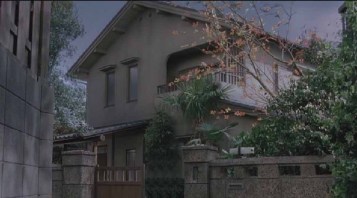 The “wrong” time is anytime after a certain murderous tragedy took place on the premise. See readers, this affliction that haunts and claims the victims of this movie is more of a “curse” than a “grudge”, although I’m told the English translation of “Ju-On” is “Curse/Grudge”. A “grudge” , as per the movie, is negative energy in action; or, in reaction. Let’s assume there are scientific laws governing a body of supernatural physics. There is a steady harmony of body and spirit, life and death. The living go about their business and the dead stay dead, their spirits at peace in whatever plane of afterlife existence there happens to be. A horrific tragedy perpetuated with evil intentions can upset this balance. Evil and horror beget evil and horror. In the film, the negative energy is attached to a house, where a mother, her little boy, and the family cat had been savagely murdered by a jealous husband/father. Those who enter the house are susceptible to the negative energy that exists in the wake of this tragedy. It attaches to them. Can they rid themselves of this negative energy by leaving the house? Fat chance! “The Grudge” is part of them now and it follows them wherever they go. Go to work and it will haunt the office. Go to school and it will be there too. Go home? That home will now be haunted.

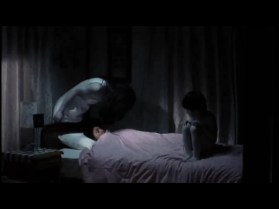 struggle with. This film (like several other Asian horror movies) has a built-in flair for all things creepy. Maybe it’s the detail devoted to the ghosts, or maybe it’s the wise abandonment of cliché plots and over-hyped character types. Perhaps it’s the balance of mood and in-your-face scares. Whatever it is, Ju-On: The Grudge works well.
 Stop the holiday press! (Is there such a thing?) Put those ornaments back on the tree right now. Return those vines of ivy to the banister. Rehang those stockings and regurgitate some of those “Ho Ho Ho”’s you swallowed on the 25th, cause I got one more Christmas-themed post for you! It is a book of Christmas ghost stories –
  Interrogation time! Where were YOU the night of October 27, 2018? If you had any sense, you would have been snugly wrapped in a blanket on your sofa with your TV tuned to MeTV. That Saturday night in question,
 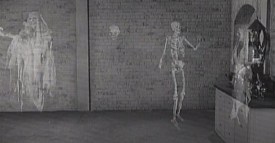 on their own accord. Through the special glasses, they see the ghosts. Quite the variety these specters are! There is an Italian chef that likes to toss knives around in the kitchen. There is a ghostly lion that comes equipped with a headless lion tamer. There’s a fiery skeleton and many others. As to the whys and wherefores regarding Plato Zorba’s collection (just what in the heck did he want to do with these ghosts?), the details are unclear as the movie never fully explains this. But never mind, remember: plot is second to the ghost-viewer gimmick.
 And she is played by Margaret Hamilton, most famous for her portrayal of The Wicked Witch of the West in The W izard of Oz. She leads a séance at one point as the family tries to contact the spirit of Uncle Zorba. A prime suspect, don’t you think? If you think so, you are wrong. It is the lawyer, Benjamin Rush, who is the murderous villain. And he will get what’s coming to him. No, not the money. He will die in the house and become the 13th ghost.
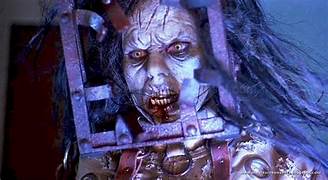 someone who is willing to sacrifice his life for the love of others. And so…..at the end, all 12 Ghosts are lined up obediently on the edges of a spinning circular platform. Arthur’s children are caged in the middle of the circle. To free them, Arthur must sacrifice himself. Gears are turning, walls are shifting.
 The modern film moves faster, that’s for sure. Its ghosts look more deadly, more real. It is filled with non-stop action and a whole lot of pizzazz. Many viewers like this sort of thing and so it would be the second film that strikes their fancy. Filmed in high tech color with bright red blood, it is more entertaining for hue-spongy eyes than a screen of “dull” black, whites and grays.
 severed head in her bedroom. She sees ghosts and witch-like figures here and there, around this corner, outside this window. (The “floating” witch-like character looks like on of those carnival fun house dummies.) During her stay, she finds a love interest, one Lance Schroeder (Richard Long). He looks out for her and tries to calm her.. How sweet!
 While the original film is marked with gimmicks and sideshow scares, this film is filled with – gore, gore, gore! I have already mentioned the operation scene. But there is more in store than what was shown as the backstory. There are a lot of flashing lights, buzzing sounds, and mechanical zaps! Parts of the movie remind me of any opening sequence for American Horror Story, whichever season.
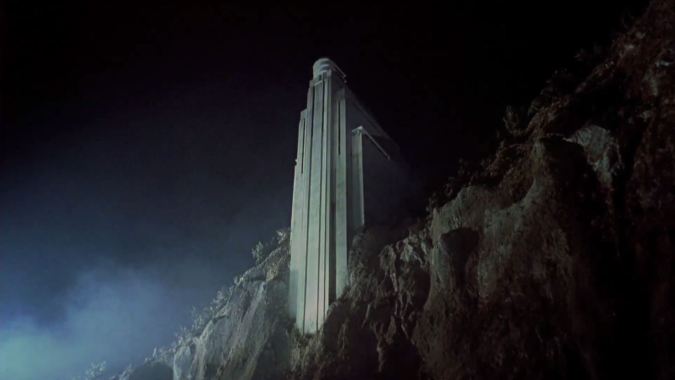

 dance before some creepy Hill House statues – yep, this scene can now be considered both classic and modern. The “Hill House” of the series has many of the same features of the Hill House of the 1963 movie, including a large gate at the beginning of the driveway, and the “twisted” spiral staircase. Both Hill Houses feature rooms that are locked – for the safety of the inhabitants. The caretakers, Mr. and Mrs. Dudley, are featured in both the series and the book. But again, please remember, these are recreations of the famous scenes, not repeats, not meant to tie directly into the happenings of the original story. These are what they call “easter eggs”; features that pay homage to the earlier works.
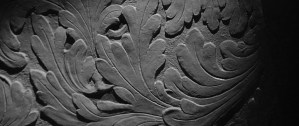 almost as if one could reach into the screen and feel the grooved texture of the bedroom walls.
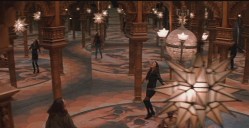 spinning room with mirrors and carnival music, I guess intending to mimic a giant carousel (there are no horses!).

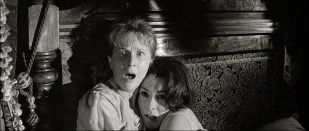 No need for this in the 1999 film. Instead viewers see the subject of the fright (the CGI ghosts), allowing the actors to just look dumb.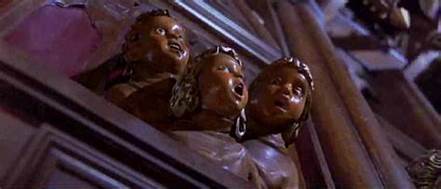
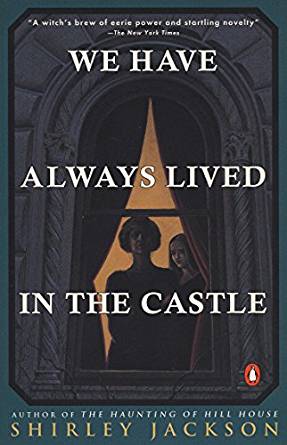 What is the most definitive haunted house of fictional literature? Many might say that it is “Hill House”, that mysterious mansion that haunts poor Eleanor Vance in Shirley Jackson’s novel “The Haunting of Hill House.” Certainly, Hill House is worthy of such a title. After all, the novel that spawned it went on to influence many if not most of the haunted house novels of the later part of the twentieth century, including Stephen King’s “The Shining” and Robert Morasco’s “Burnt Offerings”. Jackson has another story in her catalog of works that centers around a gothic style house. The story is dark and disturbing; the stuff of nightmarish fairy-tales in their original form before Disney waters them down with singing birds and colorful princesses. It is also charming (though there are no singing birds, there is a very observant cat!), funny, and quite absurd. It’s sort of a Poe-Meets-Kafka kind of piece. This novella I refer to is
 As summer winds down, so does this season’s theme; this blog will no longer be “subletting” haunted apartments. For the time being, you’ll just have to go directly to the story creators in order to vicariously reside inside their suites of terror. But don’t be so down in the mouth; I still have one more apartment complex for you to check out! Are you feeling adventurous? I hope so, for we are going to the other side of the world. Off to Japan we go, into a suburb of Tokyo. (For those Blog readers already residing in Japan, look on the bright side – travel expenses will be minimal!) We will also travel through time back to the 1980s and visit an apartment building that is situated beside a cemetery. Get ready readers as I review Japanese author Mariko Koike’s book,
  kind of scare. She writes about the things that make a trip down into a basement a terrifying experience. I refer to the shared basement in that exists in the story’s apartment complex – the storage center. . Down there the air currents are possessed. Down below there are hidden tunnels. From deep within their cavernous mouths, taunting voices call out to tenants that happen to be in the basement, beckoning them inside. Beware of the elevator that takes you down there! It often loses operational control to the things that haunt this complex! But the basement isn’t the only place in the facility plagued with supernatural terror. Sometimes ghostly hands press against the lobby windows. Oh my!
 This post shall be brief, for I have already reviewed the Swedish film
  As promised, I have for your reading pleasure a review and analysis of the third film in Roman Polanski’s Apartment Trilogy. And that film is
  are suspicious of him, even though he presents himself pleasantly. This duo, played ever so effectively by Melvyn Douglas and Shelley Winters, is never short on scowls when looking his way. Part of their scorn may have to do with his accent. They don’t seem to like the fact that his is Polish, even though he is a French citizen. Reluctantly, they give him the apartment.

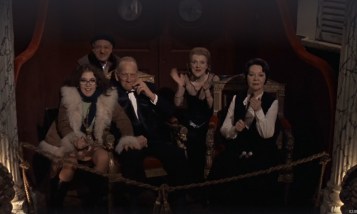 Finally he gives in. Dressed in woman’s attire, he approaches the window. Down in the courtyard, he sees all his neighbors, and Stella too, cheering him on. They are dressed as if they were at an opera. They are seated in balconies theater-style. In reality, the neighbors are standing in the courtyard begging him NOT to jump. He does so anyway and falls through the glass. He wakes up in the hospital, bandaged from head to toe, and finds Stella and himself at his bedside. He screams. It is the same scene that played out earlier in the film, only this time it’s from the perspective of the bandaged mummy. He has “become Simone” and he is “literally” beside himself.
 things about the life of Roman Polanski. As the header states, his life is intriguing, tragic and controversial. According to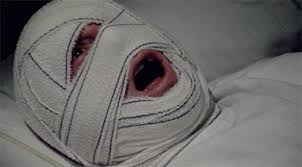
 The Books of Daniel