There won’t be any posts for a few weeks as I have some personal business to attend to. (Oh no, I have ended a sentence with a preposition!) But I will be back! Keep the house haunted for me!!!
There won’t be any posts for a few weeks as I have some personal business to attend to. (Oh no, I have ended a sentence with a preposition!) But I will be back! Keep the house haunted for me!!!
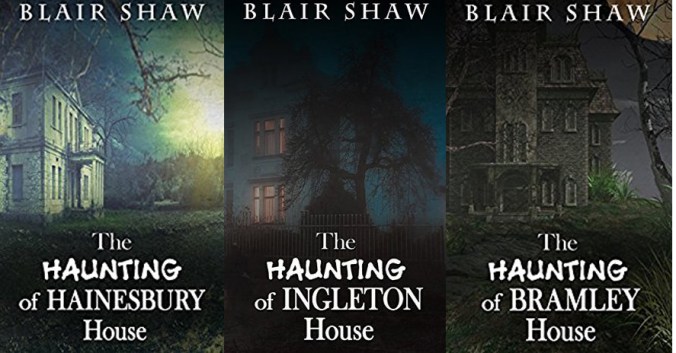
There are houses. There are hauntings. There are hauntings that take place in houses. A fitting book title for this kind of thing might be The Haunting of ( *insert name of house here*). There are several (tens? Hundreds? ) novels that make use of this title template. That’s understandable. After all, it is practical. It communicates to prospective readers what they need to know. In a nutshell it states – “if you’re looking for a haunted house novel, you have come to the right place”.
I’ve explored several books that make use of the “The Haunting of ..” template right here in this blog. The most noteworthy, in my opinion, is The Haunting of Hill House by Shirley Jackson (Read and reviewed here!) I’ve also explored several titles from Darcy Coates (The Haunting of Ashburn House , The Haunting of Blackwood House, The Haunting of Gillespie House) For my next “The Haunting of…” excursion, I turn to Blair Shaw. When I began reading her works, she had three published novellas. They are are The Haunting of Hainesbury House, The Haunting of Ingleton House, and The Haunting of Bramley House, all of which can be found at Blair Shaw’s Amazon Page.
I am including all three in this one review. Why not give each book its own review? Two reasons #1) They are very short reads. #2) They all follow the same formula.
Here is the formula. The book(s) begin(s) in England in the distant past inside a house that is named after its owners. Cruelty and murder have claimed the lives of some of the inhabitants. Fastfoward a hundred years or so. A woman is leaving her home in the United States, fleeing a sad past and facing a new adventure on the otherside of the Atlanic. Sometimes she has offspring to care for, other times no. She moves into a large manor in England, the same manor where the deadly tragedy took place. Of course, the place is haunted by the spirit/s of those that perished in the tragedy. Their disturbances are rather bothersome and in some cases deadly. Luckily, there is a way to rid the house of these spirits. In each case, (in each book), the American Woman figures out what needs to be done. She fixes it so that the spirits can pass on to their eternal home. Then she (and sometimes her offspring) lives happily ever after. The end.
While working out the framework for this review, I returned to Shaw’s Amazon Page and learned that she has since put out two more “The Haunting Of….” Books: They are The Haunting of Addison House (Date of publication March 31) and The Haunting of Morgan House (Date of publication April 16). She’s cranking these out faster than a ghost in a speed machine. However, I am not rushing to read these latest editions. After reading the three, I’m in the mood for something; shall we say “meatier”?
These aren’t bad books. I prefer something a little less formulaic, but nevertheless the stories are engaging. Shaw is a good writer; she expresses herself clearly and concisely. But I would equate these novellas to appetizers. These are stories to read in between books. They are like the “shorts” that used to premiere before the main movie back in the golden age of film. I make these comparisons not only because they are short reads. I use these analogies to equate the level of depth as well. These are simple reads. There aren’t any twists; nothing profound is going on here. But not everything is designed to be a masterpiece.
I will say this – what I like best about her novellas is the beginnings, the prologues (although they aren’t labeled as such) that tell the historical backstory. Shaw has a talent for making me feel a home in a different time period. They describe the feeling of the times well without resorting to archaic language. Perhaps I will make the time to read the rest her novellas – someday. They did seem to get better with succession. I just wish Shaw would write a longer, meatier book. She has it her, I just know it!
Hello Readers!
I just wanted to take the time to introduce a special feature. It’s called (get this!): Special Feature. Funny how that works out! It’s a static post that will remain for an undetermined amount of time until a new feature comes along.
Truth be told, I have had a Special Feature for some time, I just never called it as such. Last October it was The Ghost Hunt game. During the Christmas holidays (and long after), it was my Christmas Eve Ghost Story. Well I finally have a new Special Feature for ya! It’s sort of an essay; part fiction, part analysis, part…something. Oh hell, it’s my thoughts on ghosts! Therefore it’s called “Thinking About Ghosts.” (Again, funny how that works out!)
The link to the Special Feature is on the menu at the top of the Home Page. And it’s also right here: SPECIAL FEATURE!
I hope you will like it!
A review I wrote for HorrorNovelReviews.com
Written by: Daniel W Cheely
Of all the supernatural entities within the horror genre, ghosts are my favorite. There’s something enigmatic about the specter that I find appealing. Free from the constraints of solidity, it is able to take on many shapes and appearances. It can be visible or invisible, symbolic or literal; as sightful as a passing shadow or as elusive as disembodied emotions. A well-written ghost story should foster its specters within this complexity so that the mystery surrounding their nature is important to the story’s scare factor. The ghost stories of Joseph Sheridan LeFanu succeed on these measures. He is often considered the best when it comes to ghost stories of the Victorian period.
Carmilla by LeFanu is a story about a vampire, not a ghost. However, I loved it, partially because LeFanu uses much of the same criteria for this vampire novella as he does for…
View original post 573 more words
 Thorns and Cross – sounds like I’m about to embark upon a seasonally appropriate Easter theme post, doesn’t it? Christ wearing the crown of thorns, Christ nailed to a cross, etc. etc. and etc. All on account of a typo. Damn that “s” for being so close to the the “e” on the keyboard! Let’s remove the “s” in “Thorns” and replace it with the correct “e” and we now have Thorne and Cross – two authors who often partner together to write Gothic ghost stories. I first discovered them when I read and reviewed one of their works: The Ghosts of Ravencrest. I found the book very much to my liking.
Having familiarized myself with the pair, I decided to dissect the duo. By this I mean that I wanted to read their “solo” novels. I began with Haunted by Tamara Throne. Overall, I enjoyed it. I will explain why but first let me establish the novel’s setting and describe the house that is at the center of the story.
David Masters, best selling author of paranormal books, moves to a Victorian mansion off the coasts of California known as Baudey House. Yes, it is haunted. He knows it too. Or at least he expects it to be haunted; that what the rumors say anyway. As a paranormal kinda’ guy, it’s what he wants. The house is part of an odd seaside community that is a mixture of cantankerous yokels and new age flakes. Nearby the house is a lighthouse haunted by a headless ghost. And there are plenty more where that (or in this case, “he”) came from! Inside the Baudey House there are spirits, some of which are visual echoes that can only be perceived by those that that have sixth sense. Others are more interactive – more deadly! There are certain rooms where presences are so strongly felt that it is impossible to remain inside of them for any length of time. Somewhere in the house there is a secret passage that leads to a dungeon. It is up to Masters to find it. Then there are ceramic, hand-made dolls hidden in various places throughout the house. How weird is that!
Did I mention the murders? At different times over the course of more than one hundred years, grizzly murders have occurred inside the house. Bodies were found in various states of dismemberment. It is no wonder Baudey House became known as “Body House.”
Let me now describe the things I find most appealing about this book. The first has to do with the overall story. Thorne serves up a “full meal of a plot” with several interesting angles, many well-rounded characters, numerous situations of captivating drama, and a compelling but chilling backstory. If I had to choose one word to summarize the story, that world would be “fulfilling.”
My second piece of praise is more specific. Of all the authors that have dealt with the subject of “cold spots”, I find Thorne’s descriptions to be the most visceral, which for me translates to “frightfully descriptive.”
Cold spots, according to the According to the Associations of the Scientific Study of Anomalous Phenomena:
“… are small areas (usually a lot smaller than a room) that feel significantly colder than the surrounding area. They are considered by some to be a sign of a ghost in the area. Some cold spots are always felt in the same place while others seem to appear and disappear at different locations.”
Thorne’s accounts of cold spots are gripping, literally so; when her characters encounter them, they feel their chilling presences closing in on their bodies. First, there’s the drop in temperature, then there’s the gripping sensation, next come paralysis and finally their bodies are vulnerable to possession!
Alas, the novel has its shortcomings. Quite often, without warning, the third person narrative slips into a first person perspective. This happens in the middle of paragraphs of all places! Sometimes I found myself at the end of a sentence before realizing that I was reading the character’s thoughts. Italics go a long way! Perhaps this is a formatting issue; maybe the italics disappeared when the original file was converted to an e-file. Even so, it would have been helpful if the phrases that represented thought had their own lines.
All in all, this a good book. One Thorne down, once Cross to go! I’m not sure if Alistair Cross has written a haunted house book. I might just have to bite the bullet and “read outside the house”.
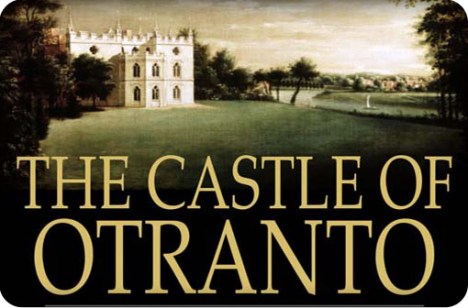 I’m willing to bet that the following themes are all too familiar – Kingdom vs. Kingdom. A despotic Prince. Underground passageways. A fleeing princess. Knights on the hunt. Dire prophesies. A castle haunted with phantoms. Have I listed enough clichés?
All of these motifs are found in Horace Walpole’s novel “The Castle of Otranto”. But let’s give the guy a break. After all, he wrote this piece back in 1764. Long before George R. R. Martin had his Game of Thrones, sooner than J. R. R. Tolkien’s The Lord of the Rings, previous to Bram Stoker’s Dracula, prior to Ann Radcliffe’s Mysteries of Udolfo, Walpole wrote this fantasy novel about a time long ago (even in 1764 it was a period piece); a time of knights and kingdoms, princesses and perils, all wrapped up in a story that is sprinkled with ghosts and other supernatural phenomena. Mind you, he had his predecessors. Shakespeare was writing of kingdoms and ghosts in the 16th century and the stories of King Arthur and The Knights of the Roundtable date back to the 11th and 12th century. However, Walpole’s The Castle of Otranto is credited as the very first gothic novel.
What does it mean to be the first “gothic novel?” Well let us see what the with the fine men and women of Wikipedia have to say.
According to Wikipedia, this novel establishes:
“many of the plot devices and character-types that would become typical of the Gothic: secret passages, clanging trapdoors, pictures that begin to move, and doors that close by themselves.”
But what makes this novel standout among other fantasy and frightful novels of its time is its unique method of blending the fantastic with the mundane. Supposedly in the late 1700s, stories of the supernatural were considered “old school” (They probably had a different term for it, but you catch my drift). Modern tales of romance and adventure were allegedly devoid of such supernatural themes and focused more on believable foes and realistic conflicts. By mixing the two literary strands, Walpole establishes what has come to be a defining theme for Gothic literature – traces of the past making their way into the modern world. Looking at the gothic haunted house stories that come later, this theme bears out over and over – curses born in the past that claim the lives of future generations, justice for sins committed long ago coming for the heirs of the original sinner; ghosts returning from the graves to haunt the living.
Wadpole, a British politician, was a fan of the ancient medieval period, so much so that he had a castle built to replicate a palace of yore. It’s called Strawberry Hill House and it still stand today, although it has gone through much renovation. In writing “The Castle of Otranto,” Wadpole tried to imitate the style of speech from the medieval era. In its initial publication, Wadpole included a preface that made is seem as if his tale was an ancient one, written in the sixteenth century.
Fascination for the ways of yore, nostalgia for periods of we never knew – this is at the heart of Gothic literature. What are ghosts but fanciful beings from times long gone!
So, how much of this novel is dedicated to ghosts and other things that go bump in the night? I’d say there is a smidgen of these elements. Maybe more. Phantoms and other mysterious things pop in and out of this story. Lord Manfred, a ruthless tyrant, arranges a marriage between his son Conrad and the maiden Isabella in order to unite two kingdoms. However, before the marriage is to take place, a giant helmet falls from nowhere and crushes him. Paranormal event #1. Lord Manfeld then takes it upon himself to have Isabella as his own. But not if she can help it. She flees through an underground passage. Lord Manfeld chases her while the painted image of his grandfather flees the portrait and interferes in the chase. Paranormal event #2.
More story follows, but I’m not going to go into much detail. There are battles. There is a love story, and there are more supernatural events; inhabitants of the castle see a giant foot that occupies an entire room, a specter in dark clothes kneels before an altar. Some of these occurrences are rather bizarre to say the least.
As to the claim that this tale deposits the supernatural into “realistic situations”, I don’t really see it. I’m not saying that this isn’t happening. It’s just that I am so far removed from the writing style of the eighteenth century and I’m a complete novice when it comes to the “ordinary, day to day life” of the royal classes of medieval society. Therefore, I’m not attuned to the supposed “realism” that is going on here. “Realism” to me is a Stephen King story, where there might be a guy in a baseball cap chomping down on a Mars candy bar at gas station and sipping his bottle of Dr. Pepper, all while speaking in local slang. In Wadpole’s work, the characters speak in a theatrical style. Formal, long-winded salutations seem to invade nearly every sentence of the dialogue. The heroes and heroines always have the noblest of intentions.
I can’t say that this novel thrilled me to death. The story is fair. However, I did learn a lot from reading the book and doing research for this article. I have a better understanding of the foundations of gothic literature and I have learned a great deal about the evolution of literary styles. For this I am thankful. And onward I will go, digesting more works within the Gothic genre. Some I will like, others not so much. But I look forward to the rewarding experience. You too can have such an experience. Just pick up a book and read, read, read!
This movie came to me in a vision. There I was, entering a tomb that is guarded by possessed skeletons. I passed them by and went on. Soon I came upon an upright coffin. Somebody opened it from the inside! There before me was a coffin-bound ghoul. He spoke to me of horror! Then he told a corny joke and unseen people threw rubber chickens at him! All this occurred in my “tele” vision. (I told you it came to me in a “vision”)
For those who don’t know, I have just briefly described the opening for the horror movie show that airs on Saturday nights on MeTV . Famous horror-host Svengoolie helms the show (and the show is called “Svengoolie’ – imagine that!), and it is a blast! You can see one of these openings in the video below.
The film Svengoolie aired last Saturday is called The Uninvited. It was the second time I have seen this classic 1944 haunted house film on his show. I think I liked it better the second time. Here is the plot in brief – a brother and sister purchase a house by the seaside. The twenty-year-old granddaughter of the seller objects to this transaction. As a former occupant of the house (although she was very young when she lived there), Stella still feels a connection to the place; a connection which she has trouble articulating. Her mother passed away near the house. There is a cliff nearby that drops into the sea. Her mother committed suicide by jumping off this cliff. Or was she thrown off? Was murder involved? There was another woman that lived with them in the seaside home. She too died when Stella was young. Stella insists on living in the house with the new occupants. She is convinced that a female spirit also resides in this house. This spirit, she insists, is trying to make contact with her. Is it her mother? Or is it the spirit of someone else, someone that wants to harm her.
Svengoolie had an interesting piece of trivia concerning this film. He said that this was the first film that took the concept of “the ghost” seriously. I’ll take his word for it. Offhand, I can’t think of an earlier film that put as much effort into telling a thoughtful ghost story. For the first time, perhaps, the ghost that manifests on the screen looks “real”. Of  course, by today’s standards, the specter in The Uninvited might appear lame. But I liked it! It is a distinct change from the “dancing sheets” that substituted as the ghosts in earlier films. Most often, these “ghosts” were used for comedic effect.
In The Uninvited, the ghost appears as a glowing swirl that dances across the screen. Soon, it takes on the appearance of a female specter; transparent and blurred just enough to allow for an imperfection of form that creates the visual effect of a vaporous figure. The ghostly sounds are quite eerie as well. There is the disembodied sobbing that is done with just the right amount of echo. There is haunting laughter that trails off to nowhere. Then there are other factors that make for a chilling, ghostly atmosphere. Book pages turn on their own accord. Flowers die instantaneously. And special attention should be payed to Actress Gail Russell (playing the role of Stella) when she gives way to dramatic pauses that pull the viewers into the contemplative yet chilling scenes. Stella smells the fragrance of her mother. She becomes blissfully joyful. Then Stella becomes frightfully cold. She succumbs to trances.

All in all this is a decent haunted house film. It’s not the best but it holds its own. My only complaint has to do with the ways that the mystery unravels. Through dialogue, the cast discuss the clues they have found and verbally hypothesize their way to the truth. This is an instance where the phrase “show don’t tell” comes in handy. I would have preferred more showing and less telling. Oh well, you can’t always get what you want, I guess. Still, it’s a good film. See it. And tune into “Svengoolie” on MeTV Thank you! Over and out!
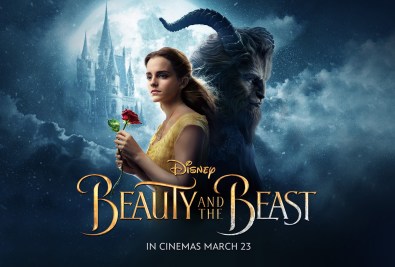 Last Sunday I spent a fine afternoon at the movies with my wife. We took in the charming, live action film Beauty and the Beast which is based off of Disney’s 1991 animated film of the same name. I was delighted to hear Emma Watson sing and I enjoyed her performance as Belle, a.k.a Beauty. I got into the love story and the whole “beauty is within” message. I was pleased with the fanciful display of CGI. Ohh it was all so precious! And through it all I kept asking myself “Can I consider this a haunted house film?” At one point myself replied, “What? ‘and they lived happily ever after’ Disney film = a haunted house story? Are you nuts?” Later on, “myself” gave in a little. He said “Okay, some of these scenes revolving around the Beast’s Castle are a bit scary. But still – no. No Haunted Castle for you!” Finally when cups, dishes, clocks and candelabras came to life, “myself” met “I” half way and said “Maybe. Maybe this is a Haunted House film and maybe it isn’t.”
Allow me to argue on behalf of “I” , The Beast’s castle is huge and creepy with foreboding towers and sharp pinnacles. It has cavernous passageways and a dark dungeon. The grounds surrounding the castle are quite terrifying. It is hidden away in a cursed section of a forest where it is always winter. Dangerous wolves roam about on these trails. Defiled  grounds and the creatures that inhabit them often surround the haunted houses of lore (See my article: Ghostly Grounds: Explorations Outside of the Haunted Houses of Film and Literature). When our heroine Belle enters the castle, she is greeted by moving candelabras, magical wardrobes, and self playing instruments – all of which can talk, sing and dance! These objects warn Belle not to venture into the east wing of the castle (or is it the west wing? I forget). The Beast tends to spend most of his time in this wing, and it can be dangerous for Belle to rummage around in there! Haunted wings, forbidden rooms and walled off passageways are staples of haunted house lore.
In the novel “Dracula”, the mysterious Count warns visitor Jonathan Harker not to go roaming around the castle (See Dracula’s Castle .) In the house that is the subject of the book. The Ghosts of Ravencrest, there is “a wing that is locked away – for there are strange things afoot in this side of the building.” Finally, the villagers who enter this castle and witness these strange goings-ons declare the place to be haunted. If you can’t trust a villager, who can you trust?
“I” has made some very good points. But alas, “myself” retracted his “maybe” and eventually “I” saw things from his point of view. All the beings inside my head have come to an agreement: The castle of the Beast is not haunted. My colleague helped to properly explain the condition of the castle. He said, “It’s not haunted, it’s enchanted.”
Throughout these reviews and articles, I struggle to define the term “haunted house” (or haunted castle, haunted inn, haunted flat, you get the idea). I have perhaps contradicted myself from time to time as I have written out various themes concerning what a haunted house is or isn’t. This is all part of the learning process, and the goal of this blog is just that – to learn, to discover. Therefore, perceptions can change along the way.
Let me continue by offering some definitions of the word “haunt.” Borrowing from Merriam-Webster , haunted can mean “to stay around or persist.” But it can also be defined as something that is “inhabited or frequented by ghosts” (via dictionary.com). A house with ghosts is haunted. However it does not have to have ghosts in order for it to be haunted. It can be haunted by tragedies or sins of the past, by curses that play out again and again, or by lingering sadness. The Fall of the House of Usher and The House of Seven Gables are examples of such ghostless haunted house stories.
Now, let us see what the dictionaries have to say about the word “enchant” From dictionary.com:
under a spell;bewitched;magical
or
utterly delighted or captivated; fascinated; charmed.
As per the context of this story, the first definition applies. The second definition is more appropriate for the castle that stands at Disney World.
For those unfamiliar with the story of Beauty and the Beast, a witch who is refused entry into a handsome Prince’s castle on account of her haggish appearance curses his household. The Prince is turned into a beast while his staff is transformed into objects (the candelabra, cups, etc.). If the Prince can find a woman to love him despite his beastly appearance, the curse will be removed. The beast can become handsome again and the  staff can once again regain their humanity. This is the story as per Disney writers. I have never read the original book by Gabrielle-Suzanne Barbot de Villeneuve (and later abridged/rewritten by Jeanne-Marie Leprince de Beaumont) But when I skim the synopsis per wikipedia, I see no reference to the bewitching of the staff. Could it be that Disney created these household object characters in order to have a silly and cutesy cast of animated creatures; creatures which are prevalent in most Disney cartoon movies? Perhaps, but at the same time, these things are downright uncanny and freaky – a nice touch for the lovers of the bizarre. I am a lover of the bizarre and I love this whole concept of living people becoming a part of the physical castle. In many haunted house stories, the physical becomes the spiritual (In The Shining, The Inn itself manifests the ghosts). Here the reverse is true.The fact that the servants transform into these objects shows that this curse not only plagues the people but it also infects the castle itself. Thus it can be said that the castle is enchanted.
As freaky as these object-things are, they are not ghosts. Nor are they objects possessed by ghosts or demons. They are regular people that have been bewitched and transformed. In this story, the theme pertaining to visitations from the past does not exist. The curse that subjects the household to take on these cruel forms is not a phenomenon that reoccurs from generation to generation (as with the curses of The Fall of the House of Usher and The House of Seven Gables). They are damned not to the past but to the awful present of never-changing appearances. For these reasons, The Beast’s castle is not haunted. {By this criteria, I realize that the strange supernatural houses in many of H.P. Lovecraft’s tales would not be considered haunted. I had written that they were. (See H.P. Lovecraft Article 1 and and H.P. Lovecraft Article 2) Oh well!}
Beauty and The Beast is a dark tale. Perhaps I can make it even darker. I can recreate the tale so that the castle is both enchanted and haunted. Again to quote my colleague, this would be an “enchaunted castle”
The beginning of the story will be the same: an old crone desires entry to the Prince’s castle in order to escape the cold and the rain. At first sight, she is the object of The Prince’s cruel scorn. His servents laugh at her as well, but not to the same extent as their Lord. Suddenly she becomes ill and The Prince laughs even more as she succumbs to tics. Right there in front of him and his staff, she dies. Her spirit rises from her body. It is a beautiful spirit and The Prince and his servents turn away in shame, feeling unworthy to behold such beauty.
The spirit says to the Prince.
“The soul is where true beauty exists. It will take you many painful centuries to learn this. For I curse this kingdom!”
From that moment, the Prince is trapped in his own body, which suddenly becomes deformed and hideous. But he is damned to remain in this body until he finds a woman to love him for what he possesses on the inside. Throughout the years, his body decays and rots until he resembles a zombie. Alas, he cannot die.
The staff, being a lesser evil than the prince, is struck dead. However, their souls will be bound to the castle. They will haunt it until The Prince finds love and is freed from his despicable body.
For centuries, this zombified Prince will roam about the castle. The bitter spirits will 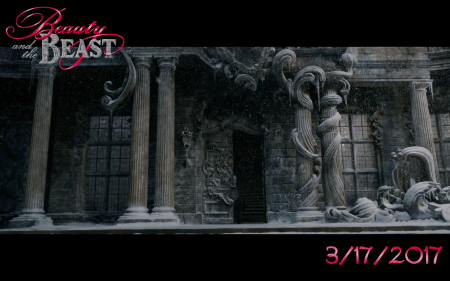 haunt him from time to time, blaming him for their fate. After many many years, he will finally find love. Her kiss will be the kiss of death. When her lips press against his, he will die but his soul will be free. The spirits of the castle with join their lord in this freedom.
So – how does that story sound? What’s that? You think it is better to stick with the original? Fine! No “enchaunted castle” for anyone! Go on loving those enchanted castles for what they are and continue admiring those haunted castles for what they have to offer.
Hey, have you ever seen the film “Haunter”?
(I think you mean “The Haunting”. There’s the original 1963 film by Robert Wise and then there’s- )
No, I don’t mean “The Haunting”. I mean “Haunter”
(Oh!!! You mean that 1995 film with Kate Beckinsale.)
NO!! That’s “Haunted!” I’m referring to “HauntER!” “er!” “er!” er!” “er!”
(Hunter? )
Oh never mind!!
Truth be told, I had never heard of this film either (until I found it on Shudder.com a 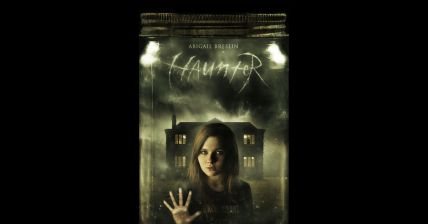 couple months ago) It premiered in 2013, but according to Wikipedia, this Canadian film had a limited release in U.S. theaters. Released on video in 2014, it only took in $129, 477. Suffice it to say, it didn’t get much exposure. Equally disappointing are the lukewarm reviews. Fifty-four percent of professional critics cited on Rottentomatoes rated this film positively – a slim majority. But there are plenty of professional critics that panned the film. Rex Reed of the New Yorks Observer writes that the film is “A dull, confusing movie for which nobody provided a script” Meanwhile, only forty-two percent of the non-professional critics (audience) view the film favorably. IMDB gives this a rating of 5.9 stars out of 10.
All this is sad to me, because I think this is an underrated film that is too good to be hidden from the masses. It is NOT dull. In fact, it is quite the opposite; I was drawn in immediately. It only took a few scenes before I had dissolved into the mystery of the house that is at the heart of this story. Is it a confusing movie? Perhaps at times. It is complex but in a captivating way. It is non-linear. Characters weave in and out of various timelines. They tunnel into different dimensions; the dimension of the living and the dimension of the dead. There is a lot packed into this 97-minute film. There is layer upon layer of awesomeness. And yet, the film doesn’t feel rushed. Nor does the plot feel oppressive and burdensome.
It is difficult to explain the plot without giving away spoilers. On all of the major review sites, a spoiler sticks out in the very first lines of the synopsis. I understand the reasoning behind its inclusion: the heart of the story beats according to this revelation. But I swear, for the first 15-20 minutes of the film, the revelation is not immediately apparent. Having read the various synopses, I knew what this revelation was before beginning the film, and yet I let myself flow freely in the directions that the plot was taking me, so much so that I nearly forgot the surprise.
In some of my reviews, I do post spoilers. Normally I warn the reader about this. Depending upon what I want to achieve with the article, I sometimes need to give things away. If I’m doing an analysis of major themes, for example, it is sometimes necessary to reveal key plot point and twists. For The Haunter, I wish to give nothing away. I am even omitting things that major review sites list freely. I want this to be a surprise from start to finish. I want it to be like the roller coaster that it is; with exciting twists and turns.
I’ll close this review by starting a new subject, hopefully to be continued in the future I consider “Haunter” to be a post-modern film. It’s non-linear and it lacks a center, so to speak. Some other haunted house stories that fall into this category are The House at the End of Time , a film and House of Leaves, a book. So I ask, are there commonalities across all post-modern haunted house stories that are limited to its genre? Are there certain themes that are begging to be discovered and analyzed? I don’t know. This would be an interesting avenue to explore. And that’s what we do here at the Haunted House Poject – drive down avenues that behold such wonderful houses of haunts!
 I was there. Back in 1986, I saw the movie House at the Norridge Theater in Norridge, Il. Norridge Theater is nearly ten years gone. But this film lives on…barely. It’s been on and off of youtube. It might be hiding in the back of the $1.99 shelf at the DVD store. I saw it again Friday night via Shudder. But I was there for its incarnation! At fifteen years of age, I watched this wacky film on the big screen. I freaked at the corny, carnivalesque demons. I laughed at the oddball humor. I walked out of the theater thinking, “Wow man, that was cool!” And I wasn’t even stoned! Thirty one years later, I find myself watching it a second time. My how time flies…and excitement fades.
IMDB categorizes the film under the genres of comedy, horror, and fantasy. To me, however, it seems genre-confused. I will explain more about this genre identification crisis later. But for now, here is the plot in a nutshell. Author Roger Cobb has been having a rough life as of late. His publisher has been pushing him for new material, but he’s been having a tough time writing ever since his young son went missing. This tragedy leads to the dissolution of his marriage. When his old aunt passes away, hey takes over her large, gothic-style house. His aunt was his sole guardian when he was young, so this is also the house he grew up in. It’s also the house that claimed his son. Apparently he had lived there with his wife and son for a time being. In any case, the House is haunted. Obviously. That is why I’m reviewing the movie!
This film smacks of the 1980s. It’s colorful, simplistic, goes for appearance over depth,  –it’s a glam punk of a movie. As mentioned, the things that haunt this place look creepy, insane and ridiculous. They looked as if they are mummy wrapped in Hefty bags. But perhaps this is part of the humor; the style! George Wendt, A.K.A, Norm from “Cheers” stars as the funny guy neighbor who likes to drink beer while Alan Autry A.K.A. Captain V.L. Bubba Skinner of “In the Heat of the Night” stars as a serious cop that comes to the house to investigate some shenanigans. It’s nice to see two beloved television actors reprise their characters in this film (not quite though, as In the Heat of the Night TV show came later. Ahhh but they are so similar).
This film is an exercise in genre experimentation, whether it is conscious of such an experiment of not. Throw in some camp, stir in in some Gothic horror, toss in the absurd, add a bunch of comedy, mix it up with some psychology and put it all together, make a movie and let us hope it all fits together in the end. And the result is….it doesn’t fit so perfectly. It’s like a puzzle where the connecting ends of the pieces just won’t go into the given slots. But if you push real hard (GRRRRRRR!!!!!!!!), it can sort of fit.
Take for instance, the war scenes. (What? War scenes? How does that fit into this plot as you have so described it?) Roger decides to write about his experiences in the Vietnam War. As he writes, we the viewers “see” his experience. These battle scenes; I’m not sure what Director Steve Miner had in mind. I sure hope it wasn’t intended as a mimicry of Platoon, because the soldiers don’t resemble the well rounded warriors of Oliver Stone’s epic film. Instead they are like the soon-to-be-slaughtered teenagers of any slasher film. They are mannequins in soldiers’ uniforms.


I guess my tastes have changed since 1986. I had forgotten most of the finer plot points.A year later I saw Evil Dead 2 in the theater. In my opinion, Evil Dead 2 does a better job with its stylized camp while remaining true to the horror genre. In the end, House is an entertaining film. But that’s about all it is. It’s sort of like the crap rock I used to listen to in the 1980s; (Quiet Riot, Motley Crue, etc.) before discovering good rock (The Who, Led Zeppelin). The crap is enjoyable but not worthy of a spot in the hall of greatness. So it is with House. Shudder also has House 2. I’ve never seen the sequel. Should I watch it? I just don’t know.
Stories and photos from Scotland
Soar to Greater Heights
Author: Rania Hanna
Do Not Copy My Images. All are copywrited.
Book reviews and writing advice
It's Ectolicious!
Frightful Fun with the Demonic Duo
History, Folkore and the Supernatural
Fantasy Author
Ghosts, Tall Tales & Witty Haiku!
Literature, books , sport and whatever intrigues me
Just another WordPress.com site
Inside the den of haunted house fiction
Ghost Writer
Book Recommendations, Inspiration, Writing, Books, Blogging and Social Issues

 The Books of Daniel