Haunting Paranormal: Ghost Story Collection – Review of Series Openers from M.L. Bullock’s

Have you ever ordered a sampler at a restaurant?  Let’s take the seafood sampler for example. There might be a couple of crab legs on your plate, some fried shrimp and tartar sauce.  Throw in some garlicky scallops, a lobster tail and you’re all set. 

I read a sampler a couple years back. I’m just getting around to writing about it now.  Don’t worry, I’m refreshed. Try refreshing two year old scallops though, that may not turn out so well. 

I reread and/or skimmed through the stories of M L Bullock’s Haunting Paranormal Ghost Story Collection, which is a collection of firsts from various series.  I saw this book advertised on Facebook at a very generous price.  Of course I can’t remember what I paid; perhaps a few dollars?  It was a kindle book.  Also, I can’t recall if it was an advert or if I was already following Bullock.  Whatever the case may be, the promotion worked on me (that rhymed) and I bought the book. 

Need I say each story contains a haunted house?  Mostly these are manors and each one has a story to tell, having hosted successive generations within their walls. Whether plantation  manors or mansions unassociated with a spread of land, they are houses of the American South.  Hence,   M. L Bullock is known as “The Queen of Southern Gothic”.  Don’t believe me?  Check out her website and see for yourself!  You’ll have to scroll down a bit.  She shows off this title in bold, colorful print. Guess I can be the King of the Houses of the Haunted if I just get my fonts right.  

 Bullock’s writing style is, well, it’s her style. Some will love it, others no. I’m somewhere in between. She’s overly descriptive  when detailing the heroine’s daily apparel or hairstyle choices. At least for my tastes. She is quite prolific, being the author of several long series. How does she pump out so much material?  For one thing, the books within the series are not very long (at least not the books that begin each series). Second, her works are very formulaic. 

Nevertheless, Bullock  is a good story teller, skilled at wrapping the reader in her worlds, both modern and historical. Had this not been the case, I wouldn’t have made it through these five stories (although with one of them I was tempted to quit).  They are:

Seven Sisters 

The Haunting of Joanna Storm

The Belles of Desire, Mississippi 

Wife of the Left Hand 

The Ghosts of Kali Oka Road

This article will touch on each story in brief, examining plot, and offering opinions. As to this last point, I will finish each succession with a “Yes”, “No”, or “Maybe”.  What are these? Well, they are answers, you see. This implies the preexistence of some kind of question, doesn’t it?   The question is: Does this introductory book entice me to read other books in the series?

First, let’s get the formula out of the way. This applies to most of the five stories, if not all.

A female protagonist finds herself in a new house or city in the American South.  Things in the new place are not exactly normal. They are, shall we say, “para” normal. Ghostly goings-ons are afoot. Sometimes the event is subtle, causing the heroine to dismiss it. Other times the event is striking, leaving no doubt the house is haunted.

A large chunk of the story will take place in historical times. Sometimes it’s half of the story, and in other cases only snippets of the past leak onto the page. In all cases, the protagonist experiences the past as if she were there as an eyewitness watching a haunting history unfold. Hence, there are two timelines, the present and the past, and the workings of the paranormal to connect the two. The means to this time bridge she crosses differ slightly from story to story.

In most of these stories, there is mystery surrounding the fate of a woman from the past who once resided in the haunted house. Either she disappeared during her lifetime or the final fate of the woman (who is a victim of some tragedy or loss) is lost to history. It is the duty of the protagonist to solve the mystery.

The protagonist’s appearance is described in great detail. Hair color or style, manner of dress, from blue jeans and t-shirts to grand dresses or yore. This description applies to her male love interest as well.  In every story, there is romance or hints at romance, earning these stories the genre badge of “Southern Gothic Romance.”

Finally, all these stories end abruptly.  It’s as if there is a built-in alarm that rudely blares, catching the reader off guard. Content with the story pacing, enthusiastic to complete the last stretches of the journey, then all of a sudden,  a hidden voice comes out of nowhere and shouts, “Last call for alcohol! Drink ’em up, we’re closing in 10 minutes!” Conclusions are fast, unsatisfactory, and forced, with many questions left unanswered. I guess this is where the reader is supposed to grasp quickly at the next book of the series. Hurry! Go to Amazon, buy and download. Damn! Slow wifi. OMG, does my device have enough charge? (As I write this, I  am reminded to charge my tablet. Seriously, I might have gone to bed with no power to read anything before sleep. The horrors!)

Obviously, I didn’t rush to buy any sequels, for as I stated, I’m going to reveal my yes-maybe-no answers concerning the prospects of continuing any of the series. However, I did finish this entire book, which means, despite how much I seem to be bashing these stories, I did discover things I liked.  I like the worlds Bullock creates, both past and present.  The characters are interesting. Bullock does take the time to build idiosyncrasies into their makeup.  And the stuff of ghosts and haunted houses are spooky and fun!  

Okay, enough of all that. Let’s explore each story in more detail, shall we?


 Seven Sisters
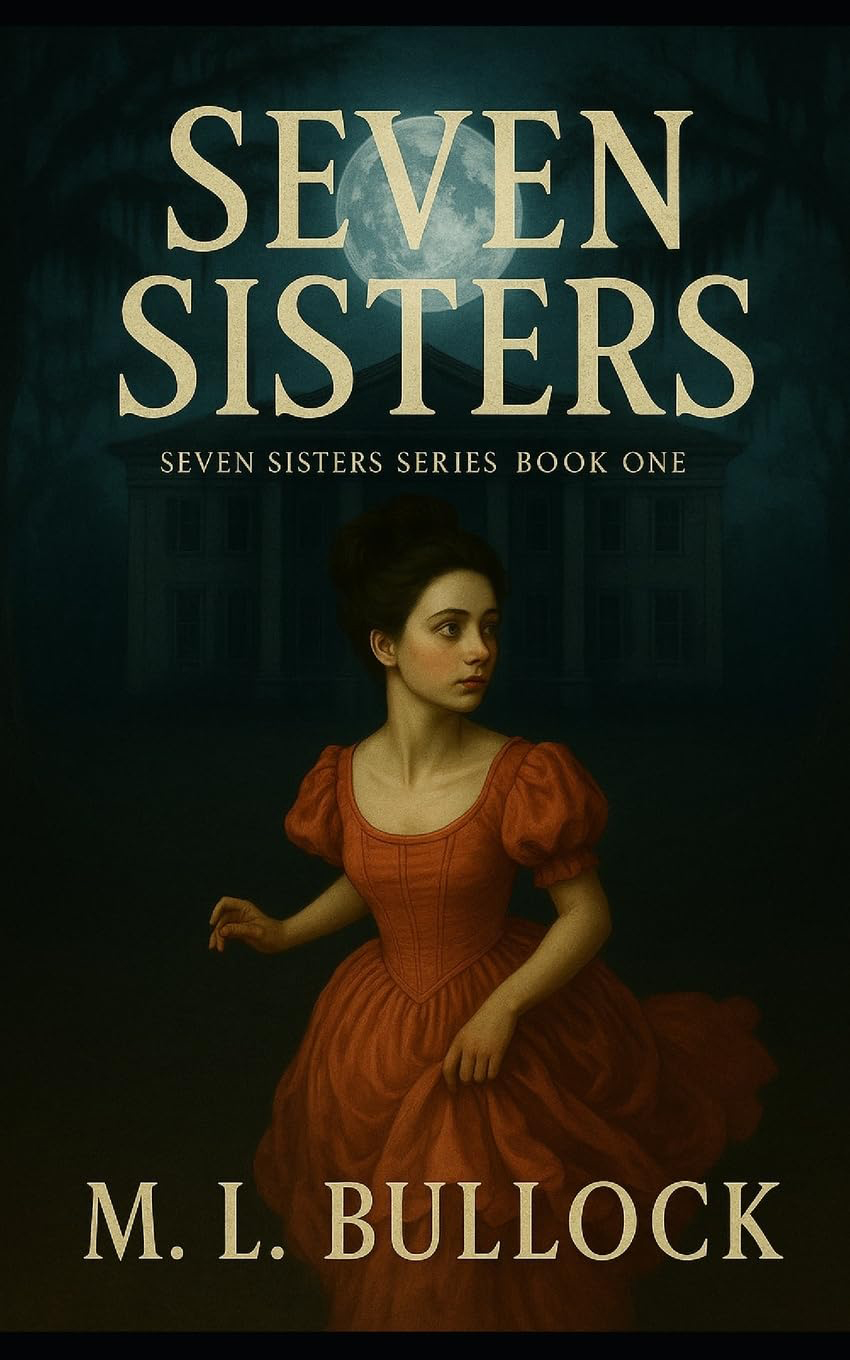
Carrie Jo,  just out of a relationship, is hired to assess the inventory of antiques inside Mobile, Alabama’s Seven Sisters Manor (former plantation), with the end goal being to convert the premises into a museum.  She is well qualified. She is a historian and has a team at her disposal to assist in renovation and research. She falls in love with Ashland, her boss, and the current owner of the estate.

She also has a special ability when it comes to dreams.  When she sleeps in the presence of artifacts, or inside an old house, her dream  transports her back in time, where she can witness the happenings from a long time ago. 

In her dream state, she is transported from  the twenty-teens to the eighteen-forties, where she witnesses the life of Calpurnia Cottonwood, the teen daughter of the former owner of Seven Sisters. Poor Calpurnia went missing sometime in the 1850s. Readers, through Carrie’s dreaming eyes, learn how she fell in love with a sailor who happened to be passing through Mobile. We feel for her when she is abused by her drunken father. The dreams tell us of other relationships from the past. How slaves interact with their masters, how slaves interact with each other. 

Carrie Joe, when exploring the manor in modern times, witnesses doors opening and closing. Could this be the activities of a Calpurnia’s ghost?

All in all, a very interesting piece of historical fiction with fine, ghostly elements.

Will I read on?  

Let me show you what I would be up against if I took on this task.

Will you look at this loooooong list?  Oh Good Lord!

SEVEN SISTERS

#1 Seven Sisters

#2 Moonlight Falls on Seven Sisters

#3 Shadows Stir at Seven Sisters

#4 The Stars That Fell

#5 The Stars We Walked Upon

#6 The Sun Rises Over Seven Sisters

#7 Beyond Seven Sisters

#8 Silent Night, Haunted Night

#9 Haunted Halls of Rosegate Manor

#10 Terror at Mossy Oak

#11 Dark Angel of Selma

#12 Silent Chapel

#13 Angel Terrible

#14 Tangled Garden

The Ultimate Seven Sisters Collection

Seven Sisters Collection Vol. 1

Seven Sisters Collection Vol. 2

Seven Sisters Collection Vol. 3

Seven Sisters Collection Vol. 4

Bonus Christmas at Seven Sisters

Bonus The Ghost on the Swing

I think it would be a more worthwhile experience if I just simply read War and Peace or Moby Dick.  As interesting as this story is, the answer is No, I shall not trudge in this field of overgrown weeds. 


The Haunting of Joanna Storm  (Book 1 of 3 in the Morgan’s Rock series)

It’s a house on the rock, overlooking the ocean, somewhere in Florida. Meagan, a writer, has leased the big, old house. There, she will work on her latest book.  It has several floors and a clocktower. Gotta love a house with a clock tower!

Oh, guess what?  It’s haunted.  Meagan sees ghosts in mirrors, hears disembodied shuffling. A mysterious maid shows up at her door one day, claiming to have been hired by Meagan’s agent.  Be wary of mysterious maids in haunted house stories.

Once upon a time, Joanna Storm lived at Morgan’s Rock.  A Hollywood starlet , Joannna lost her parents at a young age. Her father “accidentally” fell off the rock and into the ocean. In her time at Morgan’s Rock, she too heard disembodied shuffling, along with whispers. She had friends, colleagues, enemies and lovers who died tragically.  The strange thing is, no one in modern times seems to know what happened to Joanna Storm. History itself shrugs its shoulders and mutters, “Beats me.”

Meagan, as per Bullock’s formula, will visit Joanna’s timeline.  This usually happens when she encounters an item in the house that once belonged to her, such as a scarab necklace. In fact, when she dons Joanna’s dress, she becomes her! 

This story doesn’t grab me as much as Seven Sisters, but it is a mercifully short trilogy.  So, will I read on?My answer is Maybe


The Belles of Desire, Mississippi 

This story is from The Ghosts of Summerleigh, a four book series.  It takes place in Mississippi. 
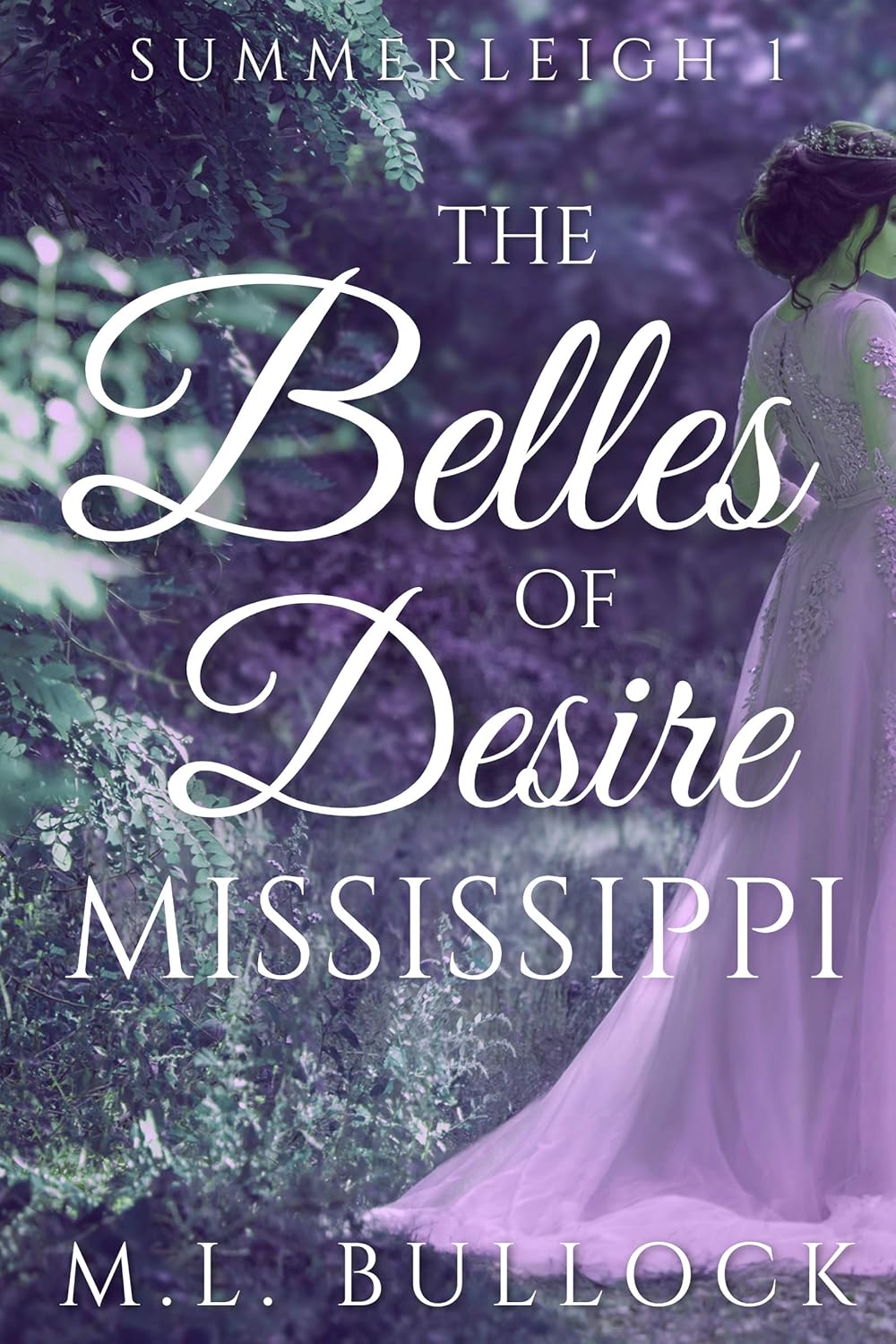
Harper Lee, a dying patient at a resident care home, forms an attachment to Jerica, one of the employees of the care home. When Harper passes, she bequeaths her family home to Jerica. Jerica is now the owner of the Summerleigh estate, which includes a grand ol’ house with multiple floors, a large chunk of land, on which a small cottage stands.

There is a catch – Lee has tasked Jerica with uncovering the mystery of what happened to Jeopardy Belle, Jerica’s older sister, who went missing in her early teens.  It is more of a plea rather than a clause within the will. However, Jerica is sensitive to Harper’s wishes and will do what she can to solve the mystery.

Jerica moves in, but stays in the cottage, not the main house. Why?  Too many ghosts are floating about in there (don’t know if they are actually “floating”, my words, not Bullocks, not Jericas)  Who are these ghosts? Turns out, there are layers of ghosts, just like layers on a cake.  Ghosts of Belles, ghosts of family/residents before the Belles. And even Jerica’s own baby boy, who she lost in a car accident, appears (although his is drawn to his mother, not the house)

Like with the other books in this review, there are two timelines. First, there’s the modern day, which includes the whole Jerica storyline. This takes place in the twenty teens.  And oh, how can I forget, Jerica has a love interest.  He helps out at a restaurant in the nearby town and happens to be a handy maintenance man and Jerica could sure use a man like that to help restore the house. I’m sure he satisfies her in other ways too.  Okay – Love interest plot covered.  Let’s go back to the good ol’ days.,

The second timeline takes place in the 1940s. The four Belle sisters (or is it five? I’m forgetting) live with their mother. Father is away a lot. When he is gone, mother is mean, especially to the oldest girl Jeopardy.  Jeopardy rebels by hanging with the wild crowd, smoking, drinking and skinny dipping. One night she goes out and never returns.

How are these timelines connected?  Through Jerica’s dreams, she learns of the past,  much like the Carrie Jo character in the Seven Sisters story.  The difference – Carrie Jo possessed this dream time-travel ability before the events of the story. Jerica has no such superpower. But after Harper’s passing, she dreams of the life of the Belle sisters as seen through Harper’s eyes. I guess Harper’s spirit is passing the info along to her in her dreams.  Perhaps Bullock, knowing she already had a story about a “dream sensitive”, didn’t feel like using a clone character, so she decided Jerica would dream of the past in such a way to miraculously plot itself out like   chapters in a book.

The book’s ending is not as sudden as Bullock’s other novels. This is the best of the five books.  I really appreciate the different character traits of the Belles sisters. The mother, father, Jeopardy’s sort-of boyfriend, all fit into the story well. There was enough depth to convince me this was a real family (of course it’s fictional).

So, will I read on?  There is only three books total, so My answer is Yes.


Wife of the Left Hand
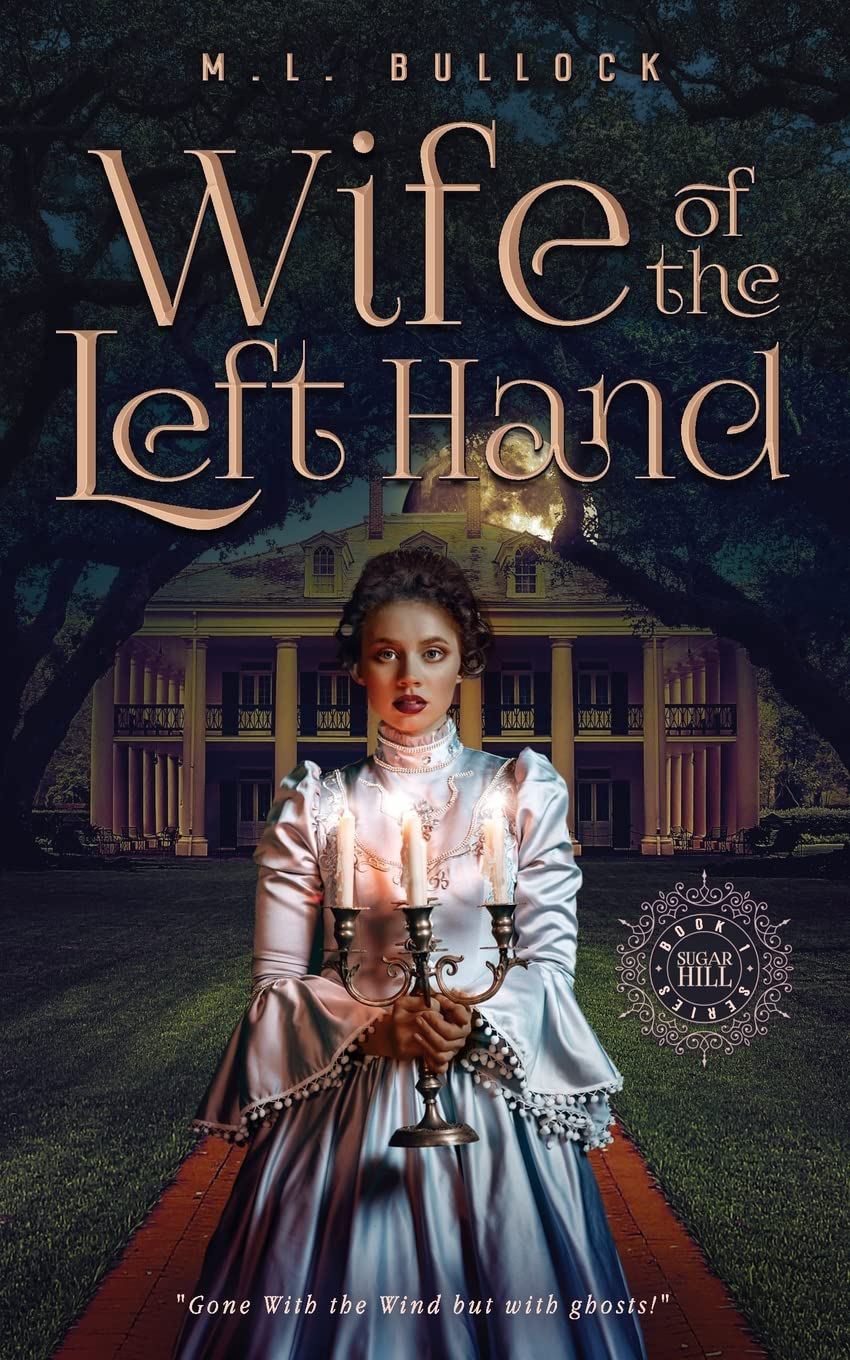
This is book 1 of 4 of the Sugar Hill Series.  For a change, let’s begin with the past. A wealthy son of a plantation owner takes Susana to be his wife. This is a morganatic marriage, also called a left-hand marriage. Simply stated, it’s the pairing of two people of unequal social class. In this case, Susana is from the lower social ranks. It falls on her to earn the privilege of being the wife of one of the most promising young rich men in the area.  But when she is accused of adultery because of a situation that is not her fault, she is ostracized by not only her husband’s family but by her own mother as well. However, the mother will do what is necessary to secure this marriage. In the end, they will use witchcraft to bind Susana to her husband. But this comes at a great cost.

All this takes place in Fontaine, Alabama somewhere in the mid 1800s. Fast forward 150-160 years, we meet Avery Dufresne, a famous  newscaster who is nearly murdered by an unknown assailant. He is still on the loose and she needs to hide. Coincidentally, she is invited to take refuge out of state and live in her family’s mansion. She was unaware that she had an extended family, not to mention a mansion to go along with them.  This is the same mansion that Susana lived in with her husband.  Her great aunt, the family matrone, places a ring on Avery’s finger, which signifies she is to be the new family head with powers to control the finances.

There are plenty of ghosts around the mansion creeping about and waking Avery up at night. Some ghosts disguise themselves in the skin of the living.  She encounters people and has long conversations with them only to find out they have long since passed.

Through  video tapes, her deceased great-great grandmother “interviews”  Avery. Somehow, even before Avery was born, this grandmother knew Avery was destined to be the matrone. These tapes reveal family history; history that even this  great-great grandmother would have been too young to have experienced.  This would be the history of Susana. Could Susana be haunting this mansion?

Did I forget to mention Avery is dating a rock star?  I did. Now it is mentioned. There – the love story is covered.

So, will I read on?  There is much substance to this layered story, and the mystery surrounding this huge and complicated family is intriguing. Why do they need an appointed matrone every generation?  

But it doesn’t grab me as much as The Belles of Desire, Mississippi. That series has a total of three books and this one has four, so my answer is Maybe.


The Ghosts of Kali Oka Road

Last and least, The Ghosts of Kali Oka Road is book 1 of 15 of Golf Coast Paranormal Series.  Unlike the other books in this review, this story takes place mostly in the present day (yadda-yadda 2012? 2013? 2014?). However, there are two events relevant to the current-day story that happened in the past.  Back in the awesome 80s (when little ol’ me was a teen), a jock takes a popular girl from school out to the woods, hoping for some hanky-panky (not an 80’s phrase, oh well). Needless to say, things don’t go his way.  Her refusal was not totally unexpected. What was shocking and downright terrifying was the thing from the sky that flew down and whisked his date away.  It looked like a giant owl. She was never seen again.

Jock dude was the last person to see her so he was the prime suspect in her disappearance . However, there was no evidence to charge him with anything.

About one hundred and forty years before this, a woman escapes from her abusive husband with the help of their male slave.  The slave is also her secret lover.  While on Kali Oka Road, she disappears. I do believe that owl-thing is involved in her vanishing.

Now for the present. Cassidy is blessed/cursed with a paranormal skill – she can paint things that happened many years ago.  She paints events with amazing detail. She captures things which only someone at the scene would know. She paints a depiction of the aforementioned woman fleeing down the road.  When she touches the painting, she goes into a trance and is transported back in time.

Cassidy joins the Gulf Coast Paranormal group to investigate the ghostly phenomena on Kali Road.  They explore the mansion the woman lived in, which is connected to the road via a wooded trail.

Oh yeah, the house is haunted.

Oh yeah 2, Cassidy has a love interest, some dude from the paranormal group.

Most of the pages in this story focus on the young men and women in this paranormal group. I don’t really care for these characters. Seems like this group of people was just mashed together with the hopes that something intriguing would arise from this mashing. Hint: this doesn’t happen.  This whole story, in fact, seems rushed and rough.

If the Seven Sisters series seems long, check out the list for The Gulf Coast Paranormal Series:

GULF COAST PARANORMAL Season One (featuring Midas, Cassidy and Sierra)

#1 The Ghosts of Kali Oka Road

#2 The Ghosts of the Crescent Theater

#3 A Haunting on Bloodgood Row

#4 The Legend of the Ghost Queen

#5 A Haunting at Dixie House

#6 The Ghost Lights of Forrest Field

#7 The Ghost of Gabrielle Bonet

#8 The Ghost of Harrington Farm

#9 The Creature on Crenshaw Road

#10 A Ghostly Ride in Gulfport

#11 The Maelstrom of the Leaf Academy

#12 The Ghosts of Phoenix No 7

#13 The Ghosts of Oakleigh House

#14 The Spirits of Brady Hall

#15 The Gray Lady of Wilmer

Bonus The October People (A Gulf Coast Paranormal Extra)

GULF COAST PARANORMAL TRILOGY

#1 Ghosted

#2 Haunted

#3 Spooked

#4 Dead

#5 Paranormal

Gulf Coast Paranormal Season One Boxed Set

GULF COAST PARANORMAL SEASON TWO (featuring Sierra and Joshua)

#1 The Wayland Manor Haunting

#2 The Beast of Limerick House

#3 The Haunting at Goliath Cave

#4 The Skeleton’s Key

#5 Death Among the Roses

#6 The Spiritus Mirror

Bonus Horror Ever After (A Gulf Coast Paranormal Extra) 

What an insane list!  So, will I read on?  My answer is NO.  Put more crudely, No fucking way!


My final thoughts

M.L. Bullock has plenty of fans. Just check out her Amazon reviews. She has found her niche within the Southern gothic and romance genre.  I prefer authors that don’t restrict themselves to  a certain sub-genre the way Bullock does. By doing so, it can come to a point where the genre itself dictates the story. Bullock’s books come close to this example. They rely heavily on formulas and overserialize the story, falling prey to the sterile ratio  “quantity over quality”.  (That’s my “q-tip” for the day. Ain’t I funny?) That said, the author has a knack for good story telling, character writing, and world building.

I promised to go forward, at least with the The Ghosts of Summerleigh series. This doesn’t mean I’m pushing aside other books on my reading list and diving straight into “Summerleigh”.

Summer is ending, folks, at least here in Chicago.  So give me some time, will ya?

One more thing – the author’s name is Monica Bullock. Such a pretty yet distinguished name! I prefer that to M.L. Bullock. Easier to remember and somehow more authorlike than the pretentious two initials/one last name bit.  That’s only my opinion.  Others will disagree.  Fair enough.  

Get ready, readers, Halloween will be here soon, and I will wanna do cool, spooky things here at this blog!
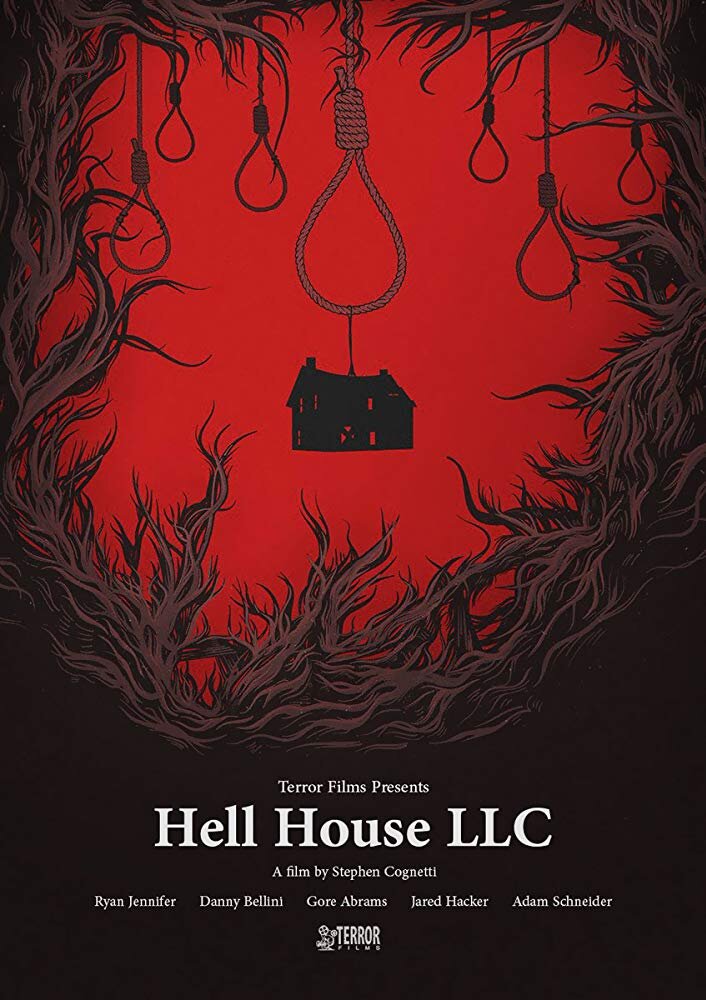
 

Review of Hell House, LLC

For as long as I remember, I have loved haunted house amusement attractions. (Wait, scratch that! I hated my first couple pass-throughs. I was a little kid and I was scared shitless. So why did I begin with “for as long as I can remember, I have loved…?”  Because, silly, it’s a great phrase for which to begin an article!). Every once in a while, a movie comes along that features  such an attraction. I always try to see these films. There is The Funhouse, for example, directed by the famed Tobe Hooper. Four kids are trapped inside a funhouse overnight.  I seem to recall this film having mixed reviews, but oh well, I love it and will rewatch it from time to time.  Since the setting does not take place in an actual haunted house but rather a carnival ride,  I have not reviewed this film at this blog.  There are no paranormal events in the film either.  Then there is The Houses October Built Great title, good movie. It’s a film consisting of four or five young people who travel  the states in search of the ultimate “haunt” (another term for a haunted house amusement attraction. This makes more sense, because these attractions are not really meant to be haunted houses but a series of horrific displays varying in theme), until a haunt finds them. This time around, I did review the film. Why? I don’t know, I somehow convinced myself this was more closer to a haunted house movie than The Funhouse. Was I wrong in this distinction? Probably.  Sue me, I guess.

Finally, the heavens above sent forth a movie made just for me  (heavens = Shudder.com). It’s a movie about a haunted house amusement attraction that is, in fact, really haunted.   From what I can tell, this film is exclusive to Shudder, and it was one of the reasons I renewed my subscription this past Halloween season, a subscription that hadn’t been active for years.

The premise: ghosts and/or demons cause deadly shenanigans on this haunt’s opening night. Imagine following a line of people through the cramped passageways, only to suddenly have to reverse.  “Go back, go back” people in front of you are shouting. Something terrible has happened at the very last exhibit. An emergency. Carnage.  When all is said and done, police and emergency vehicles are everywhere.  And several people are dead.  WTF happened?  Well, the answer to the question is the crux of the film.

Oh yeah, I forgot to mention; the name of both the haunt and the film is Hell House LLC.

The film begins as a documentary that has been filmed after the events of the story. It starts with interviews of people that have second-hand knowledge of what might have happened on that tragic night, then continues with an interview with Sara Havel, the sole surviving crew member.  

Sara has in her possession a video of the events that lead up to opening-night horrors. It just so happens that one of the crew members documented all the prepping activities with his camera. There’s always some guy or girl in these flicks that do that,  isn’t there?  The rest of the film is pretty much the video itself.  You know what this means, don’t you?  Yep, you guessed it.  Hell House LLC is a found-footage movie.

I have no idea how you the reader of this piece feels about found-footage movies.  For me, it depends on how good the story is and how little the camera operators annoy us with a shaking camera.  But if you’re one of those that has made up your mind that you absolutely hate found-footage films, I implore you to still see this movie.  It’s a great movie and when the camera does shake in enhances the scares (like when the customers are fleeing the haunt.)

The film follows a group of haunters during Halloween season  as they “set-up camp”, if you will, in Rockland County, New York, determined to convert the abandoned Abaddon Hotel into the area’s one and only haunted attraction.  The hotel itself is the subject of dark legends. Supposedly, way back in the ancient days of the 1980s, some cult leader named Andrew Tully tried to open a portal to hell on the premises. Two people went missing when he did this. Oh for Heaven’s sake Mr. Tully, couldn’t you be happy with the amenities the hotel provided?

Back to current time (2015). How are five or six people able to haul thousands of dollars worth of mechanical haunting props in a couple of cars, reconstruct the whole place, hire actors, and market the event in a 30-45 day time period? This doesn’t even include securing the rental contract and obtaining the necessary permits. I guess we the viewers are not supposed to be concerned with those things. These are experienced haunters, having operated in various places in past seasons.  So they know what they are doing and we’ll just have to trust them. Reasons not to trust them? For one thing, they are hosting a public event in a place where supposed demonic activity had taken place. And in the end people will die, so there’s that.

Actually, we the viewers do see the crew preparing for the haunt, day by day. Each new scene opens with the subtitle  “X amount of days until opening night” (I’m sure some days are skipped for the sake of the audience. The movie is supposed to scare us to death, not bore us to death. Maybe those were the days they filed the paperwork and received incoming shipments?) 

There are some genuinely creepy scenes in this film. There’s the clown dummy that just won’t stay in one place. There are these shadow things that just appear out of nowhere. And some members of the crew get possessed from time to time.  For you folks out there that love twists, the film as you covered. 

This film is not to be confused with Richard Matheson’s book  “Hell House”.  The corresponding movie is titled The Legend of Hell House. When I first saw the title “Hell House, LLC”, I immediately thought it was either a sequel or remake of Matheson’s story. Matheson’s story is a great book, and the movie is great too. but it’s an entirely different animal.  It’s the “LLC” that distinguishes the modern film  Gotta love the “LLC!”

Guess what?  There’s a Hell House 2, 3, and an origins film. Many of these have gotten good reviews. Therefore, I really am looking forward to binge watching these sequels, more so than other successful horror films that had follow ups. So much fun! It’s great to be me!

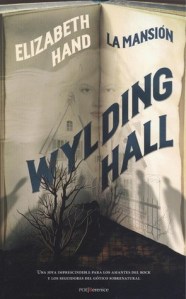
Review of Wylding Hall – A Novel by Elizabeth Hand

Would you like to take a “Wyld” guess as to what Wylding Hall, a novel by Elizabeth Hand, is all about?  Or if “Wylding” is pronounced differently, would you want a description of the novel “wyld” upon you?  My “wyld” guess is that you would want the description “wyld” upon you rather than trying to figure out what the book is about all by yourself.  So, I will tell you what it’s about. 

Wylding Hall a story about mystery. It’s a story about intrigue. It’s a story about companionship and loss. It’s a story that asks the question “what really happened during those final days?”  It’s a story about the supernatural and its strange ways of manifesting. It’s at least trying to be a story about these things.  The effort is there and I give it credit for that. Even so, and I hate to admit it, but I was a tad disappointed with this book.  I had higher hopes after reading Elizabeth Hand’s excellent novel, “A Haunting on the Hill”, which is an  authorized sequel to The Haunting of Hill House.  It was on account of this sequel that I learned of Wylding Hall. Published in 2015 it precedes A Haunting on the Hill  by eight years. I guess it’s more ideal if your books get better as you go along, right?   

There is just too much going on in this relatively short novel for any of the concepts to really shine. So if luminosity is the measure of its greatness, I would say this novel is just above dim. , 

This is a fictional account of an English folk band’s recording of an album in a haunted house. Set in the early 70’s It has many of the staples of rock bios. It details the chemistries and friction between different band members  There are bursts of psychedelia here and there.. And there’s the charming yet mystifying star, which in this case is Julian Blake. It seems Hand is taking a hand (see what I did there?)  at creating a character based on the charismatic, mysterious male rockstar prototype. Real life subjects such as Jim Morrison and Jimmy Page come to mind.   The events in the book, pieced together from varying perspectives, also remind me of the movie Eddie and the Cruisers. Just like with that film,  the mystery surrounding the lead singer’s supposed demise is brought to light by the revealed memories of surviving band members.   

Unlike the average rock bio, there are ghosts in this story. Or, maybe not.  Perhaps this isn’t a haunted house at all. If not, certainly it’s a house of mysticism.  Oh what do I mean by that?  I don’t know, man, guess you have to read the book, ya dig?

I love the material, mind you.  I love bios of young, musical groups and standout personalities within such bands. I love reading about the 60s and 70s music era and I love haunted houses. It’s just that, in the end, something didn’t fully click with me.(Was there a partial “click”?  I think so)  And yet it’s not a bad book by any means. My interest was piqued all the way to the final chapter.  However, once I finished the book, the characters were forgotten, and any feelings of attachment to this story that I might have had fled abruptly. 

While the “stuff” of the story takes place in the 1970s, the narrative takes place in the present time.. The book consists of  fictional interviews of people once associated with the former folk band Windhollow Faire,  including the surviving band members themselves. One former member committed suicide. Or so it’s believed. The other,  Julian Blake, simply disappeared.

During his time with Windhollow Faire  Blake is enigmatic, soft spoken, contemplative, and perhaps sexy in his unique ways. He dabbles in the occult. 

As you might guess, there is plenty of mystery surrounding the demise of Windhollow Faire, which comes to a head on the final days of recording what would end up being their final album.  The album was recorded at Wylding Hall, which is the haunted house of the story.  The band shacked up together for one fateful summer in this house to prepare for the recording. The house and its external surroundings are also the subject of  eerie legends amongst the locals. Ghost stories if you will.

During those days, weeks, and eventually months, the band, besides working out creative musical arrangements, indulge in sex, drugs, and what I will call spiritualism.  During the final recording sessions,  Julian Blake mysteriously vanishes.  He had been seeing a nomadic hippie girl that suddenly appeared in his life. Her appearance was just as mysterious as his disappearance. Perhaps Blake was witched away?

The blending of  an epistolary account of a former folk band with ghostly folklore sounds like an intriguing mixture.  It could be. It should be. But the final result just didn’t intrigue me all that much. Reading the novel was a disjointing experience,  but not in a way that reflects the uncanniness of an eerie haunted house, which for me is a welcoming sense of disconnectivity. Genre blending is great if done correctly. But with Wylding Hall, there lacks a much needed unifying tone to ease together the disparate muses into one unique story. Moreover, too much of my mental energy was devoted to keeping up with all the characters and their varying perspectives, so much so that I wasn’t able to effectively absorb the ghostly elements of the story.  The truth is there weren’t a whole lot of scary moments. Oh there were some, here and there, but several of the haunted house story arcs seemed to have hit a brick wall. 

On another level, I was annoyed at how often  the interviewees incessantly compared modern modes of communication and technology with those of the past.  They would say something like “Remember, back then, it would take longer to contact our manager since there were no cell phones” or “Recording an album in those days was nothing like it is today”.  We get it. The  repetition of these observations was somewhat insulting to me as a reader As readers,  we don’t need to be reminded of the time-lapse variances due to the limitations of technology over and over again, nor the nitty-gritties of certain efforts that would eventually be replaced by the clicks of a few buttons. 

Overall, the book has its faults but it does have the elements of an interesting story. It wants to grab the reader’s attention, though at times it struggles with this. There is something genuinely good about this book  and yet I can’t pinpoint exactly what it is.  All my criticisms might just be an issue of pet peeves on my part that won’t necessarily trouble another reader.  So,  I don’t know, give it a try.  Read it and see for yourself 

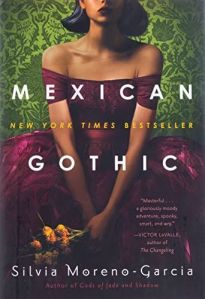
Never Mind Those Enchiladas, Let’s Get Cooking With “Mexican Gothic”!

Deconstructing  a Gothic Stew

What kind of book do I want to write? Let me see…  

First, I want it to be scary and otherworldly.  It should take place in a big house where a rather  strange family resides. The family should be multigenerational and include in laws and other extended family members. This is a rich family, but secretive, especially on matters concerning their wealth and how it was accumulated. There are dark secrets spanning generations. 

This house should hover on a “high place” that looks down on the rural village below.  Along will come a city person, an outsider, skilled in the social graces of chic environments but totally unfamiliar with the rustic ways of country people. Certainly, this person will clash with the family up on the hill, who are strange even for rural folks.  Alas, this person will have to live with them, try to understand them and uncover unimaginable secrets. Of course, there will be some romance in all this

This sounds like a gothic novel.  Therefore, it is!

But most gothic novels take place in the UK with their passed-down castles and estates , or in the US in large mansions in the northeastern states, or on southern plantations. I don’t want that.  I am going to put my big house….hmmm….where should I build such a….I got it! In Mexico! In the 1950s Mexico.  The house will be called High Place.

Gothic Novel in Mexico =  Mexican Gothic!  That’s what I will call my book – Mexican Gothic 

************  

Yeah, so,  I am sure the above scenario was not how Silvia Moreno Garcia approached the construction of her novel.  I hope I didn’t sound too glib describing this fictional approach to fiction writing. Mexican Gothic is , afterall, a good book, despite some flaws.  It  does come off as too self-consciously gothic at times, and there are very few references to any historical/cultural events or mores. At least not in a real sense; history that takes place outside the novel.  This inclusion would have strengthened her story very much and helped readers settle into the two major dimensions of setting: time and place.

Yet, when reading the novel, I did feel as if I had traveled across both time and place to end up in Somewhere, Mexico.  If I felt that way, then certainly Silvia succeeds at many levels.

Plot In Brief

In the novel, Naomi, a chic urban young woman,  is sent to the country to live with her cousin Catalina, who in turn lives in her in-laws’ mansion “High Place”.  She has been sick and had written a letter to Naomi’s father, begging to be rescued from the house. So Daddy sends daughter Naomi to investigate the situation. When Naomi arrives, she discovers Catalina has no recollection of writing such a letter.  She is, however, quite sick, and spends most of her time confined to the bedroom.

She is not mentally well, the in-laws suggest, including Catalina’s husband Virgil, who turns out to be a real cad. The matriarch (dog gone it, I can’t remember her name) is a no nonsense, rules-must-be-followed, meanie. This includes arcane rules, such as Catalina is not to be seen by any doctor besides the one that has been treating the Doyle Family (by the way, that’s the family name of these High-Place dwellers) for years. The patriarch is the very, very old Howard Doyle (See, right there I said he was a “Doyle” That proves this is the Doyle family), who is bedridden and is rarely seen by the family except on certain occasions.  What are these occasions? You don’t want to know.

There is the nice boy, the sweet one of the family. Francis is Virgil’s brother. He is everything his brother is not.  Sadly, he is too docile and subservient to stand up to the rest of the family, who are constantly bullying him.  He has a thing for Naomi but is intimidated by her sophisticated ways.

There’s something odd about the house. Once people have lived there for a certain length of time, they cannot leave. Well they can, but once they do, once they travel a certain distance away from the house (in the next town, etc.), they find themselves dead. Happens all the time, for as long as the house has held members of the Doyle family and their significant others.  Many generations have passed through the house.  On the other hand, those that have stay, like the good ole’, evil Howard Doyle, live an unnaturally long life.

The Doyles own a lot of land and have grown rich from mining.  Over the years they hired local Mexicans to do the deadly dangerous work involved in the mining while the Doyle family kept the riches. In past times, some of the workers were actually slaves.

 Did I mention that the Doyles aren’t Mexican at all?  They are English. Howard Doyle is very into eugenics and preventing certain genetic traits from surviving.

High Place is haunted. Or is it? Terrible dreams haunt Naomi during her stay. Also, she succumbs to sleepwalking, something she has never done before. Her sleepwalking ventures after hours lead her into some very uncompromising positions. The House is trying to take control of Naomi.  What’s going on?

What’s Going On – Spoilers ahead

Fungus is going on. It exists in the mines as well as the house.  It has special properties. It kills many that are exposed to it. Alas, all those poor workers. But apparently The Doyles have developed a symbiotic relationship with it.  The fungus gives them unnaturally long life.  But once the people who have grown depended on it stray too far from its magical powers, they forfeit their lifeforce and die. 

The fungus grows under the house. It is inside every crack on the walls or the floors. It transmits messages through dreams. It can possess a person.

I don’t always venture into spoiler territory, but when I do it’s for a reason.  Remember, the purpose of this blog is not just to review books and movies, it’s also to analyze themes found in haunted house films and literature.  Can’t analyze themes without encountering a spoiler or two or three or four.

If you’ve read certain posts here at this blog, you’ll know I’m a fan of haunted houses that possess a special sort of uniqueness which causes the haunting in the first place. Something beyond “there’s a ghost in the house. Therefore, the house is haunted”.  Some examples include The Shining, a hotel that possesses psychic powers only project certain gruesome scenes from its sordid past upon the paranormal sensitives.  Or the apartment building in the Sentinel books, which serves as gates to Hell and therefore must be guarded at all times. Or how about those houses (there are many in several stories) that act as receptors to the madness unleashed upon them by unstable occupants. The houses are only giving back what they have received.

In Mexican Gothic, it’s the fungus that is the source of the haunting. Some reviewers aren’t satisfied with this  Goodreads reviewer Elle has this to say:

It’s the fungus. The Doyle family is tied to the house because they breathe in the black mold and ingest funky mushrooms in order to kinda become immortal. And they’re all connected through it and they can never escape from the house and the oldest patriarch is able to control his family’s actions because he is King of the Fungus.

Note the sarcasm in Elle’s “King of the Fungus”. Reading on, she opines that the big reveal of the fungus was a big let down. However Goodreads reviewer chai (thelibrairie on tiktok!)  offers a different take on the fungus:

…it’s a place consumed by a wrongness so old and so pervasive that it never truly leaves such places. It is embedded in the mold-covered wallpaper, wedged into the supports of the house, needled into every woundlike crevice, humming darkly inside the walls and in the places no one ever ventures.

This wrongness, the novel is careful to illustrate, is as deep-running as roots, spreading through generations like a species of fungus: the result of an endless, unbroken history of brown dreams wrecked and swallowed and devoured for the sake of white people’s wellness, of brown bodies poked and prodded for the innumerable ways in which they could be serviceably consumed, a relentless and hideous abrasion of dignity that is not unfamiliar to many people of color everywhere.

I had not thought of this. Chai’s insight has made me appreciate the book more. The fungus is deep-seated racism. People have lived long healthy lives on the backs of other.She describes it as it relates to both the book and racism better than I can. I love when a haunted house is a symbol for a deeper, stronger evil.

SUMMARY

When an author writes a haunted house story and does so by compiling a list of tropes, it can go one of two ways.  It can produce an entertaining book because it gives the reader what s/he expects, while leaving plenty of room for surprise and invention.  Or, it can get so bogged down with the familiar that the book is a bore. 

Along comes Silvia Moreno Garcia with her book that defies my binary analysis. Mexican Gothic has invention and intelligent symbolism (the fungus, thanks Chai), it wasn’t bogged down to the familiar.  Still, here I go with my phrase “Self-consciously gothic” again.  I can’t explain why I feel that way when other authors staple the staples of Gothic literature into their pages and I complain not.  In the end, I like this book much more than I dislike it, so maybe that point is moot.  If I was a giver of stars, it would be four out of five. More realistically 3.9 stars out of 5) Since I’m not a star kind of guy, you don’t have to worry about me slicing up a star into decimals. No supernovas were conducted at the time of this writing. 

A Review of Charnel House

Hmm…..

Oh shit, where’s my wallet?  Oh wait, I got it.  Holy Crap, I can’t find my phone!  Nevermind, it’s over there.  Now where the hell are my friggin’ glasses?  Well how about that, they are on my head. 

I must be missing something, though. Why else am I unable to appreciate Charnel House by Graham Masterton?

Perhaps I’m not appreciative of pulp fiction (aside from The Quentin Tarantino film).  Oh but wait, I like H.P. Lovecraft and he’s a pulpy kind of dude. Hmm…

Conceivably, I enslaved myself to my own expectations.  Sure! I was expecting to absorb some great haunted house literature and instead I found myself inside a story concerned more broadly with evil demons and native folklore.  Yet, I fell in love with many stories that ignored my expectations and gave me not a haunted house but a ghost story in general.

I got it!  I’m not giving this author a chance. That’s it.  I chose the wrong book, that’s all. But this book received an Edgar Award and many people love it.  Furthermore, I am trying but I am unable to garnish enough interest to purchase any more of his  books.  I’ll show you my efforts…Here I go…I am TRYINGGGGGGG!!!  PUSH out some interest! GGGGRUNT!!!!  Alas. Nothing. Inspiration constipation.

I have to face it.  I don’t like Charnel House and I probably won’t like any other books by Graham Masterson

Plot in brief (Heh-Heh, he writes in his underwear)

The book  starts off well enough. A man goes downtown to the offices of blah-blah ( ah, I don’t remember. Some department within the city government) to complain that his house is breathing.  How cool is that shit for a lover of haunted house stories! Alas, it all goes downhill from here.

The guy at the office that receives the complaint takes on the role as the protagonist.  He turns into some kind of wannabe detective and goes on to investigate the situation. He’s smug, he’s sexist; he’s irritating if you ask me. He partners with a native American spiritual Guru, who embodies every stereotypical notion of what a trite person might consider for such a character. Throw in some generic female characters and an awkward romance as a side plot for the hell of it. And then, discover the source of the mysterious breathing. It’s an ancient demon from native folklore named Coyote.  Only Coyote ain’t bogged down in myths. He’s real.  Really, a showdown with the Demon on the Golden Gate Bridge?  

Ho-Hum

At DMRBooks.com, the blogger has this to say about Masterton:

Masterton has been described as “cheesy” and “pulpish”. He certainly doesn’t write ‘literary horror’. You know what? I don’t care. Here is why.”

I agree.  It is cheesy (VERY cheesy), and it certainly isn’t literary horror.  He doesn’t care, but I do, and these are the reasons I don’t like the book.  What I don’t care about are  the reasons the author doesn’t care.  I don’t care enough to read his reasons for not being bothered by the cheese and the pulp (sounds like some cheddar, OJ dink)   You can if you wish. Here’s the link

I get it though. His style is simple and he’s a master of quick-reading thrills (I guess), and for this people love Graham Masterton.  I don’t. Sorry.   . 

A Review of  “A Haunting on the Hill” – Sequel to “The Haunting of Hill House”


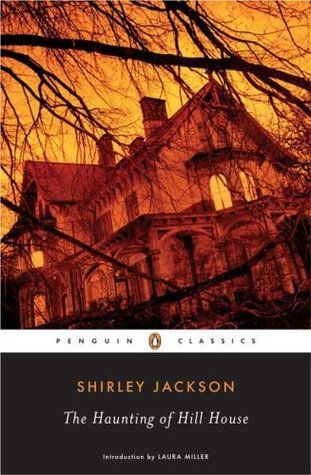
Let’s step back for a moment to recall our first experience reading Shirley Jackson’s The Haunting of Hill House. (If you haven’t read this yet, you will be sooo lost reading this article. Also, there are huge spoilers. So if you haven’t read it yet and you want to, stop being lost and get lost!) . Not only were we impressed with the style, the flow, and  the hidden intricacies within the narrative, but we were delightfully creeped out.  It’s an awesome book, isn’t it? 

Time for some comparison. Let’s imagine a different kind of scare, one that has the same power of fright but leaves one not “delightfully creeped out” but “sickeningly agitated.”  What kind of scare might this be? How about the mere idea to have a sequel to The Haunting of Hill House?  

I remember a CTA bus advertisement promoting the city of Chicago. It was a quote from Chicago film critic Roger Ebert that read, “Living somewhere else makes as much sense as a sequel to Citizen Kane”.  In other words, there are some works of art, whether they are sculptures, books, films, or compositions that are complete in their greatness. To add, subtract, or alter would only weaken the original.

What kind of pitfalls might there be trying to create a sequel to The Haunting of Hill House? First of all, Shirley Jackson passed away some time ago, so some other author would have to step in and fill the role of the late author. This is no easy task as Shirley is a tough act to follow. Second, we consumers of horror already suffered through film remakes of the original 1963 film The Haunting which was based on the book. If 1999’s The Haunting  taught us one thing, it’s  “don’t mess with the classics”

On the other hand, Michael Flannagan’s Netflix series  That Haunting of Hill House 2018  is pretty damn good. It’s a reimagining, not a retelling of Jackson’s story. As such, it is allowed certain liberties regarding plot and character changes.  So long as the tone and mystery of the original are not sacrificed, these changes are welcome.  And wouldn’t you know it, the changes made by Flannagan are not detrimental to the quality of the original.. If anything, they enhance Hill House’s overall eerie impression

Along comes Elizabeth’s Hands novel, A Haunting on the Hill . It is marketed as a sequel to The Haunting of Hill House.  Pretty damn gutsy of you, Elizabeth, to embark upon such a creation. Before writing the book, did you realize how many ways such an endeavor can easily go south?

Were you aware of the potential criticism if your work could not compare to Jackson?  Scathing criticism, mind you; the yuckiest raspberry in a basket filled with the most sour pickings of the crop.   Were you prepared to stand up for yourself against accusations of blasphemy?

Luckily for Elizabeth Hand, she writes a mighty fine story with A Haunting on the Hill. Seriously, it’s the best haunted house book I’ve read in a long time. Certainly it’s at the top of its genre when compared to other haunted house books written this century. Hand took a chance and it paid off. I have to “hand” it to Hand!

Why is Hand successful in her efforts?  I’ll offer an opinion on that. She doesn’t try to explain the mystique of Hill House. In no way does she try to “correct” the original story.  As far as I’m concerned, she doesn’t retcon. While she doesn’t duplicate Jackson’s engrossing writing style, that’s okay, and moreover it would be sinful to try.  Hand effectively pens in her own style but stays true to tone and mystery upon which Jackson “built” Hill House. Hand explores her own creative ideas and does not rehash the same plot. She gives just enough homage to the original story so readers know they are in familiar territory while at the same time uncovers areas previously unexplored.

Similar to the original story (yet not duplicating it), four people set out to stay at Hill House for a significant length of time.  The reasons for their stay are different from the reasons described in the original. The four from Jackson’s story do so in order to observe and document supernatural phenomena.  The quartet in Hand’s novel wish to hole up in the house to rehearse for a play. 

Holly Sherwin, the leader of the group and  playwright of  Witching Night , stumbles upon Hill House accidentally and is drawn to it. (Or is it Hill House that has found her?). She is attracted to its creepy vibe and decides Hill House would be a most inspiring place to rehearse her play, not yet realizing the haunted history of the mansion.  She meets Ainsley Rowan, who is in charge of subletting the mansion. Ainsley warns her that no one ever stays long at Hill House and tells her about rumors of its dark history, including the story of a woman who killed herself by crashing into a tree on the road that leads to the house. (Of course, this is a reference to Eleanor Vance in the original novel. How about that?  Eleanor, once a receiver of tales of the house’s dark past has now become part of its legend!) 

It’s all set. They move in for a one month stay. Will they make it to the end? 

The “they” includes:

  • Nisa, Holly’s girlfriend/partner, the songstress for the play.
  • Stevie, The sound engineer and voice actor
  • Amanda Greer, semi-retired B movie actress
  • And of course, Holly herself 

There are four of what I will call “outsiders”.  They are connected to the house in various ways but aren’t staying there. Certainly not after dark. They wouldn’t dare. These include:

  • Ainsley Rowan (I know; I mentioned her already)
  • Tru and Melissa, husband and wife, the cook and the cleaning lady
  • A Mysterious old woman who lives in a nearby trailer 

Tru and Melissa have a similar arrangement with the house guests as the Dudley’s had with the guests from Jackson’s novel. They do their best to provide the comforts of home for the guests, but in the end there is only so much they can do for the potentially doomed occupants. They are less hostile than the Dudleys (well…Tru is kind of a prick, come to think about it.  And the old woman in the trailer is such a witch! ((literally? Hmmm, could be!)) though they certainly have their misgivings about this whole arrangement.  These four; though I have labeled them “outsiders,”  when it comes to the goings on of Hill House, they are, to some extent, in the know. But they aren’t telling. In that way, they are truly insiders.

So, what happens to the four guests? Hill House works on all of them, that’s what. In certain places in the house, Nisa discovers she can sing like she never before. Her voice is enchanted. At a rehearsal reading, Stevie is ravishing yet startling and his acting seems all too real.  Little by little, the four clash with each other. They become mistrustful, sometimes solitary. All are scared yet they are united in their mad desire to stay at Hill House. Will this desire be their undoing? 

Ghosts of the Past /Phantoms of the Future

I would like to dedicate this section to a sentence from several paragraphs ago.  Here be the sentence:

She gives just enough homage to the original story so readers know they are in familiar territory while at the same time uncovers areas previously unexplored.

Examples are needed, don’t you think?  I’ve got it covered. First, we’ll explore the tropes that are present in both Jackson’s and Hand’s novels, albeit within different circumstances. Then, we’ll dive into certain “hauntifying” situations that are unique to Hand’s sequel novel. (“hauntifying;” I made that word up. I think it’s quite swell!).

Let’s do this!

(PSST. Some will say these next sections contain minor spoilers. I might not think or say that, but some might)

Revisiting the classical hauntings of Hill House in new contexts 

It’s the same Hill House, tucked away among the hills somewhere outside the town of Hillsdale. It has the same winding road that links the house and the gate.

What else is the same?

The spiral stairway in the library 

Clankety clank shakes this flimsy, metal staircase that leads to the top of the tower/library in Jackson’s novel.. It was not safe for Eleanor to climb but she did so anyway, putting herself and her rescuer Luke in danger, resulting in her banishment from Hill House.  Why is this ladder so alluring? The library is off limits to the guests in Hand’s book, yet one makes her way to this stairway, and the result is…..wait a minute!  Aha! Now I see. This relates to the end of the book when she….(she who?  And what does she do? Never mind. I’ve written too much already)

Blood

Seemingly from nowhere, here comes the blood.  Blood mysteriously soaks Theodora’s clothes in Jackson’s novel.  In Hand’s novel, what at first seems like wine spilled from the tipsy Amanda’s glass somehow turns to what could only be blood. It ruins an antique table cloth.

Rabbits

In Jackson’s original novel, these hares, to be more precise, make brief appearances here and there.  Eleanor and Theodora see such a creature outside the house.  If I’m not mistaken, they try to chase it but it disappears.  Luke and  Dr Montague spot one in the house and they follow it and it leads them outside.

In A Haunting on the Hill,  hares are more prominent.  They stand on their hind legs and seem to sneer at trespassers. They are certainly more aggressive.  And they’re not above dropping into the house via the fireplace (well in one sense, they are above if they get in through the roof!) . Fire itself is no obstacle as one of these creatures passes through the blaze, carrying the flames on its soon to be charred, furry, body, only to escape back to the outdoors.

The nursery

As with Jackson’s novel, the nursery room that Hand writes about is quite the enigma.  In both books it is literally chilling; those entering encounter a discomforting cold spot when crossing the threshold. Two grinning decorative heads adorn the doorway and they forever look at the room’s occupants whether they are coming or going or, worse, remaining in the room. They appear to be mocking these poor folks.

Nighttime noises

Perhaps the most memorable disturbance from Jackson’s novel is the wall-pounding noise. Okay, okay –  maybe this is mostly remembered from the film. But it happens in the novel as well, along with the soft whispers. Things that go pound, and things that whisper softly in the night.

In Hand’s novel, the pounding is absent, but someone hears whispers in the dark of night when trying to sleep. I think it’s good that Hand holds back on the pounding. She leaves this Hill House signature trait to Jackson so she can identify and imagine other haunting manifestations

What a great way to segue into Hand’s unique contributions to Hill House!

Discovering new hauntings of Hill House

The Haunting of Hill House is sometimes described as a summer horror novel.  The events in the story take place in the summer as the characters walk the grounds of the house, admiring the brooks and dreaming of picnics.  This all happens in the 1950s.

The events in A Haunting on the Hill take place nearly seventy years later. This would be in our wonderful modern age of texting and vape pens. It is not summer. What goes down in Hand’s novel does so in the cold, dark winter. 

What else is new?


Images within the woodwork  

Nothing to see here. Just your average knolls, knots and swirls ingrained into the wall design. Or are they something more? Do they form images? Do these images reveal scenes of things to come?

Hidden tunnel  

It’s accessible only by crawling. There are strange lights and its end. 

Miscellaneous 

A stray billiard ball rolling across the floor, (there is a billiard room. That’s new…I think) .  Creepy shadows (are they silhouettes?)  are peering in windows. Oh what has the blizzard brought to Hill House?

Conclusion 

While writing this piece, I stumbled upon other books by Elizabeth Hand. Wylding Hall for instance. This caught my eye because the premise seems similar to A Haunting on the Hill: A group of young musicians take up residence in a mansion to rehearse their music.  Actors vs Musicians expressing themselves artistically while living together in a haunted house. Hmm, are Hand’s stories formulaic? 

Sometimes in writing, formulas are good, sometimes not.  Guess it depends on how much the formula dictates the story.  Too strict of an adherence to a reusable,  preconceived plot kills the story. 

I’ll tell ya what!  I’ll read Wylding Hall and report back to you.  Or, you can read and see for yourself: Wylding Hall

Or, skip it for now.  But don’t skip A Haunting on the Hill.  Trust me, it’s good. It’s true to the spirit of Shirley Jackson while allowing for Elizabeth Hand’s creativity to shine.


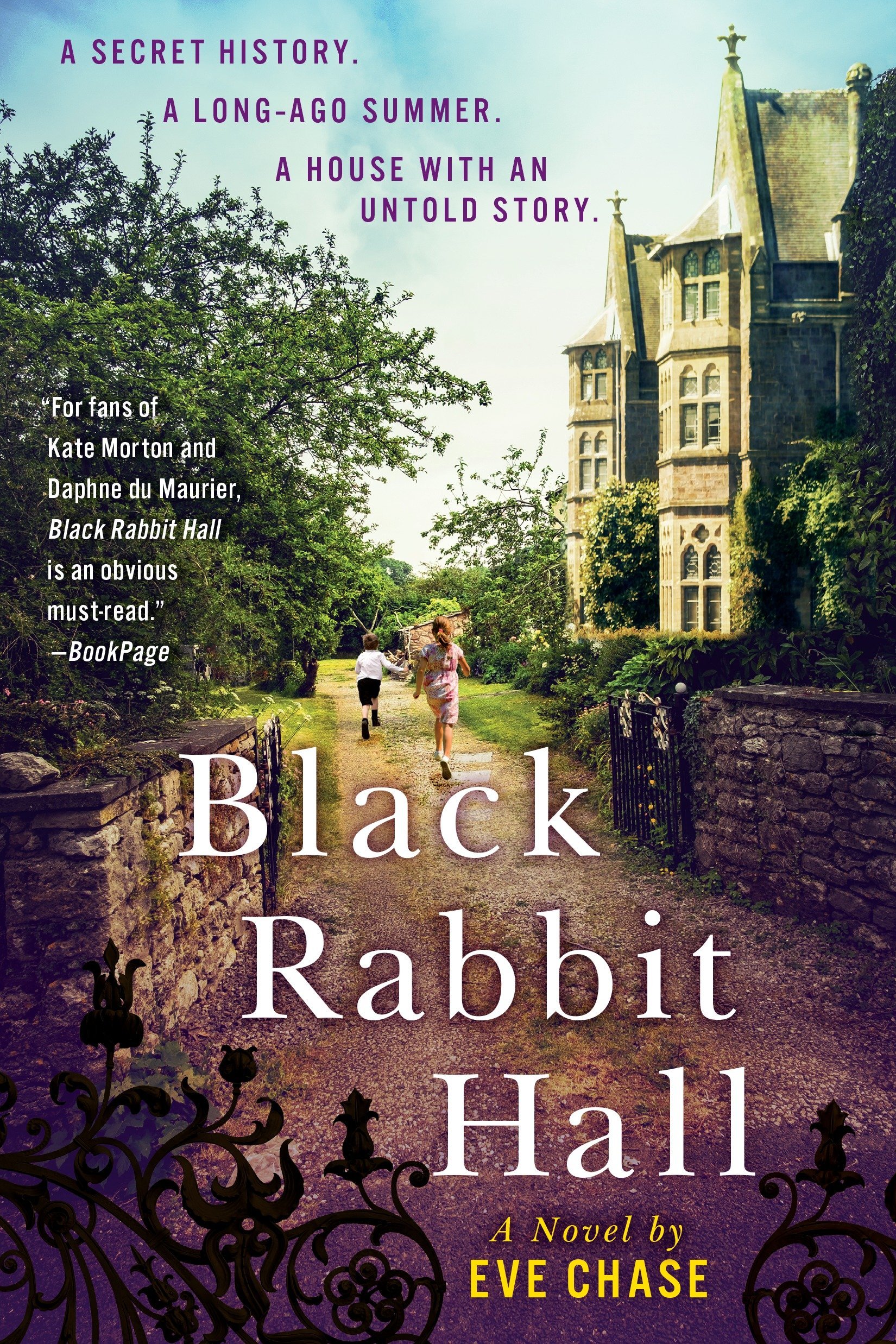
Black Rabbit Hall – Who are the Ghosts that Haunt this Story?

Once upon a post, I declared Shirley Jackson’s novel “We have Always Lived in the Castle” to be a haunted house story. Somewhere in the middle of this piece I even went so far as to title a section heading as “What Kind of Ghosts ‘Have Always Lived in the Castle’”.  This threw some readers off. They were ready to point out that “there were no ghosts in the story”. But then they read the stuff underneath the heading and it clicked. “Ah,” they said, “Now I see what you mean!”

See kids, ghosts do not always appear as things in white sheets. Nor do they always show up as glowing, semi-transparent figures.  Sometimes they are not seen at all.  Sometimes a ghost is not representative of one single personality. Sometimes there are ghosts not of a person at all, such as the ghost of a fading memory trying to resurface again, or the ghost of a feeling, long forgotten until that very moment when it suddenly haunts your heart with a confusing mixture of specificity and vagueness, familiar and foreign at the same time.     

Perhaps you can see where I am going with this. There are many ghosts lurking around the pages of Eve Chase’s Gothic novel Black Rabbit Hall, but you must widen your perspective or you’ll miss them. The summers of 1968/1969 are ghosts, ghosts of timeless seasons long gone. They haunt one Lorna in the twenty teen years, these summers that came to pass and faded before she was even born.  Lorna experiences this haunting when she visits Black Rabbit Hall, searching for a venue for her upcoming wedding.  She has vague memories of this hall as a child, but what are these memories made of? She’s not sure, and that heightens her attraction to this place all the more. She becomes obsessed with the house.  This obsession is seen as toxic to her fiancée, sister and father.

It’s a mysterious, gargantuan house with many floors and too many rooms to count. It is old and rundown, but it has its hidden charms.  The grandfather clock named Big Bertie that has never been able to tell time is one. A stone turret that leads to what would be the bridal suite is another.  Outside the hall exists terrains of cliffs and fields, beaches and tidal waves, and forests and trees. In all this Lorna will get lost. She will lose herself. She can find herself again but things will never be the same. She needs to turn to the ghosts to help her find herself. The ghosts take the form of hidden inscriptions on large rocks within the woods. They emerge within the tales told to her by the inhabitants of Black Rabbit Hall, incomplete tales she must piece together like a puzzle in order to make things whole. One such inhabitant is the servant Dill. She was there when it all happened. (When what happened?) Then there’s Mrs. Caroline Alton, the elderly lady that owns the hall and is cared for by a Dill. She’s not quite the charmer, but there’s something about her. Ghosts cling to her like moths to a light. These ghosts will connect Lorna to past events and tragedies. They will be the source of fulfilling revelations and usher in a new future.

_________________________________________________________________________

BlackRabbitHall2

Let’s go back. Back to the summers of 1968, 1969.  Black Rabbit Hall was a summer retreat for the Alton family.  Away from the hustle and bustle of London, to escape to the countryside, off they go. Hugo and his wife Nancy, and their four children; teenage twins Toby and Amber, and the younger children Kitty and Barney (Wait, what about Caroline Alton?) Summers here seem timeless. Routines give in to the whim of the weather. Big Bertie dutifully holds back on time.

But ya know, ghosts are born in timelessness. They forever exist in timelessness; coming from the past, predicting the future, invading the present and blurring time’s boundaries.  This time period is seen through the viewpoint of Amber. Something will happen that will seal tragedy within this timelessness. Amber, like Lorna many years later, like her family in the present moment, must rediscover herself and help her brothers and sisters come to terms of the new life that is upon them. 

To quote from the book:

you realize life is not at all linear but circular, that dying is as hard as being born, that it all returns to the point you think you left long, long, ago

This book was one of several items on a list of haunted house books. This list exists somewhere within the realms of the Google search engine. This is how I discovered Black Rabbit Hall.  Since it is featured on this list, I felt it my duty to justify its inclusion. That is why I spent much of this review defining and perhaps redefining the concept of ghosts. But for those who crave a more literal expression of such phantoms, you just might get it. Maybe.  Is the mysterious figure that marches out of the fields at night, leading an army of rabbit shadows, a ghost? Maybe.  

As for Black Rabbit Hall being a haunted house – aren’t houses of this kind often portrayed as conscious entities? It sure seems as if it’s the house itself that protests a certain ceremony that takes place in its confines back in the 1960s. The house and its surrounding environment whip up a quite the storm, perhaps as an indication that such a ceremony, though at the right place, is in the wrong time, celebrated by the wrong people. If anything, the house is the collective spirit of many things, many events and people.  To quote again from the book:

For all its oddness and tragedy, she knows she will miss Black Rabbit Hall , as you do miss places that make you rewrite your own map, if only slightly, places that take a bit of you away, give you something of their spirit in return

The house, in its own way, has the ability to communicate, to call to the ones the belong and shun the ones that don’t.

I recommend this book and I’m sure you will enjoy this haunted house story. If you look for ghosts in the right places, you will find them.

Poltergeist – It’s Heeeeeeere! (Finally!)


Poltergeist2

About a week ago, I posted a review that had all the ingredients of the kind of haunted house story that I love. It was a book that I could savor, and savor it I did, reading little bits at a time every night. Sarah Walter’s The Little Stranger was one of the best reincarnations of the Gothic style in modern times.  Hundreds Hall was an old manor.  Belonging to the noble Ayers family, it was passed down from generation to generation.  Memories of times past gathered like cobwebs and hung in the corners if its rooms. The happenings that created the most tragic of memories are the ones that doomed the house and gave it a character of its own. Oh how I love when that happens; when a house in a story is described so well that it is almost portrayed as a character. The source of the haunting is mysterious; it is not only embedded into the walls; it is also enmeshed in the character of the family unit itself. It’s also a product of the unique time and place in history.  All these factors are inseparable when arriving at the haunting’s source.

The story that I am reviewing now is nothing at all like what I have just described. There is nothing Gothic about it. There is no mansion that has lingered throughout history, the dwelling is brand spanking new. It is not far off in the countryside, it’s right smack dab in the middle of suburbia with many houses of similar design surrounding it.  The house itself possesses no unique charm, haunting or otherwise. Remove the ghosts and it’s just a simple boring modern structure. And I could not savor this story night after night, for it’s a movie for Christsake! Best I could do was watch it multiple times, and I have done that, over the course of thirty-eight years. My last viewing was a couple of weeks ago.  Watched in on Netflix. Finally, I decided, finally it is time to write about this. This review is long overdue.  A haunted house story that is the total opposite of what I like. And I loved every minute of it!  Let’s talk about Tobe Hooper and Steven Spielberg’s 1982 film Poltergeist.


My Experience With Poltergeist. Oh, and the Plot and Stuff

All of that contrast in the above section. I did that for a reason, not just to haphazardly populate the page with random words for the sake of adding length to the review. My reviews are too long anyway. But this is going to be another long one, so strap yourself in because there is so much I want to say. Like with The Little Stranger, there were so many tangled thoughts I had about this film, and I needed time to untangle them. And I waited five long years! That’s how long I have been writing about haunted houses of film and literature.

This film is a trailblazer. The very fact that it strays from Gothic norms and incorporates all kinds of modern themes separates itself from those haunted house films that came before it. Of course, the special effects are a big part of this, but its modern flair goes beyond that even. I’m referring to the setting, style, story and props.

For the record, I first saw this film in the theater in 1982. I believe my mom took me to see it. I was eleven-years-old. Was I scared out of my wits? Did I shit in my little boy Underoos?  No and no. Even back then, haunted house films intrigued me more than they scared me. Yes, it’s a scary film but for me, ghosts of the page and screen don’t unsettle me. Rather they fill me with a warm kind of creepy-fuzziness. I’m weird that way.

Do I really have to go into the plot?  I mean, isn’t the story by now ingrained into everyone’s head, as familiar as Star Wars, Snow White and Seven Dwarfs, and Little Red Riding Hood?

Fine, here’s a brief plot:

Sung to the tune of The Brady Bunch

Here’s the story, of a lovely family

Mom and Dad raising three very lovely broods

The youngest had hair of gold, like no other

It’s time to change our moods.


It’s the story of Carol Anne

The youngest and creepiest of the three

The ghosts took her to another dimension

Her voice heard on TV


So they called up all these special people

They would return her to mom and her spouse

But then these corpses came up from under

That’s when they knew to flee the haunted house

The haunted house, the haunted house, that’s when they knew to flee

The haunted house!  (Da da da da da da da!)


Got it? Family. Lovey-dovey. TV static. Ghosts. Ghostly arm coming through TV Screen. Ghosts attack. Tree almost eats boy. Girl sucked into closet. Disappears. Her voice is heard through the TV. Paranormal specialists come. The children’s room is a whirlwind of poltergeist activity. Toys and shit flying all around the room. Specialists stumped. Call in the “specialest” specialist of all. A Little Person. A Lady. She calms the room down. Discovers a pathway that leads to the realm of the light (you know, where the soul departs into after death). Carol Anne is in there, next to the light. Mother goes in after her. Rescues her. Yay! The End. Not! House is still haunted. Corpses are unearthed and start sprouting all over the place. As it turns out, the house was built over a cemetery. Dad works in the real-estate biz. The whole complex was built by Dad’s company. Dad’s boss had lied about removing the bodies before beginning development. Dad yells at boss. Moral of the story? Don’t ever be afraid to tell off your boss. Oh, and get the fuck out of the haunted house when you have finally had enough. And that’s what are family finally does. Now – The End.

Director and Producer

The talented Tobe Hooper directed Poltergeist. Hooper was no stranger to horror.  Before Poltergeist he helmed films such as The Texas Chainsaw Massacre and Fun House, two great films (Many will say Fun House sucked, but they are wrong.)  Hooper passed away in 2017. May he rest in peace.

But I want to focus on Steven Spielberg, Executive Producer of Poltergeist, and one of several of the film’s writers. I’m guessing you’ve heard of him.  He certainly has a knack for resurrecting film themes of the past and clothing them in modernity, doesn’t he? Raiders of the Lost Ark is such an example. This film was made to replicate the serial films of the 1930’s and 40’s which were shown in several short segments. Always ending with a cliffhanger, the viewer had to return to the theater the following week to see how their hero escaped. Well “Raiders” was cliffhanger after cliffhanger throughout the whole movie.  How about Jurassic Park? Let’s bring those dinosaurs into the modern age. Sure, dinosaurs made their impact on films in the sci-fi movies of the 1950s and 60s, but now we have the “science” for doing so, involving advancements in DNA technology.

And then there’s Poltergeist, Spielberg’s contribution to the haunted house genre. He has established a modern foundation in which to erect a more contemporary abode of horrors.  In what ways has he done this?  Let’s examine these ways.

The Evolution of The Haunted House.

Think of the classic haunted house tale, the earliest days of haunted house literature. Most likely, the house belongs to a well-to-do family. Different generations are born and raised in the same house.  The house is old. It has its own history. Many scandals have taken place underneath its roof. If the walls could talk! (Perhaps in some cases, they can!) Examples of such haunted house stories include The Fall of the House of Usher or The House of Seven Gables.

Years later, with the creation of the middle class, the affairs of the noble class and their legacies were just not on the forefront of the minds of the masses. People could not so easily relate to the concept of serial successions of generations living within the same gargantuan hall. Thus, the manors that once “housed” families that are long gone were now portrayed as abandoned structures. But their doors were always open to visitors who wanted to spend a few nights in a rumored haunted house. Think of books and films such as The Haunting of Hill House/The Haunting, The Legend of Hell House/Hell House, and The House on Haunted Hill.

Soon, books and films about haunted houses began to reflect the challenges of the middle-class homeowner. Gary Hendrix in his book Paperbacks from Hell – The Twisted History of 70s and 80s Horror Fiction has a chapter dedicated to haunted house novels, a chapter that he names Real Estate Nightmares.  The focus of haunted house stories in these works is not on a group of visitors staying at some unknown and unfamiliar mansion. Nor is the emphasis on an ancient family dwelling in an equally ancient mansion. Rather, these works tell the story of an average middle-class family that moves into a large (but not gargantuan) house, only to realize that it is haunted. Hendrix argues that the surge in popularity of such books in the 70’s and 80s is no accident.  From my review of this book, I share this paragraph:

In true form, Hendrix ties the haunted house paperback phenomenon to the economic issues of the 1970s. High interest rates, inflation, the dawning of the suburbs, the cash-strapped and their search for the best home that they could afford. According to him, these are the reasons “the haunted-house novel reached critical mass.

And I share this from the same review:

he singles our Burnt Offerings as being a first when it comes to the economics of home purchases and the whole buyer beware motif.  I…had never thought about this. “Hell” and “Hill” House were gargantuan Gothic mansions that had visiting characters investigating the spooky happenings within. The characters of Burnt Offerings leased and lived in the deadly place. They invested their money in it. Therefore, they were trapped.

Burnt Offerings (Robert Marasco) is one of my favorite haunted house novels! Other novels that fit into this category are The House Next Door (Anne Rivers Siddons) and The Amityville Horror (Jay Anson)Poltergeist also fits into this is grouping. True, it is a film, not a novel (unless one was made based on the movie), but it deals with that average home-owner struggling to find peace in their new house of horrors. But I argue that Poltergeist takes this concept even further. Let’s explore this.

With the exception of The House Next Door, the haunted houses in the books/films that I have mentioned in the preceding paragraph are still in rather isolated places. I guess Amityville is technically a suburb, but it still seems to be somewhat remote. And, these houses are rather large, perhaps of a classical architectural design. (Colonial?) The house is Poltergeist is of the cookie-cutter type of design and is surrounded by hundreds of PoltergeistHOuseother houses that look very similar.  It’s right smack dab in the middle of modern-suburbia! There is nothing special about it. It’s the house of a suburban family of the early 80s’. To the best of my knowledge, this is the first (or at least one of the first) time/s that such a place finds its way into haunted house lore.

There is more. If you’ve read the post immediately preceding this one (Review of Sarah Walter’s “The Little Stranger.”), then you know about the concept that I call “Agents of the Scare.”  Here are some examples from that article:

“In all haunted houses, there are objects and structural components of a house that are downright creepy. Maybe it’s the swaying chandelier. Or the specter that traipses down the curving stairwell, adding to the unpleasantness of each stair tread.  How about the wall hanging portrait with the moving eyes? That locked room? Te revolving bookcase? The piano that plays by itself?

I go on to point out that the book features rather unique agents of scare, particular to very old manors. A call tube that links a voice to different floors, a servant’s bell. The author makes use of these things in very creepy ways. Poltergeist too has unique agents of the scare. Uniquely modern! There is a creepy clown doll. Yeah yeah, not so unique. But, when the poltergeist takes over the children’s bedroom and toys are spinning around in a whirlwind of paranormal frenzy, which toy pauses for the camera in mid-air? An old-fashioned doll? Not! It’s the Incredible Hulk Mego action figure riding a horse!

The best and most effect “agent of the scare” is the television. Not so modern anymore, I get it. But had there ever been a more creepier television set before? I say no.  And the way it signed off at the end of the night. Wow! See kids, (those under, say 40 maybe) once upon a time, broadcasting shut down at around midnight.  Before this happened, channels displayed various pictures, maybe nature scenes, maybe urban landmarks, all with the National Anthem playing in the background. A second or two after that last note the noise of static came while the picture on the screen turned into a jumble of flickering black and white. Like in the movie, many families fell asleep at their TVs before this nightly event occurred. Looking back, the finality of the event, and the way a clear image turned to scribbles, well, all this was kind of creepy. But it took a movie, Poltergeist, to really bring this creepy effect home. Ghosts began communicating to little Carol Anne through the white noise of static. Then when Carol Anne disappears in the house and her voice turns up inside the white noise…wow!  What a creative way to take a uniquely contemporary situation and turn it into a prop of a modern-day suburban haunted house. (Hey! Don’t laugh, this was modern back in 1982!)

There are other props and storylines that I believe were used in the film with a conscious effort to separate it from haunted house films in the past. The kids’ room was decorated with posters and toys that were currently trending in pop culture. Star Wars paraphernalia is all over the place.  At one point in the film, next-door neighbors realize that their TV remotes inadvertently work on each other’s televisions. Change the channel in House A and you wind up changing the channel in House B. Finally, the father of the family is seen reading the book Reagan – the Man, The President! Can’t get anymore modern than that! (Hey! Again, I mean “modern” for that particular time.) This locks the event of the films securely in the 1980s!

Oh yeah, there are the Spielberg special effects at work. Phantoms of light parade across the screen. So much in the way of light and flashes! So innovative for the time. I do believe this was at least one of the first times such state-of-the art effects were used in a haunted house film. It still holds up today in my opinion.

Is it my imagination that note horror movies in the 80’s were more colorful and flamboyant than those of the 60s and 70s? Perhaps even a bit more comedic? Poltergeist certainly was more colorful and flamboyant.  I don’t know about the comedic part. Anyway from the ancient manor to a cookie-cutter suburban unit, haunted houses have come a long way, baby!

 A House Destroyed – Different Interpretations of Such an Event when Contrasting a Gothic House to a Modern House.

Poltergeist

Ooops! I gave away a spoiler. In the end, the Poltergeist house is destroyed. The destruction of the haunted house at the story’s end has been a common way to close a haunted house tale. It has happened in The Fall of the House of Usher. It has happened in The Shining (the book at least). Hell, it’s happened in The Castle of Otranto, which is credited as the first Gothic novel ever!  I argue the significance of the destruction of the Poltergeist house differs vastly from its predecessors. I’ll explain.

Often in my reviews, I state how much I love the concept of a haunted house that either has its own conscience or at least stands for something larger than its structure. Such a haunted house, I often say, “is more than the sum of its ghosts.”  The Poltergeist house is not, I repeat, NOT such a house. Remove the ghosts that might temporarily haunt it and the house just goes on with its boring old self. To get technical, it’s not the house that draws in the ghosts or poltergeists that haunt the family in this film. It’s the fact that the house was built over a graveyard and the ghosts seek out a living person to attach themselves to in order to stay behind here on earth instead of going into the light. (They attach themselves to little Carol Anne. In the sequels, the supernatural forces follow the family to new places.)  So at the film’s end, when the house implodes (I guess that’s what happens to it), the supernatural beings are in effect saying, “Get the fuck out of our way, house!” The house itself means nothing to them.

In the other works, when the house is destroyed, a whole lot more dies with it. Maybe it’s a family legacy, or a kingdom, or an age. It’s an entity itself that departs from the earth when the walls go crumbling down, or when the whole structure goes KAPLOOOOIE and blows up.

Poltergeist – A Cursed Film?

Oh geez, do I really want to go here? Well I already did so I guess I will continue. Some people say the film is cursed due to the off-screen tragedies that followed in the wake of the film.  Actress Dominique Dunne played the older sister. Unfortunately, she was murdered by an abusive boyfriend in the same year. And poor Heather O’Rourke, the little girl actress that played Carol Anne – she died of bowel obstruction in 1987. Several other cast members that were in the Poltergeist sequels met with untimely deaths as well.  See this link for more info.

Ah but I don’t believe in curses. Just a lot of coincidental tragedy. But the film is noted for this so I thought I would mention it. And so I did. Next –

.

.

Um, I really don’t have a “next”. This is the end of the article. Although the film does not fit my criteria for a what makes a haunted house great, it is still a great haunted house film. The stuff of modernity was used in all the right ways. Poltergeist is a groundbreaking achievement!


A Review of The Little Stranger – The Novel

OLYMPUS DIGITAL CAMERA

Some reviews are easier to write than others.  There are those stories that inspire the briefest of descriptions and the simplest of impressions. These aren’t bad stories necessarily; they can be quite good. But after the reading or viewing (novel or book), everything I want to say falls neatly in place. And there might not be much to say other than things like “very suspenseful” or “just an all-around fun bit of horror.”  Such stories don’t require layers of analysis. Nor will they transport me to wider worlds that inspire endless contemplation.  Then there are books like Sarah Walter’s The Little Stranger.  After the reading I realized there was so much I wanted to say, so much more I wanted to learn. These thoughts and curiosities I had, well, they were all jumbled up, and I had to start another book while I allowed some time for these ideas to settle and come together in their own due time.

A story that provokes simple impressions, I have stated, can be very good but it can also be very poor. This “either/or” explanation doesn’t work so well with stories that inspire a complex set of thoughts. Such complexity hardly unfolds as the result of a poorly written story.  The opposite is true. To get to the point – The Little Stranger is an excellent book. Superb! Bravo!

The Little Stranger has all the ingredients I love in a haunted house tale. Its “house” is more than “the sum of its ghosts”, meaning, its mystery is innate and not the result of a phantom that goes “boo”.  The house, Hundreds Hall, has a personality all its own. This is a story that falls under the genre of “Gothic”, and so once again, I found myself climbing that tree of this mammoth genre and exploring its various branches. Very willingly I did this. With excitement and curiosity.  I found myself comparing this story to other great literary haunted house novels but never suspecting it of concept plagiarism. Putting aside ghosts and haunted houses, the story that takes place outside these elements is engaging and speaks to matters of the heart.  I came to know the characters of the story quite well. I enjoyed visiting the Ayers family in their run-down manor and taking in all their nuances and eccentricities, their madness if I may be so bold.  And I have Dr. Faraday to thank.  Through his eyes the first-person narrative unfolds.  There is a love story in here as well. A sad love story built on longing and yearning that puts to mind that painful old adage “you can’t always get what you want.” (Thank you, Rolling Stones,!)  Because his viewpoint is “skewed” (biased) , his account of the house itself and the events that take place within its walls add to the “Skewiness” (I made this up – that state of being “skewed”) of an already “Skewed” (twisted) place and situation. Finally, I love the unique “agents of scare” that are built into the house. These would be what are otherwise neutral structural components, except that when they are manipulated by mysterious forces, they become quite creepy.

There. I gathered together all these Sarah Walter’s inspired complexities from my head and condensed and simplified them into one paragraph. My work here is done. Not!  Silly you for believing that. For you see, now I have to explain in more detail what the hell I was getting at in the paragraph above. So here comes the meat of this review!

Plot in Brief (Some spoilers)

The story takes place in the United Kingdom. It begins in 1919. As previously mentioned, the story unfolds from the viewpoint of Dr. Faraday, the family physician for the Ayers family. As a child from a humble background, the young Faraday marveled over the impressive display that was Hundreds Hall. He greatly admired the family that owned and ran it as well. Who didn’t? The Ayers were highly respected members of the noble class and they shared bits of their greatness via the feats they gave to celebrate Empire Day. The Colonel and his wife parade about with their six-year-old daughter Susan and receive grade admiration from the crowds, which are partly made up of folks from the “lesser” classes. Most of the people are not allowed in the grand Hall but young Faraday is lucky.  His mother was once a servant for the Ayers and using her connections to the household staff, she is able to grant her young boy son entrance to the Hall. And he is impressed with what he sees.

Shortly thereafter, little Susan dies, triggering change. The Ayers cease to throw Empire Day fetes. The Colonel and his wife have two more children after her death (Caroline and then Roderick). Later the Colonel dies. Things are never the same.

Fast forward thirty-years later, post-World War 2 Britain, and Faraday is now a country doctor and the family physician for the remaining Ayers. He is saddened at the state of the hall; rundown and in great disrepair, the landscape is unmaintained.  Still he admires the Hall and covets the family unit itself; he wants in.  The family has lost much of their social standing. Roderick, wounded with a limp during his service in the war, struggles with the finances. Caroline is somewhat of a recluse, more so is her mother.  And there is a hint of madness among the family.

In attempt to regain social graces, the Ayers throw a small party for other well-to-do families. It doesn’t go well. The family dog bites the nine(?)-year-old daughter of one of the guests. It’s normally a passive dog. Was the dog possessed by something? A spirit perhaps?  Roderick thinks so. According to him, he has been experiencing strange happenings in his bedroom. His mirror moves on its own accord. Fire erupts in his room, source unknown. He goes mad and is locked away.

Meanwhile Dr. Faraday falls in love with Caroline. She mildly returns this love but is quite ambivalent about this.  The servants are witnesses to what could be supernatural activity. They believe the house is not only haunted but evil. Mother and daughter fall prey to the strangeness of the house. Faraday tries to reassure them.  But its as if the house and its family have some kind of figurative disease for which the doctor cannot cure, to his frustration and great sorrow.

Is all this the work of the ghost of little Susan who dies as a child so long ago? Oh what is going on?

Similarities to other classic works

To begins this section, I quote from Wikipedia’s article on The Little Stranger:

 A mix of influences is evident to reviewers: Henry James, Shirley Jackson, Wilkie Collins, and Edgar Allan Poe.

I will address this claim, author by author.

Henry James – Turn of the Screw

With the exception of The Jolly Corner, the only work  I read from Henry James is The Turn of the Screw. But Turn of the Screw is a fine example of an inspirational source, so I’ll use that piece for comparison.

In many “spooky episodes” of our favorite television stories, a Scooby-Doo-type premise plays out – a trickster was behind the haunting all the time. There is always that person that suspects such from the very beginning. “There has to be a logical explanation,” the character will say. Well, I’m going to reverse this scenario. In both Turn of the Screw and The Little Stranger, a supernatural explanation is offered early on in the story. But we the readers know that there is something more going on to account for the bizarre events that we have encountered across the pages.  In the James novella, it is surmised that the ghosts of two deceased adulterers, a former governess and a man-servant, are haunting the children, a young brother and sister who live at Bly Manor.  But overall, the story hints that the haunting is rising up from some far deeper source, something that is buried deep within the dark tunnels of the psyche of the children’s current governess.  Likewise, Walter’s novel offers up a supernatural explanation to account for the ghostly-going-ons: the ghost of Susan, the girl that died so young, is haunting Hundred’s Hall.

In both stories, the authors give us a possible supernatural explanation.

James – former adulterous servants, man and woman, dead, ghosts corrupting the two innocent children, boy and girl. But overall the story offers a psychological explanation that may put to rest and claims of supernatural activity.

Walters – the ghost of a  little girl, sister, Susan, is haunting the place.  But it might be that something else is affecting the brother/sister siblings. The source of the scares might not have anything to do with the supernatural.  The “ghost” might just be a “collective hallucination” that plagues a family stricken with sorrow and grief. Or maybe it’s the “times” (“these days” vs. “those days”) that is the ghost?  This will be explained in further detail later in the article. (In the “Go-Go Gothic Section!” Oh boy!)

Also of note – both stories feature a brother and sister as lead characters that fall victim to a haunting that occurs in their own home.

Shirley Jackson – The Haunting of Hill House

Both stories treat the houses in each tale (Hill House and Hundred’s Hall) as conscious entities. The houses in question are either troubled, diseased, or downright evil.  In addition, both stories offer a theory that a character is unintentionally projecting negative energy upon the house, and this is what is causing the disturbances. In Jackson’s story The Haunting of Hill House it is Eleanor Lance. In Walter’s story it is Roderick. Or if not him, someone else, but who?

Wilkie Collins – ????

Duh I dunno. I never read anything by him. I should change this. (This was the easiest section to write! Hey, I only said I would address these claims, and address I did. I just forgot to fill the envelope with a letter.)

Edgar Allan Poe – The Fall of the House of Usher

Ah, my favorite and perhaps the tale I find most similar to The Little Stranger. I’ve loved The Fall of the House of Usher since I was a kid. I didn’t need that Wikipedia list to let me know that this was a major source of inspiration, for Poe’s ghost kept calling out to me as I progressed through the book.

Both stories are told from the outsider’s perspective. Each is narrated in the first person. Both narrators are visitors/guests of the family that live in the houses that are at the center of the stories. Both outsiders (The Little Stranger – Dr. Faraway/The Fall of the House of Usher – Unnamed Narrator) bear witness to the fall of great families. They watch in horror as the ones they love succumb to madness and grief. Both try and do what they can to ease the suffering of the families but in the end their efforts are futile. They feel helpless, wishing there was something they could do. It doesn’t help that they are caught up in a situation where there understanding is limited. You can’t fight a disease when you don’t even know what it is.

Also, both stories deal with an adult tortured brother and sister that are heirs to the family’s house and legacy. Likewise, they are heirs to a curse.

Similar Yet Unique

Although The Little Stranger’s influences can be found in the aforementioned literary works, it stands on its own. It is not a carbon copy; the houses in these stories are not of the cookie-cutter design. Rather, let’s think if these houses (and the stories surrounding them) coming together to form a neighborhood. Hundreds’ Hall belongs in a neighborhood that boasts Hill House, Bly Manor, etc. One should be proud to be welcomed in such a community.

Go-Go Gothic

Here I go for the umpteenth time wandering on the trails of that behemoth forest that is Gothic Literature, picking at and extracting from only some of its sprawling branches, stealing clues to bring to the next clearing where light will shine upon them and illuminate me on the story that I am currently holding in my heart. I’ve made such journeys for several articles here at this blog, and again I must emphasize that in no way am I trying to encapsulate in one article everything you needed to know about Gothic Literature but were afraid to ask. I can only explore the elements of which I am familiar and examine them within the context of the story that I am reviewing.  So, with that said, hello Gothic elements, meet The Little Stranger!

The collision of the past and the present; this is a common theme in Gothic Literature. The most obvious example in terms of ghostliness is, well, the ghost itself, or the ethereal remains of someone who died long ago making its presence known in current times. But think also of the ruins of an old castle. Long ago the castle served a mighty purpose, but not so anymore and yet part of its structure remains. What use is it to us now? Does it have something to share with us? Is it relaying a message to us modern folk about the past? Is it hiding a secret within its stone walls?  To ponder such questions is to open oneself up to the conflicts that often arise within Gothic Literature.

Gothic stories often take place in times of social change. There’s a new society on the horizon, a new social structure is replacing the old. Those that cling to the old ways have trouble navigating in the new terrain. Outmoded institutions still exist but the forces of change erode their foundations. Every passing moment they shed life-supporting stones.

After I read the book The House Next Door by Anne Rivers Siddons, I explored some of the characteristics of American Southern Gothic, for that is the genre that best describes this novel by Siddons, at least according to critics and reviewers.  What I learned parallels with what is going on here in The Little Stranger, even though the story contexts are separated by time, circumstance, and the mighty Atlantic Ocean. Though taking place in the early 1970’s, The House Next Door deals with themes that were spawned by the American Southern Gothic movement that came into being following the events of the Civil War. The Institution of slavery had come to an end. The institutionalized social order crumbled. Two quotes from Wikipedia on Southern Gothic  explain some the significance:

continuing pressures of the past upon the present, particularly with the lost ideals of a dispossessed Southern aristocracy


Similar to the elements of the Gothic castle, Southern Gothic gives us the decay of the plantation in the post-Civil War South

A different kind of social change was occurring in the United Kingdom post World War 2, the time and place of the events that occur in The Little Stranger. The Wikipedia article TheLittleStrangerWaltersfor The Little Stranger  publishes a quote from author Sarah Walters on her intentions for writing the book that explains some of this social change (quote is originally from the Toronto Star):

I didn’t set out to write a haunted house novel. I wanted to write about what happened to class in that post-war setting. It was a time of turmoil in exciting ways. Working class people had come out of the war with higher expectations. They had voted in the Labour government. They want change…. So it was a culture in a state of change. But obviously for some people it was a change for the worse.

Also of note is this, from the same article:

Reviewers note that the themes in The Little Stranger are alternately reflections of evil and struggle related to upper class hierarchy misconfiguration in post war Britain. Waters stated that she did not set out to write a ghost story, but began her writing with an exploration of the rise of socialism in the United Kingdom and how the fading gentry dealt with losing their legacies

Now, remember at the beginning of the article when I wrote “After the reading I realized there was so much I wanted to say, so much more I wanted to learn.” (See, the words of the past are colliding with these present words – oooooo! How Gothic!) Upon learning of the existence of such a social change in Great Britain, I wanted to learn more. I wanted to delve into these significant changes and report on all there was to know about the dwindling of a system that “involved the hereditary transmission of occupation, social status and political influence”  (Quote is from Wikipedia: Social Class in the United Kingdom.)

But alas, this is a major feat, a job for a social historian.  Suffice it to say, the noble class lost much of their nobility. Fortunes were lost. Let’s look at the Ayers’ household, the family at the forefront of The Little Stranger. They represent what Walters called the “fading gentry”. They did not benefit from the change. At the center of this story stands Hundreds Hall. Once a grand estate now a rundown shell of its former self. It is no accident that the beginning of the story features a memory of the grand ol’ days of Hundreds Hall and the celebration of Empire Day. Good times for the Ayers.  But the British Empire would crumble as would the legacy of the Ayers.  The remaining family longs for the past but it is gone.  If only the “grand ol’ days” went marching on, status quo preserved, the family’s standing financially and socially secured.  Hmm, now is there a symbol of any sort in this book for “better days” or, more appropriately, “what could have been?”  Yes. Little Susan, who died so young. Her sister and brother never met her.

Susan Ayers – The Ghost of What You Cannot Have. (SPOILERS)

TheLittleStranger3Try to capture a ghost. You can’t. Forget about Ghostbusters and 13 Ghosts and other movies that feature sci-fi technology that allows hunters to suck these poor phantoms into some kind of device. If you reach out to touch a specter your hand passes right through it. Throughout the book, the characters go mad when they confront what could be the ghost of the little girl – the little stranger. I submit that she represents a past that could have been but was not meant to be. That is what is so maddening about her. They can sense this more perfect past; they feel it in their hearts, even see it with their own eyes. It’s there haunting them. But they can’t have it. She is a tease. Susan would be the continuation of the finer way, the preservation of the status quo. She died. And so will the Ayers. Prematurely. One by one. Death of the body or death of the mind. All because they tried to hold on to that which is designed to pass through their fingers. Then there’s Dr. Faraday. He doesn’t see the ghost but he holds onto a misguided love for a family, for a woman, for a house that no longer exists in the form that he has embraced. He survives to tell this sad tale. Maybe that’s the trick for survival. If you embrace the ghost but are ignorant of its composition, then you can endure in sadness. Become the ghost maybe. For quite often a ghost doesn’t realize its dead.

Agents of The Scare

Wow, a lot of cheeriness going on in the above section, huh?  Let’s lighten things up a bit with good ol’ fashion “fun” horror.  In all haunted houses, there are objects and structural components of a house that are downright creepy. Maybe it’s the swaying chandelier. Or the specter that traipses down the curving stairwell, adding to the unpleasantness of each stair tread.  How bout the wall hanging portrait with the moving eyes? That locked room? (How about that wardrobe in the movie The Conjuring?  Clap-clap-clap!)  You get the drift. I just wanted to take some time to highlight some of the unique Agents of The Scare that are found in this book.

Yes there is a creepy set of stairs and a landing that foreshadows doom. Oh, there is a mirror that moves on its own accord and freaks out poor Roderick (analysis – he doesn’t like confronting himself in his present state). There is mysterious writing on the wall and strange burns spots on the ceiling. But what I enjoyed most was the servant bell and the tube.  The bell, I can’t remember how it was described, perhaps decorative rope, rings out and calls a servant to a given room. Except there was no one in the room from which the bell tolled! Then there is “the tube”, which in the book is described as a “19th century tube communication device linking the abandoned nursery.”  It descends from the upstairs down into the kitchen. If the nursery is abandoned, then what is that whooshing sound that makes its way to where frightened maids work?  The sound of breath. The sound of whispers. A child’s whisper. Imagination? The servants are freaked out by it. And you will be too!

The Little Stranger – A Movie?

I think I’ll wrap things up.  What else is there to say? I have said so much and have withheld so much as well.  A great book it is! I discovered there is a movie based on the book. It doesn’t seem like it has gotten great reviews. I will wait a while before watching it. I want my memory of Hundreds Hall preserved with the stuff of mystery and intrigue; a brilliant form of eeriness. I wish not to cheapen such a memory with the trappings of a poorly made film. That would be an injustice.  With that said, peace out.

A Review of the Dream House – A Psychological Thriller

dream_house_movie_poster_2011_1010713214Dream House. I watched it. And I am shaking my head.  The critical consensus on rottonentomatoes  for Director Jim Sheridan’s 2011 psychological thriller reads, “Dream House is punishingly slow, stuffy, and way too obvious to be scary.” Run time is 83 minutes according to IMDB.com, not a long film by any means, and yet Adam Woodward of the now defunct publication Little White Lies writes that this these not-so-many minutes of viewing time are not only “an utter waste of time” but also a “waste of talent” (quote also from rottentomatoes.com). Truly there is some recognizable talent involved in this film. It stars Daniel Craig,the modern day James Bond. It co stars Naomi Watts,  famous star of both film and television, and Rachel Weisz, who won an Academy Award for her role in The Constant Gardener. Let’s not forget the director. Mr. Sheridan directed such impressive films as My Left Foot and In The Name of the Father. So what in the heck is going on, I mean, at Metacritic.com it rates 35 out of 100. Geez, what a low score!

To repeat – “I am shaking my head.” And  I ask again “What the heck is going on?” I shake my head in disbelief and wonder about those critics because, well, I found the film to be rather enjoyable. It’s not the best thriller out there, nor does it make my top 20 list of favorite haunted house films. But come on, let’s give this flick a break here. It did its job. It thrilled me, it kept me in suspense, it unraveled mysteries that made me think, “Oh wow that was a cool setup!”. The actors performed their parts well. There was some decent direction. Perhaps the basic premise is a bit too familiar – an editor at a publishing house, Will Atenton (Daniel Craig) seeks to escape the busy city life of (New York?) by quitting his job and moving into a “The Dream House” in a quaint town in New England with his charming family to write a book. Libby the wife (Rachel Weisz) is beautiful and their two young daughters are quite the charm. Yes there is a suspicious neighbor across the street (Naomi Watts), and the house has a terrible history. A family was murdered there. We’ve seen this situation before many times, but the story moved in a direction that held my attention.There are secret rooms harboring clues from the past, there appears to be prowlers lurking around the premises, and poor Will can’t escape the scandalous glares from police and other townsfolk. More tropes. But there are surprises. Perhaps the critics don’t like the fact that the film goes from light to dark, only to end on a light note. Once the plot darkens, shouldn’t it stay dark? I guess so. But oh well. In the end it makes sense.

Dream House inspired me to think about one of my favorite subjects – haunted houses. Therefore I have to respect the film for that. These inspirations, I can’t reveal them without revealing major spoilers. And I will do that in the section below. But you have been warned. However you can skip the next section and read the final paragraph of this article, which is spoiler-free!

SPOILERS BELOW SPOILERS BELOW SPOILERS BELOW SPOILERS BELOW

When I first subscribed to Netflix, I placed Dream House on “My List,” saving it to watch later. There it stayed, a small picture of the theatrical release poster at the top of my home screen, waiting patiently, hauntingly so. Two little girls; their green patterned dresses blending in with the background wallpaper of the same color and design. Each time I logged in, the girls were there and mostly I ignored them. That doesn’t mean I was oblivious to their calling. For years, through that image, they sang out to me on each of my visits to the Netflix home page. “Come look at us, Danny! We’re waiting for you. Come! Come!” Danny; the most informal version of my name, almost sounds like “Daddy”. But it is really their Daddy that they are calling out to. “Come home Daddy!”  Are these ghostly girls calling out to their father from the grave? In a nutshell, yes. But I am Danny, not their daddy. Close enough though, don’t you think?

For maybe ten years Dream House waited for me. Never to be rotated, never to be removed from Netflix’s menu of films. Perhaps there is no demand for this film on other pay platforms, so its roots burrow deep into this site. Like that one ugly, abandoned house in an otherwise charmed setting of picturesque homes, it remains and isn’t going anywhere. So finally, after failing to find a certain film on another platform that struck my mood at the time, I settled for Netflix and in doing so, I settled once again. Let’s get this over with. To “My List” I went. Into “The Dream House” I did go. 

There were ghosts inside The Dream House; ghosts of Will Atenton’s family. They were waiting for him to come home. And come home he does in the very beginning of the film. Home from “that other place” (You mean the office in the city, where he quit his job? I “sort of” mean that, but things aren’t always what they seem.)  They welcome him warmly. For you see, Will has fond memories of them despite…well, never mind “despite” for now.  Memories can be ghosts, you see. And memories can be forgotten. But they don’t always stay forgotten. Something can trigger them, causing them to flourish again. A house can perform such a triggering, for it harbors these memories, the good as well as the bad. But these are good memories, good ghosts. And they shield poor Will’s mind from the bad ones.

It’s only inside this house that Will sees his family. For that’s where his memories lie. There these memories are embedded into the haunting that will inflict Will. Therefore it’s a haunted house. See how that works out? Never mind that the family that he interacts with might not exist outside of Will’s awareness, or that, perhaps, they only exist on account of his head injury.  That doesn’t strip them of their rightful definition. They are ghosts.

Will is the victim of false impressions brought on by both a head injury and psychological trauma. He thinks that he is abandoning a career at a publishing company to write a book in the company of his family at their Dream House. The dream is threatened when he discovers that some time ago in the same house, a man by the name of Peter Ward murdered his family. Peter was sent to a mental institution and later released. It appears that his killer is back in the neighborhood and stalking them, even trespassing on their premises. As it turns out, Will is Peter Ward. “Will Atenton” never existed; it was an alias Peter created as a defense mechanism so that his conscience will no longer have to suffer the pain of identifying with a killer. In reality, he left the institution (not the publishing house) to return to the abandoned house where he and his family once lived. He thinks his house has remained in its pristine, lived-in state. He thinks his family is still alive. In this situation, ghosts, which are normally thought of as frightful and fanciful entities, protect him for the true horror – reality.

Even though the truth is eventually revealed, things are still not as they seem. Remember what I wrote at the beginning of the article, about how the tone shifts from light to dark then back to light again?  Within this shift comes another revelation. Perhaps this shift betrays the horror of the film, but it is what it is. Also, are these ghosts really restricted to Will/Peter’s unreliable perception? Maybe and maybe not. There is a certain scene where, well, never mind. If you want to watch this movie then I will leave it up to you to look for it.

NO MORE SPOILERS /YOU CAN READ ON IN AN UNSPOILED KIND OF WAY

All in all, I thought this was a slightly above average haunted house film. I’ve seen plenty worse. So I don’t get all the negativity. Oh well. I recommend it. But if you do watch it only to discover that you agree with the preponderance of the critics, don’t sue me. Understood? Great! Bye now.