October Happenings!

leaveAutumn is like my spring. As the summer winds down and the air becomes cooler, I reflect and refresh.  Tis’ not the season to mourn the loss of nature’s greenery, but to enjoy the explosion of colorful varieties of foliage.  Nature remains very much alive. In autumn, “Things are a brewin’”, a Halloween witch might say.  Likewise, I’m going to get busy brewing.  Brewing and stirring up a batch of fun! Exciting activities are a comin’!

First of all, my book The House Sitter will go on sale for a week in October. The electronic version of this book will be priced at 99 cents.  pumkin

Later in the month, I will offer up an e-version of my book Voices: The First Chorus for free.  Free free free free free!!

I also have some exciting news about the print version of “The House Sitter” as well! There will be opportunities to win autographed copiesleave I will be hosting two fun contests, one at my Facebook page Haunted Houses of Film and Literature and the other right here at this blog.

The contest on the Facebook page involves recognizing haunted houses of film from pictures. Whoever correctly identifies the most houses will win a copy of the autographed novel.  More details to come. As for the contest being held here at this page, it will coincide with a “blog makeover.”  That’s right folks,  “this here blog” will have a fresh new look!  It’ll almost be as if I’m moving to new place. (But I’m not – I’m staying here at wordpress.) Be that as it may, as a sort of house-warming activity, I will host a ghost hunt. There will be ghosts hiding in various places on the page. The person that finds the most ghosts wins the autographed book!  Again, more details to come.  pumkin

I’m looking forward to October. I hope you are as well. I will do what I can to help make it a “spooktacular” month for you!


Review of Haunted: Houses: A Collection of 12 Ghost Stories

haunted-houses-twelveTwelve stories. Twelve authors – Twelve tiptoeing excursions through the haunted houses of their minds’ creations. Twelve haunted house tales; of course I would want to read this.  I bought it the moment I saw the ad. And then I read it. Funny how that works out!

This is the fourth time that I am reviewing an anthology. Authors and editors often take different approaches when compiling a collection of stories. It is interesting to take note of the unique perspectives and varying methods that go into this undertaking.  The first anthology I reviewed is called The Mammoth Book of Haunted Houses by editor Peter Haining. It is a tome of cherished haunted house tales from gothic to modern. Each tale begins with a page that is meant to resemble log entries in a real-estate transaction book and the stories themselves are divided into themed sections, such as “restless spirits”, “ghost children” and even “sex and the supernatural”. Gathering and compiling such classic tales, while organizing them so creatively, had to be a Herculean task.  Therefore, I shall call this method the Mammoth method (I might have borrowed a word from the title!) The second anthology I examined is the David Morgan Ghost Series.  In this collection there are five novellas that are also sold separately. Author Frank Roberts has kindly compiled them into one book for convenience sake. It is a saga told in sequences, so I shall call this the series method.  The third anthology, The Haunting of Lake Manor Hotel (edited and compiled by Nathan Hystad) is an exercise in story collaboration. Hysted creates a scenario – a haunted hotel that rests on the shores of a mysterious lake, and authors write stories that playout within the framework of his backstory. I shall call this the collaboration method.

To what method should I attribute Haunted: Houses: A Collection of 12 Ghost Stories? Before I answer this question, let me describe the book. It is a sampler – it introduces various authors to readers with samples of their work. One story, “The Promise” by Shannon Eckrich, is a short prequel to a larger series. The books in this series are sold separately, of course. Another story, L. Sydney Fisher’s The Haunted Prophecy of Natalie Bradford, is actually one chapter from her novel of the same name.  Sarah by Rebecca-Patrick Howard is but one of several stories that are companions to her series Taryn’s Camera.  In short, these tales, and perhaps some of the others, are contingent upon a larger, more episodic, story.

As with all anthologies, I prefer some stories to others. Together, they average out to a rating that might be articulated as “enjoyable; a fun way to pass the time.” Only a few are what I would call “filling”, which I define as “the ability to remain; something that sticks with me.”  Therefore, because these are story bits that are pleasing and pedestrian, I shall call this anthologizing process the “appetizer sampler method.

Imagine a seafood sampler at Red Lobster – a decent sized platter of various entrees adding up to a hearty meal. This is NOT what this book represents. Rather, it is more like a taster plate of small portions of shrimp and calamari, this and that; everything’s tasty but not too filling.

I hope that readers of this review are not assuming that I am panning this book on account of my contrasting-menu-item analogy. First of all, I do recommend it, but I am calling it what I perceive it to be. It would be wrong to call a shrimp cocktail a lobster plate. A shrimp cocktail is a shrimp cocktail. Second, I would like to point out the stories that did make a lasting impression on me. A.P. Killian does an excellent job creating a house and environment filled with mystery and intrigue in Through the Doorway.  I was filled with suspense and sympathy as a family drags their father’s haunting past into the present in Rebecca J Powell’s The Ghosts of Past Are Present. The prequel and sample chapter stories (The Promise by Shannon Eckrich and The Haunted Prophecy of Natalie Bradford by L. Sydney Fisher, respectively), the teasers that they are, had me itching for more.

Twelve chilling tales, twelve samples from up and coming authors. If you’re in the mood for a literary appetizer, seek out this book.


Review of Dollhouse (The Dark Carousel Book 1)

DollhouseHas Tim Burton made any movies lately? Maybe he’s searching for the perfect script, one that cooperates with his flair for things both colorful and dark, one that matches his glee for taking a vanilla setting and sprinkling it with sparkling oddities. Perchance he’s looking for the fairytale that tears into a child’s most bizarre nightmare and extracts its lurid images from the mind to the page. If this is the case, then he needs to look no further than Anya Allyn’s Dollhouse (The Dark Carousel Book 1). In this book there is a huge repository of “all things Burton.” It is the perfect source to mine material for a script of his standards.

Now here’s the kicker – I am pretty neutral when it comes to Tim Burton. I neither love nor hate him. I think the reason for my indifference has to do with the fact that I sometimes have trouble syncing my imagination with the fanciful worlds that he creates. These worlds are too dark for my inner child and yet too childishly bright for my rugged manliness (I can grunt the national anthem!). The fanciful world Allyn creates for Dollhouse resembles the realms of Burton’s creations in so many ways, and yet, while reading the book, I found myself free from the kind of  dissonance that his films tend to stir up in me.

Dollhouse is a novel written for “young adults.” Could this explain why I did not notice such dissonance in Allyn’s novel? Young adults = adolescents = moratorium. Teenagers – they are not yet adults, but they are no longer children. This is why fantasy novels partner so well with the YA genre. Both deal with people that inhabit “worlds” outside the realm of normalcy. Adolescence is a period of relentless changes and challenging mysteries. Likewise with fantasy novels. By nature, such stories are intended to invoke a sense of dissonance and perhaps this is why my imagination can absorb the themes in Anya’s novel more easily than the themes of Burton’s films.

Maybe she succeeds at speaking to my inner adolescent whereas Burton doesn’t know with which of my many selves to communicate? Could be. The truth is that I really don’t know. I’m guessing here. All I know is that, for some reason, I find Burton’s films somewhere between fair and good but I view this novel of Allyn’s as excellent.

So what kinds of fanciful creatures inhabit Allyn’s story? Let’s see, there are adult-sized dolls that walk and act on their own accord. There are ghosts, shadows and men and women in masquerade costumes, which seem to be their permanent attire.

The story is as follows. A group of teenagers discover a house in the woods on a fieldtrip for school. Days later, one of their own goes missing. The group searches for their friend and decides to explore the inside of the house. In one of the rooms, they find a carousel and take a ride on it. Its circling path leads to another section of the house. The problem is they can’t go back. They are trapped in “The Dollhouse”, which is run by a strange young girl that keeps children as toys. There is a toy box, where the “bad” toys are placed. This toy box has secret passages. One leads to an outside carnival with a black castle off in the distance. One leads to another time and place. One passage remains a mystery.

Now imagine this as a Burton film. Are you hearing the music box in the soundtrack? Are you seeing the fanciful costumes the “toys” are dressed in? I know I am. If this were made into a film, by Burton or someone else, I might enjoy it but I’m sure I would prefer the book.

Dollhouse is the first book in a series of four. I look forward to reading the remaining books. If fantastic worlds tickle your fancy (hee hee!), then you will enjoy these books as well.


Summer time reading and writing


Happy Summer to you all! Now, just because the days are brighter and warmer, there is no reason to give up reading. Pack away your winter coats, not your books! Like to go to the beach? Then by all means, bring your book and read in the sun. Read by the poolside. Read, read, read!

Now if I can only replace the word “read” with “write” and follow my own advice. Truth be told, the summer is getting in the way of my writing projects. Not that it’s being replaced with torturous activities. Quite the contrary! Warmer weather has ignited in me an inclination toward physical, outdoor activity. Bike riding, tennis, jogging. It’s time to exercise and lose some of this fat. At the same time, much maintenance is required to keep up the ol’ backyard. Lawn mowing, hedge trimming, fountain-filling (just go with this last one, okay? Thanks!). All of this activity has rewards in both “the doing” and “the done.” Then there are the social and recreational events. I have family visiting from Europe. In a few days, we are going on a two week vacation. We’re gonna have us some fun!

So please forgive me if you don’t hear from me very much in the next several weeks. However, in addition to all these summer activities, I do have several author-like projects on the back-burners. The Fourth of July might be right around the corner, but it’s never too early to be thinking about Halloween! I’ve been thinkin’ up some nifty promotional ideas for my books Voices and The House Sitter I wanna’ crank these out at the end of summer, in preparation for the October frights! But as of right now, I’m still in the figurative drawing room, planning them out when I find the time. Also, I’ve been editing/rewriting a novel I had “completed” several years ago. As it turns out, it needed a lot of rework. Section by section, paragraph by paragraph, I am doing the necessary rewrites. It’s a daunting task but someone has to do it!  I still haven’t decided on a title, but for now I am calling it “The House of Haunted Light.”

And this brings this article to full circle. No matter how busy I am, no matter how much of my writing time is compromised, I ALWAYS find amble time for reading. Right now I am reading two books: a classic novel by Nathaniel Hawthorne (House of the Seven Gables) and an indie novel by horror author Michael Bray (Whisper: Whisper Trilogy Book 1). I read everywhere: inside our den, outside on the patio. On the train or at a performance (between breaks). If I can read while simultaneously enjoying the summer, so can you! And if you need help deciding what to read, I think I can recommend a book or two for ya!


Ghostly Grounds: Explorations Outside of the Haunted Houses of Film and Literature


ExHauntedHouse


What’s spookier than exploring the inside of a haunted house? Answer: exploring the outside of the same house. Okay, maybe touring the grounds isn’t any more frightful than tip-toeing through the bowels and guts of a house possessed. But the exterior environment can be pretty darn frightening as well. Consider a painting of a haunted house and its surrounding environment. A full moon looms in the sky above the roof. The sky is painted dark gray. Bats populate the canvas air. There are bare trees with gnarled branches. And there are graves. They surround the house.

I’m sure most of you have seen a painting or drawing that resembles the above description. If you are a fan of haunted houses (and I’m sure you are otherwise you wouldn’t be reading this) then I’m certain that what you saw was delightfully chilling. It’s all about the atmosphere, see?   Atmosphere establishes mood, and one must be in proper form before stepping inside a haunted house, even if such an entry occurs only in the imagination. A creepy, external background effectively prepares a person for admission. You must be respectfully fearful and giddy with gloom! A haunted house surrounded by rainbows, posies and a sun-shiny orange background is sacrilege, I tell you!

This article will explore the exterior environments that are found in many haunted houses of film and literature. Such mediums go beyond the flat scope of a painting. As such, the external environment offers so much more than a means to establish atmosphere, although it succeeds in that area as well. The outer environment can provide clues to the house’s history. Secrets are often buried somewhere on the grounds. Nature’s elements foreshadow events that are to come to pass.

Grab your coat and put on your hiking boots, for we are about to trespass across the grounds of your favorite haunted houses. I have divided our tour into five categories with each category being representative of a particular area of “scare.”    By no means are these categories all-inclusive; these groupings are not representative of every possible external arena of fright. But I believe they consist of the most common “attractions” that surround haunted houses. Anyway, let’s go to it!


Oh the Weather Outside is…Frightful! ExStorm

Rainstorms! Blizzards! Fog! Oh dear! Nature’s wrath can definitely chill an atmosphere. However, frightful weather can also be a sign. Protagonists are never in for a mundane evening if they happened to be trapped within a story that begins with “On a dark and stormy night.” James Whale’s The Old Dark House is the epitome of the “stormy night quip”

(originally penned by Edward Bulwer-Lytton) . Travelers struggle along dangerous roads. The rain storm is causing mudslides. They are forced to take shelter in The Old Dark House. Though the owners are accommodating, they are mighty strange.

While severe weather often causes travelers to stay in a house they would normally avoid, it also traps them inside these frightful places. The Torrances knew they would be confined inside the walls of The Overlook Hotel in Steven King’s The Shining. It was Jack’s job to care for the place during the blizzard season. Of course, we readers (and viewers of the Stanly Kubrick film) knew there would be more terror to come for this family than a simple outbreak of cabin fever.

Then here is fog. What of fog? Fog has a way of capturing the essence of the unknown. Within its smoky haze there exists something – but what? The fog is highly symbolic and continuative of the mysteries that hover about in the house. For instance, an important clue towards understanding the dynamics of the Stewart family materializes right out of the fog in Alejandro Amenabar’s The Others.  The clue is Mr. Stewart himself, who went off to war and never came back. But there he is, underneath those haunting vapors that never seem to cease. It seems that they forever surround the grounds of the Stewarts’ manor.

Now, how about a bog within a fog? Protagonists John and Carole hear someone trashing about in the bog but they cannot see it. This phantom thrasher is also the phantom haunter of The House on the Moor – a book by author William Meikle.


 Anything’s Game on a Haunted Terrain!

ExElements


Be careful where you tread! Watch where you put your feet, for the ground you step upon may be cursed. Take for instance The Amityville Horror house. The book claims that the site on which the house is built harbors evil. But what of the “finer” elements that make up the grounds, such as the grains of sand on a beach. Can’t get much finer than that! Normally, one does not think of a sandy beach as a location for a haunted house. But The Elementals by author Michael McDowell teaches us otherwise. (Earlier, did I say that haunted house stories that are set against a sun-shiny orange background are sacrilege? I did, didn’t I? Well…The Elemental house doesn’t count, hee hee hee!) Surrounded by ever encroaching sand dunes, the house struggles against a mound that dwarfs it. As the sand spills into house through the broken windows, it pours into disturbing formations.

Remember, anything’s game on a haunted terrain! If a house is haunted, chances are that its surrounding terrain is all spooked-up as well. A beach, a field, a canyon, a garden – beware! One of the haunted houses in Author Anya Allyn’s Paracosm: Bleath: The Hauntings overlooks fields of wheat. Within these fields there are ghosts, and portals to strange worlds. If you’re ever combing the outskirts of Hollywood, I’d stay clear of Coldheart Canyon. It is the canyon that surrounds the manor of silent film star Katya Lupi. Author Clive Barker has filled this canyon with abysmal creatures; creatures that were spawned from the coupling of spirits with animals. Now, how about gardens?  Paradises of greenery. There is such a garden in Author C.M. Saunder’s Sker House. The problem is, it isn’t always there. Just because you partook of its Eden-like charm once doesn’t mean you will find it again. You just might go mad trying to relocate it.


Little House in the Big Woods? – This ain’t for you, Laura Ingalls!
ExForest

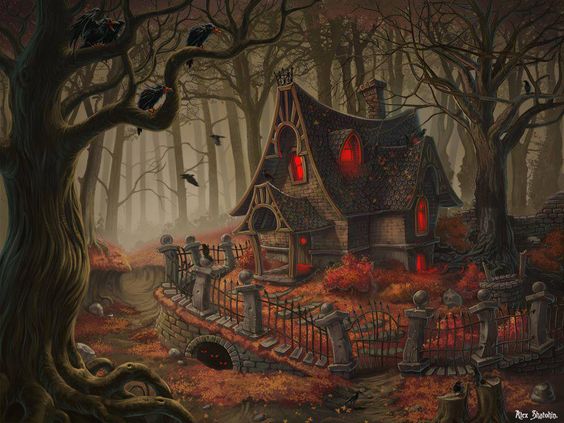
Think of the countless legends involving magical forests. There are the forests of Lord of the Rings saga – populated with its elves and talking trees (Fine! “Ents!). How about the forest at the edge of Hogwarts in the Harry Potter series with its giant spiders and centaurs? Go back, way back, to the tales of Little Red Riding Hood and her encounters with the wolf as she hiked the woodsy trails to grandma’s house. Or how about Hansel and Gretel and the witch’s house they stumble upon in the woods? Perhaps the last tale best fits with the theme of this article – houses and the terrains that surround them.

True, “forests” can easily fit into the previous category of “terrains of terror”, but since there are so many stories of haunted houses within forests, I felt it deserved a category of its own. The forests of myth are giant ecosystems of the supernatural. Cut off from civilization, mystical beings and deadly forces can thrive with little notice or interference from the larger world. What of a small house or hut that sits somewhere in the middle of this vast woodland of spiritual chaos? It is doomed. Or rather, it is susceptible to all the haunting forces that breed amongst the trees. Director Sam Raimi’s Evil Dead 1 and 2 illustrates this phenomenon. True, the demons materialize via chants spoken from a book within the cabin in the woods. But as the main character Ash Williams points out “It lives…out in those woods”. What is the “it”? The “It” is the evil force that spawns the soul-possessing demons that take over the bodies of the cabin’s inhabitants. Don’t believe me? Run away from the cabin and see how well you fare with the trees. They just might…well, watch the movies!

Then there is the house that is at the center of the madness of the woods. It is the reservoir to which all the terror must flow. In the Blair Witch Project (From Daniel Myrick and Eduardo Sanchez) three hikers are hopelessly lost in the forest. One just ups and vanishes. The terror builds and builds until finally they encounter a creepy old house from which they never return.

Finally, there are wooded trails that are perhaps extensions of a house’s hauntings. Think of this haunting as a giant hand – it surrounds the house within its grip. But the hand is several times the size of the house. The fingers spill over into the trails of the forests, damning them with ghosts, demons and all kinds of unnatural beings. I go now to the novel The Haunting of Lake Manor Hotel (edited by Nathan Hystad). As its name implies, the hotel is the subject of this collection of thirteen stories. The lake is also a centerpiece of these tales. The surrounding woods collect the ghostly remains that wash ashore from the lake; that journey outside of the haunted hotel. Possessed with witches, talismans, and strange dishware that are labeled with the names of body parts, this forest is not for the faint of heart. In Scott Nicholson’s Creative Spirit , artists gather in a manor for a creative retreat. The manor is indeed haunted, and the ghostly activities flow from the house and onto the old wagon trails and wooded pathways.


                                        Bodies of Water (Or , perhaps, bodies in water)

ExSea

Ah water! Fluid by nature, it has so many properties. Thus it can be so many things. Look into its pooling mass and you can see yourself in its reflection. Maybe, just maybe, within this reflection lurks a truth that otherwise goes unseen to the unreflective eye. In Edgar Allen Poe’s The Fall of the House of Usher, the “House of Usher” as revealed by the pool’s reflection is telling, especially as it applies to the relationship of the owners of the estate, Roderick and Madeline Usher. Sparknotes.com sums it up best:

“Doubling spreads throughout the story. The tale highlights the Gothic feature of the doppelganger, or character double, and portrays doubling in inanimate structures and literary forms. The narrator, for example, first witnesses the mansion as a reflection in the tarn, or shallow pool, that abuts the front of the house. The mirror image in the tarn doubles the house, but upside down—an inversely symmetrical relationship that also characterizes the relationship between Roderick and Madeline.”

Water seeks its own level – it conforms to the shape of its container. Given the chance, it will conquer its beholder. One must not remain inside a seaside cave for too long, especially during the tide. The Orphanage, a film by Juan Antonio Bayona, has such a cave. And it just might be inhabited by ghostly children! In The House on the Borderland by William Hope Hodgeson, there is a deep rift beside the house. Deep down, carved into the rift’s wall is a cavern. The protagonist decides to go exploring. Oh but there is water within the rift! It rises day by day and spills into the cavern on the day of our hero’s exploration. Not good!

When waters reach its own level, it conceals its depth. How deep does it go? Often we don’t know. Fathoms down, things are buried. History is hidden. Part of the reason for “The Haunting” of Lake Manor Hotel has to do with plague victims, their bodies unceremoniously thrown into the lake many years ago. Out of the depths from way back in time, they can return. How well does a lake hide the sins of the past? Sometimes very well, sometimes not. It depends what it returns. This situation is at the forefront of the movie What Lies Beneath (directed by Robert Zemeckis) and Stephen King’s novel Bag of Bones.

Let us dispense with the lakes and return to sea – an aquatic chasm of time and tragedies with a history too enormous for any generation to fully comprehend. Even the surface is but a platform of memories as vast as the sea itself. Not everything sinks. True, the treachery of men has pulled ships down to their watery graves. But the ghost lights of these ships remain and reflect off the waters. CS Saunders explains all this in great detail in Sker House, which is a coastal inn that absorbs many of the tragic memories of the sea.


 Prowlers and Growlers and the Ground-Bound
ExProwlers

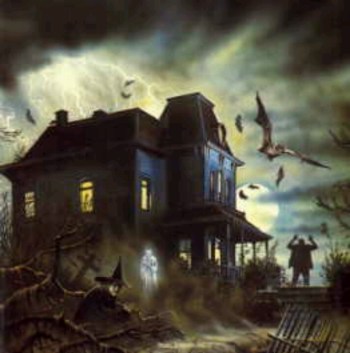
Beast or human, paranormal or not, watch for the things that prowl the grounds of a haunted house. Some are guardians. The gargoyles on castles and cathedrals, for instance, were there to scare away unwelcome guests. But some of these things bound to the grounds are just malevolent beings with nowhere else to go. In the film Cat and the Canary (Director: Elliot Nugent), for instance, the house guests must be wary of an escaped lunatic that just might be creeping around on the outside of the house. Rapping at the outside windows of The House on the Moor is a ghostly phantom. This is the same phantom I referred to earlier, the one that splashes about in the bog in the fog.

More to the point of guardianship, The hedge animals in Stephen King’s The Shining are not to be reckoned with. Yes it’s creepy when they sneak up on little Danny Torrence, but they can me much more deadly than that. After all, they out and out attack Dick Halloran as he tried to rescue the snowbound family.

Perhaps inspired by the gargoyle is The Bell Monster. It lives in the bell-tower on Scott Nicholson’s The Red Church It has wings, claws and livers for eyes. Mutilated bodies have been found on nearby roads and fields. These were Its victims.

And what are we to make of the herd of swine! With sharp teeth, crawling up from the cracks within the earth, they gather into an army and assault The House on the Borderland.


Don’t Wake the Dead! (They are sleeping underneath the yard)
ExCemetery

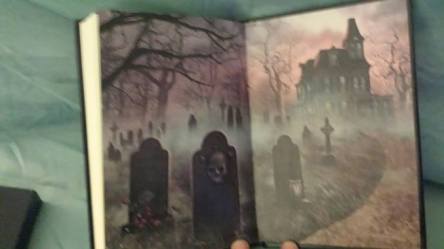
You knew this was coming. How can there be an article about the grounds of a haunted house without a cemetery category? There can’t be, so here comes the dead!


Lying underneath the mounds of soil are the former inhabitants of a house, or the once living/now dead congregation of a church. The obvious implications are that the ghosts of the buried dead have found their way inside the corresponding structure. That which remains does so to the fullest of intentions. To have a sprawling cemetery surrounding a house is to wrap a place forever in the spirit of the past. It’s only a matter of time before this figurative spirit breaks apart into literal ghosts bent on haunting the premises.

There is a churchyard in Scott Nicholson’s The Red Church. At one point in his novel, the ghosts in the graves rise to the sound of the church bell.

Some graveyards are not out in the open. Though connected in some way to former inhabitants of the nearby house, they are small and hidden away. This makes it more difficult for new occupants of a home to pinpoint the source of the haunting. Such is the case in the film The Others. There are three lone graves way across the fields some place. The weeds shelter them with the help of the groundskeeper. In the Haunting of Gillespie House (author Darcy Coates), temporary house renter Elle stumbles upon the house’s family cemetery. It is far away from the house, across the grounds and surrounded by locked gates. But she soon discovers that there are other ways that she can enter this cemetery, secretive ways.


ExTragic_ghostSo there you have it!

Houses by lakes and by sea and the things that come from their depths. Houses in forests and canyons and the things the hide within. Houses on shape-shifting terrains; monstrous metamorphoses. Houses built on unholy grounds, propped up in magical fields. Houses with neighboring corpses in their cozy graves, Houses that summons the demented and strange and set them loose on their terrifying grounds. Houses that weather terrifying storms and call forth the most brutal of nature’s elements to assist with their onslaught of horror.

These are the houses that are haunted inside and out. For every hallway spirit there is a ghost roaming the graveyard. Wandering around inside a haunted house can be terrifying. But fleeing the house does not guarantee one’s safety. You must get out and then run, run far. Far away from the house and all the things that surround it.

 

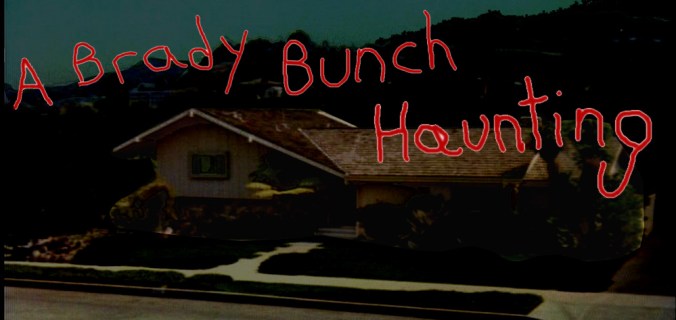
A Brady Bunch Haunting

ABradyBunchHaunting
Who grew up watching The Brady Bunch? I’m sure many of you have. I’m willing to bet that several millennials know what’s up when it comes to that “crew that somehow formed a family”  Not only has Sherwood Schwartz  saturated the airwaves with Brady bunches and brunches, Brady hours, Brady brides, Brady reunions and Brady holiday specials, but he has also penetrated the big screen with Brady Spoofs. (The third and final spoof movie, The Brady Bunch in the White House was actually a movie made for TV, but I bet someone watched in on wide-screen television, so my “big screen” description still counts!) I want to focus on the parody films. See, I would like to reignite this spoofy series with a film idea from yours truly (hint: that’s me!)  Sadly, Sherwood Schwartz passed away in 2011. Guess I’d have to seek out his next of kin to obtain all the necessary rights and permissions stuff. Is there a Son of Schwartz in the house?

Consider this post as my proposal submission. My suggestion is that the Schwartz family take into consideration my ideas for a potentially ghoulishly-groovy movie: A Brady Bunch Haunting. Perhaps The Son of Schwartz will stumble on to this blog and see this proposal. You never know!


Synopsis:

A family of six moves into the house at 4222 Clinton Way. Mr. and Mrs. Frank and Jane Lovingston, along with their three adorable children (Colleen – age five. Travis – age eight. Julia age fifteen) are in love with their new dream house. Jane’s mother Clara also lives with them and she is happy as well.  There is a large living room with an open staircase leading to a second floor with three charming bedrooms. There’s a spacious attic, a groovy kitchen that connects to a maid’s quarters. There’s also a gorgeous sitting room with glass doors that lead to a wonderful backward with a swing set.

There is just one problem – the house is haunted by the ghosts of the Brady’s (and Alice!)  Below are some possible haunting scenarios.


Davy Jones – Julia wakes in the middle of the night, goes down stairs, pulls out a Ouija Board and attempts to get in touch with the spirit of the late singer Davy Jones so that she may ask him to perform at her prom. Mrs. Lovingston interrupts this Ouija Board session and sends Julia to bed. The next morning Julia has no recollection of any of this, nor does she know who the heck this Davy Jones guy is.


The Phantom Football – Yard dwellers are in constant danger of being struck in the face by a phantom football that materializes out of thin air. On impact, a disembodied female voice cries out “Oh my nose!”


The Den of Advice Mr. Lovingston has no time for his son. Behind the living room is the former den of Mr. Brady. Right now, the room isn’t used for anything. Travis often wanders into this bare room. His mom overhears him talking to someone.

“Who are you talking to?” Jane asks.

“The R Ka Pet (architect).” Travis says. He helps me with my problems.”

Jane thinks Travis has an imaginary friend, until – she hears a man’s voice talking back to her son. He (Mr. Brady)  is saying, “Reason him, Travis. Calm, cool reasoning”


Random vase breakages – In the living room there is poltergeist-type activity. Vases suddenly break. When this happens, the disembodied voices of two young boys speak to each other. They say “Mom’s favorite vase.” And “She always says ‘Don’t play ball in the house’”


Picture of Jan While checking out her new bedroom closet, Clara uncovers an old picture of Jan Brady. She is freaked out because the picture looks exactly like she did when she was a young girl.

Later, when Clara encounters mirrors, she sees Jan’s reflection instead of her own. Both Clara and the Reflection-Jan scream in fright. Clara screams on account of the insanity of having a different reflection. Reflection-Jan screams because she sees what she will look like when she gets old. Clara has not aged very well. The thought of taking on her appearance scares her so.


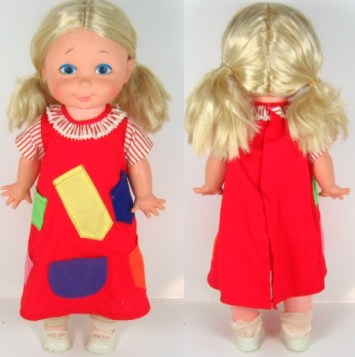
BBKKittyKitty-Karry-All  – Little Colleen lies in her bed, her arms wrapped around her doll. Suddenly, her doll vanishes. Where did it go?

There it is! It’s rocking back and forth in midair! Then, she hears the singing voice of a little girl: “Rock a bye baby, on the tree top..” Suddenly the ghost of Cindy Brady appears. Her ghostly arms are wrapped around the doll.  She whines, “I’m sorry, but this is not my Kitty!
Colleen screams as Cindy and the doll vanish. Later her doll will turn up in the dog house. Colleen will reclaim it but it will always disappear and turn up in strange places in unsettling situations (on one occasion, the doll is found hanging from the attic rafters with a knife stuck in its chest)

Every time the doll goes missing, a new doll takes its place in her bed. It is a “Kitty Karry-All”. Colleen is afraid of this mysterious doll. She breaks it and throws it away, but it always returns without any damage.


Alternate Kitty Karry-All scenario

 The night after the Cindy ghost whines about not having her Kitty Karry-All, Colleen wakes up inside Cindy’s arms. She has become “Kitty Karry-All.” The entire family including Alice stands around Cindy. They are smiling as Cindy says, “I have my Kitty back!”  Poor Colleen screams for help but it’s as if the Brady’s don’t hear her. The only response she gets is applause from the Brady’s as Cindy looks down at Colleen, smiles, and says, “I will never lose you again. I will keep you forever, and ever, and ever, and..


In bed with…Alice – While engaging in romantic activities with his wife,  Frank suddenly sees that the woman in bed with him is not Jane. It’s a goofy looking middle aged woman in a maid’s outfit.  “You can put your meatloaf in my oven now, Mr. Brady!” she says.  Frank turns away and looks again. He sees only his wife. How weird!


Ghost of Greg Poor Julia. Her attic bedroom is haunted. She is dragged out of her bed a la Paranormal Activity style.  Then she tied by her wrists and hung on the rafters.

The ghost of Greg then materializes and terrorizes her with – his guitar playing and singing

As he sings, “Clowns never laughed before” – the faces of killer clowns appear and start laughing at her.


When he sings, “Beanstalks never grew” – beanstalks sprout from cracks in the attic floor and wrap around her body.

BBVine


The voice in the suds – At strange times, the washing machine overflows and soap suds fill the entire room. This happens when the washing machine is not even is use! Sometimes, from inside the suds, a voice of a young boy is heard. It shouts “Mom!” Occasionally, the shout is followed by the concerned voice of a woman who says, “Ohh Bobby!”


BBOliverThe Boy inside the walls – Jane finds a little boy living inside the walls. His name is Oliver. He meets the rest of the family and tells them his story.

 “I have been living inside these walls ever since the Brady’s lived here. I locked myself away because I am a jinx. I thought that if I could go and live within the walls, then the Brady’s would be shielded from his bad luck.

I was wrong. The bad luck stayed with them. One by one, I watched them get murdered. Through the cracks in the wall, I watched as they all died.”

“Who killed them?” Frank wants to know. But Oliver can’t remember. It was too traumatic an experience.  But he says something really creepy.

“The Brady’s are still here. I sense them.”


The maniac butcher – Later that evening, Oliver eats dinner with the Lovingston’s.  They BBKillerSamare all sitting around the dining room table when all of a sudden, a terribly scary ghost appears.  He is holding a bloody meat cleaver.
Suddenly, Oliver remembers what happened on that fateful night.

“Sam the Butcher killed them! He went crazy after Alice dumped him.”

The Lovingston’s flee with Oliver, and they never return to 4222 Clinton Way ever again.


Review of Archie’s Haunted House (Archie & Friends All-Stars)


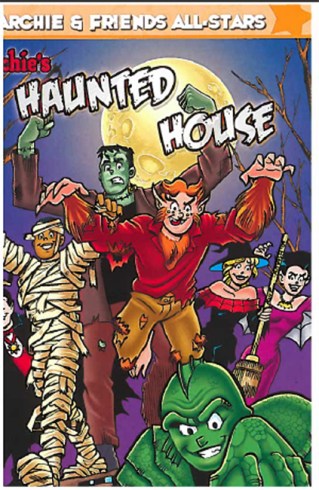
Archie Haunted House CoverThink real hard – what’s the scariest work within haunted house literature?

Think even harder – what is the funniest work of the haunted house genre?

Think harder than “even harder” – which haunted house book best captures the spirit of today’s youth?

Think so hard that your brain bleeds – which haunted house novel has the best graphic illustrations?

Tired of all this thinking? Good, because I am going to give your brain a rest by dumbing things down a bit as I get into the subject of today’s review – Archie’s Haunted House (Archie & Friends All-Stars), which, by the way, is not the crowning achievement for any of the above categories. Truth is, I don’t know which haunted house novel is the scariest, funniest, trendiest or “graphiciest” (the superlative of “graphic.” See I.. oh never mind, just read on!) But it’s not Archie’s Haunted House, but we love Archie anyway. Why? Because he is Archie! (circular reasoning notwithstanding)

Maybe some of you don’t know what an “Archie” is. Archie is the star of fictional comic book series about teenagers who do “teenage-ish” things in the small town or Riverdale. He’s been around since – My god! Really Wikipedia? Since 1941? And here I thought he was the byproduct of the late fifties and early sixties with all that soda- shop/sock hop kind of humor. The all-American teenage Archie, with red hair and all, had a side kick named Jughead, known for his laziness and addiction to junk food. Archie dated either blonde Betty ,the sweet, girl-next-door, or brunette Veronica, the snobby rich girl. Then there was Reggie the conceited one, Big Moose the dimwitted but good-hearted jock, Dilton the brainy nerd. The list goes on.

Archie has survived over the decades, has gone through various incarnations for multiple publications. As previously mentioned, there’s the “sock-hop” era Archie, there’s “Little Archie” (the teenagers as children), there was even “Christian” Archie. Archie tried (but in my opinion, failed miserably) to stay with the times. In the 1980’s he was saying no to drugs, in the 1990’s he was listening to grunge rock – you get the idea. In a parallel universe of Archie (the Life with Archie series),the Archie gang appear as superheroes, secret agents. They marry each other. In one story, poor ol’ Archie dies. But he lives in one of the other 2,343,120 Archie publications (number may be slightly exaggerated.)

As a birthday gag-gift, my friend and colleague gave me this haunted house issue of Archie from 2010. He knows I dig haunted house stuff and he also knows that I am familiar with The Archie comics. I read it and thought “why not ‘review’ it.” But the sum of the review is as follows – “It’s Archie” – more of that circular reasoning for ya!

In the first story, a costume store opens in Riverdale. The costumes are special in that the person who puts them on becomes what they are wearing. Archie is running around Riverdale as a werewolf, Reggie a vampire, etc. It takes nerdy Dilton to break the spell of these magical costumes and return the gang back to normal

The second story is about the oldest house in Riverdale. It’s supposed to be haunted, but Archie Haunted House - Forefathersthe city council sees it only as an eye sore and wants it torn down. But wait! Archie discovers the house is an important piece of history and wants it preserved. But wait again! It really does turn out to be haunted and Archie changes his mind and wants it torn down – after convincing the council to preserve it. Oh brother!
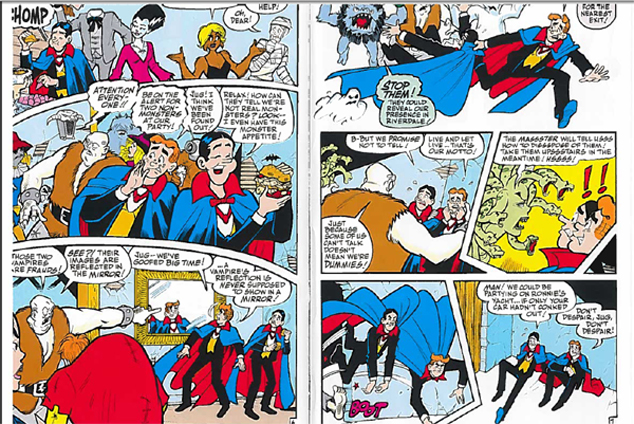
In the third tale, the girls are having a “girl-only” Halloween party and the boys come to scare them. It turn out that the boys become the ones who are scared when they mistakenly conclude that Veronica’s aunt is an axe murderer.

Finally, there’s my favorite story! Archie and Jughead, dressed as vampires, miss Veronica’s Halloween party, and so they are invited to another party – at a haunted house. In attendance are real monsters. There are mummy ladies and werewolf women, There are things with many eyes, there are ogres. There’s even a medusa. When these monsters discover that Archie and Jughead are not real vampires, they are in trouble!

Archie Haunted House - Monster Party

If you want to know the truth, I prefer the Archie comics of the 1960’s and 1970’s. My older sisters had a bunch of these lying around the house when I was growing up. I read em’ and dug em’. I cringe when the comics go out of the way to show how much they have moved with the times. In Archie’s Haunted House, Veronica and Betty discuss a Pearl Jam concert. In 2010 I think it would be a little late for that. Later, they succumb to a magic spell, and the writers compare the trance they fall into to the reactions the girls typically have after watching Brad Pitt on the screen. I would think B and V as teenagers of 2010 would go more for Robert Pattinson of Twilight. That would definitely fit – since these are horror-themed stories.

Ah but oh well. My colleague has told me that Archie comics have always thrown in references to real people and places aimed at referencing the “current times.” I’ll take his word for it; I just don’t remember the older issues being so obvious about it while simultaneously being a decade off track.

Anyway, this is a fun comic book. Not really scary, not “ha ha ha” funny, and I’m not sure who the target audience is. It can’t be today’s millennials, they won’t go for this. And I would guess that many middle-aged folks (like me) and beyond would prefer the older issues. The drawings are decent. That’s good, right? Despite the shortcomings, it’s an enjoyable read. I don’t know why. Oh wait, yes I do – it’s fun because it’s “Archie”

Archie Haunted House Nightview


The Lord of Winter – An Interview with Author Bryan Alaspa


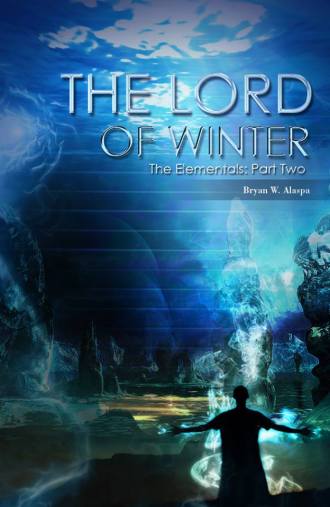
The Lord of the WinterAs promised, here is the follow-up to the segment I did with Author Bryan Alaspa and his new book The Lord of Winter (The Elementals Book 2). Last time Bryan appeared as a guest and contributed a thoughtful perspective on why a writer writes. For this segment, I interview Bryan Alaspa. Together we discuss The Elemental series in general and the Lord of Winter specifically.   So put your reading glasses on and settle on in. You are in for a treat!


Smiley


Daniel W Cheely – To clarify, the Elemental series belongs in the YA fantasy genre and is about youth with special powers, is that correct?


Bryan W. Alaspa – Yes, the Elementals series is meant for young adults. They are about an offshoot of humanity known as Elementals that can control one of the four elements that make up the universe. They are very long-lived, generally stronger than regular humans and have vast powers.


Daniel W Cheely – The heroes of the series – they are youth?


 Bryan W. Alaspa – Well, most of them are. There are older folks in there, adults. One main adult, Christopher, is going around recruiting these young Elementals, youths, to be part of his team to ward off a great evil.


Daniel W Cheely – I want to come back to the ancient race of elementals in a bit. But for now let me ask this: These youth that manipulate the elements, are they normal, average kids that one day realize they have this magic?


Bryan W. Alaspa – Most of them, yes. Most of them are offspring of other Elementals. Similar in some ways to the mutants in the comic book world of the X-Men. The Organization, the villainous conglomerate at the heart of the story, has ways of finding Elementals when they are young and recruiting them to teach them how to use their abilities.


Daniel W Cheely – The themes in your book do remind me of the X-men series, I was going to mention that. But I’m also reminded of Harry Potter and even Spider-Man in that both of these characters were normal kids until they suddenly realize that have special powers.

For many, the teen years are filled with anxiety and low self-esteem. Teens are trapped in a moratorium, not knowing who they are in relation to the larger world. Maybe they take to characters that suddenly break out of the “teen trap” and become somebody fantastic. Do you think this is why younger kids/teens are attracted to novels such as yours?


Bryan W. Alaspa – I know that is why I was always attracted to these kinds of stories. I loved Spider-Man because he was a teenager who had powers. It’s why I loved the X-Men. I think that most teens want something that makes them cooler- to stand out from the others around them.


Daniel W Cheely – Also teens want to belong. Often they aren’t allowed in certain cliques. They are shunned, etc. To one day discover that you belong to a race of Elementals – that can be a major ego boost in that you belong to a group that is way cooler than, say, jocks.

OR…is it the opposite? Do they feel as if they are misfits for belonging to this race? Or is it a little of both?


Bryan W. Alaspa – They are generally feared by the public and for the new recruits, suddenly finding out they are not “normal” or like anyone else is a little disconcerting.


Daniel W Cheely –Now in regards to the newest novel Lord of Winter – I have to ask, does the Lord of Winter = Bryan Alaspa? I know of your loathing for hot and humid weather and I can picture you, if you had the ability, smothering the heat with snowstorms to spite the summer.


Bryan W. Alaspa – Well, the name sure did come from there. In some ways, Robin Frost is a little based on me and my love of the colder months. It’s not a perfect match, but pretty close. If I did have his abilities, the summer months would be much more bearable for me.


Daniel W Cheely –In other words, you would be a responsible Lord and not whip up blizzards on the 4th of July.


Bryan W. Alaspa – 

thumbs up 


Daniel W Cheely – I’ll take that as a “yes.”  How about the young man in the story, is he responsible with his powers?


Bryan W. Alaspa – In the story, Robin Frost has had an accident earlier in his life that has damaged the part of his brain that would allow him to control his abilities. He has now lost control and threatens the entire city of Miami.


Daniel W Cheely – Yikes for Miami! Now, if The Elementals are an ancient race, could it be that such a calamity or near-calamity has happened before? Was there any tragedy or near tragedy that might have happened, say hundreds or thousands of years ago on account of their powers, or is it best to read the books for this answer?


Bryan W. Alaspa –  I have yet to explore that, but in the third novel my intention was to delve a bit deeper into the history of some of the main characters and explore more Elementals history, so it may come up then.


Daniel W Cheely – Ah – the third novel. First there was The Lightning Weaver , second The Lord of Winter. What powers might the third character have?


Bryan W. Alaspa – The third novel is called The Water Witch, which I think gives you an idea. The fourth novel will be The Firedrake.


Daniel W Cheely – So, if I recall, the four elements are Earth, Wind, Fire, and Water. The third novel is water, the fourth is fire. How about The Lightning Weaver and The Lord of Winter? The remaining elements are earth and air. Does The Lord of Winter = air while The Lightning Weaver = earth?


 Bryan W. Alaspa – The Lightning Weaver draws her power from the earth’s electrical and magnetic field, making her an earth elemental. The Lord of Winter manipulates the air to create the intense cold, snow and ice. I have also added a fifth element, dark matter, but only the villain can manipulate that


 Daniel W Cheely – That is awesome – having a villain manipulate dark matter! I wouldn’t have thought of that. Kind of like Star Wars and The Dark side of the Force, where only The Sith use the red lava elements or whatever it is that they use to make red lightsabers. Or how only The Sith making lightning.

What can the villain do with the dark matter?


Bryan W. Alaspa – Well dark matter is what scientists believe is pushing the planets away from each other. At the start, he mostly just gestures and causes people to blow apart. He gets a boost during the first novel and dark matter becomes a kind of primordial substance that was there before the humans or Elementals. Now he can teleport, create powerful blasts of energy, shapes, all kinds of things.


Daniel W Cheely –I don’t think I would want to mess with that dude!

I have found the four-element myth/philosophy interesting, although I must confess I don’t know how the belief system came about regarding people finding healing, power, insight, etc. from the four elements. I know astrology uses the theme as do some martial arts and various eastern philosophies. Do you have any insight into the history of this myth/philosophy?


Bryan W. Alaspa – I don’t really. I just always bought into the idea that everything was made up of the four elements. I think that’s true of our bodies, the things around us. Controlling one of the four elements would make someone extremely powerful


Daniel W Cheely – These are all the questions that I have. Is there anything you want to mention that we haven’t covered?


Bryan W. Alaspa – This was one of the more thought provoking interviews I’ve had. I think we’re good


Daniel W Cheely – Well thank you for taking part in this interview


Bryan W . Alaspa – You’re Welcome.


Architecture, Design, and Furnishings of a Haunted House

haunted house color


A well-described setting is essential to a good haunted house novel. Readers need to be able to “see” the house with their minds’ eye. Therefore, authors often take special care when describing the architectural layout. This same care is applied to describing the inside of the house. From marble statues and ornate wall décor to  winding corridors or spiral staircases, it is the author’s job to convey these visuals in such a way that encourages readers to temporarily forsake their off-page surroundings and take in the haunting environment that that exists within the pages.

In order for this vicarious relocation to be accomplished, writers and readers need to be familiar with certain terms that are related to architecture and interior design. I have come across many of these terms in both in my reading and writing. When reading, I may have come upon a word that described, say, a part of the roof, but I was at a loss to understand the description since I was unfamiliar with the term. Likewise; when writing, I found myself searching in vain for the right set of phrases to describe an architectural component, only to discover that there was a single word that could define the whole shebang.

This piece will examine the physical components of the houses within this genre. I will provide pictures along with definitions and examples ripped  from the pages of classic and indie novels. Definitions are provided courtesy of Merriam-Webster.com. Hopefully this will be helpful to readers and writers of this genre.


Eaves

EAVES

Definition: the lower border of a roof that overhangs the wall.

“Shaking off from my spirit what must have been a dream, I scanned more narrowly the real aspect of the building. Its principal feature seemed to be that of an excessive antiquity. The discoloration of ages had been great. Minute fungi overspread the whole exterior, hanging in a fine tangled web-work from the eaves. Yet all this was apart from any extraordinary dilapidation.”  The Fall of the House of Usher by Edgar Allan Poe.


CANDELABRUM  Candelabrum

Definition: an object with several branches for holding candles or lights.

“Now in no one of the seven apartments was there any lamp or candelabrum, amid the profusion of golden ornaments that lay scattered to and fro or depended from the roof. There was no light of any kind emanating from lamp or candle within the suite of chambers.” – The Red Masque of Death by Edgar Allan Poe.


PinaclePINNACLE

Definition:  an upright architectural member generally ending in a small spire and used especially in Gothic construction to give weight especially to a buttress.

“Little curved towers and pinnacles, with outlines suggestive of leaping flames, predominate; while the body of the building is in the form of a circle.” – House on the Borderland by William Hope Hodgeson.


GABLE

Definition: a section of a building’s outside wall that is shaped like a triangle and that is  Gableformed by two sections of the roof sloping down.

“It faced south, with one gable end buried to the lower windows in the eastward rising hill, and the other exposed to the foundations toward the street. Its construction, over a century and a half ago, had followed the grading and straightening of the road.” – The Shunned House by H.P. Lovecraft.


                                                                                              Hearth

HEARTH                                                                    

Definition: a brick, stone, or concrete area in front of a fireplace

“The fire he had left to die was roaring to life again, the blaze filling the entire hearth. He could feel its searing heat.” – The Amityville Horror by Jay Anson.


VERANDA                                                                                                                                                Veranda

Definition:   a usually roofed open gallery or portico attached to the exterior of a building

“…she put her feet down firmly and went up to the veranda and the door. Hill House came around her in a rush; she was enshadowed, and the sound of her feet on the wood of the veranda was an outrage in the utter silence.” The Haunting of Hill House by Shirley Jackson


MantelMANTEL

Definition: 1 a :  a beam, stone, or arch serving as a lintel to support the masonry above a fireplace. b :  the finish around a fireplace 2) A Shelf above the fireplace.

“..from the exquisite symmetry of the marble mantles to the filigree of the wrought iron handrails, only the best had been good enough for the man or woman who’d owned this place.” Coldheart Canyon: A Hollywood Ghost Story by Clive Barker


FLUE                                                                                                                                                 

chimney-flues

Definition: a channel in a chimney for conveying flame and smoke to the outer air

“They searched for him in the attic room and cubby hole and press, and even up the chimney flue and everywheres I guess, but all they ever found of him was his pants and round-abouts. And the goblins will get you if you don’t watch out.” The Little Orphan Annie by James Witcomb Riley


manaclesMANACLES

Definition: either one of a set of two metal rings designed to lock around a person’s wrists or ankles.

“The room was empty and quiet. Manacles and chains hung from the walls.” The House on the Moor by William Meikle


RAFTERS                                                                                                                                  

rafters

Definition: any of the parallel beams that support a roof

“He looked up, but all he could see were dark shadows high in the rafters.” – The House on the Moor by William Meikle


balustradeBALUSTRADE

Definition: a kind of low wall that is placed at the sides of staircases, bridges, etc., and that is made of a row of short posts topped by a long rail.

“They reached the second floor and, turning to the right, started along the balcony corridor. On their right, the heavy balustrade continued. To their left, set periodically along the paneled wall, were bedroom doors.” Hell House by Richard Matheson


TAPESTRIES                                                                                          black tapestry

Definition: heavy cloth that has designs or pictures woven into it and that is used for wall hangings, curtains, etc.

“The seventh apartment was closely shrouded in black velvet tapestries that hung all over the ceiling and down the walls, falling in heavy folds upon a carpet of the same material and hue.” – The Red Masque of Death by Edgar Allan Poe

Why a Writer Writes – by Bryan W. Alaspa

TheLordofWinter

Hello Readers!  I am honored to host author Bryan Alaspa.  He has been a guest on this blog before, and I was happy to help him promote his book: The Lightning Weaver – The Elementals Part One.  Well, Bryan’s been channeling those elements once again! He has followed up with the sequel – The Lord of Winter (The Elementals Book 2). It is available for pre-order this very moment!


The first book of the series is about a girl that can manipulate electricity. Alaspa follows up with a story about a boy that freeze entire cities.  Some might ask why anyone would imagine these fanciful scenarios. What’s wrong with staying firmly planted in the mundane world of reality?  There are perhaps a hundred different ways to respond to that question. A quick answer is that it would be too damn boring without the gift of imagination.  But Alaspa gives a more in-depth analysis of the subject.  Please enjoy his essay on “Why a Writer Writes”


A writer writes. That’s what you hear when you get started down this rather crazy and weird career path. You are supposed to be constantly writing, because every time you put down a word, create a new sentence and develop a new story, you get better. I know that was what happened with me.


I started writing stories all the way back in third grade. I was obsessed with the movie Jaws and I pounded out a three page single-spaced, non-existent-punctuation story called Jaws, Jr. It was terrible, of course, but the magic I tapped into when I wrote my first story was a high I have been pursuing ever since.


At first, like many, I copied the styles and writing techniques of the authors I loved to read. I wrote many short stories that were total nods to Peter Benchley, Stephen King and HG Wells. That’s not a bad thing because the other adage that you hear, although it is less known, is that “a writer reads.”


You have to read. You cannot think yourself so above the rest of the literary world that you do not read other people’s work. I find that I get some of my best inspiration reading other books. Not that I want to write my own version of what I’m reading, but somehow reading a really good book just tickles the part of the brain that taps into the world of stories I have been granted access.


So, why does a writer write? Well, I can only tell you that this writer writes because he has to. Because when I sink into the fictional world I have created it is only then that I am truly at home, truly in command. Outside, I am shy, nervous, uncertain. In the world of story, I am king, commander, god, benevolent dictator and friend.


I write because the stories come to me. They just hit me hard in the side of the head, inside my skull. They haunt my every private moment and are lurking there, hiding in the shadows when I try to fall asleep. When the story reaches a kind of critical mass, it seems like a thousand voices are running around in my head and I have to sit down and let it all out.


See, I believe that I don’t necessarily make up the stories that I write. No, I believe that I have found a way to tap into these stories. They just walk up to me in my mind and start telling me their tales. I transcribe them, offer some advice, but basically I am just pouring out words told to me by people that only I can see in my head.


I guess that makes me just a tiny bit crazy.


That’s OK, you have to be a bit crazy to want to make stuff up for a living. I think writing is necessary and telling stories is necessary. We need those distractions from the horrors of the real world. The real world is far scarier and more horrifying than anything I have ever written.


So, why does this writer write? Because I have to. Because I was made to. Because I love it. Because I want to entertain you.


I just hope you like the tales when the come.


BWA


Bryan W. Alaspa’s new novel is The Lord of Winter: Elementals Part Two, available in print and Kindle editions.

http://www.amazon.com/Lord-Winter-Elementals-Book-ebook/dp/B01BH6C6XO


Stay tuned – Bryan Alaspa will make a third appearance on this blog. This third entry will focus on the content of his Elemental Series.