H.P. Lovecraft and Haunted Houses Part 2 – Houses as Portals to Alternate Dimensions

Lovecraft2Here is my second piece on the macabre author HP Lovecraft.  In the first article, I wrote that Lovecraft was not a teller of ghost stories.  Instead of retelling what is essentially the same story – a spirit of the departed comes back to haunt a house – Lovecraft develops uniquely twisted tales that churn out equally bizarre entities.  This is true for the three stories I reviewed previously as well as the two tales I am reviewing for this post: The Strange High House in the Mist and Dreams in the Witch House.

This is not to say that the inhabitants of his strange houses are prohibited from taking on some of the attributes of the   standard apparition. They may possess ghostly features that are familiar to readers of paranormal lore. In the two stories that I am reviewing in this post, entities appear and disappear. They walk within the sky.  And yet, some of these entities appear as deities rather than ghosts. (See Nereids and Tritons.)  Then there’s Brown Jenkin, who is a familiar that takes on an  appearance that is vastly different from the average, ghostly white spirit.

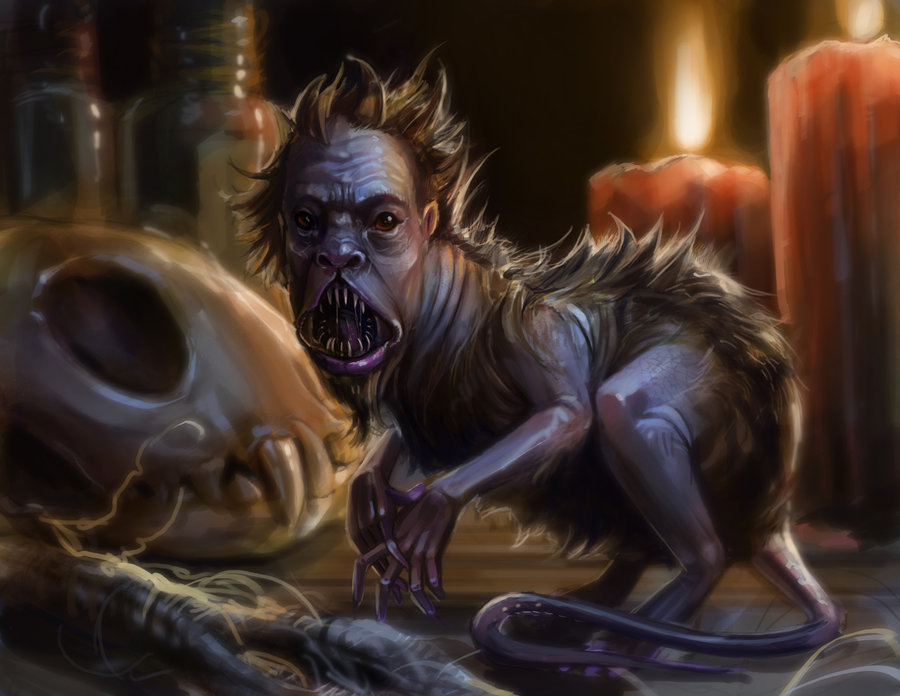
brown_jenkin_by_pawnattack-d30of05

Witnesses said it had long hair and the shape of a rat, but that its sharp-toothed, bearded face was evilly human while its paws were like tiny human hands. It took messages betwixt old Keziah and the devil, and was nursed on the witch’s blood—which it sucked like a vampire. Its voice was a kind of loathsome titter, and it could speak all languages

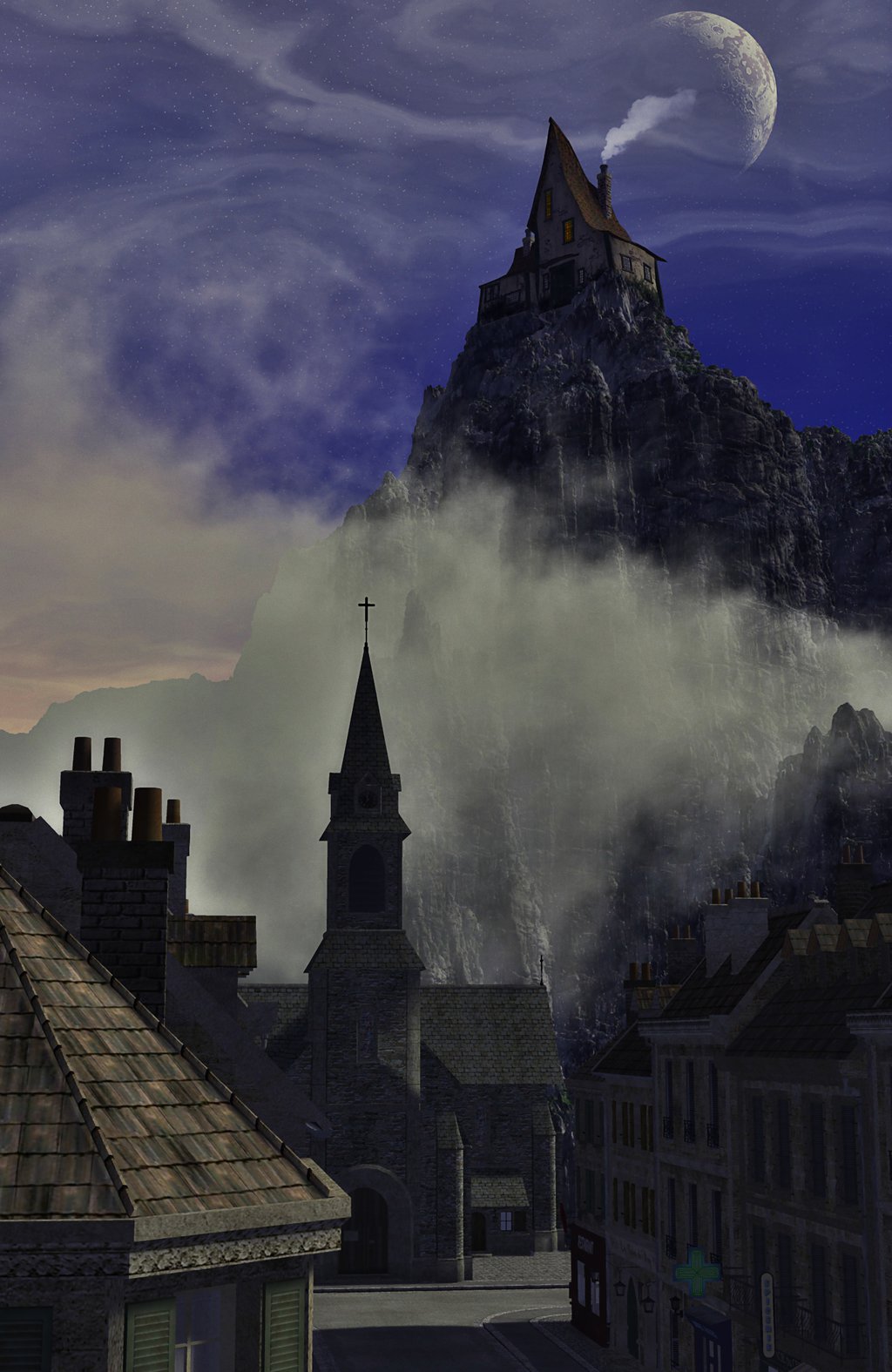
the_strange_high_house_in_the_mist_So once again, Lovecraft’s entities march to the beat or their own cadaverous drum. Ah but wait! There is something else that sets these two stories apart. Not only are the houses inhabited with beings of myth and the occult, but they also possess portals to alternate dimensions. “The Strange High House in the Mist” rests on top of a mountaintop where the front wall “stood flush with the cliff’s edge, so that the single narrow door was not to be reached save from the empty aether.” Nevertheless, “beings” do come-a- knocking; beings that materialize right out of the misty air of the sky, beings that invite a mundane man along on their heavenly parade. Within the bizarre architectural angles of The Witch House lurks an unearthly geometry that gives way to “spiral black vortices” that lead to the demon “Azathoth, which rules all time and space from a black throne at the centre of Chaos”

In a way, these houses can be seen as way stations on the edge of Heaven and Hell.  The mountaintop house opens its doors to celestial deities whereas the witch’s house unlocks demonic dimensions. However, “Heaven and Hell” is too simple of a dichotomy; analytically lazy.  Although frequented by immortal heroes of myth, “The Strange High House in the Mist” is not without its demons.  Dark shadowy creatures come to the house. Sometimes they knock on its door, but other times they try to sneak in through the windows.  In the case of Dreams in the Witch House, the pathway into the demonic dimension is not only open to evil or unrepentant souls. It is obtainable to the mathematical genius that can navigate within the geometric and physical laws of higher realms (although the protagonist does get pulled into this dimension unwillingly and repeatedly though a series or dreams)

What can be said about these houses is that they lead from an ordinary dimension to the extraordinary, whether for good or evil; whether by scientific or spiritual means.  Jim Morrison, based on the ideas of William Blake and Aldous Huxley, had this to say about his famous rock and roll band:

There are things known and things unknown and in between are The Doors

This is what the houses in these stories represent: doors that lead to the unknown. However, do these doors swing both ways? In The Strange High House in the Mist, the protagonist returns, but he his soul has remained behind. Is this a good thing or a bad thing? Read the story and decide for yourself. Read the Dreams in the Witch House as   well to learn of the fate of its protagonist. These are good reads. Challenging, heavy on the prose, but well worth it.


Review of We are Still Here

WE-ARE-STILL-HERE_Eloise-and-Fiona-Dagmar

So I found about this film via some post on one of the many horror groups that I belong to on Facebook.   It’s a very recent film and I don’t think it appeared in any major theater close to me.  I rented it through iTunes.

The promotional website looked appealing.  It packaged this film well, presenting it as a wholesomely modest effort, sparing overblown effects for a strong attachment to characters and setting.  I was looking forward to seeing a film that utilizes simple but creative techniques; techniques seemingly reserved for impassioned directors/crews that are working on a film with a limited budget.   I’d say this film met my expectations half way.  I’d definitely give it an A for effort. I feel as if I owe this film a certain liking, for its heart was in the right place.  Therefore I hope that Director Ted Geoghegan understands when I say in a heartfelt way that his film needs improvement.

We are Still Here takes place in the countryside.  Anne and Paul Sacchetti are grieving over their college-aged son who recently died tragically in a car accident. Trying to escape the past and seeking new beginnings, they move to a big old lonely house in the country.  But it seems as if their son is “still with them”, hauntingly so.  Paul offers something like “yes, he’s still in our hearts”.  But Anne senses there is more to it thaWE-ARE-STILL-HERE_Basementn that.  It’s as if his spirit has moved in with them.

Meanwhile, some creepy neighbors pay the Sacchetti’s a visit and tell them about the house’s horrible past.  The previous owners were burned alive. After a while, and after several disturbances, The Sacchetti’s invite friends of theirs to come stay with them. One of these friends is “gifted” and can commune with spirits.  Perhaps she can help them to figure out what is going on with their house?   It is later revealed that the house needs a family. Every thirty years, it releases its ghosts (of the previous owners) to extract vengeance on anyone who might be living there at the time.

This is Ted Geoghegan’s debut as a director for a feature length film. Thanks for the film, Ted. I did enjoy it. But let me offer some constructive criticism.

The establishing shots – very effective at setting the mood. This should not be understated. Still shots of the house at different angles, the countryside – all good. But they went on a few seconds too long.   The same holds true with the interior shots. Great camera work, especially that shot from behind the spider’s web! But again, the last several seconds of each shot should have been edited out of the film.

I liked the four central characters. I liked the charred ghosts. But I couldn’t get into the town’s folk. That scene at the bar – where all the patrons go silent and stare at the four outsiders – a little cliché’, don’t you think? In fact, this would have been a much better story if the town wasn’t dragged into the plot, for they were dragged somewhat awkwardly. This is especially true for those who die(?) early on (the electrician, the waitress). I have that question mark after die because I don’t know what happened to them. I think they died but I’m not sure. Things definitely happen to them but then they are just sort of forgotten about.

Ted, you have a nice, horrific house with chilling ghosts and four strong central characters – that’s all that was needed. Keep the ghostly revenge story but forget the town’s folk and their fear that if the house isn’t fed the ghosts will wander about into their lives. It only distracts from the finer points of this film.

I really want to like this film.  I appreciate Mr. Geoghegan’s love for the genre.  But I think he can do better.  Make he his next film will be one that I can love.  Is he going to direct another?  I don’t know, but if so, I’ll give it a shot.  I’m not going anywhere.  I am still here.

Review of Housebound

housebound  I found this film on Netflix. It is quirky, cute, and funny. And it’s a horror movie!  It is written and directed by Gerard Johnstone, one of the creators of the New Zealand sitcom The Jaquie Brown Diaries.  Being from America, I have never seen this show. But here’s what I suggest: Click on the preceding link. They say a picture is worth 1000 words, so look at the picture of the show’s star Jaquie Brown. This picture sums up what I believe is the tone of the show. Look at her silly yet serious expression. See the way she struggles with the video boxes. Now take one of the show’s creators and assign him the task of writing and directing a horror  movie. The result is Housebound. And interesting result it is!

Morgana O’Reilly plays the delinquent Kylie Bucknell who is arrested for robbing an ATM machine. She is sentenced to home-confinement in her mother’s house; (Oh no, not that! The United States prohibits “cruel and unusual punishment”, why can’t New Zealand do the same?) a house her mother claims is haunted. Here in her mothers’ house, Kylie is checked on often by security officers, counselors, psychologists, as well as creepy, ghostly things!

This film has received overwhelmingly positive reviews. However, some reviewers on Netflix say this film is neither funny nor scary. The humor is there, but because it isn’t blatant, these folks missed it. It is so cleverly stitched into the film’s fabric that it hides within the natural flow of the story. Not scary? Sure it is! But it’s a creepy and bizarre kind of ‘scary’, not the kind of scary for those expecting ghosts to suddenly pop out at you. (Although this sort of happens from time to time)I join the majority in praising this film. It’s not you average haunted house film. But who wants average when you can have original? And an original film it is!


H.P. Lovecraft and Haunted Houses

LovecraftI finally tore off the plastic that wrapped H.P. Lovecraft – The Complete Fiction in pristine newness. This classic-bound tome that I bought from Barnes & Noble sat on my bookshelf for a long time, waiting to be fondled – such a dirty, dirty book! I had several of Lovecraft’s stories in digital format, so there was no hurry to tear open this book and strip away its protective packaging. But I did not have his complete works. Not on my Kindle device, not on my Nook. I wanted to see if he had written any haunted house tales. The easiest way to check on this was to open the classic-bound book. And so I did.

The table of contents listed several possible haunted house stories. I read three of them:

  • The Picture in the House (Originally published in National Amateur –1921)
  • The Rats in the Walls (Originally published in Weird Tales – 1924)
  • The Shunned House (Also Published originally in Weird Tales – 1937)


LovecraftMan

Before I get into the specifics of these haunting tales, it would help to take note of a few things about the author himself.  What do I know of Lovecraft? He was a prolific horror writer of the early part of the twentieth century.  He wrote short stories and novelettes for various pulp magazines, including Weird Tales.  He did not achieve fame until after his death and he died in poverty. 

God, what I wrote seems pretty damn sad.  But I want to look at in another way, a way that is, shall I say, more inspiring? Lovecraft reminds me of today’s blogger and indie writer.  Fame is far away, but indie writers plug away at the keyboard, not for riches but on account of their “love” for the “craft” (“Lovecraft!” Sorry, I had to!).  Their work is displayed either in the blogosphere or at self-publishing outlets such as Kindle Direct Publishing at Amazon.com.  These writers network with other writers. The communities of writers read each other’s work and offer praise and constructive criticism.  And they have fun!

There was no Internet back in Lovecraft’s day. Perhaps the pulp magazine was the blog of yesteryear – the place for unknowns to share their work with the larger world. Or, at least, with that small portion of the larger world that sought out genre specific tales at a cheap price. Through these magazines and other journals, such as the United Amateur Press Association (ohhh but how “indie” sounds so much better than “amateur!”), Lovecraft shared his work. He corresponded with other such writers via handwritten letters and befriended them, even though they never met person to person. Ahh, such is the way with today’s indie writers, only the Internet makes the process so much easier.

As an indie horror writer, I knew I had to pay homage to Lovecraft eventually. So I will to so now. However, he was not a gigantic contributor to the paranormal genre. Ghosts are usually the key ingredients for any haunted house tale. But Lovecraft didn’t have that much to say about ghosts.

From the introduction of H.P. Lovecraft – The Complete Fiction:

As Lovecraft’s work progressed, he himself began eschewing traditional supernaturalism more and more. He had, in fact, never used such conventional tropes as the vampire, the ghost, or the werewolf…

…in his most characteristic work Lovecraft devised conceptions and entities entirely his own.

Lovecraft envisioned gigantic aliens, vengeful deities, ravaging sea monsters, and terrifying savages.  He plucked out the horrors within science, religion and civilizations and for the most part left the ghost behind to haunt the minds of other writers.  This being said, what then haunts the creepy old houses that sometimes show up in his tales?  The answer- very weird things!

PictureInTHeHouseThe Picture in the House – In this story, the house is haunted by a graphic book depicting cannibalism, a weird-bearded old codger, and a ceiling that drips blood.  A weary traveler rests inside a backwoods farmhouse.  He thinks it’s abandoned, until he meets its dweller – and unkempt, white bearded old man who at first commands the visitor’s respect. Later, he brings only terror to the guest as he watches his face contort in perverted ecstasy at a book depicting a butcher that has several human limbs hanging on the walls.  Then for the finally whammy, blood drips form the ceiling.

ratsinthewallsThe Rats in the Walls – What else might haunt a house? I know – how about rats in the walls? The protagonist moves into an ancient monastery where “indescribable rites had been celebrated there.” At night, the cats stare at the walls in fright. Why? The scurrying of the rats. Hundreds. Thousands. Maybe more. The cats hear them. The protagonist hears them. But the servants do not.   Eventually, the protagonist follows the sound down to the cellar. Then he follows it to even greater depths as he explores a passageway that is hidden underneath a stone altar, and this leads to a very horrible scene. Thousands upon thousands of human bones, all containing the gnaw marks of rodents.

TheShunnedHouse

The Shunned House – The haunter of this tale is perhaps the weirdest yet.  Sort of a vampire, but not quite.  Maybe a spirit, but that doesn’t work either.  Its substance is best described as a gas.  It flows out the chimney and makes strange images appear in the smoke. It takes on bizarre fungal forms on the earthen cellar floor.  It arises in the form fumes that take can overcome a person and transform his face into faces of the dead. But underneath the cellar floor it exists in a gelatinous form. Oh and it sucks the breath out of sleepers.  Yeah, I would shun this house too, I think.

There are more stories of cursed and doomed domiciles in my book and I look forward to reading them. Who knows what other kinds of bizarre creatures haunt the houses of Lovecraft’s tales!

Review of Bad Ronald

   Remember how moved Seinfeld’s Kramer was to be watching a movie that went directly to video?  (Hint: This fictional movie was about a lady in a coma).  As delightful as it is to be watching films that bypassed theaters, we must remember those poor, deprived souls of previous generations that grew up before the VCR was invented and could not watch lame direct-to-video films.  What did they do to satisfy such viewing desires?  They watched movies that went directly to TV.  One such made-for-TV film is Bad Ronald

Ronald is a teenage nerd with a penchant for fantasy that has an overprotective mother who is equally weird.  Ronald accidentally kills a girl who is making fun of him.  In order to escape prosecution, mother and son concoct a plan to conceal Ronald within the walls of their house. Can’t arrest and prosecute what you cannot find!  Mother gets sick and goes to the hospital, where she dies. Poor Ronald is left all alone behind the walls and he continues to live there when a new family moves in.

Bad Ronald was the ABC movie of the week back on October 23 of 1974. I was only three years old when this monumental event occurred, so I remember it not.  But I have a colleague that was about twelve years old when Bad Ronald aired and I thought surely he would remember watching this pivotal moment of television in the same way that viewers of the moon landing broadcast have never forgotten all that “one step for man” stuff.  Alas, he could not remember what he was doing the evening of 10-23-74.  In fact, he didn’t even realize this movie existed.  Imagine that!

Truth be told, this is an obscure film that has gained a following throughout the years. IMBD user reviews attest to its cult status. It was resurfaced within various waves of popular culture.  For instance, there is the 80’s punk band “Bad Ronald” that (Excuse me, ‘What’s that?’  This is an entirely different “Bad Ronald”, its name intended to poke fun at Ronald Reagan? Okay then, I stand corrected. I’ll just…. ‘What now?’. There IS a rap band “Bad Arnold” named after this movie?  Why don’t I just slowly back away from this paragraph and write my way nonchalantly into to next one.   Do dee doo dee doo dee dooo……)

Okay, where was I? Oh yeah, Bad Ronald – an interesting and offbeat film loved by many; surprisingly compelling for an early 1970’s made for TV movie.  Now, one might ask, what the heck does Bad Ronald have to do with haunted houses?  I tell ya what – I’ll show you how this film relates to the haunted house genre.  Let me restart this review another way:

The Wood family – mother, father, and three teenaged daughters – moves into a Victorian home.   The eldest daughter acquires a boyfriend who tells the family the dark history of the house.  As he eats dinner in the house at the Wood home he blurts out, “I never thought I would ever be here eating in this house.”  What did he mean by that?  Why did he stress “this” house? He then told them that the boy who used to live in his house killed his younger sister. Ronald was his name.

What became of Ronald?   No one knows.  The police had never found him.  As it turned out, Ronald was listening in on this morbid and frightening dinner conversation from behind the walls!

After this dinnertime story, the girls notice strange happening within their home.  They hear noises in the middle of the night – it sounds if someone is stumbling about the house.  Food begins to vanish from the refrigerator.  Someone had been tampering with the eldest daughter’s diary.  Some of the daughters are convinced that their new home is haunted.

One evening, when the parents and oldest two sisters are away, Ronald comes out of the walls and confronts the youngest daughter, who is scared out of her wits.  He declares himself Prince Norbert and he wants to steal her away and take her to his kingdom where she will be his princess.  Ronald had lost touch with reality.  He has gone quite mad.

Now does this film sound like a haunted house flick?   I’m guessing that some are still not convinced. Let me just say that for a long time I’ve wanted to see this movie. Finally I found it on dailymotion.com. The damn video got stuck every five minutes and needed a refresh. Then I was assaulted with ads. But I got through it. I wanted to see it so bad that I suffered through all the shit and spent well over two hours watching a 70-minute film.

Since I put up with all the annoying obstacles that tried and failed to prevent me from seeing this film, I at least have the right to view this film through whichever genre lens I choose. Though some will disagree, I choose to categorize this film as a haunted house movie.

If you can find Bad Ronald, watch it.  If you see it at the store, buy it.  It’s one of a kind.

Review of The Haunting of Hill House/The Haunting: Book Vs. Movie

The following article is a comparison between The book The Haunting of Hill House and the 1963 film The Haunting. To read about the Netflix Series: The Haunting of Hill House, click here:  The Haunting  of Hill House  – The Netflix  Series – What it is and What it isn’t  


haunting-of-hill-house-NOVEL 2

The Haunting of Hill House

Shirley Jackson

1953

Excellent book!


haunting-of-hill-house

The Haunting – Robert Wise -1963 – Great film!


Each deals with the same story.  Which is better?

The old adage is that the book is always better than the movie.   Quite often this is true -but never always. Tolkien fans will want to hang me out to dry for writing this, but I enjoyed Peter Jackson’s Lord of the Ring’s films more than Tolkien’s books (Hobbit films not included). On the other hand, I thought JK Rowling’s Harry Potter series were far better than the films.

So for me, it just depends.

About a week ago, I watched The Haunting again (saw it once about fifteen years ago) and reread The Haunting of Hill House – the book by Shirley Jackson that inspired the movie. Before going into the whys and wherefores of any possible preference for one over the other, let me address some possible confusion concerning these titles and another film of a similar name.

1950s – It was the decade of “Haunts” and “Hills”. Shirley Jackson’s The Haunting of Hill House novel came out in 1953, and  William Castle’s film The House on Haunted Hill premiered in 1959 (click here for my review of this film.) Please note – these stories have nothing to do with each other. Castle’s movie is NOT Jackson’s book adapted for film. The film version of Jackson’s novel is simply called The Haunting.   It came out in 1963.   Castle’s film has the word “Hill” in the title, just like the Jackson’s book.

Okay by now you’re thinking, “Ugh! Enough with the confusion! Just tell me what the damn story is about!”

Right. Well, it’s a about this house, see? And it has a history of death and violence associated with it. Dr. Montague is a professor of anthropology who wants to embark upon a scientific study of paranormal phenomena. So he rents out Hill House and invites three other people to live in the house with him and together they are to study any ghostly activities that might occur.

The tale focuses on house guest Eleanor Lance. She is the unreliable narrator, freed from a decade long burden of caring for her recently deceased invalid mother. She is quite neurotic and not prepared for the ghostly disturbances that Hill House will bring. Or maybe, in her own twisted way, she is very much ready for Hill House. Too prepared for her own good. I will expand on this later.


The book or the film – which wins? Each medium has its flaws. The film flattens out the supporting characters a bit. In the book house guest Luke Sanderson is a sociable man appreciative of tastes and pleasures, spoiled in his wealth, a reluctant hero, perhaps lonely. The film reduces him to a shallow cad. Likewise, Theodora of the novel is witty and adventurous, confident, free spirited and independent, sometimes compassionate and sometimes cruel. The film however focuses mainly on Theodora’s scorn. But this is the drawback of film in general when it comes to inserting book characters onto the screen. There is more room in a two hundred-page novel than a two-hour reel of film to round out the characters

As to the book’s faults, the dialogue and plot sequences are sometimes disjointed. Eleanor and Theodora are at each others throats at the end of one chapter, only to be locked arm-in-arm in friendship at the beginning of the next. The group as a whole will suffer through a horrifying haunted house experience, only to be laughing in camaraderie shortly thereafter as if they were vacationing at a spa. And yet, I understand this laxity of flow. The neurotic and insecure Eleanor is the central character and the story is unveiled through her unreliable thought processes.

But in the end, both platforms excel at establishing a mood and setting necessary to bring this haunting tale to life. The book does so with its poetic descriptions, tone and character development while the film captures the chilling mood with skillful camera work and brilliant art direction. The question then becomes – which of these modes of artistry better instills a fond sense for the chilling?

For me, it’s a tie.

The book has some fine moments indeed. The very first paragraph (which is always the most quoted) sums up the tone beautifully:

No live organism can continue for long to exist sanely under conditions of absolute reality; even larks and katydids are supposed, by some, to dream. Hill House, not sane, stood by itself against its hills, holding darkness within; it had stood so for eighty years and might stand for eighty more. Within, walls continued upright, bricks met neatly, floors were firm, and doors were sensibly shut; silence lay steadily against the wood and stone of Hill House, and whatever walked there, walked alone

Who or what is the “whatever” that walks alone? In the end, maybe its Eleanor? Maybe.

The book traces the haunting developments of Hill House from her skewed perspective and it does it well. It’s almost as if Eleanor herself is the ghost. From the beginning, Eleanor, trapped in arrested development  on account of her being forced to care for her invalid mother for many years, yearns for a life of her own. Ghosts to that, don’t they? Little by little, the house takes her over. She insists that she belongs at Hill House. And maybe she does? Haunted houses need their ghosts.

Toward the book’s end, she watches the rest of the occupants from afar; detached. Sometimes she is hiding on them – spying. Is she the topic of the conversation Luke and Theodora are having? No. So she moves on. Eavesdropping. She has the attention of no one.   She belongs not with them. Only with the house. And the house will have her at the end.

The film follows the slow dissolution of Eleanor as well, but to a lesser extent. Due to the limitations build into the film medium, it cannot develop the character as well as the book. Instead, it does what it can with the tools it has. It focuses a lot of attention to the house itself. And this focus is done artfully.

haunting-of-hill-house 2The establishing shots show the house in its totality. Slowly the contrast fades and the house dissolves into a dark, amorphous shape. Dutch angle camera techniques are used to give viewers a disoriented perspective of the innards of the house. The camera shakes when the characters climb a rickety staircase.   Then there are the props – the film is generous with haunted house décor. There are the wooden faces of children carved into the corners of the nursery door (creepy!), the giant statues of a saint healing lepers (mysterious!) the wallpaper of chaotic designs (unnerving!) and the enormous bedroom doors that seem to have an eerie face hidden in the etching-design.

Then there are the sound effects – the disembodied laughter, the whispering, and, of course “The booms”.   BOOM! BOOM! BOOM – as the ladies hold each other in fright – something is pounding on their chamber door!
Both the novel and the film come highly praised. It is a favorite of film director Martin Scorsese:

Director Martin Scorsese placed The Haunting first on his list of the 11 scariest horror films of all time

Likewise, Stephen King has great praise for the novel:

In his book Danse Macabre (1981), a non-fiction review of the horror genre, lists The Haunting of Hill House as one of the finest horror novels of the late 20th century and provides a lengthy review.

Maybe someone else can choose one over the other, but I cannot. I highly recommend both the book and the film.


Thank you for reading this article.  If you enjoy my writing, please consider buying my latest book.  A writer/house sitter haunts a house with his stories. They haunt him back in return.

HouseSitterCoverForHHGroup

Review of House of Leaves

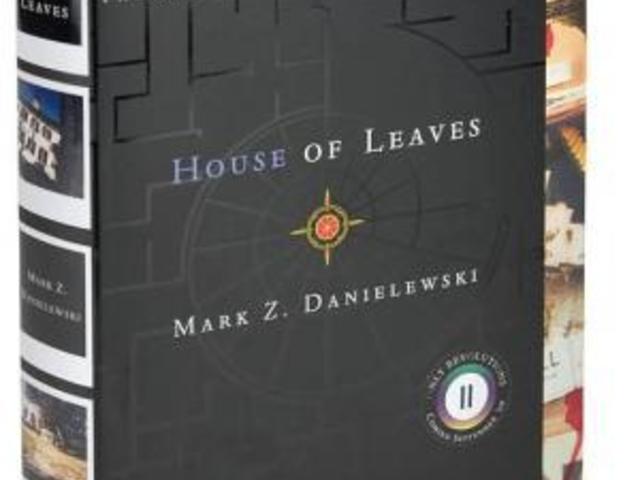
HouseOfLeavesI would have never known of the existence of this book had it not been for a certain writing project of my own. I was telling an editor friend about a novel I am writing. In my upcoming novel entitled The House Sitter, writer and haunter Brad Johnson watches over his friend’s house for a few months while he and his family are away on vacation.  While staying in his house, he decides to work out a lot of his demons by doing an ambitious amount of writing. However, he has a rather idiosyncratic writing process – he haunts things.  He studies an object, reflects upon it in an eerie way, let’s his imagination go wild and then – Presto! He has written an eerie story about the object while haunting it at the same time.  However, sometimes the object can turn around and haunt him back.

Brad finishes three short stories, all pertaining to the house.  The themes in each of his stories reflect upon his personal demons.  They are stories within a larger story.  In one story, a young boy falls down a laundry chute. Rather than being treated to a twelve- drop inside a straight metal chute, he encounters tunnels and chasms filled with possessed animals, bizarre demons, and other animated horrors.

At this point, my editor friend interrupts me and says, “You have to check out House of Leaves!”  She explained that the themes to my upcoming novel are similar to what’s inside this long and ambitious work by Mark Danielewski.   She is mostly referring to Brad’s story of mysterious tunnels occupying on house.

Well, I searched though the Amazon.com library of ebooks – and I found nothing.  No House of Leaves. How foolish of me to think this book would be available in electronic format! If I had only known about its rather unusual layout, its reliance on footnotes, its back-paging and forward–flipping style.

I purchased the paperback and unwittingly stumbled into a genre that has only recently been defined. Dare I say post-modern?  This genre is known as Ergodic literature.  Espen J Aarseth in his book Cybertext—Perspectives on Ergodic Literature writes:

 In ergodic literature, nontrivial effort is required to allow the reader to traverse the text. If ergodic literature is to make sense as a concept, there must also be nonergodic literature, where the effort to traverse the text is trivial, with no extranoematic responsibilities placed on the reader except (for example) eye movement and the periodic or arbitrary turning of pages

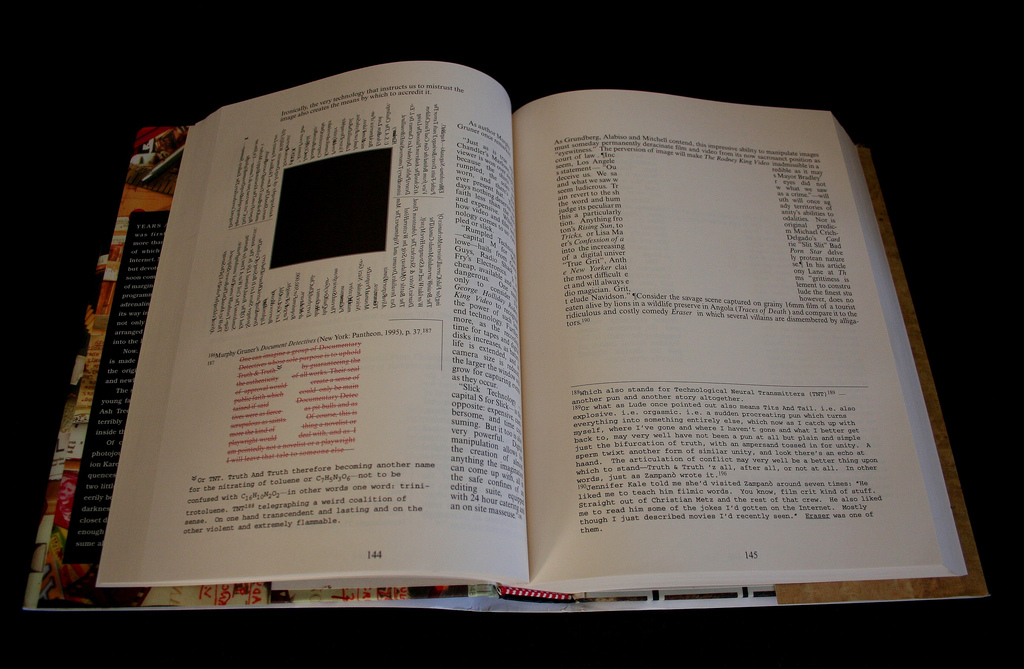
It is a book where the reader can easily get lost in a labyrinth of literal twists (the words flowed down in a spiral at one point) and non-linear flow (the reader will be led to a footnote that just might go on for a page or two before being set free to return to the place s/he left off. Where was that place again?) (1) (Yes this is a footnote! Go to the bottom of the page. Dooo it!)   And guess what? This book is about a labyrinth that exists inside a dark hallway within a house. Sometimes it’s a one-level hallway that is few meters long. At other times, it is a space of unfathomable lengths and depths.  HouseofLeaves2

I found that House of Leaves does have some similarities to my upcoming novel The House Sitter. They both contain stories within stories. They both have unreliable narrators that write in a diary. And they both, at one point or another, deal with houses that have expanding passageways that defy the physical boundaries of the house itself.

But this is where the similarities end.  Although House Sitter possesses a fair amount of complexity, it is far simpler than the other.  Pretentious at times, House of Leaves is a labyrinth of convolution. But as the theme unravels, the reader understands that this convolution points to the very essence of the book.

When I finished House of Leaves, I was imbued with the uncanny ability to utter both “huh?” and “wow!” in a single breath.  Baffling yet intriguing, the “huh-wow” effect prevailed from beginning to end, through the smooth and the rough, and believe me there are plenty of rough passages to tread through.  At times I asked myself “Why am I even bothering to read a book where I sometimes have to turn it upside-down to understand what I am reading?” At other times I exclaimed “How cool! Twenty five pages in a row where there were only four words on the page!”


WordsDown

Huh-wow, huh-wow, huh-wow.

WordsInvert

But I refused to hold the book up to a mirror for the parts where the words were inverted.  Some things I just won’t do.

The narrator of House of Leaves is Johnny Truant, a sex-obsessed and drug-addled tattoo parlor employee. Well, Johnny boy here seems a little unhinged.  Zampano is a blind author who has recently died.  He has left behind the scattered remains of a literary project.  Notebook pages litter the floor.  Words are scribbled across napkins. Truant embarks on the project of assembling the notes into a cohesive whole, adding his own comments via footnotes.  The result is an exhaustive critique of The Navidson Record – a documentary film of a family that lives in a home with a mysterious hallway that exceeds the boundaries of the house.  Will Navidson, the homeowner, sends explorers, equipped with video cameras, into the hallway.  They are lost for days. Will himself ventures into the dark and claustrophobic hallway on several occasions. At one point, all the walls and floors disappear. It appears that he will forever be trapped in “nothingness.”

It seems as if every academic snob and pretentious critic has an opinion of this film.  Journals of art, science and culture have published critiques and analyses of the film, their accounts carefully researched and documented by Zampano and later complied by Truant in footnotes. The thing is – many of these publications do not exist. Neither do many of these critics. Nor does the film. There is nothing! “Nothing” becoming a terrifying something is common theme in this book.

Truant goes off the deep end trying to assemble this piece.  He breaks down in fits of anxiety, experiences depersonalization, and ends up locking himself away in his apartment, alone with these pages.

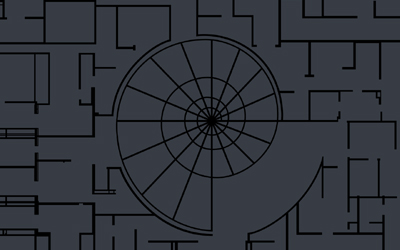
So, what the hell is going on here?  For me, this sums it up = you feed it and it will grow. Spend a taxing amount of energy on something small and in the end that which was minute will be enormous. It will be overwrought with complications, possessed with a polarity to suck you in.  Spiral

The Navidson hallway and the staircase within reflects the mindset of its occupants. Feed it fear and it will grow terrifyingly large. The film The Navidson Record is overanalyzed. As a result, the book that was written about it sprawls manically in all directions via footnotes and references. Truant, the one left to sort out all this mess, gets pulled into the void of, so much so that at one point, he discovers that he is part of this book. People he hasn’t met have read about him from his journal that was never published.

But I shall say no more. Perhaps it’s dangerous to overthink this book.  (Ohh, I said more!) The less said the better. (Yes! Less, please!)  Anything more than a modest analysis may cause the reviewer to be sucked into one of the abysses the book warns against. (No, not that!)  Or maybe it doesn’t warn again such voids at all! (Stop it!).  Maybe…

No, I won’t “fall” for it.  I will not be sucked in. The book is what it is and that’s that!

I liked it even though it was a pain in the ass to read. Why did I like it? If I go searching around my brain for the answer, you will never see hear from me again.

But I mean to continue on, with this blog, and with my novel The House Sitter.  At least I know where the hallways of that house lead.

Until next time!

Daniel W Cheely

WordsFootnote2

Review of The Fall of the House of Usher

Poe At young age, I remember being fascinated by The Fall of the House of Usher because there were no ghosts in this tale, and yet the house is haunted. If there are no ghosts, what is haunting the house?   Because this question was only vaguely answered in the movies and children’s books that I absorbed, my curiosity about this dreary tale by Edgar Allen Poe grew.   A few weeks ago I finally read the original version. And I am still intrigued by the question.

I first encountered this story as part of a book series that adapted the classics into easy-to-read books for children. They were small books; the left page had the words and the right page contained the pencil-drawn picture. I remember the picture of the book’s main character, Roderick Usher, agonizing in his reading chair. He had buried his cataleptic sister Madeline in the family vault, but oh shit! She wasn’t dead and she had broken free from the tomb. He knew she was coming after for her him, so he gave into anguish and dread. I then remember the picture of Madeline struggling with him as their huge Gothic house came tumbling down.

Even though this version went easy on the wording, I still didn’t get it. What’s with the house coming down? What is causing “The Fall” of “The House” of “Usher?”

Exploring this issue further, I watched this made for TV movie (As a side note: I remember my older sister’s boyfriend being mad that the movie being shown was NOT the Vincent Price movie version. Looks as if this Vincent Price movie has an entirely different plot than Poe’s story. Nevertheless, I still want to see it.)  As with Poe’s version, the story’s narrator comes to visit his ailing friend Roderick Usher at his gloomy house and offer his assistance. Unlike the original tale where the narrator’s job is to soothe Roderick’s spirit with companionship, the narrator is sought out so that he can make repairs to the house’s foundation. This structural renovation – it might add time to Roderick’s life.   This is because – as the house ails, so does Roderick. When the house “dies”, Roderick’s life would end as well.

I went back and reread the story in my book and finally I figured out a few things. The House of Usher was both the physical house and the long lineage of the Usher family (Roderick and Madeline are the last in line). Also – the physical House of Usher, it is alive. It had a will of its own. It possesses consciousness. This “house with a conscious” concept probably impressed me the most. It was my first experience with such a theme. Later on, it would reoccur in such films as The Shining, but ask anyone, the first of anything always is the best! (well ,except heartbreaks over a first love. Those are the worst)

And yet, there seemed as if there was more to know. For instance, what was up with Madeline Usher, who roamed about the many halls of the Usher estate like a zombie? Why was her brother burying her alive? And how did all this tie into the “house with a consciousness” theme?   Something else was lurking in the story; haunting the backgrounds of The Usher house.

Fast forward thirty three years. Arrive in the summer of 2015, right in the middle of my haunted house fiction project. It was the perfect occasion to get to the bottom of this Usher mystery. Finally I would read The Fall of the House of Usher in Poe’s words only.

And so I did.

What did I learn?

First of all, it’s much shorter than I expected. There is only 7000 + words.

Yet, “it is all there”, compacted tightly within the paragraph-long sentences that are inundated with gerund and absolute phrases. Such is the style of Poe – verbose and very challenging for the twenty first century reader (especially since he uses several words that were not to be found in my Kindle’s dictionary.) Struggling with this challenge, I combed through two websites (Poedecoder  and  Sparknotes ) hoping I would find information that would enlighten me.

From these sites, I have learned that every word of this story is crucial; every color described, every architectural component detailed, all moments of narrative and dialogue – all of this lays the groundwork for a plot that relies heavily on theme – themes I was oblivious to even after reading the original story a few weeks ago.

I’ll come back to these themes later. For now, I’ll present rundown of the plot.

Poe2

Poor Roderick Usher is ill and has urgently requested that his friend come visit and comfort him. So the unnamed narrator arrives at the House of Usher. Before even entering the humongous abode, the sight of the house troubles him. Something about it fills his him with dread. . The house appears sturdy, but run down, with decaying stones. Upon further glance, he notices a zigzagging fissure from the rooftop down to the foundation. Vines and vegetation surrounding the house have corroded. Even the air surrounding the house is oppressive.

Once inside, he reunites with Roderick, who suffers from anxiety, hypochondria and a hypersensitivity to various stimuli, such as light. He sees Roderick’s sister Madeline as she walks in the background. Roderick informs him that she too is ill and suffers from   catalepsy.

Right away, the friend gets to work at comforting his friend. He reads to him, he listens as Roderick plays the guitar. Roderick confides in him, telling he friend that their sickness is a family sickness that is tied to the house.

One evening, Roderick informs his companion that Madeline has passed away. Together they bury her in a vault within the house. A week or more passes. On a dark night, when the clouds are claustrophobically low, a storm front comes in. Both the narrator and Roderick are smitten with anxiety; neither man can sleep. The narrator tries reading to Roderick. But Roderick loses concentration. He mentions that he hears moaning. It is Madeline. For days, he has heard her escaping from the vault, prying open the coffin lid and then using subhuman strength to break through the stone door. He had buried her alive.

Finally, she bust into the room and kills Roderick. The narrator escapes the house. From a distance, he sees The House of Usher split in two and then crumble to the ground. This ends the story.

*********************

There is no way can I provide an analysis that bests all the literary analysts out there. I will not uncover any theme that a Poe expert has not yet found. There is a lot within this short piece and much of the depth goes over my head. All I had at the end of the reading is what I had started with: a house with a will of its own and a doomed brother and sister whose fate is tied to the house itself. But for me to travel down this one analytical thread that compares the rapturous destruction of the physical and self-conscious Usher house to the plunge into madness and death by the last siblings of the Usher family might be the equivalent to a restrictive tiptoe across the wet shoreline of a beckoning ocean.

More analysis was needed. Again, I consulted the experts.

For them, I learned of the theme of “doubling”

“Doubling spreads throughout the story. The tale highlights the Gothic feature of the doppelganger, or character double, and portrays doubling in inanimate structures and literary forms. The narrator, for example, first witnesses the mansion as a reflection in the tarn, or shallow pool, that abuts the front of the house. The mirror image in the tarn doubles the house, but upside down—an inversely symmetrical relationship that also characterizes the relationship between Roderick and Madeline.”

See that, when I first read this story, I missed the part of the narrator staring into the pool of water. By missing this great example of this “doubling”, I also failed to see how it symbolized the relationship between brother and sister.

Furthermore, the fact that brother and sister were two parts of an inseparable whole was lost on me as well

“During the course of the story, the intellect (Roderick) tries to detach itself from its more physically oriented twin (Madeline). This can be seen in Roderick’s aversion to his own senses as well as by his premature entombment of his twin sister. Living without Madeline (that is without the senses), Roderick’s condition deteriorates”

And:

“The fissure or the crack in the decaying mansion, that is noted by the narrator near the beginning of the story, represents “an irreconcilable fracture in the individual’s personality.”

Poe3

Wow! A lot of stuff in afoot! But at last, thanks to these websites, I am finally capable of adding some of my own insight. Based on my rudimentary knowledge of Freudian concepts, perhaps Madeline is Roderick’s ID – his inner impulses, his deepest and darkest desires (also – this tale hints at incest between brother and sister). If one tries to repress this side of the personality – bury it- it will only arise again stronger than ever before.

So – I have found the “ghosts” that haunt this tale, that haunt this house. Brother and sister are one. They cannot separate. One half cannot bury the other, just as a personality cannot split with bringing on madness and destruction. And so death and destruction are inevitable and when the Usher lineage comes to an end, so ends the House that has surrounded each generation for years and years. The house and lineage are one. Everything fits together like jagged pieces to a bizarre puzzle.

Still I am sure that there are more “ghosts” to be found. This story is maddening in that way. It’s mad, mad, mad…and brilliant. It has been haunting me ever since I was a child and it continues to do so. Like the narrator and companion of this tale, it pulls me into The House of Usher, but it does so over and over again. But I welcome this haunting. I welcome its invitation to keep coming back inside and look around. Because with each revisit, I never know what I might find!

Review of The Conjuring


Director James Wan (Saw, Insidious) brings forth another frightening film that fans of haunted house movies are sure to love.  The Conjuring   is one of several movies that are based on the fieldwork of real life demonologist Ed Warren and his clairvoyant wife Lorrain. The list includes Amityville Horror, The Haunting of Connecticut, and Annabelle, which is a prequel to this film.

In this film, the Warrens come to the aid of the Perron family.  Roger and Carolyn Perron and their five daughters move to a house that is occupied with “unfriendly spirits,” to put it mildly.  The Warrens warn the Perrons that there are some extremely dangerous spirits haunting their house. Such spirits have never had the privilege of walking the earth as a human. Therefore, they desire to possess the living. All this is code for: Demons.

As far as my tastes go, I would have preferred if there were no further explanations given about the nature of these demons.  But this film goes on to portray them as Satan’s minions. They are enemies of The Church and tend to get a little testy around crucifixes and holy water.  For me, the demon is a more curious entity when it is only described as a spirit that has never lived. The demon in Paranormal Activity was only vaguely defined (at least in the first film of the series). Therefore, there was an air of mystery surrounding this evil presence that was absent in the demons of The Conjuring.  To date, my favorite description of the demon comes from Anne Rice’s novel Queen of the Damned.  They were spirits that always existed in their present form, and they witnessed the process of evolution, not knowing what to make of it.  They confused the pre Darwinian era witches when they told them that they remembered when humans were animals.

But I understand, this not how this particular story goes. The “demons” the Warrens profess to fight are the evil spirits as defined by the Church.

“The forces they confront are religious entities that – by their own admission – exist for the sheer purpose of opposing the works of God”

Please, don’t get me wrong.  This is a delightfully creepy film.  Part Exorcist, part Amityville Horror, and while inferior to both of these films, it is still able to “conjure” up all kinds of eerie phenomena.  Witness the consequences of playing the “Hide and Clap” game inside a haunted house! In this game, the seeker is blindfolded and hiders provide clues to their whereabouts by clapping. But seeker beware! There just might be other “players” that have infiltrated the game!  Observe as young Cindy Perron, night after night, is drawn to her wardrobe in a sleepwalking trance where she sluggishly thumps her head against the closed doors. What is hiding behind those doors?  And finally, why is there a hidden cellar?  The entranceway is boarded up but the downward staircase is soon discovered. What lurks below?

The events in this film are supposedly true.  Yeah, I don’t believe that. Likewise, I’m not a believer in demons, Satan- spawned or otherwise. And yet “fatherless demons” (no Satan-daddy!)  without a hell to be banished to seem more real to me and therefore more scary.  Nevertheless, this is a scary film. For those hungry for horror it is deliciously chilling and quite yummy!

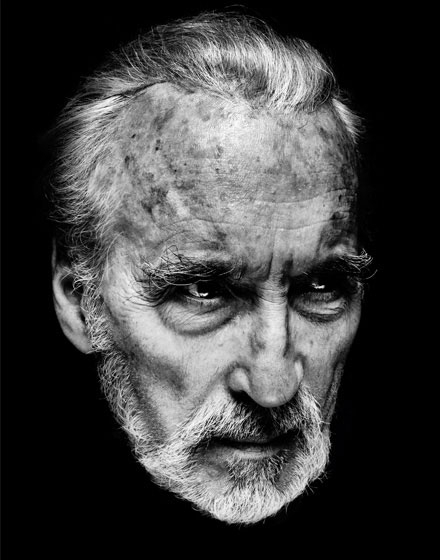
House Haunting with Christopher Lee

Christopher-Lee-HauntLast week, the world lost a horror legend. On June 7, 2015 Sir Christopher Lee passed away. I first became aware of him at the turn of the millennium through movies such as The Star Wars Prequels and The Lord of the Rings series. It wasn’t until later that I discovered his long spanning career in the horror film industry, particularly with Hammer Films, a London based film-production company. Forgive me for this late discovery of his full resume. I can try and blame it on my age. After all, I didn’t happen upon this earth until 10 + years after he made his most famous horror movies of the late 1950’s. But this excuse is lame, since I grew up watching older horror movies (i.e. Son of Svengoolie). I should have known better.

For instance, I still have not seen Horror of Dracula, which is perhaps his best known horror flick. I mean to correct this soon. Very soon! The aristocratic gentleman that he was– it seems as if he was born to play the blood-sucking count. However, in keeping up with the theme of this blog, I decided to watch three of his films that loosely contribute to the haunted house genre. I say loosely because the houses in these films are not haunted by ghosts or other supernatural entities. Rather they are mansions, castles, etc. where grisly events occurred. Nevertheless, they contain several features common in haunted house lore: secret passages and rooms, long and winding staircases, knight’s armors, huge 18th century portraits and eccentric custodial masters.

These films – they are what they are – low budget, dated pieces where the acting and writing are somewhat subpar. And yet, I enjoyed Sir Lee’s performances in all three films

What follows are mainly descriptions of the films, not necessarily reviews. Old low budget horror movies – you love em’ or hate em, and not much can change a person’s opinion. For me, I’m somewhere in the middle; sometimes they make me cringe, sometimes laugh (mostly at scenes not meant to be funny), but they always seem to capture my interest. I usually find something to like about these old movies. And I’m gonna tell ya about the stuff I like in these three movies! Here I go!

The House that Dripped Blood – 1971

Four short stories about a series of tenants that experience chilling misfortunes while staying at the house. The first tenants are a horror writer and his wife. The writer is working on a novel about a countryside strangler that has escaped from the asylum. The problem for the writer is that not only has the villain escaped from the asylum, but he has managed to free himself from the confines of the story and break into the real world. The writer sees him hiding and creeping around the house

The next tenant in another Hammer Horror favorite. Peter Cushing stars as a wealthy man who desires to retire to this house and live out the rest of his life gardening, reading and listening to music. However he becomes obsessed with an exhibit at a museum of haunted horrors. It is the made up head of a woman. She looks eerily like someone from Cushing’s past.

It is the third story that features Christopher Lee – the man of the hour! He moves into the house with a young daughter. He is a strict authoritarian – he doesn’t allow her to play with toys, she is prohibited from attending school (she is privately taught), and he doesn’t want her to be around fire.

The fourth and final story features a movie actor who turns into a vampire whenever he dons a black cloak that he purchased at a novelty store.

At the end, a narrator tells the audience how the house itself ties all these stories together. Personally, his explanation doesn’t work for me. Oh well. That’s how it goes. Personally I like the story with Lee the best. Is this because I watched this film with the specific intent of looking out for his talents? Maybe. But a mysterious fireplace and this voodoo doll and a creepy little girl hold my attention as well.

Curse of the Crimson Altar – 1968

Mark Eden stars as Robert Manning, a man whose brother has gone missing. His last known whereabouts were at a large house in the country. The man of the house is Morely, played brilliantly by Christopher Lee!   Manning shows up, searching for his brother. Morely says that he has never met his brother but he offers Manning a room in his humongous abode while he spends the next few days investigating the disappearance of his brother in the nearby village.

Tales of ancient witchcraft are amidst in the town – and they tie in to Morely’s heritage, as well as Mannings. There is a cemetery on the grounds of the house. There is a secret passageway into the house that leads to a room filled with pagan sacrificial paraphernalia – an altar, ancient knives, masks of goats and sheep. And there is the witch we see now and then. Her body is painted green. In fact, she looks as if she belongs on a Star Trek set kissing Captain Kirk.

Some interesting tidbits of this film – It also stars Boris Karloff.This is one of his final films. The chemistry between Karloff and Lee is excellent. They cue off each other well.  It is based off of a H.P. Lovecraft short story called The Dreams in the Witch House

Castle of the Living Dead – 1964

An Italian film dubbed in English, Christopher Lee stars as Count Drago, the man of the castle, who has a penchant for mummifying and embalming living things so that they might then “live forever”. His obsession with this taxidermy starts with animals and then, of course, he moves on to humans. He even has a room where a whole bunch of people are forever frozen; the inanimate guests of his eternal party! In this film, Drago invites a troupe of entertainers to his castle so that they may entertain him with their show. Just kidding! He wants to mummify them.

This film is probably the most “so-so” of the three. One would think a castle with the living dead would have zombies or even vampires. But no, just mummified, immobile beings. They don’t seem to be the “living” dead to me – just “dead” dead.

Anyway, the film features an old drone and she is a riot! She always speaks in a creaky voice, and always with rhyme –

“Beware of the castle over there,

Proceed cautiously if you must dare”

That’s not an actual line from the film, but it’s close enough. But the thing is, this witch is played by, of all people, Donald Sutherland!  With a black cloak draped around his body and most of his face, his identity is hidden. However, he also place a dim-witted policeman. But is role as the hag is more interesting.

*************************************

Are these three the best horror films of Christopher Lee? Probably not. Yet, he never ceases to captivate. These were the films that I could find that most resembled the haunted house genre. Know of any other “Haunted House” Lee films? Let me know. I would be glad to check them out.