Review of The Turn of the Screw (Book) and The Innocents (Film)

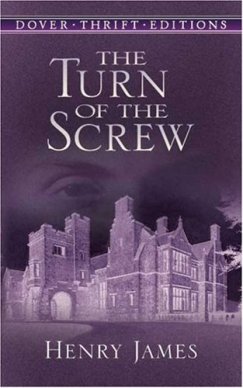
turnofthescrewThe story that is the subject of this review concerns a worrisome governess, her two enchanting little charges, an agreeable maid, a haunted mansion, and two “evil” spirits. The determined Miss Giddens will stop at nothing to save sweet little Flora and dear Miles from the “evil” that haunts Bly, the country estate in which they dwell.  This “evil” incarnates as the ghosts of the children’s former custodians, the late Peter Quint and Miss Jessel. While alive, these two had a sordid affair, often engaging in sexual acts openly, possibly in front of the children. It is up to Miss Giddens to put an end to their “corruptible ways” that continue after death.  But in order to do so, she must convince the children to confront that which haunts them. And the first step in this process is to get them to overcome their denial: Miss Giddens needs to be able to get the children to  admit that they are indeed haunted.  For they carry on as if nothing bothers them.  For they are “The Innocents”.  Meanwhile, the “screw continues to turn”.   
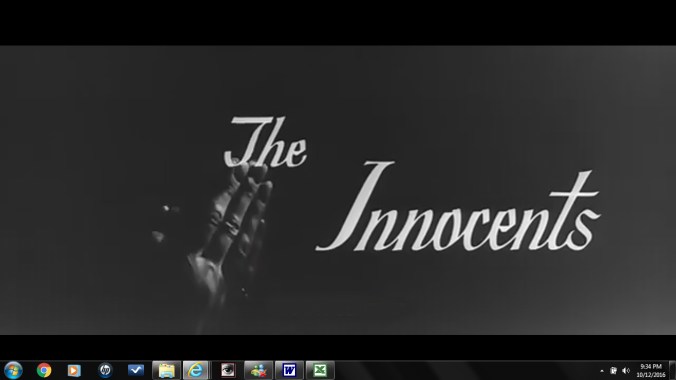
innocents


The preceding paragraph presents a concise synopsis (I hope so anyway), and yet it is only the skin of the story. There is much more going on below the surface. Notice how I have placed the word “evil” in quotation marks on three occasions. Likewise, I have placed “corruptible ways” inside these protective, overhanging symbols that defend these words from a single-sided perspective. Do these spirits really represent evil and corruption?  Maybe. Or maybe not. Maybe there are no ghosts at all.

There has been much argument and analysis over this Henry James masterpiece: The Turn of the Screw. Likewise, there has been much praise for Jack Clayton’s The Innocents, a film interpretation of the famous novella. I will get into the analysis in a bit. But first, let’s deal with the basics of each medium.

The Turn of the Screw begins with a group of friends that gather on Christmas Eve and listen listen as someone recites a ghost story.  Ghost stories were part of the Christmas tradition in the days of yore. Think Charles Dickens and “A Christmas Carol” – with the ghosts of Christmas past, present and future.  Anyway, the story that is told is “The Turn of the Screw”.  The title is based on an expression that means “an action which makes a bad situation worse, especially in order to force someone to do something.”

The person doing the forcing is Miss Giddens. She is forcing her charges to admit to being haunted by the ghosts of their former caretakers. Does her insistent broaching of the subject make things worse? Yes indeed! But she realizes this, and so she treads cautiously.  Through hints and subtle coaxing, she addresses the children.  One of the more noteworthy aspects of James’s writing has to do with the dialogue. When speaking to each other, the characters engage in art of circumlocution – communicating in a vague way, being indirect. When the governess gets very close to approaching the children about the henryjamesghosts, the children suddenly stop answering her questions. Or they change the subject. Miles, the cleverer one of the two children, will throw his questioner off as he rebuts with questions of his own, questions that make Miss Giddens rethink this whole ghost business and cause her to have doubts.  Admittedly, the book is a tedious read. In the end, I was able to find enjoyment with it, but the enjoyment has its costs. I paid for it with much rereading and contemplation.
The film The Innocents is easier to comprehend, and thankfully the mystery and ambiguity of Henry James’s story remains.  It is based on a play by the same name (The Innocents by William Archibald), which in turn is based on Turn of the Screw. The famous Truman Capote pens the screenplay for the film.

More so than the book, the film is a haunted house movie. The film making style is chilling and haunting. The soundtrack features a child humming a tune, an effect that comes off as innocently creepy.  The camera successfully captures symbolic imagery; the sky and clouds are reflected in the pond, the rays of sun streak into the house.  There are good closeups of facial expressions; kudos to the actors who communicate so much with a simple twist of their facial muscles.  Then there is the camera and sound styling that make for a compelling haunted house movie; effective uses of shadows, camera pans across long hallways, background creaks, and laughter – echoing, reverberating laughter.

The differences between the film and the novella can be summed up this way:

The Turn of the Screw – a complex psychological drama that features ghosts.

The Innocents – A ghost/haunted house story with psychological underpinnings.

As far as analysis is concerned, I will base most of it on the film. The main question that arises has to do with the ghosts. Are they real, or are they figments of Miss Gidden’s imagination? If they are imaginary, why on earth would she dream up such horrors!

Let’s assume they are imaginary (Actually, I’m going to assume they are both real and imaginary. I will explain this later). To what mental processes are we the reader/viewer to attribute these imaginary products?  Let’s examine what others say about this.

From the New Yorker, with quotes from David Bromwich:

He (David Bromwich) concludes, flat out, that the evil that threatens the children “is channeled and communicated by the governess,” who presents us with “an unforgettable image of psychological projection—the inward fears of the governess transfigured by imagination into a palpable menace.” He effectively offers us a ghost story without ghosts.

Then there is this from sparknotes:

With the publication of a 1934 essay by the influential critic Edmund Wilson, a revised view of the story began to gain currency. Wilson’s Freudian interpretation, that the governess is a sexually repressed hysteric and the ghosts mere figments of her overly excitable imagination, echoed what other critics like Henry Beers, Harold Goddard, and Edna Kenton had previously suggested in the 1920s.

Ahh those Freudian, psychological innards; the ID and the Superego duking it out before us. The New Yorker quote mentions projection; another psychological term. Oh how I love it that such a term is associated with a haunted house story, for it adds a whole new dimension of analysis to us people of the page – us students of haunted house lore.  Some time ago, I wrote an article about haunted house lore from a sociological point of view. (You can read it here.) Now, we at the page can examine haunted houses from a psychological point of view. The “ghost conjurer” in our story is Miss Giddens. Her mind churns out the spirits, and her eyes act as the projectors. The house is the screen on which she sets her spirits free. It accepts these spirits and reflects them back to us, the viewers of the film (or us as the readers of the novella). In this way, the spirits can be both imaginary (projected from her mind) and real, (or existing as “observable entities” to us the viewer/reader.) As ghost story fans, we can relish in the thrill of encountering ghosts while at the same time understand them for what they are – psychological manifestaions.  OR – the ghosts might still be real, even to the other characters of the story that deny seeing them. Nevertheless, they still exist as symbolic entities. Maybe it can then be said that they are made of “ethereal symbolism.”  Is that such a thing? Well it is now, cause I just coined the phrase!

Let’s see how this plays out in the film, shall we? Yes we shall! Oh and beware! There are spoilers lurking below!

Here’s a recap. Miss Giddens takes charge of two children at Bly Estate. They are so mannered, so bright beyond their years.  They seem so pure as to be uncanny; unreal. When she learns that ghosts are haunting them and intent on possessing them, she does everything she can to protect the purity. Notice I said “the” purity and not “their” purity. Yes on the surface, it is their innocence she wants to protect. But there in another “purity” she seeks to salvage. That purity is her own. Miss Giddens sees herself in the children. Each child represents a competing side of her inner conflict. Flora is the most innocent. She is the sponge that is ready to soak up experience.  She is the one to be corrupted. She represents Miss Gidden’s lack of experience, her virginity. Miles, the slightly older brother, represents the darker side of Miss Gidden’s explorations of her own psyche, the guilt that comes with the “sinfulness” of sexual awakening. Thus, he is the corrupter.

the-innocents-the-childrenHow dare I place such moral weight on children? Who am I to equate the ways of children with adult-like offenses? To place such burdens entirely on the children is unthinkable, and this is why the spirits of adults exist as their ghostly counterparts. Flora is (supposedly) haunted by Miss Jessel, the former governess that was “corrupted” by the servant Peter Quint. Miles is haunted (supposedly) by Quint, the corrupter, the one who “touches” Miss Jessel.  And Miss Jessel, shamefully, allows such “touching.” In a way, Miss Jessel and Quint are familiars, if we go by this definition of offered by Pierre A. Riffard.

From Wikipedia:

A familiar spirit (alter ego, doppelgänger, personal demon, personal totem, spirit companion) is the double, the alter-ego, of an individual. It does not look like the individual concerned. Even though it may have an independent life of its own, it remains closely linked to the individual.

Thus, Quint and Miss Jessel represent the darker side of the children’s innocence while at the same time serve to epitomize the Freudian conflicts within Miss Giddens.

Let us go now to certain scenes and lines of dialogue in order to obtain evidence for my analysis.

In describing the house, it his mentioned that there are many rooms that are locked and empty. This symbolizes areas of the psyche that have yet to be explored. But due to barriers such as “guilt”, entry is forbidden. Flora comments on the rooms and says “Big rooms get bigger at night.”  I take this to mean that in darkness (in the unknown areas of the psyche) psychological tasks seem huge. But Flora also says “I wish I could sleep in many rooms all at once,” showing how she craves experience. Like Miss Giddens herself.

On the other hand, it is revealed that Miss Giddens is raised by her father, a strict minister, in a house with several brothers and sisters. She says her house was small, “too small for secrets.” She had no room for discovery. There was little personal growth.

Flora prays the “Now I Lay Me” prayer. She comments on the “if I die before I wake” part of the prayer. She says about dying, “If I don’t go to Heaven, my soul will roam.” This is the searching for self, perhaps even barred from Heaven on account of guilt.

Miles is not yet on the screen. He is away at school. But soon he comes home, having been expelled. The letter explaining the expulsion doesn’t go into any details. It will be revealed that he is a bad influence on the other students, but still the specifics remain unknown. Later he lies in bed and Miss Giddens stands outside his bedroom door. Strangely, he knows she is there. The unconscious mind knows all. He is on the other side, where her desires exist. Miss Giddens wants to cross over to them but is afraid to do so.

Miss Giddens plays hide-and-seek with the children (What will she see when she finds them? Will she find evil hiding inside sweetness?) In the attic Miles jumps out from his hiding place and grabs his governess’s head. His grip is strong.  This occurs in front of a picture of Quint. He is her sexual desire. This urge takes a hold of her and won’t let go.

In another scene, the kids play “dress up”. They wish to surprise Miss Giddens with their costumes. This activity is similar to the hide/seek metaphors. Who are these children underneath the surface, beyond the costume?

One evening, Miles misbehaves. He goes outside in middle of night. Flora watches him from the window as he stands eerily in the moonlight in the courtyard below. All this is a set up to prove to Miss Giddens that he can be bad.  Later, when explaining his behavior, Miles says, “A well-behaved child is boring.” So Miles does something wrong and Flora enables it.  Miss Giddens, like Flora, looks down upon him. She is aware of her desires, her impulses of the ID, and she seems them clearly, but from afar.  After ushering Miles back to bed, there are implications of a pedophilic encounter.  But of course this is all symbolic so we need not worry. But Miles kisses his governess. The kiss is long and passionate and Miss Giddens allows it to happen.

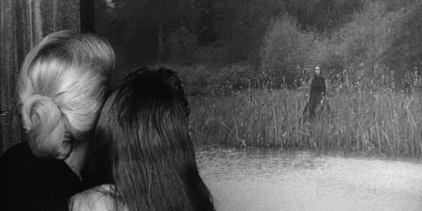
In a climactic scene, Miles distracts Miss Giddens while Flora runs out of the house. (Innocence if fleeing!) Miss Giddens finds the young girl at the edge of the pond. She is theinnocentsdancing (the last attempt at retaining innocence) Miss Giddens sees the ghost of Miss Jessel on the other side of the pond. She insists that Flora sees her too. Somewhat hysterically, she demands that Flora confess to seeing her. Flora screams and has a breakdown. Later, along with the maid, Mrs. Gross, she departs from the premises, never wanting to see Miss Giddens again.  To this, Mrs. Gross says, “Waking a child can be worse than any bad dream”.  This line pretty much sums up what has happened. Flora (and Miss Giddens) is forced to “wake up” and confront the loss of innocence. No longer is she pure. No longer is she protected. With such revelations, heartbreak is only natural.
After confronting the loss of innocence, the next step is to confront those “sinful,” lustful desires. Miss Giddens is now alone with Miles. They sit at a table and drink tea like they are two adults on a date. She confronts him.  She asks him about why he was kicked out of school. At some point during their conversation, Miles lashes out, “You dirty minded hussie!”  While this happens, the ghost of Quint looks in through the window. Miss Giddens says “Those are not your words!”  She insists that they are coming from the spirit which possesses him.  She forces him to put a name to the evil. Finally he does. He says “Quint!”  Then, Miles dies. This is the final step. Once the demon is acknowledged, once it has a name (is easily identifiable), all notions of innocence and any pretense for purity is gone. Dead.

So, wrapping this up, Miles calls out the name of the spirit on his own accord. Miss Giddens, though coaxing him to call out the name, does not tell him which name to say. This leads credence to the theory that there really are spirits floating about in this story. But they might not exist independently outside of Miss Gidden’s perspective. The children may be conduits through which the spirits come to be; the current which powers up the projector that operates inside the governess.

Overall, I prefer the film to the book. The film is much more of a haunted house story than the book. And you know me – I just love me some good ol’ fashion house haunting tales.  But please, don’t discredit the book. It is indeed a brilliant piece of work. It has stumped academics for years and it will do so for many years to come.


Review of 1408 (The Film)

1408-cover I wonder if Mike Enslin (Played by John Cusack) knows about “creeper weed.” He is the protagonist of Mikael Hafstrom’s film 1408 which is based on a short story by Stephen King.  In case he doesn’t know much about such things, I’ll explain it to him.  See Mr. Enslin, you know you’ve been smoking “creeper weed” if after you have taken a couple of hits, you feel nothing. So you take a few more puffs.  These extra inhalations allow you to, finally, feel something; not much, but oh well, the buzz it gives you will just have to do.  You go about your business. At some point during this business, you suddenly realize that you are stoned off of your ass!  The buzz has snuck up on ya! It “creeped” its way into your state of being, leaving you to wonder “When did all this happen?”  It’s a strong buzz too.  You’re not thinking straight. Everything is out of whack.  You’re afraid. (BTW, how do I know about “creeper weed”?  I heard it from a guy who knows a guy who knows a guy that read a book about it)

Mr. Enslin, are you all right? Oh dear. It seems that Mr. Enslin is a tad uncomfortable upon hearing of the effects of creeper weed.  But it’s worse than that Mr. Enslin, right?  You are terrified. It almost seems as if you have had a similar experience. Maybe not with drugs. Maybe with, I don’t know, a haunted hotel room that turned reality inside out and nearly drove you insane with fear?

See readers, Mike Enslin doesn’t believe in ghosts or any kind of paranormal phenomena. He is an author of haunted house books (Like yours truly!). He travels to supposedly haunted inns, uncovers the history as to why the place is haunted (past murders, death by illnesses, etc.) and writes about his experience in these hotels. But he never experiences anything out of the ordinary.  Until he stays in the Dolphin Hotel in New York City. Room 1408.  A fine suite it is; luxurious, two or three rooms. The hotel manager (Samuel L Jackson) had warned him that no guest has ever lasted more than an hour inside this room. Well, Enslin arrives in his room, several minutes go my and….nothing!  Same old, same old.  (Boring impotent weed.) Okay, so suddenly there are fancy chocolates on the bed and a couple of other complimentary items and décor that wasn’t there moments ago.  Or, maybe they were there and he just didn’t notice.  Nothing else to see – move on, move on!  So the clock radio alarm goes off.  The last guest must have set it to go off at this time.  Things are a little weird, but these happenings, whatever they are, are harmless.  Then ghosts appear and start jumping out of the windows. (Uh oh….!)  More stuff happens; stuff stranger than the previous occurrences. Then More! Still MORE!   Suddenly poor Mike doesn’t know what’s real and what isn’t.  And the room won’t let him leave!  Everything goes to hell and Mike comes to the realization that the evil of the room has slowly but surely “crept” up on him. A devastating evil it is. And it won’t let him go.

room-1408_o_gifsoup_com


The drug metaphors I have used to describe this film; excuse me if this puts you off, but I believe they effectively describe the feel of the movie. It has the flair of a psychedelic trip; albeit a trip or horrors – a very bad trip. But luckily for us the viewers, we are grounded in reality on the other side of the screen. Any “trippy” experience to be had is thankfully vicarious. But I’ll admit that I found myself a bit exhausted by the film’s end.

I really liked this movie. It is a tense film with psychological drama mixed in with the horror. John Cusack is excellent. And Samuel L Jackson, though his screen time is limited, brings a welcoming performance.  This movie is one of my favorites. See it!

Review of Dollhouse (The Dark Carousel Book 1)

DollhouseHas Tim Burton made any movies lately? Maybe he’s searching for the perfect script, one that cooperates with his flair for things both colorful and dark, one that matches his glee for taking a vanilla setting and sprinkling it with sparkling oddities. Perchance he’s looking for the fairytale that tears into a child’s most bizarre nightmare and extracts its lurid images from the mind to the page. If this is the case, then he needs to look no further than Anya Allyn’s Dollhouse (The Dark Carousel Book 1). In this book there is a huge repository of “all things Burton.” It is the perfect source to mine material for a script of his standards.

Now here’s the kicker – I am pretty neutral when it comes to Tim Burton. I neither love nor hate him. I think the reason for my indifference has to do with the fact that I sometimes have trouble syncing my imagination with the fanciful worlds that he creates. These worlds are too dark for my inner child and yet too childishly bright for my rugged manliness (I can grunt the national anthem!). The fanciful world Allyn creates for Dollhouse resembles the realms of Burton’s creations in so many ways, and yet, while reading the book, I found myself free from the kind of  dissonance that his films tend to stir up in me.

Dollhouse is a novel written for “young adults.” Could this explain why I did not notice such dissonance in Allyn’s novel? Young adults = adolescents = moratorium. Teenagers – they are not yet adults, but they are no longer children. This is why fantasy novels partner so well with the YA genre. Both deal with people that inhabit “worlds” outside the realm of normalcy. Adolescence is a period of relentless changes and challenging mysteries. Likewise with fantasy novels. By nature, such stories are intended to invoke a sense of dissonance and perhaps this is why my imagination can absorb the themes in Anya’s novel more easily than the themes of Burton’s films.

Maybe she succeeds at speaking to my inner adolescent whereas Burton doesn’t know with which of my many selves to communicate? Could be. The truth is that I really don’t know. I’m guessing here. All I know is that, for some reason, I find Burton’s films somewhere between fair and good but I view this novel of Allyn’s as excellent.

So what kinds of fanciful creatures inhabit Allyn’s story? Let’s see, there are adult-sized dolls that walk and act on their own accord. There are ghosts, shadows and men and women in masquerade costumes, which seem to be their permanent attire.

The story is as follows. A group of teenagers discover a house in the woods on a fieldtrip for school. Days later, one of their own goes missing. The group searches for their friend and decides to explore the inside of the house. In one of the rooms, they find a carousel and take a ride on it. Its circling path leads to another section of the house. The problem is they can’t go back. They are trapped in “The Dollhouse”, which is run by a strange young girl that keeps children as toys. There is a toy box, where the “bad” toys are placed. This toy box has secret passages. One leads to an outside carnival with a black castle off in the distance. One leads to another time and place. One passage remains a mystery.

Now imagine this as a Burton film. Are you hearing the music box in the soundtrack? Are you seeing the fanciful costumes the “toys” are dressed in? I know I am. If this were made into a film, by Burton or someone else, I might enjoy it but I’m sure I would prefer the book.

Dollhouse is the first book in a series of four. I look forward to reading the remaining books. If fantastic worlds tickle your fancy (hee hee!), then you will enjoy these books as well.


Review of Insidious

“It’s not the house that’s haunted. It’s your son.”

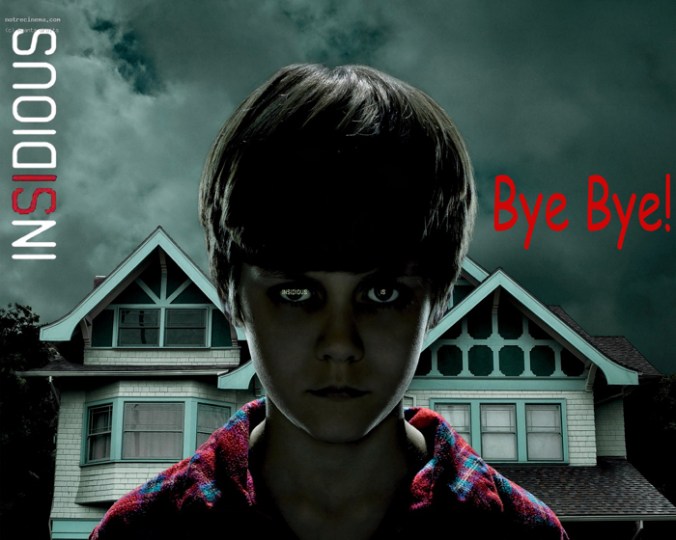
Really? Oh… well then! Since this is a haunted house blog, and because the house is not haunted, I guess this ends my review of Insidious.  Great movie – no haunted house. Goodbye now!

InsidiousBye


.

.

.

.

.


Oh. You’re still here. In that case, I guess I should say a little more about this film. The quote that leads this review is from one of the film’s characters, Elise Rainer; a specialist in the field of paranormal arts. She and her team come to the aid of the Lambert family. Young Dalton Lambert (age 7? 8?) enters a coma of sorts. Shortly thereafter, freakish things from beyond the grave begin to prance around their houses (they live in two of them consecutively, moving from one to another in a futile attempt to flee from the ghosts). Elise informs the distraught parents, Josh and Renai, that their son is not in a coma. Dalton is an astral-traveler, she tells them. When he sleeps, his soul leaves his body to go on mystic, otherworldly voyages. However, during his last trip, he strays too far and enters “The Further” – a realm populated by evil spirits. Here he is trapped. At the same time, other spirits, both evil and neutral, sense the soulless body lying there in the bed. They crave it! To inhabit such a body is to taste life once again. This is why there have been a lot of ghosts hanging around both of the Lambert’s residences. It matters not which house they live in; Josh and Renai have a haunted little boy.

Wow, I dug pretty deeply into the plot, didn’t I? I hope I haven’t unearthed too many spoilers. I’m guessing I have not, not by IMDB’s standards anyway. After all, their one-sentence summary is:

A family looks to prevent evil spirits from trapping their comatose child in a realm called The Further


Now, isn’t that sentence packed with a whole lot of plot?

Anyway, I will reveal no more plot intricacies. I will say that this is a great Insidious 2film. It is one of the better horror movies of the modern age. And though, technically, it’s not the houses that are haunted, this film has all the makings of a good haunted house flick. Before the coma tragedy and the hauntings that follow, the family goes through the normal concerns of adjusting to a new home. Isn’t this how many haunted house films begin? Insidious certainly has the haunted house props. The first house has a tall staircase and a spooky attic. The second has a long hallway with a grandfather clock at the hallway’s end that sort of stands in an eerie spotlight. There are plenty of places for ghostly beings to hide. Creating such hiding places in suburban homes seems to be one of specialties of Director James Wan. As he does for Insidious so does he do for The Conjuring. (Hint: “The hide-and-seek clap game.” Still confused? Well then, watch The Conjuring or read my review of it here.)  The styles of both films (and the sequel – Conjuring 2) are very similar, and pleasingly so. Oh, and I must not fail to mention the baby monitors!  Witness the terror a mother goes through when she hears voices inside a room this is supposed to be occupied only by her innocent baby!
There are only two things that annoy me about this film. These “things” are known as  “Specs” and “Tucker”. They are the two nerdish assistants of Elise Rainer. They constantly try to outdo each other with their skills as paranormal specialists. I get it – they are there for comedic relief. But I found their shenanigans distracting. For me their comedy went against the flow of the film.

Nerdy technicians aside, I love this film. It is creepy in its subtly and bold with its shocks. A must see for any horror fan.


Review of The House of the Seven Gables

HouseGablesBefore I began reading The House of the Seven Gables,  I knew very little about it. Of course I had “heard of it.” After all, it has a memorable title. Wasn’t this some kind of early American soap opera that those post-revolutionary war people watched on their 19th century televisions? (I think it followed Days of our Lives) Or maybe it came on the scene later, post-Hollywood; as a biography of Clark Gable and his six brothers?

I’m kidding. I knew it was a classic American novel written by Nathaniel Hawthorne and that it is often acted out on the stage. But what else is it? I really didn’t know. Is it a haunted house novel that I should read and review for this blog? The short answer, I discovered, is “Yes. It is a haunted house novel.” But it is much more than that. It’s not really horror, per se. At least not in modern day terms. Hawthorne in his own preface labels his book as a “romance.” C Hugh Holman and William Harmon define “romanticism” as:

“the predominance of imagination over reason and formal rules (classicism) and over the sense of fact or the actual (realism),”

After the reading, I discovered that, not only is this a romantic novel, but it is also a significant work within the American Gothic movement in literature. So, what are some of the characteristics of this “American Gothic” haunted house (besides the seven gables)? Let me begin by explaining what’s not in this book. There are no blood-curling screams in the night, no fanciful specters roaming the halls, no undead creatures rising up from the cellar.   So what haunts this house? As a young kid, I had asked the same question about Poe’s The Fall of the House of Usher , another tale from the American Gothic movement (You can read about this experience here). From a young age I have been mystified by these dark romantic tales and intrigued with the symbolism that lurks within them. It is this symbolism to which we must turn in order to answer our question.

The House of the Seven Gables is haunted by the sins of the past. By guilt and greed. By sorrow and injustice. By an antiquated air of appearances. It is occupied by the old and scowling Hepzibah Pyncheon and her frail and wraithlike brother Clifford. Living in another section of this large house is the eccentric daguerreotypist Holgrave. The visiting niece Phoebe Pyncheon brings a much-needed shine of pleasantries to this dark setting, but will it last? For the curse upon the Pyncheon family is deep-seated.

Curses – sins of the past – family tensions; these are the things that haunt Gothic novels.To quote the website www.americangothic.narod.ru/america.htm:

The role of the Gothic is figuratively to embody an intergenerational tendency.


…demonstrates in the majority of cases that neither the personal nor cultural past is dead and that both can easily return.

A house at the center of a Gothic novel needn’t have such obvious creatures of horror as “the ghost” or “the vampire” for it to be a haunting tale. Horror icon H.P Lovecraft had a great deal of respect for Hawthorne’s works . In his essay Supernatural Horror in Literature, he opines that The House of Seven Gables is “New England’s greatest   7 nathaniel-hawthorne-0008contribution to weird literature.” In the same essay he identifies an “overshadowing malevolence of the ancient house” that he considers being “almost as alive as Poe’s House of Usher.” Any story of a shadowy past that lingers in a new age is a tale of a haunting. When these shadows of the past are cast upon a household and immersed within the current activities inside their dwelling, that house is indeed haunted.
However, The House of the Seven Gables does have some supernatural elements. It’s a tale of feuding lineages, beginning in the 17th century with Colonel Pyncheon and Matthew Maule and a land dispute that puts these two men at odds with each other. Pyncheon cheats Maul out of land, accuses him of being a witch and then poor Maule is executed, but not before cursing the colonel with the damning words , “God will give him blood to drink!” And so begins the curse. The house of seven gables is then built upon this ill-gotten land. In the many years that follow, certain members of the Pyncheon family meet with untimely deaths while inside the cursed abode. While sitting at a desk, while sitting in a leisure chair – the life is cast out of them.

Hundreds of years after the death of Maule, Hepzibah and Clifford Pyncheon, brother and sister, old and frail, live out their dismal lives inside the house. They are encased in this behemoth structure, yet they are wrought with poverty. Towards the book’s end we discover what contributes to their misfortune, but on the way we read about their miserable day-to-day lives. The journey toward their fate is enmeshed with ghostly metaphors.

The presence of the long-dead Colonel Pyncheon is continually felt via his large portrait that hangs in a sitting room.  As the book explains:

The other adornment was the portrait of old Colonel Pyncheon, at two thirds length, representing the stern features of a Puritanic-looking personage, in a skull-cap, with a laced band and a grizzly beard; holding a Bible with one hand, and in the other uplifting an iron sword-hilt

Through watchful albeit painted eyes, he inflicts his reverence from beyond the grave, perhaps due in part to an unconscious sense of infamy the current occupants feel toward him.

Then there is Clifford who, when he is introduced into the story, had me believing on first read that he himself was a ghost. Perhaps he is, but not literally. He is introduced from the perspective of young Phoebe, the visiting maiden cousin that brings cheer to a cheerless home. She hears him before she sees him.

She retired to her chamber, but did not soon fall asleep, nor then very profoundly. At some uncertain period in the depths of night, and, as it were, through the thin veil of a dream, she was conscious of a footstep mounting the stairs heavily.


Phoebe heard that strange, vague murmur, which might be likened to an indistinct shadow of human utterance.


Later she sees him at the breakfast table. Here is one of many gloomy descriptions of him:

..his mind and consciousness took their departure, leaving his wasted, gray, and melancholy figure–a substantial emptiness, a material ghost–to occupy his seat at table.

With his long white hair and garments from another age, Clifford appears rather ghostly. It can be said that he is the embodiment of ghosts of a sorrowful past, a sorrow that clings to him like the sheet of a Halloween ghost. His sister doesn’t fare very well either:

above a quarter of a century gone by, has dwelt in strict seclusion, taking no part in the business of life, and just as little in its intercourse and pleasures.

Not a participator in the most casual of modern day affairs, Hepzibah too is but a ghost, even if figuratively so.

Then there is the harpsichord of the long since deceased Alice Pyncheon. Sometimes it makes music, seemingly on its own accord. The book is vague on whether this phantom music is made by the ghost of the late Alice or whether it is a kind of collective, symbolic hallucination – a longing for those rare but charming moments that blessed the Pyncheon family in the midst of their misfortune.

There are more metaphors and hints of a haunting throughout the book. If you wish to learn of more, I recommend reading the book. But I must say it can be a tedious read. The sentences are very long and flowery. Themes and descriptions are often repeated and drawn out. Much of the vocabulary is archaic. All this and, you know what? The more I contemplate on the story, the closer I’m pulled toward its deep heart that continues to beat a century and a half after its conception.

Sometimes a bit of effort is required to unearth something of magnitude. Although I did not realize its importance to the American gothic movement when I began the novel, I treated it with respect. I didn’t settle for a free ebook. Rather, I bought a physical book with a hard cover. I patiently read it in silent environments and uttered no complaints when I had to reread certain parts for clarification. Much of the reading took place in our newly constructed den – a room designed for reading and writing. Hell, I think on one occasion I had a brandy to go with the reading. Now that’s respect with a pinch of style!

Continue reading

Review of Whisper – Whisper Trilogy Book 1

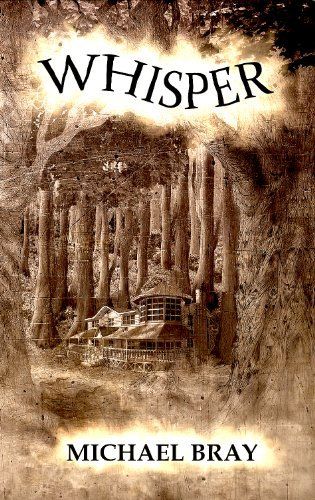
WhisperSome time ago, I posted an article titled: Ghostly Grounds: Explorations Outside of the Haunted Houses of Film and Literature  In this article, I write about the creepy environments in which authors and filmmakers “build” their haunted houses. I have a large section dedicated to “the forest;” a very popular landscape of myth and legend, often harboring fanciful and horrific things – elves, witches, werewolves, and ghosts to name a few. Then I give examples of popular haunted house stories that include haunted forests: Evil Dead, The House on the Moor, and The Haunting of Lake Manor Hotel.

I wish I had read Michael Bray’s Whisper – Whisper Trilogy Book 1  before writing this article. It is the epitome of the “mysterious forest” archetype. I certainly would have included this modern horror novel in the article. There is more than wind stirring in the trees that surround “Hope House” – the subject of Bray’s book. Hope House is an historical abode built upon cursed grounds. There are presences lurking in the neighboring forest; perhaps as many as there are trees. One can only guess at the total. Likewise, one can only make guesses about their nature. Are they evil? What do they look like? (for they go unseen – in the beginning!)

These woodland entities make their presence known to Steve and Melody Samson, the newest homeowners of Hope House, not by sight, but by alternative sensory pathways. In the rustling of the treetop leaves, Steve hears whispers; whispers that eventually call out his name. Also, a certain “feeling” continually haunts both Steve and Melody. They feel as if they are being watched by multiple sets of eyes. For me, it is always scarier when spirits are felt before there is a direct confrontation; heard before they are seen. And this is what happens here.

The story of Hope House and its surrounding grounds unfolds in three different periods of time 1) The present time: a couple buys a house in the woods 2) 150-200 years ago – the construction of Hope House, built with slave labor on cursed grounds by an opportunist blinded by his own ambition 3) thousands of year ago – a cannibalistic tribe and a supernatural tragedy. Bray effectively juxtaposes these time periods. Never was I confused. Whenever a time jump occurs, it happens in just the right place. The storyline keeps on flowing while these jumps serve to heighten the overall suspense. These trips back in time reveal exciting clues and interesting back-stories.

There are interesting side characters in Whisper. There is a slimy real-estate agent with dark secrets, a drunken crone who knows things, a seemingly inconspicuous bartender (but things are never what they seem). All of these characters know things that our main characters Steven and Melody do not. What do they know? Read the book to find out!

The book has its flaws, some of which have to do with editing. There are some grammatical errors here and there. Aside from grammar issues, too often Bray uses “a smile” as a one-size-fits-all way of describing facial expressions. Characters seem to smile on every occasion – when they are arguing and when they are in turmoil. Then there are a couple of minor issues I had with some of the plot points. There are some areas that would benefit from further development. There are noteworthy events that find their place in the story and then stay put, never to resurface again, missing out on opportunities to establish a stronger link to the larger story. Also, some of the story resolutions are bit trite for my taste.

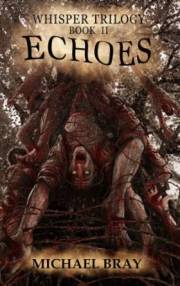
But overall Whisper is a good book. I look forward to reading the rest of the books in this trilogy. And here they are:  Echoes and Voices


Echoes
Voices

Review of Ghost Story – Book Vs. Movie

MBDGHST EC005


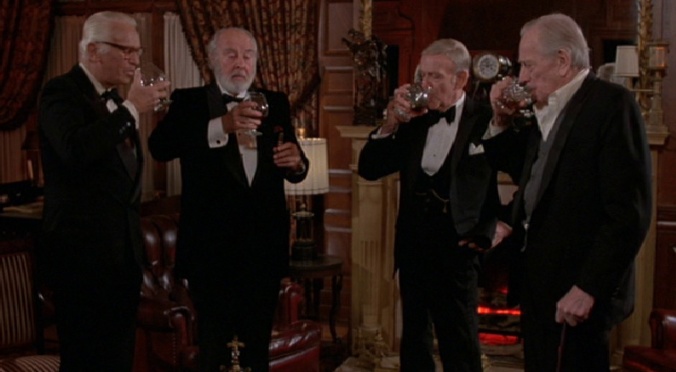
Old, distinguished men in elegant attire sip their brandy and tell ghost stories. A mysterious woman unbound by time haunts successive generations of boys and men. The deadly consequences of secrets buried long ago are only just beginning to surface. All this and more make up Ghost Story, a novel by Peter Straub and then later a film by John Irvin.

In past reviews when I have compared a book to a movie, I have used a pseudo-ratio to show how books benefit from a structural advantage. I call this the “200 page/2 hour reel” ratio. Simply stated, there is more opportunity for story and character development in a book than a film. A film based on a book is often forced to take shortcuts, usually to the detriment of the story. At the same time, it is nearly impossible for a film to lay out all of the plot points of a story-heavy book such as Ghost Story unless we allow for a nine-hour film. (I guess that’s where a television mini-series comes to “the rescue.” Ah but this often backfires. But this is a subject for another article.) What does one do about such a dilemma?  Let’s ask Lawrence D Cohen, the screenwriter for Ghost Story.

Cohen is a masterful screenwriter who first “came to prominence” for penning the screenplay for the 1976 film Carrie, a fine film based on a book by Stephen King. In Ghost Story, just like with Carrie, he skillfully paves the road that leads from the book to the movie. Cohen and Director John Irvin know the limitations of the film medium and wisely do not attempt to exceed them. They carefully carve out a simpler yet equally fulfilling story from Peter Straub’s behemoth book. It has been suggested that film critic Roger Ebert prefers the film to the book. If this is so, I might just agree with him. Mind you, I said “might!”

Ghost-Story-BannerAs I alluded to earlier, Ghost Story is a long book. Both in scope as well as style, it owes a lot to Stephen King, from its epic quality of plot intricacies to its focus on small town characters and their foibles. In particular, Ghost Story bears a strong resemblance to Salem’s Lot.  Hank Wagner from darkecho.com  describes this similarity quite well, presenting quotes from Peter Straub himself to back up his claims:
 

Numerous readings reveal how much the book owes to Salem’s Lot. Straub has publicly acknowledged this debt, stating that “I wanted to work on a large canvas. Salem’s Lot showed me how to do this without getting lost among a lot of minor characters. Besides the large canvas I also wanted a certain largeness of effect. I had been imbued with the notion that horror stories are best when they are ambiguous and low key and restrained. Reading Salem’s Lot, I realized that the idea was self defeating.” On reflection, the debt to Salem’s Lot is obvious. Both feature small towns under siege from the supernatural. In both, the terror escalates until the towns are threatened with destruction — Jerusalem’s Lot is consumed by purifying fire, while Milburn is decimated. In each, a writer’s arrival in town seems to trigger disaster. Both writers strike up alliances with young teenagers whose lives are ruined by the terror, Ben Mears with Mark Petrie and Don Wanderly with Peter Barnes. Both forge an almost parental bond with their young allies, replacing those lost parents. In both, the evil lives on — Ben and Mark end up on the run, while Don, after ending the threat of Eva, presumably goes off to face her evil aunt.


I would only add one more similarity – both novels feature a house that is a home or former home to the evil presences of these books. In fact, I need to make this addition, for these reviews are part of the Haunted House themed project and therefore, the stories I review must include a haunted house, even though most of the action in these stories take Ghost Story movieplace outside these houses. (For the record, I have found Salem’s Lot and Ghost Story on sites that list haunted house films and literature – so there!) But here is the take away – the story is too broad to settle on in with just a few characters at one location at a specific point in time.
 

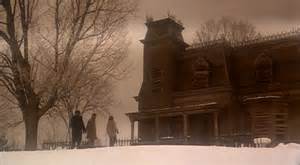
Like with Stephen King’s The Stand and It, there are multiple characters with story lines that encompass more than a few pages. While the primary characters consist of the five old men that tell ghost stories (Collectively known as “The Chowder Society”), the writer/nephew of one of these men (Don Wanderly), and the “ghost” in her many incarnations, there are so many others – the promiscuous wife of one of the old men, the drunk plow driver, the cantankerous sheriff, thrill seeking teenagers, and on and on it goes. The story takes place in a snowy town in New York, but the book takes readers across the country as a large chuck of one of the plots (there are a few) unfolds in California. Oh yes, the town of Milburn has the obligatory haunted house. In fact there are several! The evil goes where it wants – haunting several abodes and businesses, including a movie theater that continuously runs the film “The Night of the Living Dead.” Several of the townsfolk fall prey to the evil. They become possessed, they become the objects of their worst nightmares; they die. And it doesn’t help matters any that a series of snowstorms shuts down the town. The people of Milburn are besieged on all fronts by so many forces.

I say, if you like Stephen King’s epic and character-heavy novels, then it is highly likely that you will enjoy Ghost Story as well. I know I did.

Now, how does one turn all this into a movie? By focusing on one central plot and abandoning the side stories. By letting go of most of the characters and centering only on a handful. And this work well, with a large part of the success coming from the suburb cast:

Douglas Fairbanks Jr      John Houseman                      Fred Astaire              Melvyn Douglas

ghoststorymen


It was the final film for Astaire, Fairbanks, and Douglas. Melvyn Douglas has so far appeared in two other haunted house movies that I have reviewed. (See The Old, Dark House and The Changeling.  Although I did not mention him in these articles.)

The film focus in on one plot – a young woman (as a ghost or whatever evil form you call it) returns from the dead to seek revenge on the four old men (Astaire, Douglas, Fairbanks and Houseman) who had killed her when they were young. This plot line occurs in the book as well but it is much more complicated. Normally when I do a book vs. movie review, I make a bullet-point list outlining the differences within each medium. I feel that is unnecessary here as I have already honed in on the most significant difference. Once that difference is understood and accepted (and accept it I do), an inventory of the nitty-gritty components of such a variance becomes pointless (In more ways than one: meaningless and “no bullet-points.” Get it?) The story that is portrayed is done with great care. It is better to minimize one’s focus to achieve a clear vision than to try and maximize the field of vision, only to achieve a blurry and unwatchable product.

As great as the book is, I find myself preferring the film (Or, I “might” prefer it to the book, as I said earlier). At times during my reading, I found myself lost in the tangled trails of plot. Yes, these trails do untangle and eventually lead you where you want to go, but still, it was a tedious experience at times. The film is straight forward and satisfying.

Not that I am against the complex – by no means. I enjoy books of great breadth and depth.

Perhaps such a comparison is unfair. It’s like comparing a plate of apples to a gourmet meal. It’s just that, as much as great as a gourmet meal is , sometimes I just want apples.

************************************************************

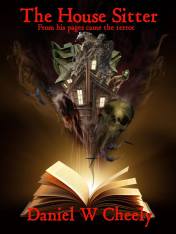
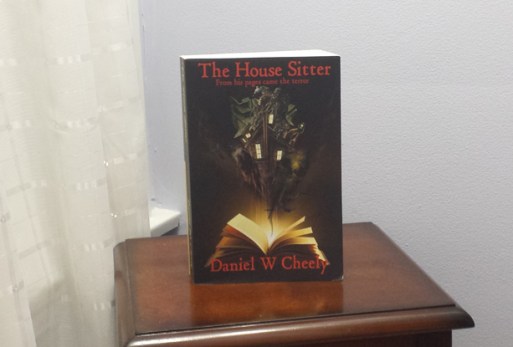
Thank you for reading this article.  I invite you to check out my latest book: The House Sitter
– A writer haunted a house with his own stories.

HouseSitterCoverForHHGroup

Review of The Changeling

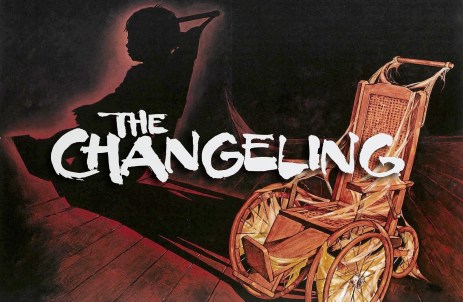
ChanglingCoverGeorge C Scott portrays John Russell, a grieving widower that rents a historical mansion where things go “bump in the night.” Truthfully, it’s more of a “bang”, but it’s no less creepy. Searching to begin anew after tragically losing his family, Russell, a music composer, accepts a teaching job at university. With a new job comes a new life, new acquaintances – and a new home. New and scary. He has no idea what experiences are waiting for him; what mysteries he will help to unravel in The Changeling 
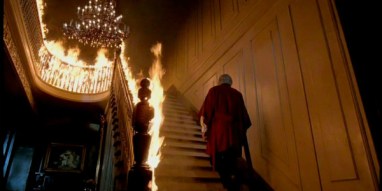
Most of the scares come from sounds, and effectively so. In the tradition of The Haunting, loud disturbances haunt the rooms and halls. Joining the audible haunts are the ghostly cries of a young child. The background music is quite chilling as well. But there are plenty of terrifying images to accompany these sounds and cries. These are largely the ghostly recreations of tragedies past. In one scene in particular, a ghost submerged in water cries for help; his cries rise to the surface in bubbles. This scene is an example of awesome editing and creative synchronization of visuals and sound. In another scene, a locket and chain rise up from the soil of a well like a slithering snake. A decent scene indeed!

The drawback of this film has to do with the back-and-forth change in scenery. Just when the viewer is settling into the dark and chilling atmosphere of this dark house, the scene awkwardly changes to a busy street on a bright morning of another day. Too much time is spent solving mysteries outside of the house rather than in the very heart of the haunting.

However the overall story is good and the resolution – the reason this film is called “The  the-changeling-1980Changeling” is intriguing indeed.   This isn’t the best haunted house film out there but it has its redeeming moments. It is definitely worth seeing.


Review of The Conjuring 2

the-conjuring-2 2

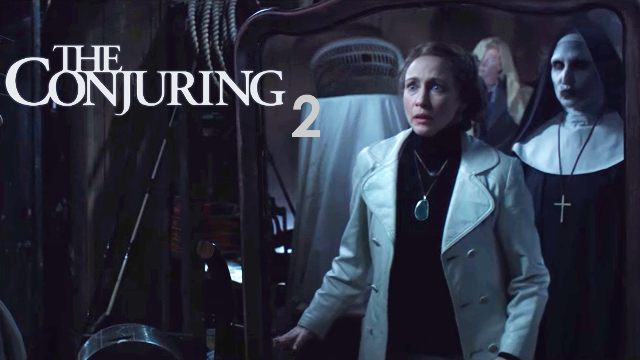
Demonologists Ed and Lorraine Warren heed their call and once again come to the aid of a family that is plagued by evil spirits. This time, their call takes them across the ocean. They pack their bags and leave their New England home, bound for “Old” England, where they are to investigate a phenomenon that has been described as “London’s Amityville.” The Hodgson household consists of a single mother, her four children, and one or two unwanted presences. Will the Warrens be able to rid their home of these unwanted guests? And, more specifically, will they be able to help Janet Hodgson – the young girl who frequently becomes possessed by this evil? Go see The Conjuring 2 and these questions will be answered. Until then, read the rest of this article for informative tidbits and opinions.

Oh good, you listened to me and continued reading. Let’s begin with some background information. For those new to The Conjuring series, the reoccurring characters of Ed and Lorraine Warren are based on a real married couple that investigated paranormal phenomenon back in the 1970’s and 80’s. According to wikipedia, the Warrens claimed to have investigated over 10,000 cases of “actual” or “potential” of supernatural activity. Does this mean that we should settle in for 10,000 movies? Probably not – that’s overkill. But the Warren case files have spawned several movies, including both Conjuring movies. The first film is based on the 1971 Perron Family case – ghosts and or/demons haunt the Rhode Island home of this poor family (click here to read my review of The Conjuring). This second film is based on the Enfield Poltergeist case, which documents moving furniture, overturned chairs and levitating children. The film shows all this and so much more. Other films loosely related to the Warrens are AnnabelleThe Haunting in Connecticut, and The Amityville Horror. While there are no references to the Warrens in The Haunting in Connecticut and Amityville Horror, The Conjuring 2 opens with Ed and Lorraine investigating the Amityville House after The Lutz’s have fled. In order to determine if there is an evil presence associated with the house, Lorraine uses her skills as a medium to experience the horrific murders that claimed the lives of The Defeos –the family that lived in the house before The Lutz’s. From the killer’s perspective, she comes to understand what happened that fateful evening while uncovering a clue she does not yet understand, for it is a clue that is linked to things that would occur later in the Hodgson house. This opening sequence is brutal, chilling and captivating all at the same time.

So, what did I think of the rest of the movie? Before I get into that, let me be honest about the-conjuring-2certain biases on my part. First, I prefer the ghosts and demons of films and literature to be somewhat elusive; their origins speculative, their nature not limited to the narrow parameters of “good” and “evil”. The spirits of The Conjuring films are evil demons as defined by the Bible. Adhering to tradition of well-known demon lore, we assume they will take possession of someone, mostly likely a young woman. We suppose that the possessed victim will at some point rant in a guttural, inhuman voice. We expect the demons to get a little testy when confronted with a crucifix – the symbol of “goodness.” All of these assumptions, suppositions, and expectations come true. Second, I favor unhurried and carefully crafted atmospheres of disturbances to the flashy and loud jump scares. Creepy over shocking, I say! The Conjuring 2 has a lot of jump scares for sure, more than its predecessor. For these reasons, it is doubtful that any films of The Conjuring series will make it to the top of my preferences list.
All this being said, The Conjuring 2 is a decent film with plenty of scares for everyone. While the film relies heavily on “jump scares”, they are done effectively and creatively. A person or object is on one side of the room and then suddenly, there s/he/it is right before the camera and this “jump” is unexpected. The ghosts and demons in this film manifest in scary forms. If you are the type of person that wants to see the phantoms that are doing the haunting, you will not be disappointed. And overall, the acting is good, the characters are sympathetic, and there are some touching moments outside of the realms of the scare factor.

I’ll let you be the judge as to what’s “true” about this film. In my opinion, it is fiction based on fabrications of truth. Ah but who am I? Maybe the events portrayed in this film are very real for some of you. If so, great – all the more reason to be scared. And isn’t that why we see horror movies in the first place – to be scared?


Thank you for reading this article.  If you enjoy my writing, please consider buying my latest book The House Sitter.  A writer/house sitter haunts a house with his stories. They haunt him back in return. Click on picture to see the book on Amazon

HOuseSitterUSe

Review of Terror in the Haunted House (My World Dies Screaming)


terror_in_haunted_house_poster_02Let’s begin with the first several moments of the film. It begins with hypnotic spirals overlaid by the text “The first picture in Psycho Rama – The Fourth Dimension –Subliminal Communication.”

Next there is an establishing shot of a three-story house. Credits are rising in the air! (Likewise, according to the rock band Rush, “the sigh of Eth is rising in the air”. Check it out here! ) Then, ‘she’ speaks. She the narrator – she that is sharing her nightmare with us. It is a reoccurring dream of an old house that “stands like a moldering tombstone.” The camera zooms in on the front door. It opens on its own accord.  We the viewers enter, trespassing further into her nightmare.

Up the stairs we follow the unseen camera. Old portraits hang on the walls. Another door opens and we see a stairway leading to an attic. The narrator is very worried about what’s up there. Stairwell curtains dance to the whims of a draft. Scary. Terror! The hypnotic spirals return.  She screams!

That’s about as far as we need to go. Anybody who starts watching this film can stop at this point.  The rest of the film is an exercise in “suck-o-rama.”

Alright, fine, here’s some more info. It turns out that this nightmare house really exists, so the husband/boyfriend/whothehellcares guy takes this freaked out wife/girlfriend/Iforget woman to the house and they stay in it, seeking to unveil any clues as to why she keeps having this dream. This might have been her childhood house, I don’t recall, but trust me; it’s not worth remembering these details. The rest of the film is all talk and screaming.

Talk-Talk-Talk-Talk “EEEEEEEE!”  Talk-Talk-Talk-Talk  “EEEEEEEE!”


The mystery (none), the twists (yawn) the revelations (oh.) – all are smashed claustrophobically into the dialogue.  Every fifteen minutes or so, she the main character is screaming at something: a shadow, a mouse, a mirror, a clown, a hairpin, a can of soup. Okay, most of the preceding scares I made up. I don’t remember or care what she screamed about. All I remember was that it was annoying as hell. But these audile annoyances are soothing interludes when compared to the eye-irritating “visuals” that these filmmakers thought would be so innovative to flash on the screen. Yes, this is the “Pyscho Rama” – The “Fourth Dimension”,  the “Subliminal Communication”

Every so often, images of cartoonish faces flash on the screen. Here are some examples captured from the film:


They come and go in the blink of an eye, disturbing our sensitive corneas. They’re as welcome as flying pests at a picnic. What were the filmmakers hoping to achieve with these… things?  I personally have no idea. They didn’t frighten me.  And no, I don’t believe in “subliminal communication.” I did not succumb to mind control and I’m quite certain that I did not open my subconscious mind to demonic possession by absorbing the content within these annoying flickers.  Back in the 80s, certain pastors tried to tell me that whenever I would listen to the song “Stairway to Heaven”, a backwards message would enter my brain, rearrange itself to communicate “forwardly” to my subconscious and then deposit the damning words “Here’s to my sweet Satan” deep down in the bosom of my being. It was bunk then just as it was bunk thirty five years earlier in 1958, the year of this film’s release.

So – to recap. If you feel that you must  watch some of this film, set aside five minutes and watch the opening. It is a good opening. Enjoy the creepy mood but do your best to endure the “subliminal” flashes. There are at least two of them, maybe more, within these first five minutes. But that’s better than enduring ninety minutes of these incessant intrusions.