Haunting Paranormal: Ghost Story Collection – Review of Series Openers from M.L. Bullock’s

Have you ever ordered a sampler at a restaurant?  Let’s take the seafood sampler for example. There might be a couple of crab legs on your plate, some fried shrimp and tartar sauce.  Throw in some garlicky scallops, a lobster tail and you’re all set. 

I read a sampler a couple years back. I’m just getting around to writing about it now.  Don’t worry, I’m refreshed. Try refreshing two year old scallops though, that may not turn out so well. 

I reread and/or skimmed through the stories of M L Bullock’s Haunting Paranormal Ghost Story Collection, which is a collection of firsts from various series.  I saw this book advertised on Facebook at a very generous price.  Of course I can’t remember what I paid; perhaps a few dollars?  It was a kindle book.  Also, I can’t recall if it was an advert or if I was already following Bullock.  Whatever the case may be, the promotion worked on me (that rhymed) and I bought the book. 

Need I say each story contains a haunted house?  Mostly these are manors and each one has a story to tell, having hosted successive generations within their walls. Whether plantation  manors or mansions unassociated with a spread of land, they are houses of the American South.  Hence,   M. L Bullock is known as “The Queen of Southern Gothic”.  Don’t believe me?  Check out her website and see for yourself!  You’ll have to scroll down a bit.  She shows off this title in bold, colorful print. Guess I can be the King of the Houses of the Haunted if I just get my fonts right.  

 Bullock’s writing style is, well, it’s her style. Some will love it, others no. I’m somewhere in between. She’s overly descriptive  when detailing the heroine’s daily apparel or hairstyle choices. At least for my tastes. She is quite prolific, being the author of several long series. How does she pump out so much material?  For one thing, the books within the series are not very long (at least not the books that begin each series). Second, her works are very formulaic. 

Nevertheless, Bullock  is a good story teller, skilled at wrapping the reader in her worlds, both modern and historical. Had this not been the case, I wouldn’t have made it through these five stories (although with one of them I was tempted to quit).  They are:

Seven Sisters 

The Haunting of Joanna Storm

The Belles of Desire, Mississippi 

Wife of the Left Hand 

The Ghosts of Kali Oka Road

This article will touch on each story in brief, examining plot, and offering opinions. As to this last point, I will finish each succession with a “Yes”, “No”, or “Maybe”.  What are these? Well, they are answers, you see. This implies the preexistence of some kind of question, doesn’t it?   The question is: Does this introductory book entice me to read other books in the series?

First, let’s get the formula out of the way. This applies to most of the five stories, if not all.

A female protagonist finds herself in a new house or city in the American South.  Things in the new place are not exactly normal. They are, shall we say, “para” normal. Ghostly goings-ons are afoot. Sometimes the event is subtle, causing the heroine to dismiss it. Other times the event is striking, leaving no doubt the house is haunted.

A large chunk of the story will take place in historical times. Sometimes it’s half of the story, and in other cases only snippets of the past leak onto the page. In all cases, the protagonist experiences the past as if she were there as an eyewitness watching a haunting history unfold. Hence, there are two timelines, the present and the past, and the workings of the paranormal to connect the two. The means to this time bridge she crosses differ slightly from story to story.

In most of these stories, there is mystery surrounding the fate of a woman from the past who once resided in the haunted house. Either she disappeared during her lifetime or the final fate of the woman (who is a victim of some tragedy or loss) is lost to history. It is the duty of the protagonist to solve the mystery.

The protagonist’s appearance is described in great detail. Hair color or style, manner of dress, from blue jeans and t-shirts to grand dresses or yore. This description applies to her male love interest as well.  In every story, there is romance or hints at romance, earning these stories the genre badge of “Southern Gothic Romance.”

Finally, all these stories end abruptly.  It’s as if there is a built-in alarm that rudely blares, catching the reader off guard. Content with the story pacing, enthusiastic to complete the last stretches of the journey, then all of a sudden,  a hidden voice comes out of nowhere and shouts, “Last call for alcohol! Drink ’em up, we’re closing in 10 minutes!” Conclusions are fast, unsatisfactory, and forced, with many questions left unanswered. I guess this is where the reader is supposed to grasp quickly at the next book of the series. Hurry! Go to Amazon, buy and download. Damn! Slow wifi. OMG, does my device have enough charge? (As I write this, I  am reminded to charge my tablet. Seriously, I might have gone to bed with no power to read anything before sleep. The horrors!)

Obviously, I didn’t rush to buy any sequels, for as I stated, I’m going to reveal my yes-maybe-no answers concerning the prospects of continuing any of the series. However, I did finish this entire book, which means, despite how much I seem to be bashing these stories, I did discover things I liked.  I like the worlds Bullock creates, both past and present.  The characters are interesting. Bullock does take the time to build idiosyncrasies into their makeup.  And the stuff of ghosts and haunted houses are spooky and fun!  

Okay, enough of all that. Let’s explore each story in more detail, shall we?


 Seven Sisters
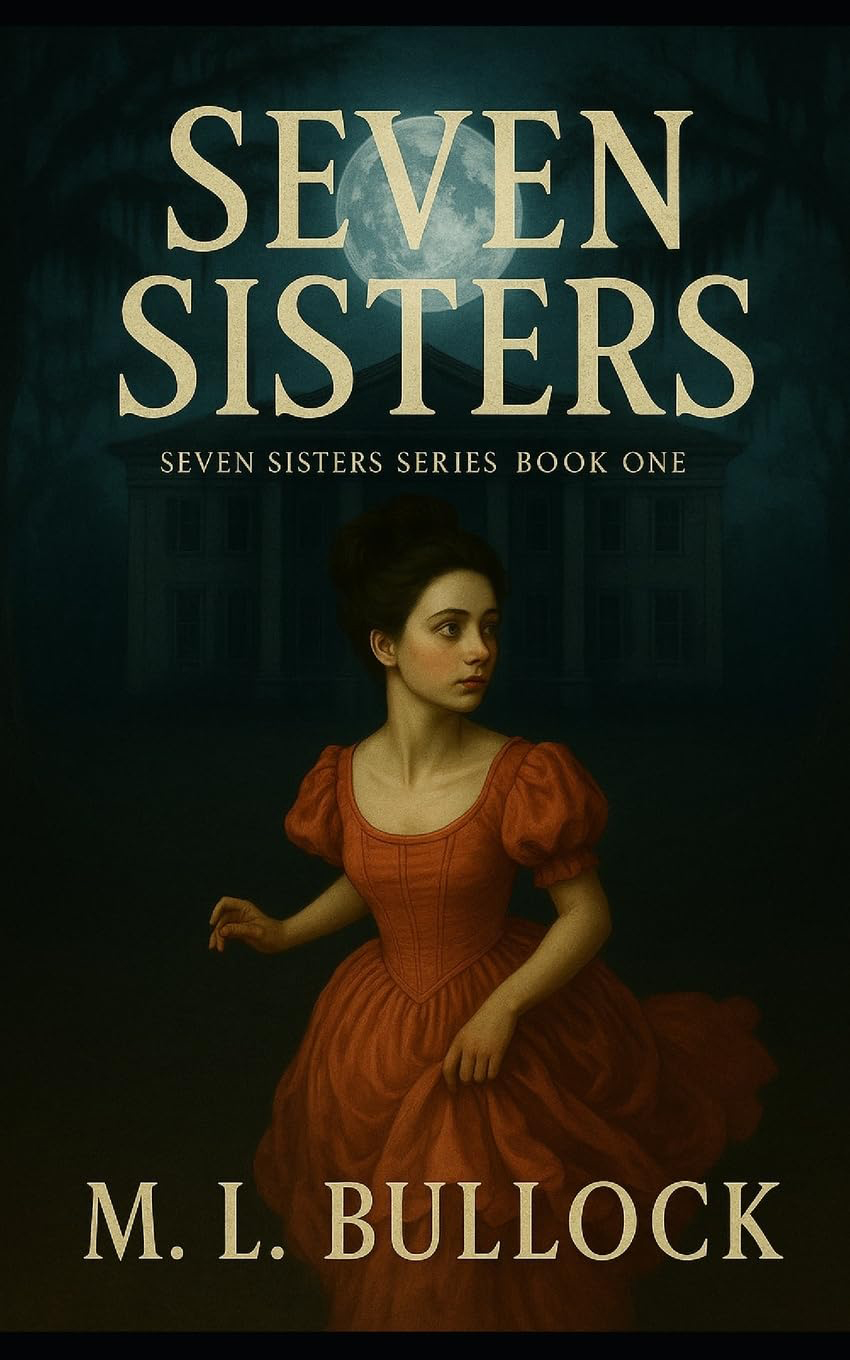
Carrie Jo,  just out of a relationship, is hired to assess the inventory of antiques inside Mobile, Alabama’s Seven Sisters Manor (former plantation), with the end goal being to convert the premises into a museum.  She is well qualified. She is a historian and has a team at her disposal to assist in renovation and research. She falls in love with Ashland, her boss, and the current owner of the estate.

She also has a special ability when it comes to dreams.  When she sleeps in the presence of artifacts, or inside an old house, her dream  transports her back in time, where she can witness the happenings from a long time ago. 

In her dream state, she is transported from  the twenty-teens to the eighteen-forties, where she witnesses the life of Calpurnia Cottonwood, the teen daughter of the former owner of Seven Sisters. Poor Calpurnia went missing sometime in the 1850s. Readers, through Carrie’s dreaming eyes, learn how she fell in love with a sailor who happened to be passing through Mobile. We feel for her when she is abused by her drunken father. The dreams tell us of other relationships from the past. How slaves interact with their masters, how slaves interact with each other. 

Carrie Joe, when exploring the manor in modern times, witnesses doors opening and closing. Could this be the activities of a Calpurnia’s ghost?

All in all, a very interesting piece of historical fiction with fine, ghostly elements.

Will I read on?  

Let me show you what I would be up against if I took on this task.

Will you look at this loooooong list?  Oh Good Lord!

SEVEN SISTERS

#1 Seven Sisters

#2 Moonlight Falls on Seven Sisters

#3 Shadows Stir at Seven Sisters

#4 The Stars That Fell

#5 The Stars We Walked Upon

#6 The Sun Rises Over Seven Sisters

#7 Beyond Seven Sisters

#8 Silent Night, Haunted Night

#9 Haunted Halls of Rosegate Manor

#10 Terror at Mossy Oak

#11 Dark Angel of Selma

#12 Silent Chapel

#13 Angel Terrible

#14 Tangled Garden

The Ultimate Seven Sisters Collection

Seven Sisters Collection Vol. 1

Seven Sisters Collection Vol. 2

Seven Sisters Collection Vol. 3

Seven Sisters Collection Vol. 4

Bonus Christmas at Seven Sisters

Bonus The Ghost on the Swing

I think it would be a more worthwhile experience if I just simply read War and Peace or Moby Dick.  As interesting as this story is, the answer is No, I shall not trudge in this field of overgrown weeds. 


The Haunting of Joanna Storm  (Book 1 of 3 in the Morgan’s Rock series)

It’s a house on the rock, overlooking the ocean, somewhere in Florida. Meagan, a writer, has leased the big, old house. There, she will work on her latest book.  It has several floors and a clocktower. Gotta love a house with a clock tower!

Oh, guess what?  It’s haunted.  Meagan sees ghosts in mirrors, hears disembodied shuffling. A mysterious maid shows up at her door one day, claiming to have been hired by Meagan’s agent.  Be wary of mysterious maids in haunted house stories.

Once upon a time, Joanna Storm lived at Morgan’s Rock.  A Hollywood starlet , Joannna lost her parents at a young age. Her father “accidentally” fell off the rock and into the ocean. In her time at Morgan’s Rock, she too heard disembodied shuffling, along with whispers. She had friends, colleagues, enemies and lovers who died tragically.  The strange thing is, no one in modern times seems to know what happened to Joanna Storm. History itself shrugs its shoulders and mutters, “Beats me.”

Meagan, as per Bullock’s formula, will visit Joanna’s timeline.  This usually happens when she encounters an item in the house that once belonged to her, such as a scarab necklace. In fact, when she dons Joanna’s dress, she becomes her! 

This story doesn’t grab me as much as Seven Sisters, but it is a mercifully short trilogy.  So, will I read on?My answer is Maybe


The Belles of Desire, Mississippi 

This story is from The Ghosts of Summerleigh, a four book series.  It takes place in Mississippi. 
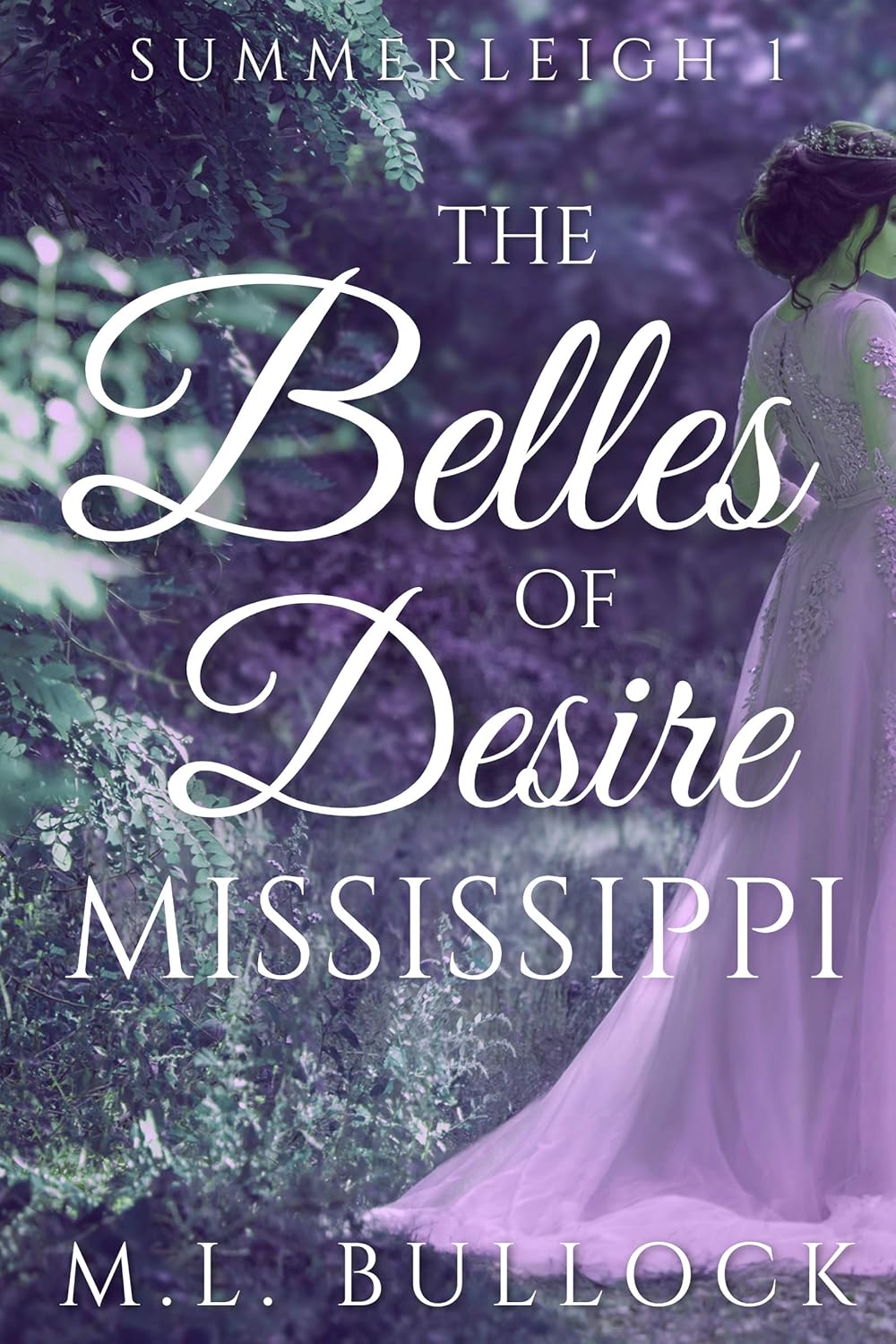
Harper Lee, a dying patient at a resident care home, forms an attachment to Jerica, one of the employees of the care home. When Harper passes, she bequeaths her family home to Jerica. Jerica is now the owner of the Summerleigh estate, which includes a grand ol’ house with multiple floors, a large chunk of land, on which a small cottage stands.

There is a catch – Lee has tasked Jerica with uncovering the mystery of what happened to Jeopardy Belle, Jerica’s older sister, who went missing in her early teens.  It is more of a plea rather than a clause within the will. However, Jerica is sensitive to Harper’s wishes and will do what she can to solve the mystery.

Jerica moves in, but stays in the cottage, not the main house. Why?  Too many ghosts are floating about in there (don’t know if they are actually “floating”, my words, not Bullocks, not Jericas)  Who are these ghosts? Turns out, there are layers of ghosts, just like layers on a cake.  Ghosts of Belles, ghosts of family/residents before the Belles. And even Jerica’s own baby boy, who she lost in a car accident, appears (although his is drawn to his mother, not the house)

Like with the other books in this review, there are two timelines. First, there’s the modern day, which includes the whole Jerica storyline. This takes place in the twenty teens.  And oh, how can I forget, Jerica has a love interest.  He helps out at a restaurant in the nearby town and happens to be a handy maintenance man and Jerica could sure use a man like that to help restore the house. I’m sure he satisfies her in other ways too.  Okay – Love interest plot covered.  Let’s go back to the good ol’ days.,

The second timeline takes place in the 1940s. The four Belle sisters (or is it five? I’m forgetting) live with their mother. Father is away a lot. When he is gone, mother is mean, especially to the oldest girl Jeopardy.  Jeopardy rebels by hanging with the wild crowd, smoking, drinking and skinny dipping. One night she goes out and never returns.

How are these timelines connected?  Through Jerica’s dreams, she learns of the past,  much like the Carrie Jo character in the Seven Sisters story.  The difference – Carrie Jo possessed this dream time-travel ability before the events of the story. Jerica has no such superpower. But after Harper’s passing, she dreams of the life of the Belle sisters as seen through Harper’s eyes. I guess Harper’s spirit is passing the info along to her in her dreams.  Perhaps Bullock, knowing she already had a story about a “dream sensitive”, didn’t feel like using a clone character, so she decided Jerica would dream of the past in such a way to miraculously plot itself out like   chapters in a book.

The book’s ending is not as sudden as Bullock’s other novels. This is the best of the five books.  I really appreciate the different character traits of the Belles sisters. The mother, father, Jeopardy’s sort-of boyfriend, all fit into the story well. There was enough depth to convince me this was a real family (of course it’s fictional).

So, will I read on?  There is only three books total, so My answer is Yes.


Wife of the Left Hand
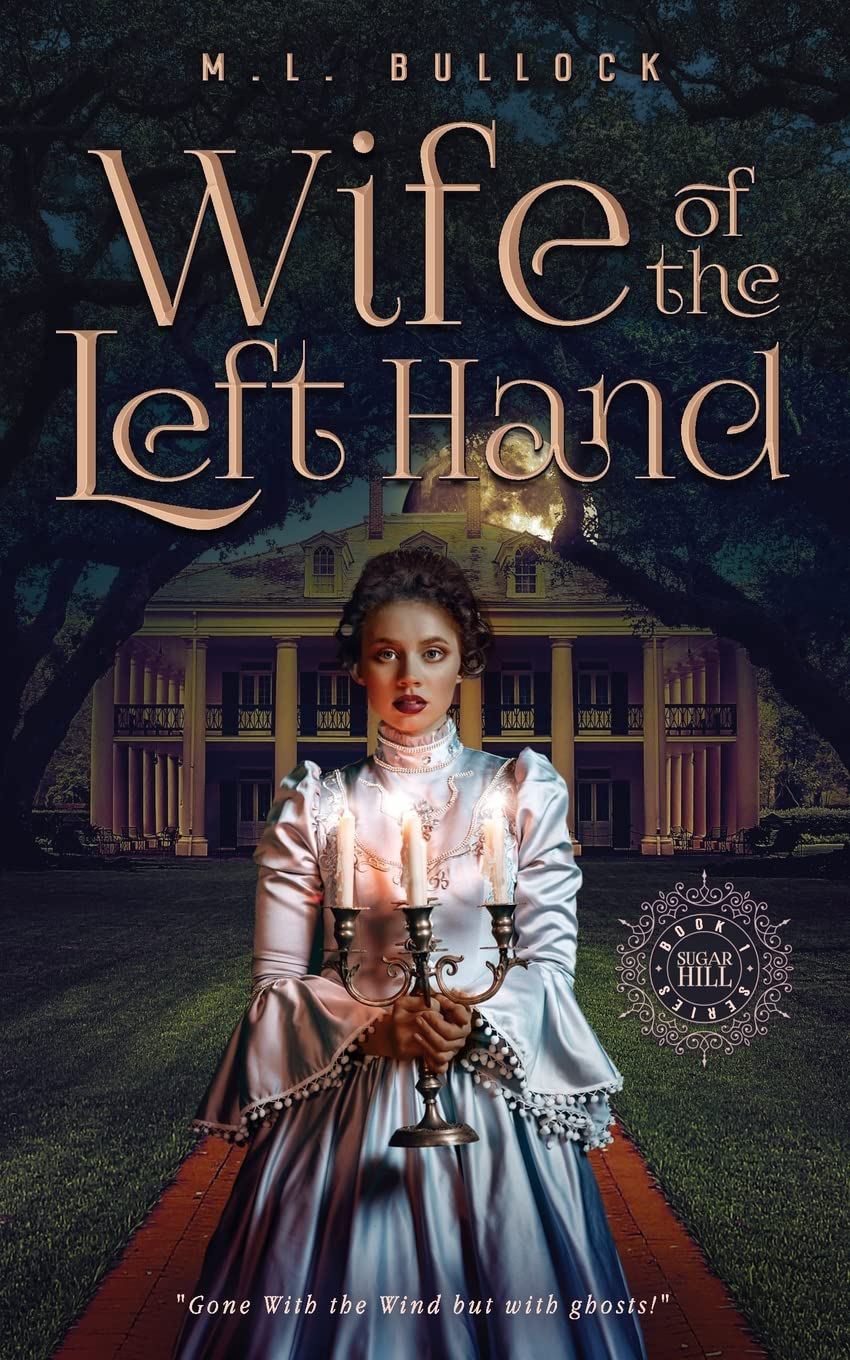
This is book 1 of 4 of the Sugar Hill Series.  For a change, let’s begin with the past. A wealthy son of a plantation owner takes Susana to be his wife. This is a morganatic marriage, also called a left-hand marriage. Simply stated, it’s the pairing of two people of unequal social class. In this case, Susana is from the lower social ranks. It falls on her to earn the privilege of being the wife of one of the most promising young rich men in the area.  But when she is accused of adultery because of a situation that is not her fault, she is ostracized by not only her husband’s family but by her own mother as well. However, the mother will do what is necessary to secure this marriage. In the end, they will use witchcraft to bind Susana to her husband. But this comes at a great cost.

All this takes place in Fontaine, Alabama somewhere in the mid 1800s. Fast forward 150-160 years, we meet Avery Dufresne, a famous  newscaster who is nearly murdered by an unknown assailant. He is still on the loose and she needs to hide. Coincidentally, she is invited to take refuge out of state and live in her family’s mansion. She was unaware that she had an extended family, not to mention a mansion to go along with them.  This is the same mansion that Susana lived in with her husband.  Her great aunt, the family matrone, places a ring on Avery’s finger, which signifies she is to be the new family head with powers to control the finances.

There are plenty of ghosts around the mansion creeping about and waking Avery up at night. Some ghosts disguise themselves in the skin of the living.  She encounters people and has long conversations with them only to find out they have long since passed.

Through  video tapes, her deceased great-great grandmother “interviews”  Avery. Somehow, even before Avery was born, this grandmother knew Avery was destined to be the matrone. These tapes reveal family history; history that even this  great-great grandmother would have been too young to have experienced.  This would be the history of Susana. Could Susana be haunting this mansion?

Did I forget to mention Avery is dating a rock star?  I did. Now it is mentioned. There – the love story is covered.

So, will I read on?  There is much substance to this layered story, and the mystery surrounding this huge and complicated family is intriguing. Why do they need an appointed matrone every generation?  

But it doesn’t grab me as much as The Belles of Desire, Mississippi. That series has a total of three books and this one has four, so my answer is Maybe.


The Ghosts of Kali Oka Road

Last and least, The Ghosts of Kali Oka Road is book 1 of 15 of Golf Coast Paranormal Series.  Unlike the other books in this review, this story takes place mostly in the present day (yadda-yadda 2012? 2013? 2014?). However, there are two events relevant to the current-day story that happened in the past.  Back in the awesome 80s (when little ol’ me was a teen), a jock takes a popular girl from school out to the woods, hoping for some hanky-panky (not an 80’s phrase, oh well). Needless to say, things don’t go his way.  Her refusal was not totally unexpected. What was shocking and downright terrifying was the thing from the sky that flew down and whisked his date away.  It looked like a giant owl. She was never seen again.

Jock dude was the last person to see her so he was the prime suspect in her disappearance . However, there was no evidence to charge him with anything.

About one hundred and forty years before this, a woman escapes from her abusive husband with the help of their male slave.  The slave is also her secret lover.  While on Kali Oka Road, she disappears. I do believe that owl-thing is involved in her vanishing.

Now for the present. Cassidy is blessed/cursed with a paranormal skill – she can paint things that happened many years ago.  She paints events with amazing detail. She captures things which only someone at the scene would know. She paints a depiction of the aforementioned woman fleeing down the road.  When she touches the painting, she goes into a trance and is transported back in time.

Cassidy joins the Gulf Coast Paranormal group to investigate the ghostly phenomena on Kali Road.  They explore the mansion the woman lived in, which is connected to the road via a wooded trail.

Oh yeah, the house is haunted.

Oh yeah 2, Cassidy has a love interest, some dude from the paranormal group.

Most of the pages in this story focus on the young men and women in this paranormal group. I don’t really care for these characters. Seems like this group of people was just mashed together with the hopes that something intriguing would arise from this mashing. Hint: this doesn’t happen.  This whole story, in fact, seems rushed and rough.

If the Seven Sisters series seems long, check out the list for The Gulf Coast Paranormal Series:

GULF COAST PARANORMAL Season One (featuring Midas, Cassidy and Sierra)

#1 The Ghosts of Kali Oka Road

#2 The Ghosts of the Crescent Theater

#3 A Haunting on Bloodgood Row

#4 The Legend of the Ghost Queen

#5 A Haunting at Dixie House

#6 The Ghost Lights of Forrest Field

#7 The Ghost of Gabrielle Bonet

#8 The Ghost of Harrington Farm

#9 The Creature on Crenshaw Road

#10 A Ghostly Ride in Gulfport

#11 The Maelstrom of the Leaf Academy

#12 The Ghosts of Phoenix No 7

#13 The Ghosts of Oakleigh House

#14 The Spirits of Brady Hall

#15 The Gray Lady of Wilmer

Bonus The October People (A Gulf Coast Paranormal Extra)

GULF COAST PARANORMAL TRILOGY

#1 Ghosted

#2 Haunted

#3 Spooked

#4 Dead

#5 Paranormal

Gulf Coast Paranormal Season One Boxed Set

GULF COAST PARANORMAL SEASON TWO (featuring Sierra and Joshua)

#1 The Wayland Manor Haunting

#2 The Beast of Limerick House

#3 The Haunting at Goliath Cave

#4 The Skeleton’s Key

#5 Death Among the Roses

#6 The Spiritus Mirror

Bonus Horror Ever After (A Gulf Coast Paranormal Extra) 

What an insane list!  So, will I read on?  My answer is NO.  Put more crudely, No fucking way!


My final thoughts

M.L. Bullock has plenty of fans. Just check out her Amazon reviews. She has found her niche within the Southern gothic and romance genre.  I prefer authors that don’t restrict themselves to  a certain sub-genre the way Bullock does. By doing so, it can come to a point where the genre itself dictates the story. Bullock’s books come close to this example. They rely heavily on formulas and overserialize the story, falling prey to the sterile ratio  “quantity over quality”.  (That’s my “q-tip” for the day. Ain’t I funny?) That said, the author has a knack for good story telling, character writing, and world building.

I promised to go forward, at least with the The Ghosts of Summerleigh series. This doesn’t mean I’m pushing aside other books on my reading list and diving straight into “Summerleigh”.

Summer is ending, folks, at least here in Chicago.  So give me some time, will ya?

One more thing – the author’s name is Monica Bullock. Such a pretty yet distinguished name! I prefer that to M.L. Bullock. Easier to remember and somehow more authorlike than the pretentious two initials/one last name bit.  That’s only my opinion.  Others will disagree.  Fair enough.  

Get ready, readers, Halloween will be here soon, and I will wanna do cool, spooky things here at this blog!

 

Ghost Summer: Stories – On a Summer Solstice

“Summertime, summertime, sum-sum- summer time.”

It’s summer time!  As a lover of haunted house literature and other spooky things, there is nothing like a stroll down a wooded trail in the dusk of an evening.   A moon is up there in the sky; its light finding me through the hovering tree branches with leaves of red, yellow, orange and brown.  At the end of the trail is a spooky old house. Jack-o’-lanterns  decorate the porch. Candlelight flickers through their ominous, triangular eyes.

Wait a minute, I’m describing an autumn evening in October, aren’t I?  What happened to this summertime stuff?

Truth be told, summer is my favorite season. But fret not autumnal lovers, fall is a very close second. Just because the summer solstice has staked its claim, it doesn’t mean I have to “give up the ghost”, does it?  Of course not. Haunted houses can be just as welcoming in the warm months (provided there’s air conditioning. Bring out the coolant. Or should I say “Boolant?”)

I know I have written about summer haunted houses somewhere in this blog.  I might not have outlined them all in one place as I did here with winter:

A Season of Snow: Five Winter-Themed Haunted House Novels I Have Reviewed

Or maybe I did?  I’m old now; I forget things and fail at searching efforts ( I can’t even find glasses on my head now a days)

I know I reviewed Michael Mcdowell’s “The Elementals”.  Haunted houses on the beach beside an ocean – can’t get much more summery than that!  Then there’s Michael Fowler’s “Nyctophobia” that takes place in a sun-drenched village in  Spain.  I would be remiss if I didn’t mention Dan Simmons “Summer of Night”.  Preteens, summer break, bike riding, a haunted school. 

Just to make sure the concept of summer ghost stories exists, I typed into Google exactly that – “summer ghosts stories”.  The first entry was a near literal return of a title bearing that exact  phrase – Ghost Summer: Stories by Tananarive Due.  I needed to look no further!  A collection of summer ghosts stories – and by a talented, award winning author to top off the ice cream cone. Ohhhh boy!  I was suddenly hot with sunlit excitement.  What a great find to begin a summer!

Tananarive Due is a “leading voice in Black speculative fiction”  (www.tananarivedue.com/bio-contact) I read one item from her bibliography –” Good House” It was a pleasant and enriching experience so I was more than delighted to take another journey to places of her creation and meet such interesting characters born of her mind.  This time, I found myself in Gracetown, FL meeting a literal African-American family, as the mother is from Ghana.  Three of the stories in the book take place in Gracetown.  The book consists of several stories and the breakdown is as follows: (thanks to the Goodreads profile of Magdalena aka A Bookaholic Swede for this information.)

This review concerns itself only with Ghost Summer.  It is the story I jumped to first since, after all, it does contain  two of the three key words of my search. In addition, all the rest are short stories. Ghost Summer is a novella (or at least a long novelette.)  Like a thick burger right off the patio grill, I needed something hardy to quell my appetite.  I’ll get to the rest. Hopefully the summer of 2025 is destined to be long with plenty of time for reading breaks. Now, I might not review them all. I might not review any of the others. Remember kids, what is the theme of these reviews?  

Answer: Ghosts?  * insert a wrong answer buzz here *

No, silly, it’s haunted houses, which sometimes don’t even feature ghosts.  Ghost Summer does have a haunted house.  The nature of its haunting has to do with the topographical terrain and things pertaining to the land that once was. I’m not yet sure if the other stories feature such charming abodes.

Twelve-year-old Davie and his little sister are vacationing with their father one summer at the house of his parents in Gracetown.  It seems this house and its corresponding land is the only place he can actively engage in his favorite pastime – ghost hunting. Legends say Gracetown is haunted, but only children are able to see ghosts.  These would be summer ghosts.  In this story, it’s not autumnal air or the chill of winter that ushers in the spirits.  It’s those magical summer eves that churn out the hauntings. 

The grandparents think all this is interesting but fictional. With a video camera and voice recorder, he has had fun with this on previous visits, but with limited results.  That changes with this visit, the very visit the Due writes about.  What are the coincidences that little Davie and his little sister participate in ghost hunting sessions that are too productive for their own good and at the very same time the author decides to tell readers a ghost story! 

For most of the story, bro and sis don’t have far to travel when it comes to chasing ghosts.  Ghost Hunting Central Station is right there in the living room! I remember sleepovers as a kid. Often we would camp out in a living room or basement with sleeping bags.  With flashlights in hand and ears attuned to nighttime sounds, it was fun to try and scare ourselves. This story brings me back to those days.  

However, the kids in this story encounter things in their campouts that go way beyond the “hee hee hee’s” elicited by members of my peer group. While we giggled, these kids scream in agony and terror.  All we felt on our floor was soft carpeting. Davie and his sister feel rising water that drenches their legs, all  while the adults can neither feel nor see such water.   Where the house stands now there used to be a swamp. Does this bit of history have something to do with the phantom water?  Hmm.

Other things to look for: a late night phantom dog prowling the hallways,  sniffing loudly underneath bedroom doors, disembodied screams from the surrounding land, and three mysterious boys at a campfire deep within the woods. 

There are other things at play in this story as well. There are tense family dynamics. There is the stuff of history, which always provides clues to a modern day haunting. It’s a history of land disputes between black and white landowners, racism and lasting strife. Of bad blood. Of children that go missing.

Tananarive Due is an expert at merging realistic historical fiction with ghost stories.  I look forward to reading all the stories in this book

Review of Hell House, LLC

For as long as I remember, I have loved haunted house amusement attractions. (Wait, scratch that! I hated my first couple pass-throughs. I was a little kid and I was scared shitless. So why did I begin with “for as long as I can remember, I have loved…?”  Because, silly, it’s a great phrase for which to begin an article!). Every once in a while, a movie comes along that features  such an attraction. I always try to see these films. There is The Funhouse, for example, directed by the famed Tobe Hooper. Four kids are trapped inside a funhouse overnight.  I seem to recall this film having mixed reviews, but oh well, I love it and will rewatch it from time to time.  Since the setting does not take place in an actual haunted house but rather a carnival ride,  I have not reviewed this film at this blog.  There are no paranormal events in the film either.  Then there is The Houses October Built Great title, good movie. It’s a film consisting of four or five young people who travel  the states in search of the ultimate “haunt” (another term for a haunted house amusement attraction. This makes more sense, because these attractions are not really meant to be haunted houses but a series of horrific displays varying in theme), until a haunt finds them. This time around, I did review the film. Why? I don’t know, I somehow convinced myself this was more closer to a haunted house movie than The Funhouse. Was I wrong in this distinction? Probably.  Sue me, I guess.

Finally, the heavens above sent forth a movie made just for me  (heavens = Shudder.com). It’s a movie about a haunted house amusement attraction that is, in fact, really haunted.   From what I can tell, this film is exclusive to Shudder, and it was one of the reasons I renewed my subscription this past Halloween season, a subscription that hadn’t been active for years.

The premise: ghosts and/or demons cause deadly shenanigans on this haunt’s opening night. Imagine following a line of people through the cramped passageways, only to suddenly have to reverse.  “Go back, go back” people in front of you are shouting. Something terrible has happened at the very last exhibit. An emergency. Carnage.  When all is said and done, police and emergency vehicles are everywhere.  And several people are dead.  WTF happened?  Well, the answer to the question is the crux of the film.

Oh yeah, I forgot to mention; the name of both the haunt and the film is Hell House LLC.

The film begins as a documentary that has been filmed after the events of the story. It starts with interviews of people that have second-hand knowledge of what might have happened on that tragic night, then continues with an interview with Sara Havel, the sole surviving crew member.  

Sara has in her possession a video of the events that lead up to opening-night horrors. It just so happens that one of the crew members documented all the prepping activities with his camera. There’s always some guy or girl in these flicks that do that,  isn’t there?  The rest of the film is pretty much the video itself.  You know what this means, don’t you?  Yep, you guessed it.  Hell House LLC is a found-footage movie.

I have no idea how you the reader of this piece feels about found-footage movies.  For me, it depends on how good the story is and how little the camera operators annoy us with a shaking camera.  But if you’re one of those that has made up your mind that you absolutely hate found-footage films, I implore you to still see this movie.  It’s a great movie and when the camera does shake in enhances the scares (like when the customers are fleeing the haunt.)

The film follows a group of haunters during Halloween season  as they “set-up camp”, if you will, in Rockland County, New York, determined to convert the abandoned Abaddon Hotel into the area’s one and only haunted attraction.  The hotel itself is the subject of dark legends. Supposedly, way back in the ancient days of the 1980s, some cult leader named Andrew Tully tried to open a portal to hell on the premises. Two people went missing when he did this. Oh for Heaven’s sake Mr. Tully, couldn’t you be happy with the amenities the hotel provided?

Back to current time (2015). How are five or six people able to haul thousands of dollars worth of mechanical haunting props in a couple of cars, reconstruct the whole place, hire actors, and market the event in a 30-45 day time period? This doesn’t even include securing the rental contract and obtaining the necessary permits. I guess we the viewers are not supposed to be concerned with those things. These are experienced haunters, having operated in various places in past seasons.  So they know what they are doing and we’ll just have to trust them. Reasons not to trust them? For one thing, they are hosting a public event in a place where supposed demonic activity had taken place. And in the end people will die, so there’s that.

Actually, we the viewers do see the crew preparing for the haunt, day by day. Each new scene opens with the subtitle  “X amount of days until opening night” (I’m sure some days are skipped for the sake of the audience. The movie is supposed to scare us to death, not bore us to death. Maybe those were the days they filed the paperwork and received incoming shipments?) 

There are some genuinely creepy scenes in this film. There’s the clown dummy that just won’t stay in one place. There are these shadow things that just appear out of nowhere. And some members of the crew get possessed from time to time.  For you folks out there that love twists, the film as you covered. 

This film is not to be confused with Richard Matheson’s book  “Hell House”.  The corresponding movie is titled The Legend of Hell House. When I first saw the title “Hell House, LLC”, I immediately thought it was either a sequel or remake of Matheson’s story. Matheson’s story is a great book, and the movie is great too. but it’s an entirely different animal.  It’s the “LLC” that distinguishes the modern film  Gotta love the “LLC!”

Guess what?  There’s a Hell House 2, 3, and an origins film. Many of these have gotten good reviews. Therefore, I really am looking forward to binge watching these sequels, more so than other successful horror films that had follow ups. So much fun! It’s great to be me!

Review of Wylding Hall – A Novel by Elizabeth Hand

Would you like to take a “Wyld” guess as to what Wylding Hall, a novel by Elizabeth Hand, is all about?  Or if “Wylding” is pronounced differently, would you want a description of the novel “wyld” upon you?  My “wyld” guess is that you would want the description “wyld” upon you rather than trying to figure out what the book is about all by yourself.  So, I will tell you what it’s about. 

Wylding Hall a story about mystery. It’s a story about intrigue. It’s a story about companionship and loss. It’s a story that asks the question “what really happened during those final days?”  It’s a story about the supernatural and its strange ways of manifesting. It’s at least trying to be a story about these things.  The effort is there and I give it credit for that. Even so, and I hate to admit it, but I was a tad disappointed with this book.  I had higher hopes after reading Elizabeth Hand’s excellent novel, “A Haunting on the Hill”, which is an  authorized sequel to The Haunting of Hill House.  It was on account of this sequel that I learned of Wylding Hall. Published in 2015 it precedes A Haunting on the Hill  by eight years. I guess it’s more ideal if your books get better as you go along, right?   

There is just too much going on in this relatively short novel for any of the concepts to really shine. So if luminosity is the measure of its greatness, I would say this novel is just above dim. , 

This is a fictional account of an English folk band’s recording of an album in a haunted house. Set in the early 70’s It has many of the staples of rock bios. It details the chemistries and friction between different band members  There are bursts of psychedelia here and there.. And there’s the charming yet mystifying star, which in this case is Julian Blake. It seems Hand is taking a hand (see what I did there?)  at creating a character based on the charismatic, mysterious male rockstar prototype. Real life subjects such as Jim Morrison and Jimmy Page come to mind.   The events in the book, pieced together from varying perspectives, also remind me of the movie Eddie and the Cruisers. Just like with that film,  the mystery surrounding the lead singer’s supposed demise is brought to light by the revealed memories of surviving band members.   

Unlike the average rock bio, there are ghosts in this story. Or, maybe not.  Perhaps this isn’t a haunted house at all. If not, certainly it’s a house of mysticism.  Oh what do I mean by that?  I don’t know, man, guess you have to read the book, ya dig?

I love the material, mind you.  I love bios of young, musical groups and standout personalities within such bands. I love reading about the 60s and 70s music era and I love haunted houses. It’s just that, in the end, something didn’t fully click with me.(Was there a partial “click”?  I think so)  And yet it’s not a bad book by any means. My interest was piqued all the way to the final chapter.  However, once I finished the book, the characters were forgotten, and any feelings of attachment to this story that I might have had fled abruptly. 

While the “stuff” of the story takes place in the 1970s, the narrative takes place in the present time.. The book consists of  fictional interviews of people once associated with the former folk band Windhollow Faire,  including the surviving band members themselves. One former member committed suicide. Or so it’s believed. The other,  Julian Blake, simply disappeared.

During his time with Windhollow Faire  Blake is enigmatic, soft spoken, contemplative, and perhaps sexy in his unique ways. He dabbles in the occult. 

As you might guess, there is plenty of mystery surrounding the demise of Windhollow Faire, which comes to a head on the final days of recording what would end up being their final album.  The album was recorded at Wylding Hall, which is the haunted house of the story.  The band shacked up together for one fateful summer in this house to prepare for the recording. The house and its external surroundings are also the subject of  eerie legends amongst the locals. Ghost stories if you will.

During those days, weeks, and eventually months, the band, besides working out creative musical arrangements, indulge in sex, drugs, and what I will call spiritualism.  During the final recording sessions,  Julian Blake mysteriously vanishes.  He had been seeing a nomadic hippie girl that suddenly appeared in his life. Her appearance was just as mysterious as his disappearance. Perhaps Blake was witched away?

The blending of  an epistolary account of a former folk band with ghostly folklore sounds like an intriguing mixture.  It could be. It should be. But the final result just didn’t intrigue me all that much. Reading the novel was a disjointing experience,  but not in a way that reflects the uncanniness of an eerie haunted house, which for me is a welcoming sense of disconnectivity. Genre blending is great if done correctly. But with Wylding Hall, there lacks a much needed unifying tone to ease together the disparate muses into one unique story. Moreover, too much of my mental energy was devoted to keeping up with all the characters and their varying perspectives, so much so that I wasn’t able to effectively absorb the ghostly elements of the story.  The truth is there weren’t a whole lot of scary moments. Oh there were some, here and there, but several of the haunted house story arcs seemed to have hit a brick wall. 

On another level, I was annoyed at how often  the interviewees incessantly compared modern modes of communication and technology with those of the past.  They would say something like “Remember, back then, it would take longer to contact our manager since there were no cell phones” or “Recording an album in those days was nothing like it is today”.  We get it. The  repetition of these observations was somewhat insulting to me as a reader As readers,  we don’t need to be reminded of the time-lapse variances due to the limitations of technology over and over again, nor the nitty-gritties of certain efforts that would eventually be replaced by the clicks of a few buttons. 

Overall, the book has its faults but it does have the elements of an interesting story. It wants to grab the reader’s attention, though at times it struggles with this. There is something genuinely good about this book  and yet I can’t pinpoint exactly what it is.  All my criticisms might just be an issue of pet peeves on my part that won’t necessarily trouble another reader.  So,  I don’t know, give it a try.  Read it and see for yourself 

October Garden – A Narrative Following an Autumn Greeting from Yours Truly.

**** Before reading the narrative below, click on the picture link and support my sponsor (pssst! I’m my own sponsor).   The eBook is only 99 cents!*****************************************

TheAcquaintance

***************** Okay, now you can go read the following narrative *************************************

Happy Autumn to you, Happy Autumn to you, Happy Autumn dear readers, Don’t forget to go “Boo!”

Wait…I didn’t mean for you to “boo” the song, or “boo” me for that matter. I meant to make a ghost sound because Halloween is just around the corner and… Oh, nevermind!

It is Oct 1 and I’m here to tell you what I have planned at this blog to celebrate the Halloween season.

It all begins with a narrative I wrote concerning the coming of October. This spilled out pretty darn quickly from brain to screen, so it hasn’t gone through an extensive editing process. A little odd maybe, some awkward grammar here and there perhaps. But I think it’s alright.

Later this month, I want to review two haunted house movies that have come out recently and somewhat recently. Both have the root word “Haunt” in them.

Lastly, toward the end of the month, I’ll present a short story. It involves trick-or-treating, urban legends, and cemeteries. 

How’s all that sound?  Sounds pretty damn awesome, right?

Since today is the first of October, let’s get right to it.  

I present to you:

                                                    OctoberGarden

It all happens on an empty field.  A prairie where nature is allowed to run her course. The grass is tall and there are dips in the land collecting water. Frogs splash around and add ribbits to the night. 

There are houses on either side of the prairie. They are identical and evenly spaced apart. They are accompanied by cul-de-sacs and maze-like lanes and courts. Those that dwell in the cookie-cutter houses parade about in their fenced-off yards, petting their pink flamingos and warming their upturned noses under tiki lights. They spit at the early setting sun, pounding their asses into lawn chairs to hold down summer.  Folding their arms, hearts shielded from the telling breeze of early autumn. Lemonade seltzers between their shaking thighs. Oh my.

At least there are trees here and there. Does anyone look at them? Does anyone care?

Albert Jenkins knows what’s up. He’s the only one. A loner by trade, but he’s never lonely. No more lonely than the huddled asses sheltered in their confines in lonely groups of two, three of four.   Two lonely + three lonely + four lonely = lots of loneliness. Remove all the extra asses to decrease the loneliness down to one.  One who is more than ready to say “bye-bye” to the early setting sun. (“Bye-Bye sun, hee hee, Bye bye,” Albert says)   Albert knows The Spirit is only one. The only one. The One Outside. Her will shall be and its best to open your own spirit to her inevitable ways. 

Albert knows. Albert knows.

The thirtieth of September fades away and come October first, while the divided dwellers log onto their devices after dinner, Albert connects instead with the network configured by The One Outside. He has always been one to look toward the sky but this evening he does so with his back pressing into the Earth. The tall grass of the prairie threatens to cover him up like a discarded body from someone’s car trunk. But that’s okay, she will always see him. She looks at him from all directions, down, up, across, and out. Mostly out.  Outside of time and space, beyond that blue substance that we call sky.

“Hear me please,  my Only One!  To you on the Great Outside, hear my cries!”

Albert hopes The Great Spirit will hear his pleas that originate from the inside. But of course she will.

“Let October come not with hesitation, but mightily. Allow it to flourish in every single atom. In every living cell. Birth its spirit generously, and let it carry in its essence the seeds of the hallowed.  Eve be early, for the Hallowed are always welcome.  Prepare us for Halloween!”

The One Outside hears him. She hears him indeed.

This evening, the early darkness is welcomed, if by no one else than Albert. This single welcoming is enough for The Great Spirit to double down on her duties. To pull the veil across the sky with greater speed. To hesitate not with the coming of the night. 

BatThe nighttime skies as of late had been rather sparse of celestial bodies. Not tonight. The One Outside does her thing, pressing the tip of her finger against the firmament,  burning into the black veil of night  a crescent moon.  So much more spectral than a moon of full light. Shaped like the Grim Reaper’s scythe, hiding its fullest essence in darkness. With a wink she twinkles into being the stars. One million bright reflections of just one of her eyes. One blink yields a legion of flickers, and thousands of her eyelashes rain down in flutters. They come to life in the form of bats, crossing the moon in their flight and spiraling downward. 

Albert smiles, and the long grass blades that surround him curl and retract. Poised like snakes in the moment before an attack, they allow him to have a clear view of the sky. His heart welcomes the descending bats, for what kind of Halloween season would it be with an empty sky void of creepy moons and scary bats?

There is more. The bats aren’t the only dark animation to decorate the night. Conjured from the shadows that cover most of the moon, silhouette witches on broomsticks flee the silvery glow. They are gigantic incarnations of the wall-hanging Halloween decorations in the days of yore. Albert sees them in the moonlight. Of the shadow and from the shadow, they make their descent. So far away yet Albert sees them all.

The bats have arrived, diving in steady arcs from tree to tree. The silhouette witches, shrunken to the size of the wall-hanging decoration they resemble, have finished their descent as well. Beings of pointy hats and noses. Their broomsticks like wild projectiles curving and dipping.

“Look at them go!” Albert cries as he takes delight at the hundreds of scattering witches. And go they do, beyond the trees in the distance, over the rooftops of the cookie-cutter house dwellers. Down into their WitchSil chimneys, through the crevices in their foundations.  Of the shadow and from the shadow, to return to the shadow.  They hide within the darkest corners of the houses, their distinct shape dissolving as they blend in uniformly with the blackness.   Unseen, yes. Unfelt, no. The dwellers will know. The dwellers will know.

And the blades of grass on their finely-cut lawns laugh. From blade to blade, they pass along  what sounds like a possessed doll’s chuckle. Blade leaning into blade, the maniacal chuckles pass beyond the property lines and into the grass of the no-man’s-land prairie, until the blades of grass surrounding our man Albert strike at him with their tiny little tips and Albert is overcome with a fit of mad giggles as he receives a tickling of knowledge. 

He knows what has happened. He knows the witches haunt the homes of the dwellers. And, he knows  of “the beats.”

Existing in the shadows since the dawn of time, the witches possess the ability to echo the wildest beats nature has ever known. From the crashing of tides to the eruptions of volcanos, carrying with them the tromps of the mighty dinosaurs, the silhouette witches merge these beats into a wild but capturing rhythm that overcomes these dwellers. In spasmatic movement, they flee their premises of shallow dreams in a mad, hypnotic craze. Moving unnaturally, limbs contorted, bones snapping and breaking.  they arrive at the prairie and continue on with their “Autumn Dance.”  Puncturing rips appear on their skin as their foul  entrails spill out. Clots of blood drip in pulps. Broken bones fall from their sources and litter the lands.

Albert hears this dance and all the accompanying footsteps. He prays to The One Outside for their redemption.

“Give them a second chance. Salvage from them what is good. Let what is bad be eaten by the earth!”

The One Outside grants his wish. To the prairie she speaks in a silent tongue that only the ground understands. It is a salutation that calls for a response and the earth dares not commit blasphemy through inaction. With utmost respect, it opens not one but several mouths.  

Hundreds of chasms unfold across the prairie with deafening roars. The One Outside hears these roars and she is pleased.

In deference to the mouths’ hungry roars, the silhouette witches cease with the rhythms and the Autumn Dance comes to a halt. The broken people see  these foreboding chasms and hear the mighty roars. They are the shivering, hyperventilating ones, now crazed with fear, for they see all that which has spilled from their bodies coagulating together into sluggish blobs. The foulest elements of their beings, sprouting sluggish arms, pull their remains forward. Part skeleton, part blob, they crawl in a path toward their fates. Toward their graves.

These “Path-Etics” hover at the edges of the mouths.  The earth’s gravity, measured in hunger, strengthens and the Path-Etics are sucked inside the mouths. When every person present has fed the worst parts of their being to the earth, the mouths close and their lips pucker into mounds of satisfaction to form burial sites.

Now, this quaint October scene upon a prairie is blessed with a Halloween staple – a cemetery.  Yay for Halloween.

The terrified ones still have more to give. The One Outside draws a hearty breath. In doing so, she sucks the cancerous components of their souls out of what remains of their skins. A horde of homeless souls hover outside the bodies that once kept them so protected. Attached to nothing, their forms threatened out of existence by the whims of chance and change, these banished ghosts wail into the night.

“Save us! Keep us whole and give us a place to be!”

The One Outside looks down upon Albert. He gently nods his head. All the stars twinkle as she returns his nod with a wink, sending delightful shivers up his spine. The ground too shakes. It has been blessed by the Spirit as well and the tremors are felt over yonder by the grounds that behold the now empty dwellings where the witches hide. Overcome by such a blessing, the grounds turn soft, permeable and willing. All the houses, garages, lanes and courts sink deep into the soupy grounds, never to rise again.

Out of nowhere, looking down upon the prairie, a new house has formed. A dark, mysterious mansion with a crooked terrace, loose shutters and broken windows.  To this house the lost souls are banished. They take up residence immediately, taking their sorrow with them for company.

BatThe overall setting looks quite different than it did twenty minutes ago. The sky is in full night time mode. The moon is menacing. Both bats and witches are out and about, for the witch silhouettes fled the houses when they were sinking into the ground. Only one house stands – a house of lost souls.

And yet there is still the matter of the community of former cookie-cutter house dwellers.  They have lost the toxic, bile-ridden parts of their body; converted to slime,  buried in graves. They have had the toxic parts of their souls removed from their essence.  Though several hundred stand, there is very little left in each. It’s amazing how much toxicity consumes a person, leaving behind only a small percentage for goodness. Whatever is left stands bewildered upon the grounds. Old and young looking aimlessly in all directions. Bodies weak from depletion. The aftermath of a spiritual lobotomy.  They are practically zombies.

Albert knows there is a plan for these folks. The One Outside has granted all his wishes so far.  She is not about to leave the people in such a dismal state. From outside the boundaries of all that is known, She whistles a haunting melody,  sending it inside a wind. The wind falls upon the land, stripping leaves from the trees to make for a picturesque autumn setting.  It seeps into the soil, dropping deep, deep and deeper.  The song that is inside her heavenly breath is meant for “the slithering one” that lurks deep within the earth. It alone will take in its seductive call.

Still lying with his back upon the ground, Albert’s spine feels the vibrations of the waves created  by the snake-like entity. It is awake. It is the One True Root from which all living things grow. It unites all roots as it slithers among them. It passes undetected from host to host, extracting life out of every seed and cell. Its branches are infinite. It is everywhere all the time.

Tonight, The One True Root is potent like never before. The Spirit’s voice penetrates its scales and echoes throughout its elongated body. It stimulates each and every branch. Tonight the branches rise to the surface and break through the earth’s floor. They slither around every single person that stands on these grounds. They burrow  into their skin and deposit seeds. New life  sprouts from within their bodies.  Vines break through their stomachs, tendrils squirm out of their noses. Yellow and orange flowers  break out everywhere. Green leaves unfurl throughout the entire surface area of their skins.

Firmly rooted to the ground, these people never need to move again. This is their place. It’s out with the old and in with the new. The new is coming through, breaking through their heads like  hatchlings cracking through their eggs. Their new heads are big, round and orange.

The graveyard that was once a prairie is now a pumpkin patch as well. Halloween, here we come.

But the setting is not yet complete. For the first time since the beginning of this October transformation, Albert stands on his feet. He knows what he must do on behalf of the members of the community. He must empty the little bit that exists within their hollow heads. Rid them of preconceived notions. Using a pocket knife, he slices into the pumpkins and pulls out their guts. Continuing on, he carves eyes into the pumpkins’ heads so that his former neighbors may see their new environment. Next, he chisels out noses below the eyes so the former cookie-cutter house dwellers might smell autumn’sWitchSil aroma, maybe for the first time ever. Below the nose he cuts out mouths, not so they can speak but so they can smile at their brand new lives with appreciation.

The final task. Albert points to the sky. The One Outside blows him a kiss and it descends to the earth in a ray of light.  The light strikes Albert on the finger, causing it to glow. “All around the neighborhood, I’m going to let it shine!” Albert says, quoting a song from his childhood.  Into each and every pumpkin he inserts his glowing finger.  A portion of the glow remains inside every one.

 It is the best neighborly gesture ever. By the power and grace of The One Outside, Albert lights souls into existence. The light inside each pumpkin absorbs whatever portions of the old souls that have been left behind and transforms them into something fresh, something new.

It’s October at its finest. Gone are the tacky houses and the artificial people they hid. In its place is a graveyard, a pumpkin patch, a haunted house, and brand-spanking new spirits  fresh as pumpkin pie! The witches and bats make fine spectators and they take in the scene as well. Albert is mad with glee! The One Outside appoints him the caretaker of this October Garden and he accepts this position proudly. He turns to look at all the lit pumpkins. Oh how they smile! They love it.  Everyone loves it.  October is going to be a great month. The best.  Happy Halloween!

HalloweenVine


Review of Dark House of Dreams

Gods and goddesses and demons, oh wow! Arachnids and familiars and oracles, oh dear! Earthquakes and famine and war, oh shit! Shiny men – skinless women – revived dead, say what?

And ghosts. So many ghosts. Hanging out on the roads, in the alleys, in your darkest dreams. Oh, and they hang out in houses too. This last point provides me with the necessary loop hole to include Joe Pawlowski’s novel Dark House of Dreams in my reviews of haunted house literature. But for the most part, it belongs in an entirely different genre.

The genre of the novel as per Amazon.com is dark fantasy.  Scrolling through best sellers that fall into this category, I came across title words such as “summoner,” “underworld,” “dragon,” and “retribution.” Hopefully these words conjure the kinds of themes this genre deals with. I am largely unfamiliar with this genre. I do not normally review books that fall into this category since my genre consists of stories pertaining to ghosts and haunted houses. A reader that is solely attracted to Gothic literature might not be interested in a book of this sort. Likewise, a reader exclusively dedicated to modern haunted house fiction might not be smitten with the stuff of this novel either. Fans looking for similarities to The Haunting of Hill House, The Shining or The Amityville Horror will find nothing of the sort in Dark House of Dreams.

The plot is rather complex and difficult to describe. Dark House of Dreams is one book in a series; the Ring Gargery Series. Much of the book devotes itself to fleshing out a story arc that will reach its curve in future novels. However, this isn’t the first of the series. The Watchful Dead: A Tale of Old Hastur (A Ring Gargery Thriller) predates this novel and is described as “a nightmare blend of gothic traditionalism, magical realism and dark fantasy.”  Perhaps this novel might align more closely to haunted house fiction theme? I should have read this first. Oh well.

Ring Gargery is the protagonist, but he’s by no means the only character to lend readers a perspective. Having spent his childhood isolated within the walls of his house, he comes of age outside the walls, in a world of slaves and nobles where travel is done by boat or horseback, villages are many miles apart and great turmoil is afoot.

An earthquake caused by a demon has ravaged a neighboring community. A giant spider, a god, is burrowing under the town and rising every so often to claim a victim. All this while Ring ekes out a living as a stableman. His pastimes include drinking bowls of wine with friends at pubs and engaging in romantic rendezvous with women. He is also searching for his mother, who mysteriously “went lost”.  Meanwhile, he has these prophetic dreams that place him in a dark house where he is tasked with exploring different “rooms” each time he drifts off to sleep.  When crossing the threshold, he enters not  a room but a landscape of some sort.

What is my favorite slice of turmoil in this story? Why that would be the ghosts, of course! A sorceress has broken down the gates of the underworld and the ghosts have been freed to walk the ….earth? (I’m not even sure this story takes place on earth). The community is forced to live side-by-side with these phantoms. They are mostly a nuisance, but sometimes they can be dangerous enough to be maddening or even deadly.  For mysterious reasons, Ring’s childhood house is overrun with ghosts. They are drawn to it the way flying insects are attracted to light.

Then there is more. There’s politics; councilmen argue and point fingers and do underhanded things. There are murders and kidnappings. There is death by public execution. And then there is more. I can go on and on.

How did I stumble upon this book and why am I reviewing it?  I found an advertisement for this book in one of the many Facebook groups I belong to that encourage authors to promote their books. The title caught my eye. When a haunted house guy such as myself sees the words “dark house”, he reads on. When he sees the word “ghosts” in the synopsis, he considers it for purchase. If the price is right (it was), he goes in for the buy. And that’s what I did. Though there are only a few instances of ghostly goings-on’s that frighten the occupants of a house or castle, dog gone it, I just wanted to say something about Dark House of Dreams.  It took work to finish this book. So many unusual character names, so many unique names for various families, tribes or religious sects (thank you Joe Pawlowski for the list of characters with descriptions at the book’s end!).  I wanted there to be something to show for my efforts. Hence this article; it’s my participation trophy.

Did I like it? In a nutshell, yes. I wouldn’t have finished it if I didn’t. I have no criticisms.  I can’t say that I’m in love with it though. It’s just a matter of taste. It is remarkably well written. And to think of the work involved in creating the world of this novel, set in a mysterious place. Every word spoken, every object used, every place the reader is taken to props up this world and fits neatly together to forge this fantastic setting.  Yes, it took work to comprehend this setting, but much less I am sure than it took to create it. So no, it’s not really a haunted house tale. And it probably does not belong within my catalog of reviews. But here it is anyway. Sue me if you must.

A Review of The Little Stranger – The Novel

OLYMPUS DIGITAL CAMERA

Some reviews are easier to write than others.  There are those stories that inspire the briefest of descriptions and the simplest of impressions. These aren’t bad stories necessarily; they can be quite good. But after the reading or viewing (novel or book), everything I want to say falls neatly in place. And there might not be much to say other than things like “very suspenseful” or “just an all-around fun bit of horror.”  Such stories don’t require layers of analysis. Nor will they transport me to wider worlds that inspire endless contemplation.  Then there are books like Sarah Walter’s The Little Stranger.  After the reading I realized there was so much I wanted to say, so much more I wanted to learn. These thoughts and curiosities I had, well, they were all jumbled up, and I had to start another book while I allowed some time for these ideas to settle and come together in their own due time.

A story that provokes simple impressions, I have stated, can be very good but it can also be very poor. This “either/or” explanation doesn’t work so well with stories that inspire a complex set of thoughts. Such complexity hardly unfolds as the result of a poorly written story.  The opposite is true. To get to the point – The Little Stranger is an excellent book. Superb! Bravo!

The Little Stranger has all the ingredients I love in a haunted house tale. Its “house” is more than “the sum of its ghosts”, meaning, its mystery is innate and not the result of a phantom that goes “boo”.  The house, Hundreds Hall, has a personality all its own. This is a story that falls under the genre of “Gothic”, and so once again, I found myself climbing that tree of this mammoth genre and exploring its various branches. Very willingly I did this. With excitement and curiosity.  I found myself comparing this story to other great literary haunted house novels but never suspecting it of concept plagiarism. Putting aside ghosts and haunted houses, the story that takes place outside these elements is engaging and speaks to matters of the heart.  I came to know the characters of the story quite well. I enjoyed visiting the Ayers family in their run-down manor and taking in all their nuances and eccentricities, their madness if I may be so bold.  And I have Dr. Faraday to thank.  Through his eyes the first-person narrative unfolds.  There is a love story in here as well. A sad love story built on longing and yearning that puts to mind that painful old adage “you can’t always get what you want.” (Thank you, Rolling Stones,!)  Because his viewpoint is “skewed” (biased) , his account of the house itself and the events that take place within its walls add to the “Skewiness” (I made this up – that state of being “skewed”) of an already “Skewed” (twisted) place and situation. Finally, I love the unique “agents of scare” that are built into the house. These would be what are otherwise neutral structural components, except that when they are manipulated by mysterious forces, they become quite creepy.

There. I gathered together all these Sarah Walter’s inspired complexities from my head and condensed and simplified them into one paragraph. My work here is done. Not!  Silly you for believing that. For you see, now I have to explain in more detail what the hell I was getting at in the paragraph above. So here comes the meat of this review!

Plot in Brief (Some spoilers)

The story takes place in the United Kingdom. It begins in 1919. As previously mentioned, the story unfolds from the viewpoint of Dr. Faraday, the family physician for the Ayers family. As a child from a humble background, the young Faraday marveled over the impressive display that was Hundreds Hall. He greatly admired the family that owned and ran it as well. Who didn’t? The Ayers were highly respected members of the noble class and they shared bits of their greatness via the feats they gave to celebrate Empire Day. The Colonel and his wife parade about with their six-year-old daughter Susan and receive grade admiration from the crowds, which are partly made up of folks from the “lesser” classes. Most of the people are not allowed in the grand Hall but young Faraday is lucky.  His mother was once a servant for the Ayers and using her connections to the household staff, she is able to grant her young boy son entrance to the Hall. And he is impressed with what he sees.

Shortly thereafter, little Susan dies, triggering change. The Ayers cease to throw Empire Day fetes. The Colonel and his wife have two more children after her death (Caroline and then Roderick). Later the Colonel dies. Things are never the same.

Fast forward thirty-years later, post-World War 2 Britain, and Faraday is now a country doctor and the family physician for the remaining Ayers. He is saddened at the state of the hall; rundown and in great disrepair, the landscape is unmaintained.  Still he admires the Hall and covets the family unit itself; he wants in.  The family has lost much of their social standing. Roderick, wounded with a limp during his service in the war, struggles with the finances. Caroline is somewhat of a recluse, more so is her mother.  And there is a hint of madness among the family.

In attempt to regain social graces, the Ayers throw a small party for other well-to-do families. It doesn’t go well. The family dog bites the nine(?)-year-old daughter of one of the guests. It’s normally a passive dog. Was the dog possessed by something? A spirit perhaps?  Roderick thinks so. According to him, he has been experiencing strange happenings in his bedroom. His mirror moves on its own accord. Fire erupts in his room, source unknown. He goes mad and is locked away.

Meanwhile Dr. Faraday falls in love with Caroline. She mildly returns this love but is quite ambivalent about this.  The servants are witnesses to what could be supernatural activity. They believe the house is not only haunted but evil. Mother and daughter fall prey to the strangeness of the house. Faraday tries to reassure them.  But its as if the house and its family have some kind of figurative disease for which the doctor cannot cure, to his frustration and great sorrow.

Is all this the work of the ghost of little Susan who dies as a child so long ago? Oh what is going on?

Similarities to other classic works

To begins this section, I quote from Wikipedia’s article on The Little Stranger:

 A mix of influences is evident to reviewers: Henry James, Shirley Jackson, Wilkie Collins, and Edgar Allan Poe.

I will address this claim, author by author.

Henry James – Turn of the Screw

With the exception of The Jolly Corner, the only work  I read from Henry James is The Turn of the Screw. But Turn of the Screw is a fine example of an inspirational source, so I’ll use that piece for comparison.

In many “spooky episodes” of our favorite television stories, a Scooby-Doo-type premise plays out – a trickster was behind the haunting all the time. There is always that person that suspects such from the very beginning. “There has to be a logical explanation,” the character will say. Well, I’m going to reverse this scenario. In both Turn of the Screw and The Little Stranger, a supernatural explanation is offered early on in the story. But we the readers know that there is something more going on to account for the bizarre events that we have encountered across the pages.  In the James novella, it is surmised that the ghosts of two deceased adulterers, a former governess and a man-servant, are haunting the children, a young brother and sister who live at Bly Manor.  But overall, the story hints that the haunting is rising up from some far deeper source, something that is buried deep within the dark tunnels of the psyche of the children’s current governess.  Likewise, Walter’s novel offers up a supernatural explanation to account for the ghostly-going-ons: the ghost of Susan, the girl that died so young, is haunting Hundred’s Hall.

In both stories, the authors give us a possible supernatural explanation.

James – former adulterous servants, man and woman, dead, ghosts corrupting the two innocent children, boy and girl. But overall the story offers a psychological explanation that may put to rest and claims of supernatural activity.

Walters – the ghost of a  little girl, sister, Susan, is haunting the place.  But it might be that something else is affecting the brother/sister siblings. The source of the scares might not have anything to do with the supernatural.  The “ghost” might just be a “collective hallucination” that plagues a family stricken with sorrow and grief. Or maybe it’s the “times” (“these days” vs. “those days”) that is the ghost?  This will be explained in further detail later in the article. (In the “Go-Go Gothic Section!” Oh boy!)

Also of note – both stories feature a brother and sister as lead characters that fall victim to a haunting that occurs in their own home.

Shirley Jackson – The Haunting of Hill House

Both stories treat the houses in each tale (Hill House and Hundred’s Hall) as conscious entities. The houses in question are either troubled, diseased, or downright evil.  In addition, both stories offer a theory that a character is unintentionally projecting negative energy upon the house, and this is what is causing the disturbances. In Jackson’s story The Haunting of Hill House it is Eleanor Lance. In Walter’s story it is Roderick. Or if not him, someone else, but who?

Wilkie Collins – ????

Duh I dunno. I never read anything by him. I should change this. (This was the easiest section to write! Hey, I only said I would address these claims, and address I did. I just forgot to fill the envelope with a letter.)

Edgar Allan Poe – The Fall of the House of Usher

Ah, my favorite and perhaps the tale I find most similar to The Little Stranger. I’ve loved The Fall of the House of Usher since I was a kid. I didn’t need that Wikipedia list to let me know that this was a major source of inspiration, for Poe’s ghost kept calling out to me as I progressed through the book.

Both stories are told from the outsider’s perspective. Each is narrated in the first person. Both narrators are visitors/guests of the family that live in the houses that are at the center of the stories. Both outsiders (The Little Stranger – Dr. Faraway/The Fall of the House of Usher – Unnamed Narrator) bear witness to the fall of great families. They watch in horror as the ones they love succumb to madness and grief. Both try and do what they can to ease the suffering of the families but in the end their efforts are futile. They feel helpless, wishing there was something they could do. It doesn’t help that they are caught up in a situation where there understanding is limited. You can’t fight a disease when you don’t even know what it is.

Also, both stories deal with an adult tortured brother and sister that are heirs to the family’s house and legacy. Likewise, they are heirs to a curse.

Similar Yet Unique

Although The Little Stranger’s influences can be found in the aforementioned literary works, it stands on its own. It is not a carbon copy; the houses in these stories are not of the cookie-cutter design. Rather, let’s think if these houses (and the stories surrounding them) coming together to form a neighborhood. Hundreds’ Hall belongs in a neighborhood that boasts Hill House, Bly Manor, etc. One should be proud to be welcomed in such a community.

Go-Go Gothic

Here I go for the umpteenth time wandering on the trails of that behemoth forest that is Gothic Literature, picking at and extracting from only some of its sprawling branches, stealing clues to bring to the next clearing where light will shine upon them and illuminate me on the story that I am currently holding in my heart. I’ve made such journeys for several articles here at this blog, and again I must emphasize that in no way am I trying to encapsulate in one article everything you needed to know about Gothic Literature but were afraid to ask. I can only explore the elements of which I am familiar and examine them within the context of the story that I am reviewing.  So, with that said, hello Gothic elements, meet The Little Stranger!

The collision of the past and the present; this is a common theme in Gothic Literature. The most obvious example in terms of ghostliness is, well, the ghost itself, or the ethereal remains of someone who died long ago making its presence known in current times. But think also of the ruins of an old castle. Long ago the castle served a mighty purpose, but not so anymore and yet part of its structure remains. What use is it to us now? Does it have something to share with us? Is it relaying a message to us modern folk about the past? Is it hiding a secret within its stone walls?  To ponder such questions is to open oneself up to the conflicts that often arise within Gothic Literature.

Gothic stories often take place in times of social change. There’s a new society on the horizon, a new social structure is replacing the old. Those that cling to the old ways have trouble navigating in the new terrain. Outmoded institutions still exist but the forces of change erode their foundations. Every passing moment they shed life-supporting stones.

After I read the book The House Next Door by Anne Rivers Siddons, I explored some of the characteristics of American Southern Gothic, for that is the genre that best describes this novel by Siddons, at least according to critics and reviewers.  What I learned parallels with what is going on here in The Little Stranger, even though the story contexts are separated by time, circumstance, and the mighty Atlantic Ocean. Though taking place in the early 1970’s, The House Next Door deals with themes that were spawned by the American Southern Gothic movement that came into being following the events of the Civil War. The Institution of slavery had come to an end. The institutionalized social order crumbled. Two quotes from Wikipedia on Southern Gothic  explain some the significance:

continuing pressures of the past upon the present, particularly with the lost ideals of a dispossessed Southern aristocracy


Similar to the elements of the Gothic castle, Southern Gothic gives us the decay of the plantation in the post-Civil War South

A different kind of social change was occurring in the United Kingdom post World War 2, the time and place of the events that occur in The Little Stranger. The Wikipedia article TheLittleStrangerWaltersfor The Little Stranger  publishes a quote from author Sarah Walters on her intentions for writing the book that explains some of this social change (quote is originally from the Toronto Star):

I didn’t set out to write a haunted house novel. I wanted to write about what happened to class in that post-war setting. It was a time of turmoil in exciting ways. Working class people had come out of the war with higher expectations. They had voted in the Labour government. They want change…. So it was a culture in a state of change. But obviously for some people it was a change for the worse.

Also of note is this, from the same article:

Reviewers note that the themes in The Little Stranger are alternately reflections of evil and struggle related to upper class hierarchy misconfiguration in post war Britain. Waters stated that she did not set out to write a ghost story, but began her writing with an exploration of the rise of socialism in the United Kingdom and how the fading gentry dealt with losing their legacies

Now, remember at the beginning of the article when I wrote “After the reading I realized there was so much I wanted to say, so much more I wanted to learn.” (See, the words of the past are colliding with these present words – oooooo! How Gothic!) Upon learning of the existence of such a social change in Great Britain, I wanted to learn more. I wanted to delve into these significant changes and report on all there was to know about the dwindling of a system that “involved the hereditary transmission of occupation, social status and political influence”  (Quote is from Wikipedia: Social Class in the United Kingdom.)

But alas, this is a major feat, a job for a social historian.  Suffice it to say, the noble class lost much of their nobility. Fortunes were lost. Let’s look at the Ayers’ household, the family at the forefront of The Little Stranger. They represent what Walters called the “fading gentry”. They did not benefit from the change. At the center of this story stands Hundreds Hall. Once a grand estate now a rundown shell of its former self. It is no accident that the beginning of the story features a memory of the grand ol’ days of Hundreds Hall and the celebration of Empire Day. Good times for the Ayers.  But the British Empire would crumble as would the legacy of the Ayers.  The remaining family longs for the past but it is gone.  If only the “grand ol’ days” went marching on, status quo preserved, the family’s standing financially and socially secured.  Hmm, now is there a symbol of any sort in this book for “better days” or, more appropriately, “what could have been?”  Yes. Little Susan, who died so young. Her sister and brother never met her.

Susan Ayers – The Ghost of What You Cannot Have. (SPOILERS)

TheLittleStranger3Try to capture a ghost. You can’t. Forget about Ghostbusters and 13 Ghosts and other movies that feature sci-fi technology that allows hunters to suck these poor phantoms into some kind of device. If you reach out to touch a specter your hand passes right through it. Throughout the book, the characters go mad when they confront what could be the ghost of the little girl – the little stranger. I submit that she represents a past that could have been but was not meant to be. That is what is so maddening about her. They can sense this more perfect past; they feel it in their hearts, even see it with their own eyes. It’s there haunting them. But they can’t have it. She is a tease. Susan would be the continuation of the finer way, the preservation of the status quo. She died. And so will the Ayers. Prematurely. One by one. Death of the body or death of the mind. All because they tried to hold on to that which is designed to pass through their fingers. Then there’s Dr. Faraday. He doesn’t see the ghost but he holds onto a misguided love for a family, for a woman, for a house that no longer exists in the form that he has embraced. He survives to tell this sad tale. Maybe that’s the trick for survival. If you embrace the ghost but are ignorant of its composition, then you can endure in sadness. Become the ghost maybe. For quite often a ghost doesn’t realize its dead.
Agents of The Scare

Wow, a lot of cheeriness going on in the above section, huh?  Let’s lighten things up a bit with good ol’ fashion “fun” horror.  In all haunted houses, there are objects and structural components of a house that are downright creepy. Maybe it’s the swaying chandelier. Or the specter that traipses down the curving stairwell, adding to the unpleasantness of each stair tread.  How bout the wall hanging portrait with the moving eyes? That locked room? (How about that wardrobe in the movie The Conjuring?  Clap-clap-clap!)  You get the drift. I just wanted to take some time to highlight some of the unique Agents of The Scare that are found in this book.

Yes there is a creepy set of stairs and a landing that foreshadows doom. Oh, there is a mirror that moves on its own accord and freaks out poor Roderick (analysis – he doesn’t like confronting himself in his present state). There is mysterious writing on the wall and strange burns spots on the ceiling. But what I enjoyed most was the servant bell and the tube.  The bell, I can’t remember how it was described, perhaps decorative rope, rings out and calls a servant to a given room. Except there was no one in the room from which the bell tolled! Then there is “the tube”, which in the book is described as a “19th century tube communication device linking the abandoned nursery.”  It descends from the upstairs down into the kitchen. If the nursery is abandoned, then what is that whooshing sound that makes its way to where frightened maids work?  The sound of breath. The sound of whispers. A child’s whisper. Imagination? The servants are freaked out by it. And you will be too!

The Little Stranger – A Movie?

I think I’ll wrap things up.  What else is there to say? I have said so much and have withheld so much as well.  A great book it is! I discovered there is a movie based on the book. It doesn’t seem like it has gotten great reviews. I will wait a while before watching it. I want my memory of Hundreds Hall preserved with the stuff of mystery and intrigue; a brilliant form of eeriness. I wish not to cheapen such a memory with the trappings of a poorly made film. That would be an injustice.  With that said, peace out.

Waiting Spirits – From the Dark Forces Teen Horror Series of the Early ’80s

Here’s to the kids of not too long ago yesterday. Growing up, they had all kinds of options when it came to reading young adult stories about the supernatural. They had books that featured ghosts, witches, vampires  and other cool and creepy things. I didn’t have Harry Potter when I was growing up, only Colonel  Potter on M*A*S*H reruns.. Being that the early 80s were the dawning of my young adult years, Twilight  had not yet set in (And from what I’ve heard about the series, that’s a good thing.), While adolescence  was a time of strong emotions, I never got the Goosebumps over the whole thing. In order for me to get my fix of the spookies , I had to turn to – The Dark Forces! Oh no! (Ohhh yes!)

What are the Dark Forces?

DarkForcesCollection

The Dark Forces is a series of teen horror novels that was published by Bantam Books in the early 1980s. The series consists of roughly fifteen book written by various authors. Each book is a stand-alone story and to the best of my knowledge there are no overlaps or crossovers between books. All of them consist of supernatural tales that feature teenage protagonists who go toe-to-toe with ghosts, demons and other magical entities. The series averages about 150 pages per book. These are not timeless classics; they are not on par with one Harry Potter. While The Harry Potter novels thrilled fans of all ages, I doubt that the Dark Forces series had any following from adult readers.  They just didn’t have the breadth of topics or the simple yet sophisticated kind of storytelling that went into creating the Hogwarts culture. Today these books are largely forgotten. In fact they are hard to come by,, at least when it comes to paperbacks. I’m sure some can be found on Amazon, Ebay, etc. As mediocre as they are in terms of popularity and content, I enjoyed reading them when I was thirteen. They certainly had cool looking covers. I didn’t read them all. Maybe half?

For a few years now, I had been wondering about these books. Alas, I couldn’t remember the title of the series nor any specific book title. But thanks to some references from Paperbacks from Hell: The Twisted History of ‘70s and ‘80s Horror Fiction, I was able to gather enough information to conduct a search for the right, proper, and fitting book from this series.  Of course, that would be a haunted house book. Did this series feature any such thing? Gosh, I didn’t know! But if it did, by golly, I was determined to find it, read it and review it.  The results of this determination are toward the end of this piece. But for now, read on to learn even more about The Dark Forces series.

Going Deeper into the Dark Forces

Were  things really that drastic in the early 80s that I had to succumb to “dark forces” to get my reading kicks? Was there no other reading outlet to save my precious soul? I suppose there was. There were The Hardy Boys and The Nancy Drew Mystery  series, but those were already on the way out and besides, from my understanding,  they were more mystery than fantasy. Maybe there was some other book series  that I simply neglected. No matter because The Dark Forces worked for me. Ha ha ha ha ha! (Go back and read the “ha ha’s” with a sinister sounding laugh).

Truth be told, this series was all about warning impressionable youngsters like  myself about the dangers of messing around with dark forces. If memory  serves me correctly, the books I read had lessons for us , the misdirected sheep that followed those  evil, soul-corrupting trends that struck like a plague  back there in the early  80s. Created by evil masterminds, targeted against us – the precious  children of America – such trends included role-playing  games such as Dungeons and Dragons, heavy metal music, and video  games. For you see, demons were liable  to take over  the games and music, and that’s bad and stuff.

I’m only half joking about the things I wrote in the previous paragraph. I never had to worry about demons infesting my pastimes. And there  ain’t nothing wrong with Dungeons  and Dragons, video games and heavy metal  music! Like anything  else, so long as they are used  and not misused, it’s all good. But back in them there  days (early 80s), adults were worried about  these sort of activities  and the ill-effects they might have on their sons and daughters.

There were stories , real or fabricated I never knew, about “that one boy” that lost all touch with reality on account of his addiction to Dungeons and Dragons.  I remember how freaked out a certain religious  fanatic relative became when I was gifted the game at Christmas. Since the game calls for spell casting, even though it’s all make-believe, this person had real concerns about treating magic playfully. In regards to heavy metal music and rock and roll in general, certain religious  leaders and politicians reacted quite  unfavorably to the explicit lyrics of certain songs. They insisted that albums with such songs have warning labels. Others  claimed that certain  songs had “backwards, Satanic messages.”  The leaders of my Sunday School youth group hauled us all off to a seminar on the  Satanic influences of rock and roll. The pastor leading  the seminar  explained to us that backward messages come though all to clear in our subconscious. Therefore, rock music is, in effect, hypnotizing youth into worshipping  Satan. He actually  believed this. As far as video games go, a common concern among parents is the graphic violence that is portrayed. But in the early  80s  video games were in their infancy and graphics were laughable by today’s standards. Still parents found reasons to get all in an uproar. Video games were stealing time away  from homework. They were seen as addictive  and, as with Dungeons  and  Dragons, parents worried that  their children would  lose touch with reality as they give themselves  up to the fantasy worlds portrayed  in the games.

Now, what does all this have to do with the Dark Forces series? To refresh, I had written “the books I read had lessons for us , the misdirected sheep that followed those  evil, soul-corrupting trends that struck like a plague  back there in the early  80s.” How so, you might  be asking?

The first book of the series is The Game by Les Logan. I don’t remember reading this one,DarkForcesTheGame but according to some Goodreads reviews , it seems to serve as a warning against the use of Ouija boards. So kids, even though such a game is sold on the same shelf as Monopoly and Scrabble, don’t buy it!  The Ashton Horror (#12 in the series)  by Laurie Bridges ,is another book that I missed. But according to the synopsis on Goodreads, young Dennis gets some attention from the prettiest girl in town. She invites him to join a “fantasy game club”. No, no Dennis, fantasizing is the Devil’s work, don’t do it…Dennis? And wouldn’t you DarkForcesTheAshtonHorrorknow it, the club members are trying to free an imprisoned demon. Bad club members!


I do remember owning Beat the Devil  (#10 in the series) by Scott Siegel. DarkForcesBeatTheDevilWho could forget that cover? Anyway, Doug is an expert at arcade video games. He becomes obsessed by a game called “Beat the Devil.” This game takes precedence over the important things in his life; his school work, his girlfriend, even his own sanity. And guess who it is that is sucking away at Doug’s life? Why, it’s the Devil himself! So you see kids, even though it may be far-fetched to think that the Devil is controlling  you via Pac-Man and Donkey Kong, video games can make your life “Hell” if you become addicted to them.

DarkForcesTheBargainThe book I remember the most is The Bargain (#5 in the series) by Rex Sparger. I remember the story featured a teenaged (or maybe they were in their early  20s, I don’t know) rock band called The Coastals, or something  like that. Anyway, a shady promoter approaches them, m promises them fame and riches, and soon thereafter  he is their manager. He convinces them to change their  name to Sabbat and change to a heavy metal sound and image. I guess they had a more pop-oriented style before (I hate pop!) If you haven’t  already guessed, this manager is secretly an agent of Satan. The band as, in effect, signed a contact  with the Devil, but somehow they get out of it and defeat the evil forces. By the book’s end, a pastor helps the band and as it turns out, the pastor can play a mean guitar. Isn’t that precious?
So in sum, with current synopses to backup my memory, I describe these books as simple stories (easy to read) that are warning manuals in disguise. They are saturated with warnings against games and trends that are marketed as harmless pastimes when if fact they are gateways to the dangerous world of “dark forces”.  Even as a teen, as I enjoyed reading these books, I became annoyed with the not-too-subtle warnings.

Now here is a question: Was each and every book of the series like this? I don’t know. As I mentioned earlier, I didn’t read the series in its entirety. Alas, my impressions are largely based on memories  from thirty-five years ago. Being that it has been such  a long time since I  had read any of these books, is it possible that  my impressions are flawed, my memories imperfect? This is very possible. So I decided that I needed to read one of these books and review the material from a more current mindset.  Once again, I wanted to take a trip down memory  lane as I did  when I reread Ghost House Revenge, as I  did when I  took in the various book descriptions in Paperbacks  from  Hell. Were there any books in the Dark Forces series that featured  haunted houses? Yes, I found one. Waiting Spirits (#11 in the series) by Bruce Coville. This is not one of the books I had read as a youngster. This would be my first reading.

Would this book serve as yet another lesson about avoiding the lure of “dark forces”?

Would I feel differently reading one of these books as an adult? Are there story elements that anyone, both young and old, could enjoy? I  would find out. And I did find out. You can read all about it in the following  paragraphs.

Wait No Longer, The Waiting Spirits are Here

A family spends a summer at a house by the beach. It’s a nice summer home, although  Lisa doesn’t  want to be there. She has her life back home, which includes a chance at dating a guy she likes. Before the summer’s  end, she’ll find a boyfriend  right there by the beach. See Lisa , now that it’s all over, wasn’t it good for you to spend the summer at that house? You found a boyfriend, You learned a lot of family history. You got possessed and tried to kill your younger sister. Good times!

Who is all in the household? Well there’s Lisa’s ten year old sister Carrie. They get along quite well. There’s mom and dad. Dad is trying to write a book, so everyone  just please leave him alone. Mom just does mom stuff . Grandma  is there. She is a retired professor and it is her house. She grew up in it. She’ll behave a little mysteriously now and then, so readers should watch out for her. And of course, there are some ghosts inside the house. They always help to make a summer eventful.

For a novel directed  at young teens, his book is surprisingly dark. Yes I know, this is from the Dark  Forces series, so wouldn’t  that be a no-brainer? I guess what I mean is, yeah of course any subject  matter concerning  ghosts or demons  is by definition  “dark.”  But the story doesn’t just leave the darkness to the  mere presence  of supernatural  entities but this book. Instead it  clinches  it with a darkness that lurks in the backstory and manifests in the behavior of the spirits and the havoc they cause. In various places in the book, there is the death of a child, the terror of an insane ghost, and the startling repercussions of a teen possessed.

I had serious reservations at the beginning. After the prologue, Author Coville  wastes no time “RUSHering” in the story. This rush is was most likely  geared at teen readers that are in no mood for prolonged  setups. It is raining everyday during the family’s first week at the summer home. The girls  are bored out of their minds. The grandma comes to the rescue with an idea to pass the time: they should “play a game” where they can try to communicate with spirits. Grandma is referring  to “automatic  writing”, the process where the one with the paper and a pencil becomes a medium while the spirit  will take control of the pencil and write out a message. So haphazardly  Grandma  suggests this and with a mere shrug, the girls  and their mother agree. One their very first attempt, with Lisa acting as the medium, they make contact  with a spirit. All that was needed was some kind of mundane utterance, something like, “Are there any spirits here, please respond”. This did the trick because right away, Lisa becomes temporarily  possessed and the spirit  uses her hand to  write a message. After this, all the “game” participants  had an attitude like “huh. That was  weird. Oh well, what should we do next?”

Despite that weak beginning, the story does mature a bit. There is some pretty scary ghost stuff going on and the story  slows down so that it can take it all in. Mind you, I’m not saying his piece is a candidate  for The Pulitzer  Prize of haunted house  novels. It’s rather  juvenile, but it’s better than I  thought  it would be. And guess what?? It didn’t smack me over the head with lessons and warnings. Coville, thank you for not doing that. Ironically  it’s an adult that starts the trouble  by initiating the automatic  writing game.

Bruce Coville is a prolific children’s author with an extensive bibliography. His books are divided into several series of his own, including Magic Shop Books (five books), My Teacher is an Alien (four books), I Was a Sixth Grade Alien (twelve books), and many more (From Wikipedia). His series Bruce Coville’s Chamber of Horrors (four books) includes Waiting Spirits. Will I  read any of these? Probably  not. I read Waiting Spirits to experience  a quick dive into the sea of Dark Forces nostalgia while  adding to my collection of Haunted house book reviews. I have done this.  Waiting Spirits is not a bad book, so these other Coville books probably won’t be bad either. But I’m not it’s intended  audience. I was once, back when these books were published. I am not anymore. Time to move on. And besides, I’m a haunted house guy and just because these are “horror” books, it doesn’t mean that any of the remaining three feature haunted houses and….oh wait…..I now see that the second book of his “Chamber of Horrors” series Spirits and Spells does feature a haunted house. Ohhh and it seems interesting:

Trying out their new haunted house game, Spirits and Spells, in the creaky old Gulbrandsen place seemed like a cool idea to Travis, Tansy and their friends.

That was before they found out what was in the attic…and the basement…and everywhere in between.


Am I going to be sucked into yet another book meant for a young reader? We’ll see. We shall see


Ghost House/Ghost House Revenge – Two Books from that Horror Fiction Paperback Boom of the ’80s.

GhostHouse2One dark and not so stormy night (most nights it doesn’t storm), I found two books on the Internet for which I had been searching for some time.  I owned this two-part series when I was a kid.  Two paperbacks; both were about haunted houses (what a surprise!). The problem was – I couldn’t remember the titles of these novels nor the name of the author who wrote them .  It took many searches before I finally hit the jackpot. Not only did I find the books I was looking for, but I uncovered a phenomenon I didn’t know about. It might be called “the horror paperback boom of the 70s/80s.”

I participated in the later days of this horror paperback boom, and I didn’t even know  it!  Back then, I only knew it as “reading”. At the age of fourteen, in 1985, I sat at my school desk and read one of the two of these paperbacks that I owned , unaware that I was making history.

Okay, so maybe I’m exaggerating a wee bit here with my “making history” comments. I  encourage you to blame the Internet for this. This “Internet” thing forced upon me such articles as Vintage Chillers: ‘80s Horror Novels You Need to Read  and ordered me to look into books such Paperbacks from Hell: The Twisted History of ‘70s and ‘80s Horror, all because I  innocently typed the words “80s horror novels” into a search engine. From the list of articles and book synopses that the search engine returned,    I learned of this horror paperback  phenomenon.

After skimming through some of these articles, I learned that there were many successful   horror paperback writers in the 70s and 80s. For some reason, horror novels flooded the bookstores, and mainstream  publishers were more than happy  to churn them out by the millions. The more the merrier. Perhaps  it had something to do with the success of the novels by Stephen  King, who rose  to fame in the early  70s? Were  publishers looking for the next King, hoping to find this needle in a haystack  by creating the pile of hay? I’d have to read the sources more thoroughly to get these answers. Another takeaway is that many of these books did not withstand the test of time. Best sellers one day, forgotten the next. Expired copyrights, not available  for print anymore, never converted  to digital format. Sadness.

Somehow, by combing through the various articles and lists, I was able to discover the identities of the two books I sought after.  They are, respectively, Ghost House (1980) and Ghost House Revenge (1981) by Clare McNally.  These two books seem to fall into the category of “books that history has forgotten”. Thankfully, they were both available in Kindle format on Amazon, both selling for $2.99. Needless to say, I bought and read them. Stripping away my nostalgia-based bias, these might not be the best haunted house books out there, but they are decent enough reads, especially  for that low price. I do believe that all print copies are used books

At this time, I would like to share what I remembered about the overall reading experience of these books. I will be going back thirty-four years or so.  Here I go!!

I don’t know how I acquired my paperback of Ghost House Revenge. But there it was GhostHouseRevenge2inside my lift-top desk, my one desk for the entire  school year (same teacher/classroom all year round too). In between lessons, there was free time, where a student could do homework ,  draw, or read. Do middle schools still offer this kind of free time? Well that’s besides the point. Anyway it was during this free time that I did most of my Ghost House Revenge reading.
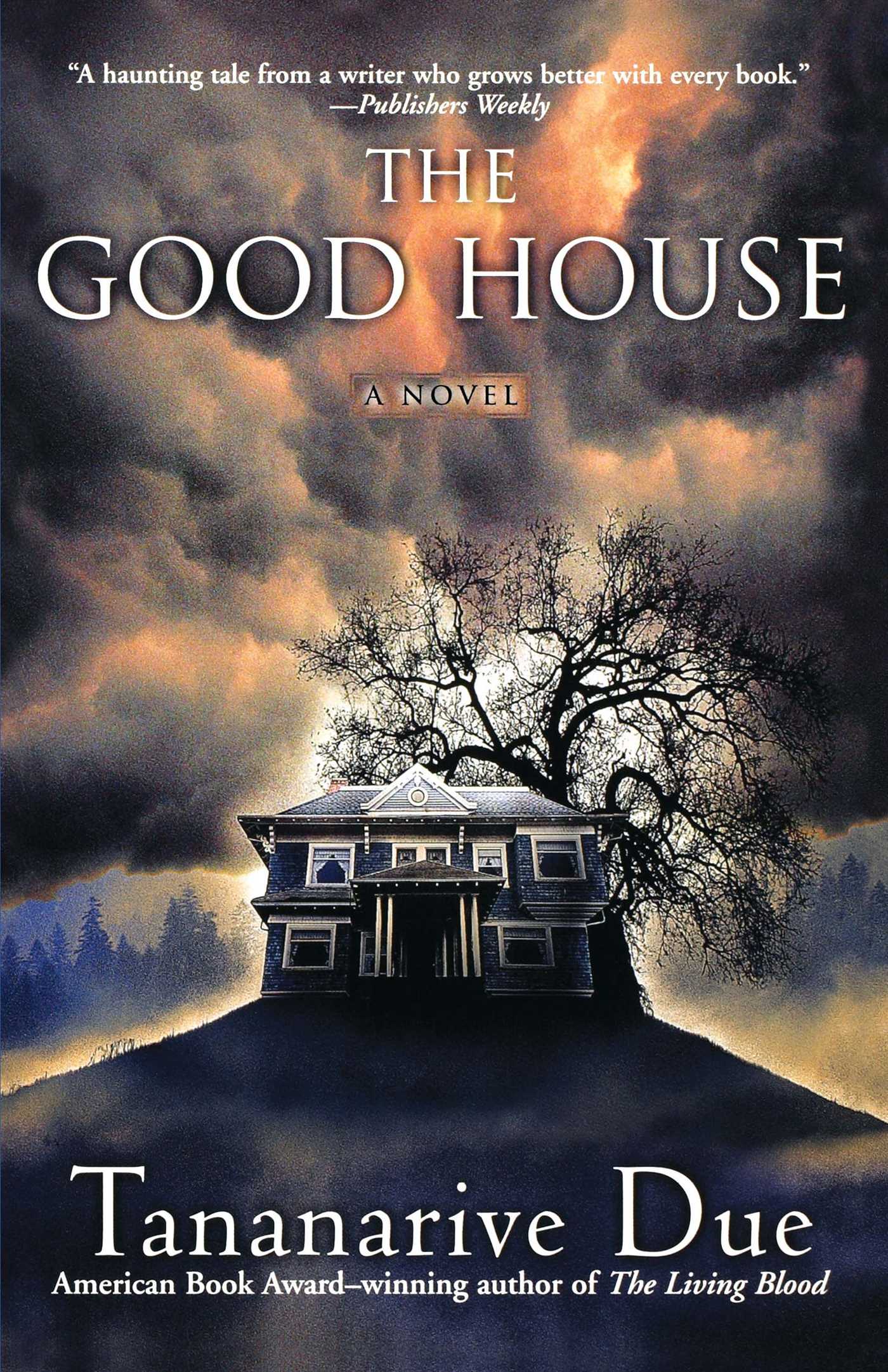
I had remembered bits of the story. I mostly recalled a physical therapist guy named Derek and his socially awkward pre-teen daughter, who’s name had escaped me. (Her name is Alicen). Father and daughter lived temporarily  in the house of one of his clients who needed therapy on a daily basis. The client had fallen out of a window and needed help learning how to walk again. The client  had a family; a spouse and several children. I couldn’t remember whether  it was the father or mother that needed therapy  (It was the father  – Gary). I couldn’t  remember  his wife’s name (Melanie) or the names and number of children they had (Three – Gina , age 13, Kyle 9 or 10, Nancy 5?).

I remembered that the house was haunted but I didn’t remember the details (the spirit of a vengeful woman terrorizes them). I recalled that Derek wasn’t always nice to Alicen, and I remembered there was something  a bit off about her.  And then, I remember Steven U. No, he’s not a character from the book, he was my best friend in the 8th Grade. I had put the book aside for awhile and he borrowed it from me. He read faster than I did. In a matter of days,  he got further into the book than I did, and he had to go and tell me “So and So got ripped to shreds!”  This is what I remembered most! I remembered who it was that got “torn to shreds” (I’m not telling ya!) and I used these words in my searches (*name* torn to shreds). And….nothing came of these searches. Sadness! This is because, I learned, that the book never describes the fate of this character in those exact terms. These were Steven’s word’s, not McNally’s. But it’s obvious that is what had happened to the character.

The book was (and is) a relatively simple read. It served as a welcoming  pastime for such a young and blossoming mind, not to mention some blossoming hormones. For instance, the other night, when I got to a part in the book where the ghost woman grabs Derek’s crotch, I suddenly remembered stumbling upon this scene way back when. Another brick in the puberty Wall!  Um..let’s move on to another paragraph.

The thing about my initial reading of this book, either I didn’t realize that Ghost House Revenge was a sequel or I simply didn’t care. As an inexperienced reader, I guess it didn’t click that one is supposed to read the original novel first. Throughout the book, there is backstory that pertains to the first novel Ghost House. This happens when Gary tells Derek how he fell out the window (his fall occurs in the first novel), or when both Melanie and Gary explain to Derek about how the house had once been haunted, but isn’t anymore (They are wrong, it still is haunted, but by a different ghost). Once I got into the meat and guts of the story, I must have then known that this was the second of two books. I certainly knew after I acquired  Ghost House at a garage sale. This acquisition came months after reading its successor.

Excited, I opened the book and read how the family was moving into a big house. I remembered that Gary was giving Melanie the cold shoulder. She had recently been having an affair, but she broke off the fling. The couple was trying to reconcile. I remember how Gary kept imagining his wife’s legs wrapped around another man’s legs, and this thought bothered him. It didn’t bother the young me, though. This description excited me. That puberty thing again.

So what happens next? I didn’t find out. I put the book down. Summer vacation was at hand and what person brand new to his teenage years wants to spend the summer reading a book? I put it down after the first few pages and never went back….until a few weeks ago. It wasn’t until then that I learned that the ghost of some 1792 dude dwelled in the house and that he would go onto to develop a thing for Melanie. Very powerful this ghost. He had his way with Melanie many times both sexually and mentally.

After all these years bits and pieces of these books stuck with me. I wanted to finally read the first book and then revisit the second. But this task was difficult, since I couldn’t even remember the names of these books or the name of the author. “Torn to shreds” was not a viable query, oh what was I to do?  And so, after stumbling onto articles pertaining to the yesteryears phenomenon of  “all these horror paperbacks everywhere; good ones, bad ones, ugly ones,” I somehow found these two books once again. I read them and enjoyed them. They aren’t the greatest; there’s some very literal storytelling going on (no symbolism, etc.,). But the books are page turners.

So, this whole post turned out to be more of a piece on the history of my early days of reading and on the horror-themed paperback boom. Not much of a review, is this? Should I describe the “Ghost House” some more? It’s a colonial bay house in New England, built in the 18th century. Should I go into more detail about the ghostly encounters? Both books feature powerful, malicious ghosts. They wreak havoc on this peaceful family. Children are locked up on the roof, locked down in the cellar, tied to posts on the connecting beach.  Gary is injured multiple times when going toe-to-toe with these spirits. Certain characters become possessed. Some characters die.

Still not enough details for you? If this is the case, then you should just go ahead and read the books for yourselves. Below are the buy links. Enjoy!

Ghost House

Ghost House Revenge


The Good House – First Book Review for Black History Month Series

GoodHouseTo the house that belongs to the Vodou priestess the locals brought  the possessed girl. Hopefully Marie Toussaint would cleanse her.

To the house that once belonged to her grandmother, Angela Toussaint returns. It’s hers now. Here she will jump start her life ,  take care of her  teenaged son and perhaps rekindle her love for her ex-husband . All this falls apart. Things go very wrong.

At this legendary house, Fifteen year old Corey Toussaint, curious by nature, finds magical relics that once belonged to his great grandmother. He uncovers secrets that the house hides, deadly secrets

This is a story of a terror plaguing multiple  generations, a story about a  stretch of land with strong connections to the spirit world. On this land the “The Good House” stands, home to four recipient  generations of horror.

Hi there!  In honor of Black History Month, I welcome you to the first review in this series of haunted house novels written by black women. I begin with Tananarive  Due’s acclaimed novel The Good House.  “Good House” is haunted, but it is not the epicenter of the haunting. The trigger for the haunting lies within the lineage of the Toussaint family and on the spirit-laden lands upon which the house rests. It is the combination of a family sensitive to the magic of Vodou positioned in an environment that is receptive to other-worldly forces that stirs up the ghosts, or more appropriately, the demons. Or most appropriately – the “baka”.

The story unfolds from multiple perspectives.  At the heart of the story is Angela Toussaint. I suppose she would be the central character. If this were made into a movie, whoever played Angela would be the actress in a leading role.  The year is 2001 (approximately) and Angela, a successful lawyer from California, is temporarily residing in her second home in Sacajawea, Washington for the summer. This is “Good House”  (also “Goode House”), her childhood home, where she was raised by her grandmother, Marie Toussaint, now deceased. Angela ’ s own mother was unfit to raise her due to mental health issues (or perhaps  her soul was “infected”.)

The townsfolk  of Sacajawea warmly welcome Angela’s return. Her family, her house, it’s all part of the town’s history, all woven into the fabric of the community, though the weaving process , from a historical perspective, was quote contentious. She is one of the few black members of the community. Mostly, race is not an issue, although the town  has pockets of redneck racists. (Her son Corey will learn this) She is highly respected. But when her grandmother  was young woman living in Good House.it was a different  story.

Angela  is seeking  to  refresh  her life.  Having only partial custody of her teenaged  son, her experiences with him have been limited  as of late and she wishes to change that. Corey  seems to favor his father, and so she tries to rebond  with him one fateful summer at Good House. At the same time, her relationship  with her ex-husband is not lost. He visits  the house, and there is a rekindling.

So far I am describing a rebuilding of family and community. But this will not happen. Instead everything falls apart. Neighbors go insane. Some kill their loved ones. Others kill themselves. Her friends suffer horrific calamities   Her own family meets tragedy  head on. Something unspeakable  has been unleashed.

As previously mentioned, Angela’s story is the central  narrative. And yet, it is my least favorite of the various perspectives. At times, it gets too bogged down in mundane things such as the tasks involving  her career and the details  of her exercise routine. Even the attention focused on her love life was too much for me. For my tastes. But then again, I’m a guy and romance dramas don’t do a whole lot for me. However, Angela’s story ties together the stories from the perspectives of other characters, so her tale is an important  one. And it is these other perspectives that I  will now focus on. For me, they capture the intrigue of the book. These would be the perspectives  of Corey the teenager  and Marie the grandmother. WARNING: there will be spoilers  ahead. I don’t know how else to discuss the themes I’m   about to delve into without them.


Spoilers  Section

Marie Toussaint


Why is the house at the center of the story a “good house”? Because once upon a time, people  came to the house to be healed. Because the former owner, Elijah Goode, a pharmacist in the early 1900s, dispensed medicines, specially brewed with natural  herbs and a little bit of magic. The herbs grew on blessed grounds, on land populated with spirits. These special medicines were concocted by his maid Marie Toussaint, later to be his wife, a voodoo priestess. Marie will inherit the house upon Elijah ’ s death, marry an Indian man, be the recipient of much hatred and racism. Still, she will exorcise a demon from one of the daughters of the townsfolk. It is “a good house”. It was a “good”  thing for her to do, especially since she was the one to summons the demon  in the first place.

What if you were a black woman of Creole  descent in the 1920s,  and your life was turned  upside-down by murderous racists, and you had the power to extract revenge on them with an act that was as simple as snapping your fingers? Would you go in for the  kill? Marie Toussaint showed restraint when her first husband was murdered by racists in New Orleans. When she moved across  the country to Washington with her young daughter and married a white pharmacist, Elijah Goode (His house = Goode/Good House), racism would rear its ugly head again, even after she helped the nearby communities by using magic to extract the healing power within the herbs that grew on this enchanted land.   When she, a black woman, inherited the house of her husband, a white man, people in the nearby town of Sacajawea sought out lawyers to get her out. To further piss-off this community of racists, she took Red John as a common law  husband. He was formerly viewed as “the good Indian who knew his place”. Red John had been “the white man’s pet”, but this new arrangement might cause him to step “out of his place”.  Both Marie and Red John were stepping out of their places, so the people of the town  shot bullets through her windows and front door.

It was all Marie could stand. She gave into anger. A kind of momentary  anger that all  of us fall victim  to now and again. An anger that might elicit a curse word or two from ordinary people. Marie is not an ordinary person. She utters a curse. But the thing is, her words are packed with much more power than your average “God damn you!” Chances are, God won’t sent a person to Hell based upon one person’s idle request. Marie remembered  a word that was stolen from the gods. A powerful  word. She spoke it, unleashing a powerful baka. Her words, so simple to say, so deadly the consequences. Mudslides ravage  the down. A demon is summoned  and it does what demons do – it possesses the living.

This is the backstory – the history.  But as all of us amateur historians know, history repeats itself. Some eighty years later, the baka will once again be summoned and ravage the community. Who is it that calls upon the baka? Her great grandson Corey.


Corey Toussaint


Corey, fifteen, an aspiring poet and rap artist, is having trouble adjusting to his new environment in the rural northwest.  For a whole summer, he must live with his mother Angela at Good House in  Sacajawea, Washington.  He is used to his urban environment in Los Angeles, where he has many friends and lives under the lax supervision of his father. He had no friends in Sacajawea. His mother is naggy and strict. He is the only black kid in the community.

Eventually, he forms a friendship with a white kid named Sean. They share a love for rap music. However, not all of the kids in this community are friendly to him. Some are downright hostile, such as the town bully Bo Cryer , proud of his confederate flag t-shirts, ready to beat “sense” into this new “gangster kid”.   And beat him he does.

Corey is a bright and curious kid. He finds items of his great grandmother  hidden away in the house. He finds her diaries, reads her  journals. He learns Vodou  spells. At first, he uses these spells for innocent things, such as reclaiming lost items. But even this kind of tampering  has its costs. And when he speaks the forbidden word to get back at the bully ,  all hell breaks loose.

Here Ends the Spoilers Sections


So, are there any, shall we say, “Haunted  House  happenings” in the story?  There are some. A piano plays by itself, a presence or two are felt at times, a mysterious ”friend” of Corey’s defies physics by the way she sits on a tree branch and talks to him through his upstairs  window. Sometimes the plumbing churns out foul black slush through the faucets. Then there is the night that every  room in the house is blanketed with leaves, turning the floors of Good House into a forest’s  bed. As previously mentioned, the house is not necessarily the “ epicenter of the haunting.”  But the house itself is important to the story, so much so that author Tananarive  Due devotes attention to describing the rooms, the attic and cellar, the furnishings and portraits on the wall.  The modern day characters that populate the Sacajawea community (Sacajawea is a fictional town, BTW) have great respect for the Goode House. For them it is not only an historical landmark, but it’s a history that continues on.  The townsfolk cling to the stories of the past that that focus on the generosity of Angela’s grandmother, Marie Toussaint. She is spoken of as a town healer. When Angela returns to her property and hosts a Fourth of July party at Goode House, many prominent people of the town show up. They have warm affections for Angela and the house and its history of “goodness”.

The people of Sacajawea have either forgotten the darker history of Goode House or have chosen not to confront it. Some still remember, or at least know of the cruel accounts of racism directed toward Marie Toussaint and her house (details of this are in the spoiler section above), but they either don’t speak of these things or do so in a “hush-hush” tone. But such a darkness cannot be extinguished by modern lights. Maybe this is one of the many messages of the book?

Is there anything to say about this book concerning the subject of black history? Well, this is a work of fiction, for sure. Even when it comes to the subject of Vodou, Due admits that while she utilized real concepts associated within that religion (i.e. “lwas”, spirits  of Haitian  Vodou or “baka”, evil spirits), she creatively improvised when it came to creating the spells, prayers, and magic that take place in story. But Vodou is a real  religion and it was practiced by many African slaves

From Britannica.com 

“Vodou is a creolized religion forged by descendants of Dahomean, Kongo, Yoruba, and other African ethnic groups who had been enslaved and brought to colonial Saint-Domingue (as Haiti was known then) and Christianized by Roman Catholic missionaries in the 16th and 17th centuries.”

While fictional and fanciful, Good House does point to many historical circumstances on the subject of black history. It teaches the importance of family and the value of heritage, especially for a people that were so cruelly uprooted. It reminds us of the prevalence of racism toward African Americans in the early part of the twentieth century, and lets us not forget the ongoing prejudice and discrimination that still occurs today. On this last note, maybe I should repeat a phrase I used earlier that gets to the heart of this…and more. I will do that. Here I go:

“ But such a darkness cannot be extinguished by modern lights.”

In other words, our country’s racist past cannot be erased. The ghosts of history will not allow for this. Nor should they.


About the Author


GoodHouseTananariveDueTananarive Due is a an educator, former journalist and author. She is the daughter of civil rights activist Patricia Stephens Due, who as a member of CORE, (Congress of Racial Equity) and participated in several marches and a jail-in. Tananarive is the author of several books on the subject of  black history/speculative fiction. Her novel “Black Rose” is based upon the research of Alex Haley.

***The above information was taken from Wikipedia.com