Followers of this blog – Help find the ghosts!


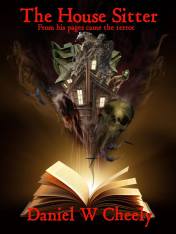
In case anyone out there in reader land hasn’t noodled around this blog in a while, please take note of the Ghost Hunt Page.  There are ghosts hiding out in various places across the blog.  Find them and earn points.  Whoever earns the most points wins an autographed copy of my book The House Sitter.

HouseSitterCoverForHHGroup

Details are at The Ghost Hunt page.  Be there or be square! Roam around the lair and have a scare!

Review of 1408 (The Film)

1408-cover I wonder if Mike Enslin (Played by John Cusack) knows about “creeper weed.” He is the protagonist of Mikael Hafstrom’s film 1408 which is based on a short story by Stephen King.  In case he doesn’t know much about such things, I’ll explain it to him.  See Mr. Enslin, you know you’ve been smoking “creeper weed” if after you have taken a couple of hits, you feel nothing. So you take a few more puffs.  These extra inhalations allow you to, finally, feel something; not much, but oh well, the buzz it gives you will just have to do.  You go about your business. At some point during this business, you suddenly realize that you are stoned off of your ass!  The buzz has snuck up on ya! It “creeped” its way into your state of being, leaving you to wonder “When did all this happen?”  It’s a strong buzz too.  You’re not thinking straight. Everything is out of whack.  You’re afraid. (BTW, how do I know about “creeper weed”?  I heard it from a guy who knows a guy who knows a guy that read a book about it)

Mr. Enslin, are you all right? Oh dear. It seems that Mr. Enslin is a tad uncomfortable upon hearing of the effects of creeper weed.  But it’s worse than that Mr. Enslin, right?  You are terrified. It almost seems as if you have had a similar experience. Maybe not with drugs. Maybe with, I don’t know, a haunted hotel room that turned reality inside out and nearly drove you insane with fear?

See readers, Mike Enslin doesn’t believe in ghosts or any kind of paranormal phenomena. He is an author of haunted house books (Like yours truly!). He travels to supposedly haunted inns, uncovers the history as to why the place is haunted (past murders, death by illnesses, etc.) and writes about his experience in these hotels. But he never experiences anything out of the ordinary.  Until he stays in the Dolphin Hotel in New York City. Room 1408.  A fine suite it is; luxurious, two or three rooms. The hotel manager (Samuel L Jackson) had warned him that no guest has ever lasted more than an hour inside this room. Well, Enslin arrives in his room, several minutes go my and….nothing!  Same old, same old.  (Boring impotent weed.) Okay, so suddenly there are fancy chocolates on the bed and a couple of other complimentary items and décor that wasn’t there moments ago.  Or, maybe they were there and he just didn’t notice.  Nothing else to see – move on, move on!  So the clock radio alarm goes off.  The last guest must have set it to go off at this time.  Things are a little weird, but these happenings, whatever they are, are harmless.  Then ghosts appear and start jumping out of the windows. (Uh oh….!)  More stuff happens; stuff stranger than the previous occurrences. Then More! Still MORE!   Suddenly poor Mike doesn’t know what’s real and what isn’t.  And the room won’t let him leave!  Everything goes to hell and Mike comes to the realization that the evil of the room has slowly but surely “crept” up on him. A devastating evil it is. And it won’t let him go.

room-1408_o_gifsoup_com


The drug metaphors I have used to describe this film; excuse me if this puts you off, but I believe they effectively describe the feel of the movie. It has the flair of a psychedelic trip; albeit a trip or horrors – a very bad trip. But luckily for us the viewers, we are grounded in reality on the other side of the screen. Any “trippy” experience to be had is thankfully vicarious. But I’ll admit that I found myself a bit exhausted by the film’s end.

I really liked this movie. It is a tense film with psychological drama mixed in with the horror. John Cusack is excellent. And Samuel L Jackson, though his screen time is limited, brings a welcoming performance.  This movie is one of my favorites. See it!

October Happenings!

leaveAutumn is like my spring. As the summer winds down and the air becomes cooler, I reflect and refresh.  Tis’ not the season to mourn the loss of nature’s greenery, but to enjoy the explosion of colorful varieties of foliage.  Nature remains very much alive. In autumn, “Things are a brewin’”, a Halloween witch might say.  Likewise, I’m going to get busy brewing.  Brewing and stirring up a batch of fun! Exciting activities are a comin’!

First of all, my book The House Sitter will go on sale for a week in October. The electronic version of this book will be priced at 99 cents.  pumkin

Later in the month, I will offer up an e-version of my book Voices: The First Chorus for free.  Free free free free free!!

I also have some exciting news about the print version of “The House Sitter” as well! There will be opportunities to win autographed copiesleave I will be hosting two fun contests, one at my Facebook page Haunted Houses of Film and Literature and the other right here at this blog.

The contest on the Facebook page involves recognizing haunted houses of film from pictures. Whoever correctly identifies the most houses will win a copy of the autographed novel.  More details to come. As for the contest being held here at this page, it will coincide with a “blog makeover.”  That’s right folks,  “this here blog” will have a fresh new look!  It’ll almost be as if I’m moving to new place. (But I’m not – I’m staying here at wordpress.) Be that as it may, as a sort of house-warming activity, I will host a ghost hunt. There will be ghosts hiding in various places on the page. The person that finds the most ghosts wins the autographed book!  Again, more details to come.  pumkin

I’m looking forward to October. I hope you are as well. I will do what I can to help make it a “spooktacular” month for you!


Review of Haunted: Houses: A Collection of 12 Ghost Stories

haunted-houses-twelveTwelve stories. Twelve authors – Twelve tiptoeing excursions through the haunted houses of their minds’ creations. Twelve haunted house tales; of course I would want to read this.  I bought it the moment I saw the ad. And then I read it. Funny how that works out!

This is the fourth time that I am reviewing an anthology. Authors and editors often take different approaches when compiling a collection of stories. It is interesting to take note of the unique perspectives and varying methods that go into this undertaking.  The first anthology I reviewed is called The Mammoth Book of Haunted Houses by editor Peter Haining. It is a tome of cherished haunted house tales from gothic to modern. Each tale begins with a page that is meant to resemble log entries in a real-estate transaction book and the stories themselves are divided into themed sections, such as “restless spirits”, “ghost children” and even “sex and the supernatural”. Gathering and compiling such classic tales, while organizing them so creatively, had to be a Herculean task.  Therefore, I shall call this method the Mammoth method (I might have borrowed a word from the title!) The second anthology I examined is the David Morgan Ghost Series.  In this collection there are five novellas that are also sold separately. Author Frank Roberts has kindly compiled them into one book for convenience sake. It is a saga told in sequences, so I shall call this the series method.  The third anthology, The Haunting of Lake Manor Hotel (edited and compiled by Nathan Hystad) is an exercise in story collaboration. Hysted creates a scenario – a haunted hotel that rests on the shores of a mysterious lake, and authors write stories that playout within the framework of his backstory. I shall call this the collaboration method.

To what method should I attribute Haunted: Houses: A Collection of 12 Ghost Stories? Before I answer this question, let me describe the book. It is a sampler – it introduces various authors to readers with samples of their work. One story, “The Promise” by Shannon Eckrich, is a short prequel to a larger series. The books in this series are sold separately, of course. Another story, L. Sydney Fisher’s The Haunted Prophecy of Natalie Bradford, is actually one chapter from her novel of the same name.  Sarah by Rebecca-Patrick Howard is but one of several stories that are companions to her series Taryn’s Camera.  In short, these tales, and perhaps some of the others, are contingent upon a larger, more episodic, story.

As with all anthologies, I prefer some stories to others. Together, they average out to a rating that might be articulated as “enjoyable; a fun way to pass the time.” Only a few are what I would call “filling”, which I define as “the ability to remain; something that sticks with me.”  Therefore, because these are story bits that are pleasing and pedestrian, I shall call this anthologizing process the “appetizer sampler method.

Imagine a seafood sampler at Red Lobster – a decent sized platter of various entrees adding up to a hearty meal. This is NOT what this book represents. Rather, it is more like a taster plate of small portions of shrimp and calamari, this and that; everything’s tasty but not too filling.

I hope that readers of this review are not assuming that I am panning this book on account of my contrasting-menu-item analogy. First of all, I do recommend it, but I am calling it what I perceive it to be. It would be wrong to call a shrimp cocktail a lobster plate. A shrimp cocktail is a shrimp cocktail. Second, I would like to point out the stories that did make a lasting impression on me. A.P. Killian does an excellent job creating a house and environment filled with mystery and intrigue in Through the Doorway.  I was filled with suspense and sympathy as a family drags their father’s haunting past into the present in Rebecca J Powell’s The Ghosts of Past Are Present. The prequel and sample chapter stories (The Promise by Shannon Eckrich and The Haunted Prophecy of Natalie Bradford by L. Sydney Fisher, respectively), the teasers that they are, had me itching for more.

Twelve chilling tales, twelve samples from up and coming authors. If you’re in the mood for a literary appetizer, seek out this book.


Review of Dollhouse (The Dark Carousel Book 1)

DollhouseHas Tim Burton made any movies lately? Maybe he’s searching for the perfect script, one that cooperates with his flair for things both colorful and dark, one that matches his glee for taking a vanilla setting and sprinkling it with sparkling oddities. Perchance he’s looking for the fairytale that tears into a child’s most bizarre nightmare and extracts its lurid images from the mind to the page. If this is the case, then he needs to look no further than Anya Allyn’s Dollhouse (The Dark Carousel Book 1). In this book there is a huge repository of “all things Burton.” It is the perfect source to mine material for a script of his standards.

Now here’s the kicker – I am pretty neutral when it comes to Tim Burton. I neither love nor hate him. I think the reason for my indifference has to do with the fact that I sometimes have trouble syncing my imagination with the fanciful worlds that he creates. These worlds are too dark for my inner child and yet too childishly bright for my rugged manliness (I can grunt the national anthem!). The fanciful world Allyn creates for Dollhouse resembles the realms of Burton’s creations in so many ways, and yet, while reading the book, I found myself free from the kind of  dissonance that his films tend to stir up in me.

Dollhouse is a novel written for “young adults.” Could this explain why I did not notice such dissonance in Allyn’s novel? Young adults = adolescents = moratorium. Teenagers – they are not yet adults, but they are no longer children. This is why fantasy novels partner so well with the YA genre. Both deal with people that inhabit “worlds” outside the realm of normalcy. Adolescence is a period of relentless changes and challenging mysteries. Likewise with fantasy novels. By nature, such stories are intended to invoke a sense of dissonance and perhaps this is why my imagination can absorb the themes in Anya’s novel more easily than the themes of Burton’s films.

Maybe she succeeds at speaking to my inner adolescent whereas Burton doesn’t know with which of my many selves to communicate? Could be. The truth is that I really don’t know. I’m guessing here. All I know is that, for some reason, I find Burton’s films somewhere between fair and good but I view this novel of Allyn’s as excellent.

So what kinds of fanciful creatures inhabit Allyn’s story? Let’s see, there are adult-sized dolls that walk and act on their own accord. There are ghosts, shadows and men and women in masquerade costumes, which seem to be their permanent attire.

The story is as follows. A group of teenagers discover a house in the woods on a fieldtrip for school. Days later, one of their own goes missing. The group searches for their friend and decides to explore the inside of the house. In one of the rooms, they find a carousel and take a ride on it. Its circling path leads to another section of the house. The problem is they can’t go back. They are trapped in “The Dollhouse”, which is run by a strange young girl that keeps children as toys. There is a toy box, where the “bad” toys are placed. This toy box has secret passages. One leads to an outside carnival with a black castle off in the distance. One leads to another time and place. One passage remains a mystery.

Now imagine this as a Burton film. Are you hearing the music box in the soundtrack? Are you seeing the fanciful costumes the “toys” are dressed in? I know I am. If this were made into a film, by Burton or someone else, I might enjoy it but I’m sure I would prefer the book.

Dollhouse is the first book in a series of four. I look forward to reading the remaining books. If fantastic worlds tickle your fancy (hee hee!), then you will enjoy these books as well.


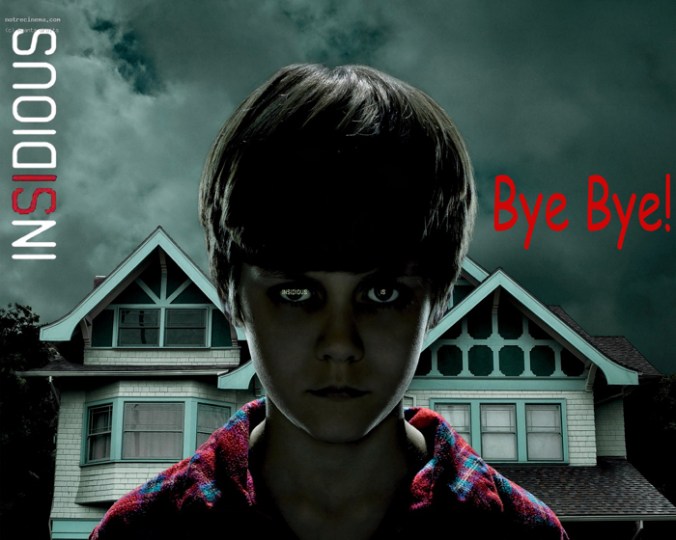
Review of Insidious

“It’s not the house that’s haunted. It’s your son.”

Really? Oh… well then! Since this is a haunted house blog, and because the house is not haunted, I guess this ends my review of Insidious.  Great movie – no haunted house. Goodbye now!

InsidiousBye


.

.

.

.

.


Oh. You’re still here. In that case, I guess I should say a little more about this film. The quote that leads this review is from one of the film’s characters, Elise Rainer; a specialist in the field of paranormal arts. She and her team come to the aid of the Lambert family. Young Dalton Lambert (age 7? 8?) enters a coma of sorts. Shortly thereafter, freakish things from beyond the grave begin to prance around their houses (they live in two of them consecutively, moving from one to another in a futile attempt to flee from the ghosts). Elise informs the distraught parents, Josh and Renai, that their son is not in a coma. Dalton is an astral-traveler, she tells them. When he sleeps, his soul leaves his body to go on mystic, otherworldly voyages. However, during his last trip, he strays too far and enters “The Further” – a realm populated by evil spirits. Here he is trapped. At the same time, other spirits, both evil and neutral, sense the soulless body lying there in the bed. They crave it! To inhabit such a body is to taste life once again. This is why there have been a lot of ghosts hanging around both of the Lambert’s residences. It matters not which house they live in; Josh and Renai have a haunted little boy.

Wow, I dug pretty deeply into the plot, didn’t I? I hope I haven’t unearthed too many spoilers. I’m guessing I have not, not by IMDB’s standards anyway. After all, their one-sentence summary is:

A family looks to prevent evil spirits from trapping their comatose child in a realm called The Further


Now, isn’t that sentence packed with a whole lot of plot?

Anyway, I will reveal no more plot intricacies. I will say that this is a great Insidious 2film. It is one of the better horror movies of the modern age. And though, technically, it’s not the houses that are haunted, this film has all the makings of a good haunted house flick. Before the coma tragedy and the hauntings that follow, the family goes through the normal concerns of adjusting to a new home. Isn’t this how many haunted house films begin? Insidious certainly has the haunted house props. The first house has a tall staircase and a spooky attic. The second has a long hallway with a grandfather clock at the hallway’s end that sort of stands in an eerie spotlight. There are plenty of places for ghostly beings to hide. Creating such hiding places in suburban homes seems to be one of specialties of Director James Wan. As he does for Insidious so does he do for The Conjuring. (Hint: “The hide-and-seek clap game.” Still confused? Well then, watch The Conjuring or read my review of it here.)  The styles of both films (and the sequel – Conjuring 2) are very similar, and pleasingly so. Oh, and I must not fail to mention the baby monitors!  Witness the terror a mother goes through when she hears voices inside a room this is supposed to be occupied only by her innocent baby!

There are only two things that annoy me about this film. These “things” are known as  “Specs” and “Tucker”. They are the two nerdish assistants of Elise Rainer. They constantly try to outdo each other with their skills as paranormal specialists. I get it – they are there for comedic relief. But I found their shenanigans distracting. For me their comedy went against the flow of the film.

Nerdy technicians aside, I love this film. It is creepy in its subtly and bold with its shocks. A must see for any horror fan.


Review of The House of the Seven Gables

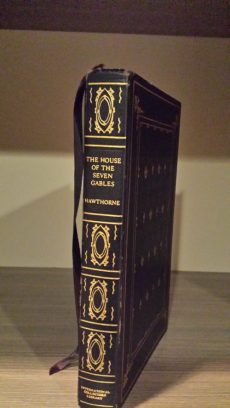
HouseGablesBefore I began reading The House of the Seven Gables,  I knew very little about it. Of course I had “heard of it.” After all, it has a memorable title. Wasn’t this some kind of early American soap opera that those post-revolutionary war people watched on their 19th century televisions? (I think it followed Days of our Lives) Or maybe it came on the scene later, post-Hollywood; as a biography of Clark Gable and his six brothers?

I’m kidding. I knew it was a classic American novel written by Nathaniel Hawthorne and that it is often acted out on the stage. But what else is it? I really didn’t know. Is it a haunted house novel that I should read and review for this blog? The short answer, I discovered, is “Yes. It is a haunted house novel.” But it is much more than that. It’s not really horror, per se. At least not in modern day terms. Hawthorne in his own preface labels his book as a “romance.” C Hugh Holman and William Harmon define “romanticism” as:

“the predominance of imagination over reason and formal rules (classicism) and over the sense of fact or the actual (realism),”

After the reading, I discovered that, not only is this a romantic novel, but it is also a significant work within the American Gothic movement in literature. So, what are some of the characteristics of this “American Gothic” haunted house (besides the seven gables)? Let me begin by explaining what’s not in this book. There are no blood-curling screams in the night, no fanciful specters roaming the halls, no undead creatures rising up from the cellar.   So what haunts this house? As a young kid, I had asked the same question about Poe’s The Fall of the House of Usher , another tale from the American Gothic movement (You can read about this experience here). From a young age I have been mystified by these dark romantic tales and intrigued with the symbolism that lurks within them. It is this symbolism to which we must turn in order to answer our question.

The House of the Seven Gables is haunted by the sins of the past. By guilt and greed. By sorrow and injustice. By an antiquated air of appearances. It is occupied by the old and scowling Hepzibah Pyncheon and her frail and wraithlike brother Clifford. Living in another section of this large house is the eccentric daguerreotypist Holgrave. The visiting niece Phoebe Pyncheon brings a much-needed shine of pleasantries to this dark setting, but will it last? For the curse upon the Pyncheon family is deep-seated.

Curses – sins of the past – family tensions; these are the things that haunt Gothic novels.To quote the website www.americangothic.narod.ru/america.htm:

The role of the Gothic is figuratively to embody an intergenerational tendency.


…demonstrates in the majority of cases that neither the personal nor cultural past is dead and that both can easily return.

A house at the center of a Gothic novel needn’t have such obvious creatures of horror as “the ghost” or “the vampire” for it to be a haunting tale. Horror icon H.P Lovecraft had a great deal of respect for Hawthorne’s works . In his essay Supernatural Horror in Literature, he opines that The House of Seven Gables is “New England’s greatest   7 nathaniel-hawthorne-0008contribution to weird literature.” In the same essay he identifies an “overshadowing malevolence of the ancient house” that he considers being “almost as alive as Poe’s House of Usher.” Any story of a shadowy past that lingers in a new age is a tale of a haunting. When these shadows of the past are cast upon a household and immersed within the current activities inside their dwelling, that house is indeed haunted.

However, The House of the Seven Gables does have some supernatural elements. It’s a tale of feuding lineages, beginning in the 17th century with Colonel Pyncheon and Matthew Maule and a land dispute that puts these two men at odds with each other. Pyncheon cheats Maul out of land, accuses him of being a witch and then poor Maule is executed, but not before cursing the colonel with the damning words , “God will give him blood to drink!” And so begins the curse. The house of seven gables is then built upon this ill-gotten land. In the many years that follow, certain members of the Pyncheon family meet with untimely deaths while inside the cursed abode. While sitting at a desk, while sitting in a leisure chair – the life is cast out of them.

Hundreds of years after the death of Maule, Hepzibah and Clifford Pyncheon, brother and sister, old and frail, live out their dismal lives inside the house. They are encased in this behemoth structure, yet they are wrought with poverty. Towards the book’s end we discover what contributes to their misfortune, but on the way we read about their miserable day-to-day lives. The journey toward their fate is enmeshed with ghostly metaphors.

The presence of the long-dead Colonel Pyncheon is continually felt via his large portrait that hangs in a sitting room.  As the book explains:

The other adornment was the portrait of old Colonel Pyncheon, at two thirds length, representing the stern features of a Puritanic-looking personage, in a skull-cap, with a laced band and a grizzly beard; holding a Bible with one hand, and in the other uplifting an iron sword-hilt

Through watchful albeit painted eyes, he inflicts his reverence from beyond the grave, perhaps due in part to an unconscious sense of infamy the current occupants feel toward him.

Then there is Clifford who, when he is introduced into the story, had me believing on first read that he himself was a ghost. Perhaps he is, but not literally. He is introduced from the perspective of young Phoebe, the visiting maiden cousin that brings cheer to a cheerless home. She hears him before she sees him.

She retired to her chamber, but did not soon fall asleep, nor then very profoundly. At some uncertain period in the depths of night, and, as it were, through the thin veil of a dream, she was conscious of a footstep mounting the stairs heavily.


Phoebe heard that strange, vague murmur, which might be likened to an indistinct shadow of human utterance.


Later she sees him at the breakfast table. Here is one of many gloomy descriptions of him:

..his mind and consciousness took their departure, leaving his wasted, gray, and melancholy figure–a substantial emptiness, a material ghost–to occupy his seat at table.

With his long white hair and garments from another age, Clifford appears rather ghostly. It can be said that he is the embodiment of ghosts of a sorrowful past, a sorrow that clings to him like the sheet of a Halloween ghost. His sister doesn’t fare very well either:

above a quarter of a century gone by, has dwelt in strict seclusion, taking no part in the business of life, and just as little in its intercourse and pleasures.

Not a participator in the most casual of modern day affairs, Hepzibah too is but a ghost, even if figuratively so.

Then there is the harpsichord of the long since deceased Alice Pyncheon. Sometimes it makes music, seemingly on its own accord. The book is vague on whether this phantom music is made by the ghost of the late Alice or whether it is a kind of collective, symbolic hallucination – a longing for those rare but charming moments that blessed the Pyncheon family in the midst of their misfortune.

There are more metaphors and hints of a haunting throughout the book. If you wish to learn of more, I recommend reading the book. But I must say it can be a tedious read. The sentences are very long and flowery. Themes and descriptions are often repeated and drawn out. Much of the vocabulary is archaic. All this and, you know what? The more I contemplate on the story, the closer I’m pulled toward its deep heart that continues to beat a century and a half after its conception.

Sometimes a bit of effort is required to unearth something of magnitude. Although I did not realize its importance to the American gothic movement when I began the novel, I treated it with respect. I didn’t settle for a free ebook. Rather, I bought a physical book with a hard cover. I patiently read it in silent environments and uttered no complaints when I had to reread certain parts for clarification. Much of the reading took place in our newly constructed den – a room designed for reading and writing. Hell, I think on one occasion I had a brandy to go with the reading. Now that’s respect with a pinch of style!

Continue reading

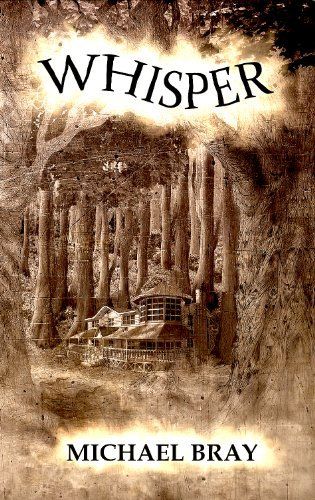
Review of Whisper – Whisper Trilogy Book 1

WhisperSome time ago, I posted an article titled: Ghostly Grounds: Explorations Outside of the Haunted Houses of Film and Literature  In this article, I write about the creepy environments in which authors and filmmakers “build” their haunted houses. I have a large section dedicated to “the forest;” a very popular landscape of myth and legend, often harboring fanciful and horrific things – elves, witches, werewolves, and ghosts to name a few. Then I give examples of popular haunted house stories that include haunted forests: Evil Dead, The House on the Moor, and The Haunting of Lake Manor Hotel.

I wish I had read Michael Bray’s Whisper – Whisper Trilogy Book 1  before writing this article. It is the epitome of the “mysterious forest” archetype. I certainly would have included this modern horror novel in the article. There is more than wind stirring in the trees that surround “Hope House” – the subject of Bray’s book. Hope House is an historical abode built upon cursed grounds. There are presences lurking in the neighboring forest; perhaps as many as there are trees. One can only guess at the total. Likewise, one can only make guesses about their nature. Are they evil? What do they look like? (for they go unseen – in the beginning!)

These woodland entities make their presence known to Steve and Melody Samson, the newest homeowners of Hope House, not by sight, but by alternative sensory pathways. In the rustling of the treetop leaves, Steve hears whispers; whispers that eventually call out his name. Also, a certain “feeling” continually haunts both Steve and Melody. They feel as if they are being watched by multiple sets of eyes. For me, it is always scarier when spirits are felt before there is a direct confrontation; heard before they are seen. And this is what happens here.

The story of Hope House and its surrounding grounds unfolds in three different periods of time 1) The present time: a couple buys a house in the woods 2) 150-200 years ago – the construction of Hope House, built with slave labor on cursed grounds by an opportunist blinded by his own ambition 3) thousands of year ago – a cannibalistic tribe and a supernatural tragedy. Bray effectively juxtaposes these time periods. Never was I confused. Whenever a time jump occurs, it happens in just the right place. The storyline keeps on flowing while these jumps serve to heighten the overall suspense. These trips back in time reveal exciting clues and interesting back-stories.

There are interesting side characters in Whisper. There is a slimy real-estate agent with dark secrets, a drunken crone who knows things, a seemingly inconspicuous bartender (but things are never what they seem). All of these characters know things that our main characters Steven and Melody do not. What do they know? Read the book to find out!

The book has its flaws, some of which have to do with editing. There are some grammatical errors here and there. Aside from grammar issues, too often Bray uses “a smile” as a one-size-fits-all way of describing facial expressions. Characters seem to smile on every occasion – when they are arguing and when they are in turmoil. Then there are a couple of minor issues I had with some of the plot points. There are some areas that would benefit from further development. There are noteworthy events that find their place in the story and then stay put, never to resurface again, missing out on opportunities to establish a stronger link to the larger story. Also, some of the story resolutions are bit trite for my taste.

But overall Whisper is a good book. I look forward to reading the rest of the books in this trilogy. And here they are:  Echoes and Voices


Echoes
Voices

Review of Ghost Story – Book Vs. Movie

MBDGHST EC005


Old, distinguished men in elegant attire sip their brandy and tell ghost stories. A mysterious woman unbound by time haunts successive generations of boys and men. The deadly consequences of secrets buried long ago are only just beginning to surface. All this and more make up Ghost Story, a novel by Peter Straub and then later a film by John Irvin.

In past reviews when I have compared a book to a movie, I have used a pseudo-ratio to show how books benefit from a structural advantage. I call this the “200 page/2 hour reel” ratio. Simply stated, there is more opportunity for story and character development in a book than a film. A film based on a book is often forced to take shortcuts, usually to the detriment of the story. At the same time, it is nearly impossible for a film to lay out all of the plot points of a story-heavy book such as Ghost Story unless we allow for a nine-hour film. (I guess that’s where a television mini-series comes to “the rescue.” Ah but this often backfires. But this is a subject for another article.) What does one do about such a dilemma?  Let’s ask Lawrence D Cohen, the screenwriter for Ghost Story.

Cohen is a masterful screenwriter who first “came to prominence” for penning the screenplay for the 1976 film Carrie, a fine film based on a book by Stephen King. In Ghost Story, just like with Carrie, he skillfully paves the road that leads from the book to the movie. Cohen and Director John Irvin know the limitations of the film medium and wisely do not attempt to exceed them. They carefully carve out a simpler yet equally fulfilling story from Peter Straub’s behemoth book. It has been suggested that film critic Roger Ebert prefers the film to the book. If this is so, I might just agree with him. Mind you, I said “might!”

Ghost-Story-BannerAs I alluded to earlier, Ghost Story is a long book. Both in scope as well as style, it owes a lot to Stephen King, from its epic quality of plot intricacies to its focus on small town characters and their foibles. In particular, Ghost Story bears a strong resemblance to Salem’s Lot.  Hank Wagner from darkecho.com  describes this similarity quite well, presenting quotes from Peter Straub himself to back up his claims:
 

Numerous readings reveal how much the book owes to Salem’s Lot. Straub has publicly acknowledged this debt, stating that “I wanted to work on a large canvas. Salem’s Lot showed me how to do this without getting lost among a lot of minor characters. Besides the large canvas I also wanted a certain largeness of effect. I had been imbued with the notion that horror stories are best when they are ambiguous and low key and restrained. Reading Salem’s Lot, I realized that the idea was self defeating.” On reflection, the debt to Salem’s Lot is obvious. Both feature small towns under siege from the supernatural. In both, the terror escalates until the towns are threatened with destruction — Jerusalem’s Lot is consumed by purifying fire, while Milburn is decimated. In each, a writer’s arrival in town seems to trigger disaster. Both writers strike up alliances with young teenagers whose lives are ruined by the terror, Ben Mears with Mark Petrie and Don Wanderly with Peter Barnes. Both forge an almost parental bond with their young allies, replacing those lost parents. In both, the evil lives on — Ben and Mark end up on the run, while Don, after ending the threat of Eva, presumably goes off to face her evil aunt.


I would only add one more similarity – both novels feature a house that is a home or former home to the evil presences of these books. In fact, I need to make this addition, for these reviews are part of the Haunted House themed project and therefore, the stories I review must include a haunted house, even though most of the action in these stories take Ghost Story movieplace outside these houses. (For the record, I have found Salem’s Lot and Ghost Story on sites that list haunted house films and literature – so there!) But here is the take away – the story is too broad to settle on in with just a few characters at one location at a specific point in time.
 

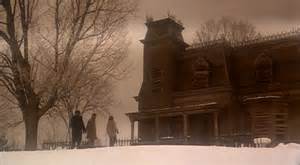
Like with Stephen King’s The Stand and It, there are multiple characters with story lines that encompass more than a few pages. While the primary characters consist of the five old men that tell ghost stories (Collectively known as “The Chowder Society”), the writer/nephew of one of these men (Don Wanderly), and the “ghost” in her many incarnations, there are so many others – the promiscuous wife of one of the old men, the drunk plow driver, the cantankerous sheriff, thrill seeking teenagers, and on and on it goes. The story takes place in a snowy town in New York, but the book takes readers across the country as a large chuck of one of the plots (there are a few) unfolds in California. Oh yes, the town of Milburn has the obligatory haunted house. In fact there are several! The evil goes where it wants – haunting several abodes and businesses, including a movie theater that continuously runs the film “The Night of the Living Dead.” Several of the townsfolk fall prey to the evil. They become possessed, they become the objects of their worst nightmares; they die. And it doesn’t help matters any that a series of snowstorms shuts down the town. The people of Milburn are besieged on all fronts by so many forces.

I say, if you like Stephen King’s epic and character-heavy novels, then it is highly likely that you will enjoy Ghost Story as well. I know I did.

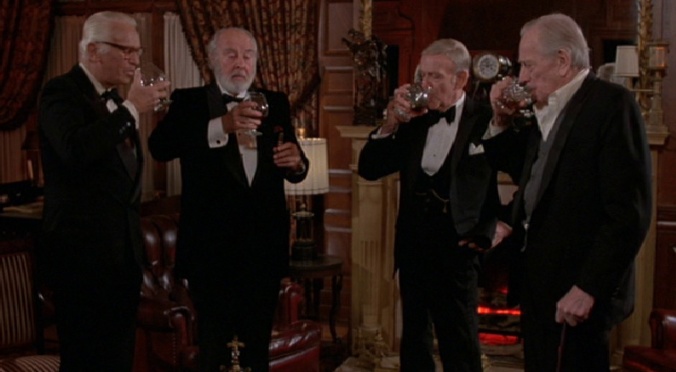
Now, how does one turn all this into a movie? By focusing on one central plot and abandoning the side stories. By letting go of most of the characters and centering only on a handful. And this work well, with a large part of the success coming from the suburb cast:

Douglas Fairbanks Jr      John Houseman                      Fred Astaire              Melvyn Douglas

ghoststorymen


It was the final film for Astaire, Fairbanks, and Douglas. Melvyn Douglas has so far appeared in two other haunted house movies that I have reviewed. (See The Old, Dark House and The Changeling.  Although I did not mention him in these articles.)

The film focus in on one plot – a young woman (as a ghost or whatever evil form you call it) returns from the dead to seek revenge on the four old men (Astaire, Douglas, Fairbanks and Houseman) who had killed her when they were young. This plot line occurs in the book as well but it is much more complicated. Normally when I do a book vs. movie review, I make a bullet-point list outlining the differences within each medium. I feel that is unnecessary here as I have already honed in on the most significant difference. Once that difference is understood and accepted (and accept it I do), an inventory of the nitty-gritty components of such a variance becomes pointless (In more ways than one: meaningless and “no bullet-points.” Get it?) The story that is portrayed is done with great care. It is better to minimize one’s focus to achieve a clear vision than to try and maximize the field of vision, only to achieve a blurry and unwatchable product.

As great as the book is, I find myself preferring the film (Or, I “might” prefer it to the book, as I said earlier). At times during my reading, I found myself lost in the tangled trails of plot. Yes, these trails do untangle and eventually lead you where you want to go, but still, it was a tedious experience at times. The film is straight forward and satisfying.

Not that I am against the complex – by no means. I enjoy books of great breadth and depth.

Perhaps such a comparison is unfair. It’s like comparing a plate of apples to a gourmet meal. It’s just that, as much as great as a gourmet meal is , sometimes I just want apples.

************************************************************

Thank you for reading this article.  I invite you to check out my latest book: The House Sitter
– A writer haunted a house with his own stories.

HouseSitterCoverForHHGroup