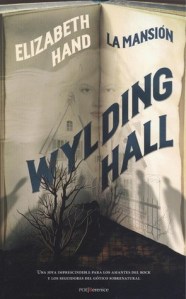
 Would you like to take a “Wyld” guess as to what Wylding Hall, a novel by Elizabeth Hand, is all about? Or if “Wylding” is pronounced differently, would you want a description of the novel “wyld” upon you? My “wyld” guess is that you would want the description “wyld” upon you rather than trying to figure out what the book is about all by yourself. So, I will tell you what it’s about.
Wylding Hall a story about mystery. It’s a story about intrigue. It’s a story about companionship and loss. It’s a story that asks the question “what really happened during those final days?” It’s a story about the supernatural and its strange ways of manifesting. It’s at least trying to be a story about these things. The effort is there and I give it credit for that. Even so, and I hate to admit it, but I was a tad disappointed with this book. I had higher hopes after reading Elizabeth Hand’s excellent novel, “A Haunting on the Hill”, which is an authorized sequel to The Haunting of Hill House. It was on account of this sequel that I learned of Wylding Hall. Published in 2015 it precedes A Haunting on the Hill by eight years. I guess it’s more ideal if your books get better as you go along, right?
There is just too much going on in this relatively short novel for any of the concepts to really shine. So if luminosity is the measure of its greatness, I would say this novel is just above dim. ,
This is a fictional account of an English folk band’s recording of an album in a haunted house. Set in the early 70’s It has many of the staples of rock bios. It details the chemistries and friction between different band members There are bursts of psychedelia here and there.. And there’s the charming yet mystifying star, which in this case is Julian Blake. It seems Hand is taking a hand (see what I did there?) at creating a character based on the charismatic, mysterious male rockstar prototype. Real life subjects such as Jim Morrison and Jimmy Page come to mind. The events in the book, pieced together from varying perspectives, also remind me of the movie Eddie and the Cruisers. Just like with that film, the mystery surrounding the lead singer’s supposed demise is brought to light by the revealed memories of surviving band members.
Unlike the average rock bio, there are ghosts in this story. Or, maybe not. Perhaps this isn’t a haunted house at all. If not, certainly it’s a house of mysticism. Oh what do I mean by that? I don’t know, man, guess you have to read the book, ya dig?
I love the material, mind you. I love bios of young, musical groups and standout personalities within such bands. I love reading about the 60s and 70s music era and I love haunted houses. It’s just that, in the end, something didn’t fully click with me.(Was there a partial “click”? I think so) And yet it’s not a bad book by any means. My interest was piqued all the way to the final chapter. However, once I finished the book, the characters were forgotten, and any feelings of attachment to this story that I might have had fled abruptly.
While the “stuff” of the story takes place in the 1970s, the narrative takes place in the present time.. The book consists of fictional interviews of people once associated with the former folk band Windhollow Faire, including the surviving band members themselves. One former member committed suicide. Or so it’s believed. The other, Julian Blake, simply disappeared.
During his time with Windhollow Faire Blake is enigmatic, soft spoken, contemplative, and perhaps sexy in his unique ways. He dabbles in the occult.
As you might guess, there is plenty of mystery surrounding the demise of Windhollow Faire, which comes to a head on the final days of recording what would end up being their final album. The album was recorded at Wylding Hall, which is the haunted house of the story. The band shacked up together for one fateful summer in this house to prepare for the recording. The house and its external surroundings are also the subject of eerie legends amongst the locals. Ghost stories if you will.
During those days, weeks, and eventually months, the band, besides working out creative musical arrangements, indulge in sex, drugs, and what I will call spiritualism. During the final recording sessions, Julian Blake mysteriously vanishes. He had been seeing a nomadic hippie girl that suddenly appeared in his life. Her appearance was just as mysterious as his disappearance. Perhaps Blake was witched away?
The blending of an epistolary account of a former folk band with ghostly folklore sounds like an intriguing mixture. It could be. It should be. But the final result just didn’t intrigue me all that much. Reading the novel was a disjointing experience, but not in a way that reflects the uncanniness of an eerie haunted house, which for me is a welcoming sense of disconnectivity. Genre blending is great if done correctly. But with Wylding Hall, there lacks a much needed unifying tone to ease together the disparate muses into one unique story. Moreover, too much of my mental energy was devoted to keeping up with all the characters and their varying perspectives, so much so that I wasn’t able to effectively absorb the ghostly elements of the story. The truth is there weren’t a whole lot of scary moments. Oh there were some, here and there, but several of the haunted house story arcs seemed to have hit a brick wall.
On another level, I was annoyed at how often the interviewees incessantly compared modern modes of communication and technology with those of the past. They would say something like “Remember, back then, it would take longer to contact our manager since there were no cell phones” or “Recording an album in those days was nothing like it is today”. We get it. The repetition of these observations was somewhat insulting to me as a reader As readers, we don’t need to be reminded of the time-lapse variances due to the limitations of technology over and over again, nor the nitty-gritties of certain efforts that would eventually be replaced by the clicks of a few buttons.
Overall, the book has its faults but it does have the elements of an interesting story. It wants to grab the reader’s attention, though at times it struggles with this. There is something genuinely good about this book and yet I can’t pinpoint exactly what it is. All my criticisms might just be an issue of pet peeves on my part that won’t necessarily trouble another reader. So, I don’t know, give it a try. Read it and see for yourself
 The Books of Daniel